Get in touch
info@canadiancyber.ca


Rafia Rizwan

April 17, 2026
A practical guide to handling an API security questionnaire using ISO 27017, with clear reviews for authentication, authorization, logging, and cloud governance.
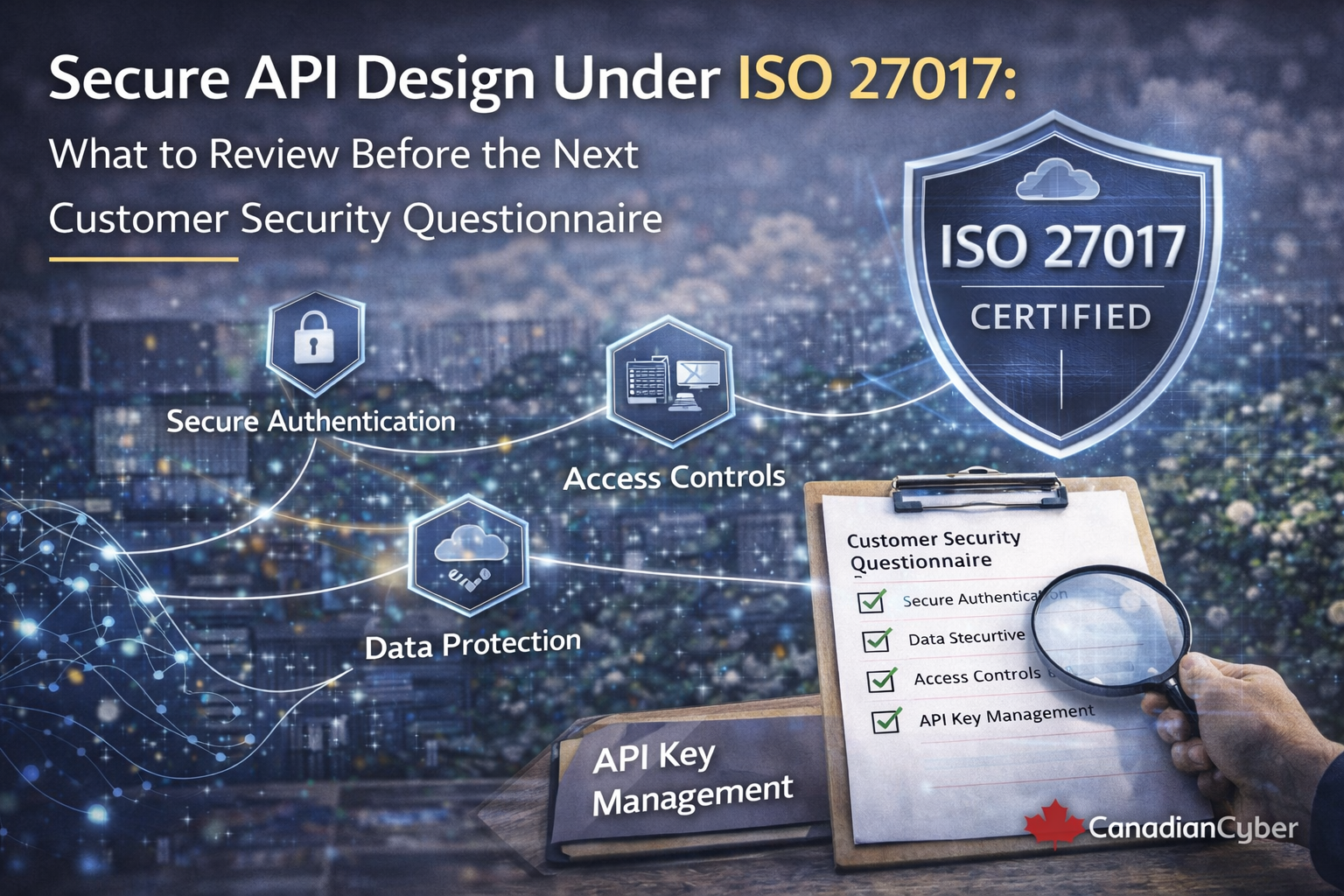
That makes sense. APIs are where systems connect. They carry sensitive data. They support customer workflows, partner connections, mobile apps, and automation tools.
When API security is weak, customers notice fast. When API security is hard to explain, trust drops fast too.
This is where ISO 27017 helps. It gives cloud teams a practical way to review API security as a governed cloud control area, not just a coding task.
Most customer questionnaires are asking one simple question: can we trust your platform to expose and handle data safely through its APIs?
That question leads to many smaller ones.
Most product teams have answers to at least some of these questions. The problem is that the answers are often spread across code, cloud settings, gateway controls, CI/CD pipelines, identity systems, monitoring tools, and internal team knowledge.
ISO 27017 is not an API standard. It is a cloud security guidance standard. That is why it works well here.
APIs do not live on their own. They sit inside cloud environments shaped by shared responsibility, cloud identity, hosted infrastructure, centralized logging, managed secrets, deployment pipelines, and customer isolation rules.
That means API security is not only about endpoint code. It is also about who can expose the API, who can change it, how access is managed, how changes are reviewed, how monitoring works, and how the full service is governed.
Picture a SaaS company with public APIs for customer integrations. The team has already done a lot of good work. Tokens are required. TLS is enabled. The API sits behind a gateway. Logs are collected. Validation exists. Role checks are built into the code.
Then a large customer sends a security questionnaire. The questions become sharper.
Now the problem is not only whether the API is secure. The real problem is whether the company can explain its controls in a way a customer can trust.
A weak API review focuses only on routes, methods, payloads, and headers. A stronger review asks larger questions.
That is the difference between API implementation and API governance. Customer questionnaires usually care about both.
This is usually the first place customers look. They want to know how API clients prove identity and how those credentials are protected.
A strong model usually includes unique credentials per customer or integration, scoped permissions, managed secrets, no hardcoded keys, and controlled issuance and revocation.
Authentication proves who is calling. Authorization decides what they can do. This is one of the most important parts of SaaS API design because customers want to know what stops one tenant from accessing another tenant’s data.
| Review item | Why it matters |
|---|---|
| Tenant-aware checks | Stops cross-tenant exposure |
| Object-level authorization | Prevents ID-based access abuse |
| Role enforcement | Keeps privileges aligned to real need |
| Admin or internal API separation | Prevents support or engineering bypass paths |
Many serious API issues come from weak authorization logic, not weak encryption.
Customers also want to know whether data is protected in transit and whether sensitive content is handled carefully in requests, responses, logs, and support workflows.
Review TLS enforcement, certificate handling, response minimization, export controls, logging practices, and whether secrets or sensitive fields appear in traces or debug records.
A secure API today can become an insecure API tomorrow if changes move too quickly without review. This is why ISO 27017 is so useful. Cloud security is tightly linked to deployment discipline.
Review how API changes are proposed, approved, tested, and deployed. That includes code, gateway rules, WAF settings, secret references, route exposure, environment variables, cloud IAM roles, and deployment manifests.
Customers want to know not only that the API is protected, but also that abuse, misuse, and failure patterns are visible. Logging on its own is not enough. You need meaningful monitoring and a clear response path.
Many API security issues come from internal exposure, not the public customer path. Review separation between production and non-production APIs, use of real customer data in test systems, support access to internal endpoints, engineer access to production data, and controls around admin or diagnostic APIs.
Customers often assume external API security is only part of the story. They also want to know that engineers and support staff do not have uncontrolled internal access.
| API area | Practical review focus | ISO 27017-aligned theme |
|---|---|---|
| Authentication | Token, key, and secret management | Cloud access control |
| Authorization | Tenant isolation and role enforcement | Secure use of cloud-hosted services |
| Data protection | TLS, minimization, and protected handling | Protection of cloud-processed data |
| Change control | Reviewed deployments and gateway changes | Controlled cloud change management |
| Monitoring | Logging, alerting, and abuse detection | Cloud monitoring and traceability |
| Operational access | Internal and admin API restriction | Secure administration in cloud environments |
Not every API program needs a full redesign. Most teams get the biggest value by tightening the most exposed areas first.
Even strong teams repeat the same mistakes. They focus only on authentication and ignore deeper authorization. They treat gateway settings as the full security story. They log too much sensitive payload data. They keep internal APIs too broad. They use long-lived tokens without a clear rotation path. They rely on code behavior without explaining how the control is governed.
These issues are not always dramatic. But they are exactly the kinds of things that make customer reviewers uneasy.
Customer security questionnaires often turn APIs into the center of the trust conversation. That is reasonable. APIs expose data, business logic, and operational discipline all at once.
A practical ISO 27017 review helps teams look beyond the endpoint list and review the full API control environment, including authentication, authorization, transport protection, secure change control, monitoring, abuse detection, and internal operational access.
In the end, customers are not only asking whether your API is secure. They are asking whether it is governed, monitored, and controlled in a way they can trust.