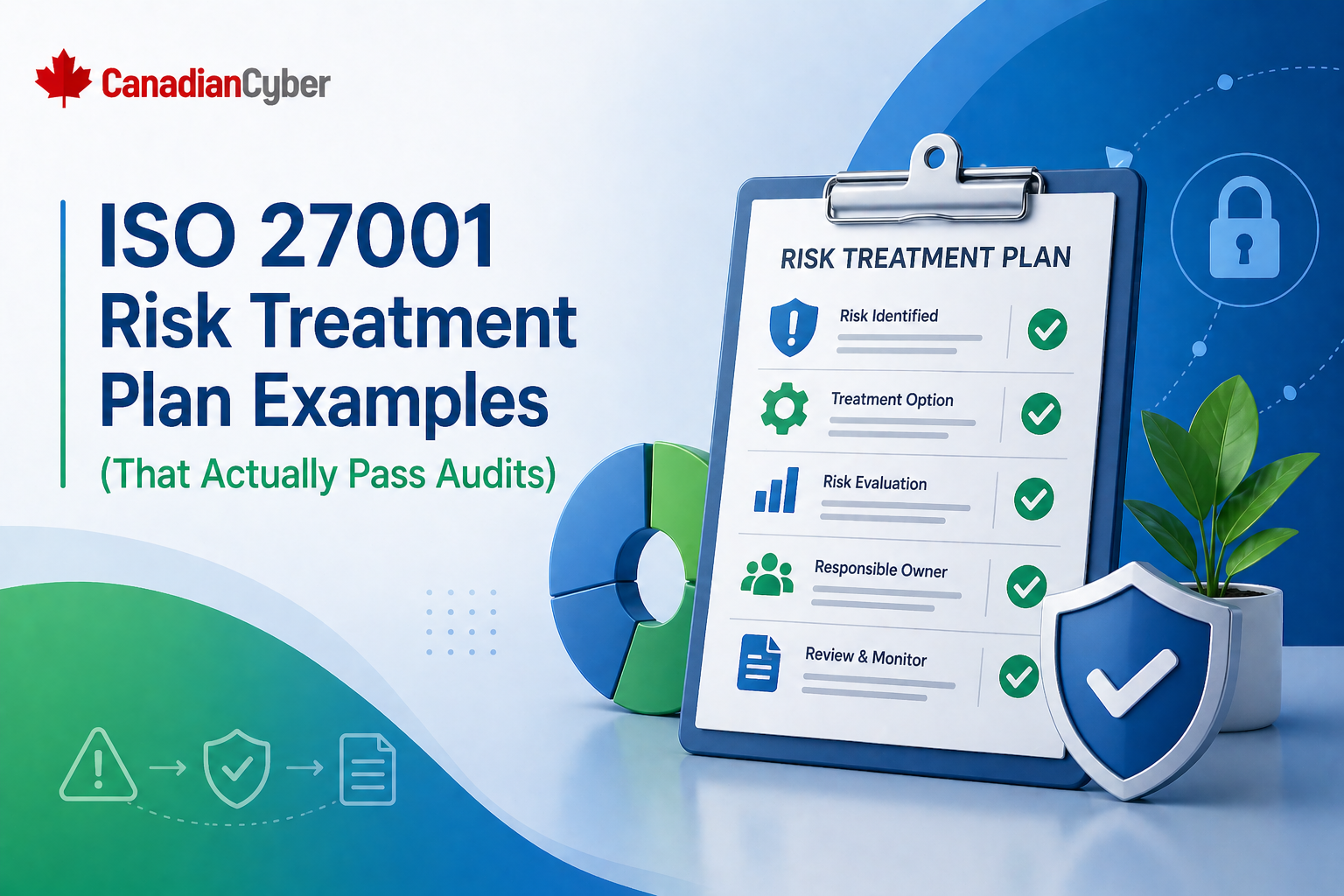
ISO 27001 • Risk Treatment • Audit Readiness
ISO 27001 Risk Treatment Plan Examples That Actually Pass Audits
A risk register shows what could go wrong. A risk treatment plan proves what your organization is doing about it, who owns the work, and what evidence shows completion.
Quick Snapshot
| Category | Detail |
|---|---|
| Topic | ISO 27001 risk treatment plans |
| Goal | Turn vague treatment notes into specific, auditable actions |
| Audit focus | Risk, decision, action, owner, deadline, evidence, and residual risk review |
| Best for | ISO 27001 implementers, risk owners, compliance leads, vCISOs, and internal auditors |
Introduction
A risk register tells you what could go wrong.
A risk treatment plan tells you what the organization is actually doing about it.
That difference matters a lot in ISO 27001.
Many companies build a risk register, score risks, and assign owners. Then the treatment plan gets reduced to vague notes like:
- improve access controls
- strengthen monitoring
- review vendors
- update policy
- enhance awareness
Those phrases may sound reasonable, but they rarely pass audit scrutiny well.
Risk → treatment decision → specific action → owner → deadline → evidence → residual risk review
In simpler terms: an ISO 27001 risk treatment plan should not describe good intentions. It should show practical, trackable actions that reduce risk and can be proven with evidence.
Why Risk Treatment Plans Fail Audits
Risk treatment plans usually fail because they are too vague.
The organization may have identified a real risk, but the treatment does not show:
- what will actually change
- who owns the action
- when it will be done
- what evidence will prove completion
- how residual risk will be reviewed afterward
Weak treatment: Improve privileged access.
Better treatment: Complete quarterly privileged access review for production cloud admin roles, remove unnecessary accounts, store review evidence, and update residual risk after completion.
Need Audit-Ready Risk Treatment Plans?
Canadian Cyber helps organizations turn vague risks into clear treatment actions with owners, evidence, due dates, and residual risk review.
What Auditors Want to See
Auditors usually want a treatment plan that is specific, assigned, time-bound, linked to evidence, tied to residual risk, and reviewed after completion.
| Question | Why It Matters |
|---|---|
| What risk is being treated? | Connects action to business risk |
| What treatment option was chosen? | Shows decision logic |
| What specific action will happen? | Makes the plan testable |
| Who owns it? | Creates accountability |
| When is it due? | Prevents indefinite treatment |
| What evidence proves it? | Supports audit testing |
| What residual risk remains? | Shows risk was re-evaluated |
The Four Risk Treatment Options
| Treatment Option | What It Means |
|---|---|
| Mitigate | Reduce the risk by implementing or improving controls |
| Accept | Formally accept the risk because it is within tolerance |
| Transfer | Shift some risk through insurance, contracts, or outsourcing |
| Avoid | Stop the activity creating the risk |
Example 1: Privileged Access Risk
Risk: Unauthorized or excessive privileged access to production systems could lead to customer data exposure, service disruption, or unauthorized changes.
Weak treatment: Review admin access.
Audit-ready treatment: Complete a privileged access review for production cloud, identity provider, source control, and deployment platform admin roles. Remove unnecessary privileged access, document approvals for retained admin accounts, and store the completed review evidence in the ISMS evidence library.
| Treatment Decision | Mitigate |
| Owner | IT / Cloud Operations Lead |
| Due Date | 30 days |
| Evidence | Access review report, removal tickets, retained access approvals |
| Residual Risk Review | Re-score after removals are complete |
Example 2: Vendor Security Risk
Risk: A critical vendor with weak security controls could expose customer data or disrupt service delivery.
Weak treatment: Improve vendor management.
Audit-ready treatment: Risk-rank all vendors that process customer data or support critical services. Complete security review for high-risk vendors, collect available SOC 2 or ISO 27001 evidence, document risk decisions, assign vendor owners, and set annual reassessment dates.
This passes better because it shows vendor risk is being actively managed, not just acknowledged.
Example 3: Incident Response Weakness
Risk: Inconsistent incident documentation could delay response, weaken evidence, and reduce the organization’s ability to learn from security events.
Weak treatment: Update incident response process.
Audit-ready treatment: Update the incident response template to require detection source, severity, owner, timeline, response actions, closure summary, and lessons learned. Train security and IT responders on the updated template. Review the next incident or near miss using the new format.
Example 4: Backup Recovery Risk
Risk: Failure to restore critical systems from backup could extend downtime and affect service availability.
Weak treatment: Test backups.
Audit-ready treatment: Perform a restore test for the production database backup in a controlled environment. Document test scope, date, owner, restore result, issues found, and corrective actions. Review recovery time and update the backup procedure if needed.
Need Stronger Backup or Incident Evidence?
We help teams turn backup, incident response, and resilience risks into specific treatment actions that auditors can follow.
More Audit-Ready Risk Treatment Examples
| Risk Area | Audit-Ready Treatment Direction |
|---|---|
| Security awareness | Assign annual training, track completion, run phishing simulation, and provide targeted follow-up for failed users. |
| Cloud misconfiguration | Define cloud baseline, run configuration review, remediate high-risk issues, and document exceptions with expiry dates. |
| Data retention | Map customer data locations, define retention rules, update deletion procedures, and include support attachments and exports. |
| Secure development | Require pull request review, enable branch protection, and store evidence of reviewed changes and deployment approvals. |
| Unsupported assets | Update inventory, assign owners, identify unsupported assets, and create remediation or compensating control actions. |
| Third-party access | Review contractor accounts, remove unnecessary access, document retained approvals, and add contractor access to review cadence. |
Risk Treatment Plan Template
Here is a practical structure your team can use:
| Field | What to Include |
|---|---|
| Risk ID | Link to risk register |
| Risk Statement | Clear description of risk and impact |
| Treatment Decision | Mitigate, accept, transfer, or avoid |
| Treatment Action | Specific action to be completed |
| Owner | Person accountable |
| Due Date | Target completion date |
| Evidence Required | What proves completion |
| Residual Risk Review | When and how risk will be re-scored |
Common Mistakes to Avoid
- Writing vague actions: “Improve security” is not a treatment plan.
- Forgetting evidence: If you cannot prove it, the treatment will be weak in audit.
- Assigning generic owners: “IT team” is weaker than a named accountable owner.
- Leaving due dates open-ended: Treatment without deadlines becomes indefinite.
- Not reviewing residual risk: The treatment should change the risk picture.
- Confusing existing controls with future treatment: Existing MFA is not a treatment action unless something new is being implemented or improved.
Canadian Cyber’s Take
At Canadian Cyber, we often see organizations build risk registers that look complete but risk treatment plans that are too vague to pass audit smoothly.
The best plans are simple, but specific.
Auditors want to follow a clear chain: what risk was identified, what decision was made, what action will reduce the risk, who owns it, when it is due, what evidence proves it, and how residual risk will be reviewed.
Takeaway
ISO 27001 risk treatment plans do not need to be complicated. But they must be clear.
A treatment plan that actually passes audit should connect: risk → decision → action → owner → evidence → residual risk.
If that chain is missing, the plan will feel weak. If that chain is clear, your risk management process becomes much easier to defend.
How Canadian Cyber Can Help
We help organizations build risk registers and treatment plans that are practical, auditable, and aligned with ISO 27001 expectations.
- ISO 27001 risk assessment workshops
- risk treatment plan development
- Statement of Applicability alignment
- corrective action tracking
- residual risk scoring
- SharePoint-based risk registers
- internal audit preparation
- vCISO guidance for risk governance
Stay Connected With Canadian Cyber
Follow Canadian Cyber for practical guidance on ISO 27001, risk treatment, audit readiness, vCISO support, and SharePoint evidence management.