Case Study • ISO 27001 • Fintech Stage 2 Readiness
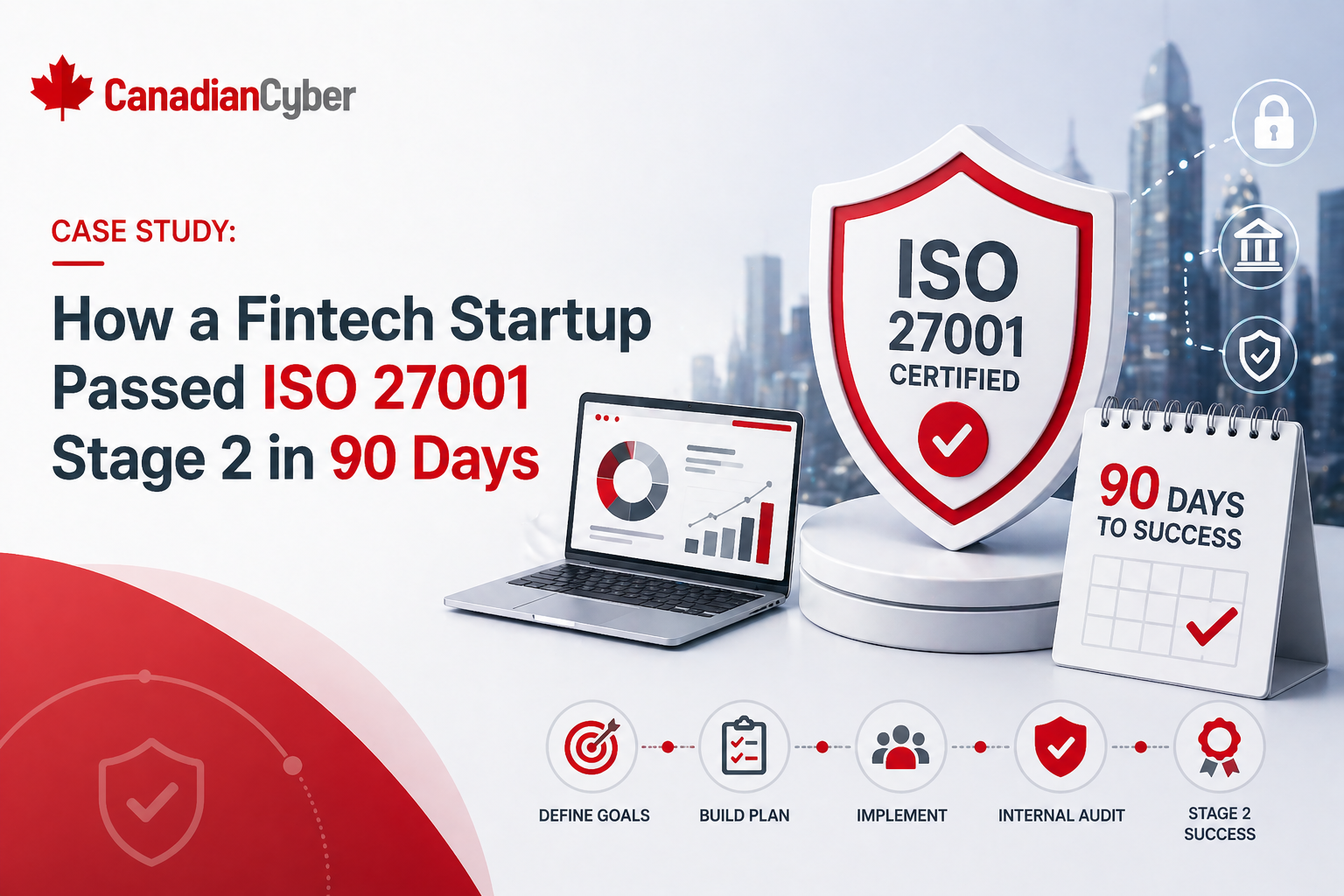
Case Study: How a Fintech Startup Passed ISO 27001 Stage 2 in 90 Days
A fictional fintech startup moved from scattered readiness to audit confidence by treating ISO 27001 Stage 2 like an execution sprint, not a documentation project.
Quick Snapshot
| Category | Detail |
|---|---|
| Company type | Fictional fintech SaaS startup serving small financial teams |
| Timeline | 90 days before ISO 27001 Stage 2 audit |
| Main challenge | Scattered evidence, inconsistent reviews, vague risk treatment, and unfinished audit readiness activities |
| Winning approach | Clear scope, control ownership, evidence centralization, internal audit, corrective actions, and management review |
Introduction
Passing ISO 27001 Stage 2 in 90 days sounds fast.
For a fintech startup, it can sound almost impossible.
Financial data. Cloud infrastructure. Vendor dependencies. Customer security questions. Access control. Secure development. Incident response. Risk treatment. Evidence. Internal audit. Management review.
There is a lot to prove.
The fintech startup passed Stage 2 by treating ISO 27001 like an execution sprint, not a documentation project.
This case study shows how the team focused on scope, evidence, ownership, and corrective action fast enough to move from scattered readiness to audit confidence.
The Startup
The company was a growing fintech SaaS startup serving small financial teams.
Its platform handled:
- customer account information
- transaction workflow data
- invoice and payment records
- user access logs
- API integrations
- support tickets
- cloud-hosted financial records
The company already had some good security basics:
- MFA
- cloud backups
- endpoint protection
- access controls
- policies in draft
- a risk register started
- vendor records partially collected
The team was not starting from zero. But it was not audit-ready either.
The Challenge
The startup had 90 days before Stage 2.
The biggest gaps were not unusual:
- policies existed but were not all approved
- access reviews were inconsistent
- vendor evidence was scattered
- risk treatment plans were vague
- corrective actions were not tracked tightly
- internal audit had not been completed
- management review was not ready
- evidence was stored across folders, tickets, and spreadsheets
Preparing for ISO 27001 Stage 2?
Canadian Cyber helps fintech startups organize evidence, close gaps, complete internal audit, and prepare management review before the auditor arrives.
Week 1–2: Locking the Scope
The first step was scope clarity.
The team defined the ISMS around the fintech SaaS platform, including:
- production cloud infrastructure
- application and APIs
- customer data stores
- identity and access systems
- CI/CD pipeline
- support tooling
- monitoring and logging
- key vendors
- employees supporting the service
They also documented exclusions clearly. This prevented scope creep and helped everyone understand what the audit would actually test.
Week 3–4: Cleaning Up Ownership
Next, every major control area received an owner.
| Control Area | Why Ownership Mattered |
|---|---|
| Access control | Confirmed user access, privileged roles, and offboarding evidence |
| Vendor management | Centralized third-party reviews and security evidence |
| Incident response | Ensured incident records, templates, and escalation paths were ready |
| Cloud security | Connected cloud controls to evidence and monitoring outputs |
| Risk register | Made risk treatment traceable and easier to audit |
| Corrective actions | Ensured findings were tracked to closure with evidence |
This changed the project immediately. Instead of one compliance lead chasing everyone, each control owner knew what they had to prove.
Week 5–6: Turning Risks Into Treatment Plans
The risk register was cleaned up. The team rewrote vague risks into clear statements and added inherent risk, existing controls, residual risk, treatment decision, owner, target date, and evidence needed.
| Risk | Treatment Action |
|---|---|
| Excessive privileged access could expose customer data | Complete privileged access review and remove unnecessary admin roles |
| Vendor weakness could affect financial data handling | Complete critical vendor reassessments and document risk decisions |
| Backup failure could delay recovery | Run restore test and retain evidence |
Need Help Cleaning Up Risk Treatment?
We help fintech teams turn vague risks into clear treatment plans with owners, evidence, target dates, and audit-ready traceability.
Week 7: Access Review Sprint
Access control became a focused sprint.
The team reviewed:
- cloud admin roles
- production access
- GitHub access
- support tool permissions
- customer data access
- privileged accounts
- leaver records
They removed unnecessary access, documented approvals, and stored evidence in SharePoint. This became one of the strongest evidence areas for Stage 2.
Week 8: Vendor and Support Workflow Cleanup
The fintech had several important vendors, including a cloud provider, payment-related integration provider, support platform, monitoring tool, identity provider, and endpoint management tool.
The team risk-ranked vendors, collected available security evidence, and documented ownership.
They also reviewed support access because support tickets sometimes contained customer financial context. The result was a cleaner vendor register and better proof of third-party oversight.
Week 9: Internal Audit
The internal audit was kept focused and practical.
It tested:
- access reviews
- vendor management
- risk treatment
- incident records
- policy approvals
- backup evidence
- secure development controls
- corrective actions
The audit found several issues, but that was expected. The important part was that findings were documented and assigned quickly.
Week 10: Corrective Action Closure
The team treated corrective actions like a sprint board.
Each action had:
- owner
- due date
- priority
- evidence required
- verification status
| Corrective Action Examples |
|---|
| Update incident closure template |
| Attach missing vendor review evidence |
| Complete backup restore proof |
| Finalize policy approvals |
| Document secure code review evidence |
| Close stale access review follow-up |
Week 11: Management Review
Management review was prepared with a simple but complete pack.
- ISMS scope
- audit results
- open and closed corrective actions
- risk register summary
- incident summary
- vendor review status
- security objectives
- resource needs
- improvement priorities
Leadership reviewed the program and made decisions before Stage 2. That mattered because ISO 27001 is a management system, not just a technical checklist.
Week 12: Evidence Rehearsal
Before the auditor arrived, the team ran a mock evidence request.
They tested whether they could quickly produce:
- approved policies
- risk register
- Statement of Applicability
- access review evidence
- vendor reviews
- internal audit report
- corrective action tracker
- management review minutes
- backup test evidence
- incident records
- secure development evidence
The evidence rehearsal caught a few final gaps. Those gaps were fixed before Stage 2 began.
What Made the 90-Day Timeline Work
| Success Factor | Why It Worked |
|---|---|
| Scope was clear | The team avoided wasting time on unrelated tools and unclear boundaries |
| Owners were assigned early | Every control had someone responsible for evidence and follow-up |
| Evidence was centralized | SharePoint became the evidence workspace instead of scattered folders |
| Internal audit was practical | The audit found real gaps without overwhelming the team |
| Corrective actions closed quickly | Findings were tracked like operational work |
| Leadership stayed involved | Management review was not treated as a formality |
Want a 90-Day ISO 27001 Readiness Sprint?
Canadian Cyber supports focused ISO 27001 implementation sprints for fintech teams that need practical structure, evidence discipline, and audit readiness fast.
What Could Have Gone Wrong
The timeline would have failed if the team had:
- tried to write policies without fixing processes
- ignored access review cleanup
- delayed internal audit
- left corrective actions vague
- treated vendor review as optional
- stored evidence randomly
- waited until the audit week to rehearse requests
Canadian Cyber’s Take
At Canadian Cyber, we often see startups believe ISO 27001 Stage 2 readiness is mostly about having the right documents.
It is not.
Stage 2 is about proving the ISMS is operating. For a fintech startup, that means the auditor needs to see:
- real risk treatment
- approved policies
- access discipline
- vendor oversight
- internal audit results
- corrective action follow-up
- management review
- evidence that controls are working
Takeaway
Passing ISO 27001 Stage 2 in 90 days is not easy.
But for a fintech startup with some security foundations already in place, it can be realistic if the work is structured properly.
The key is to focus on:
- clear scope
- strong ownership
- practical evidence
- risk treatment
- access review
- vendor oversight
- internal audit
- corrective action
- management review
Stage 2 is not about proving the company wrote documents. It is about proving the company operates an ISMS that protects information, manages risk, and improves over time.
How Canadian Cyber Can Help
We help fintech startups prepare for ISO 27001 with practical implementation support, evidence readiness, and audit-focused execution.
- ISO 27001 implementation sprints
- Stage 2 readiness reviews
- risk register and treatment planning
- access and vendor control cleanup
- internal audit preparation
- corrective action tracking
- management review support
- SharePoint-based evidence structuring
- vCISO guidance for fintech security and compliance
Stay Connected With Canadian Cyber
Follow Canadian Cyber for practical guidance on ISO 27001, fintech compliance, audit readiness, vCISO support, and SharePoint evidence management.