vCISO • EdTech Security • Student Data Protection
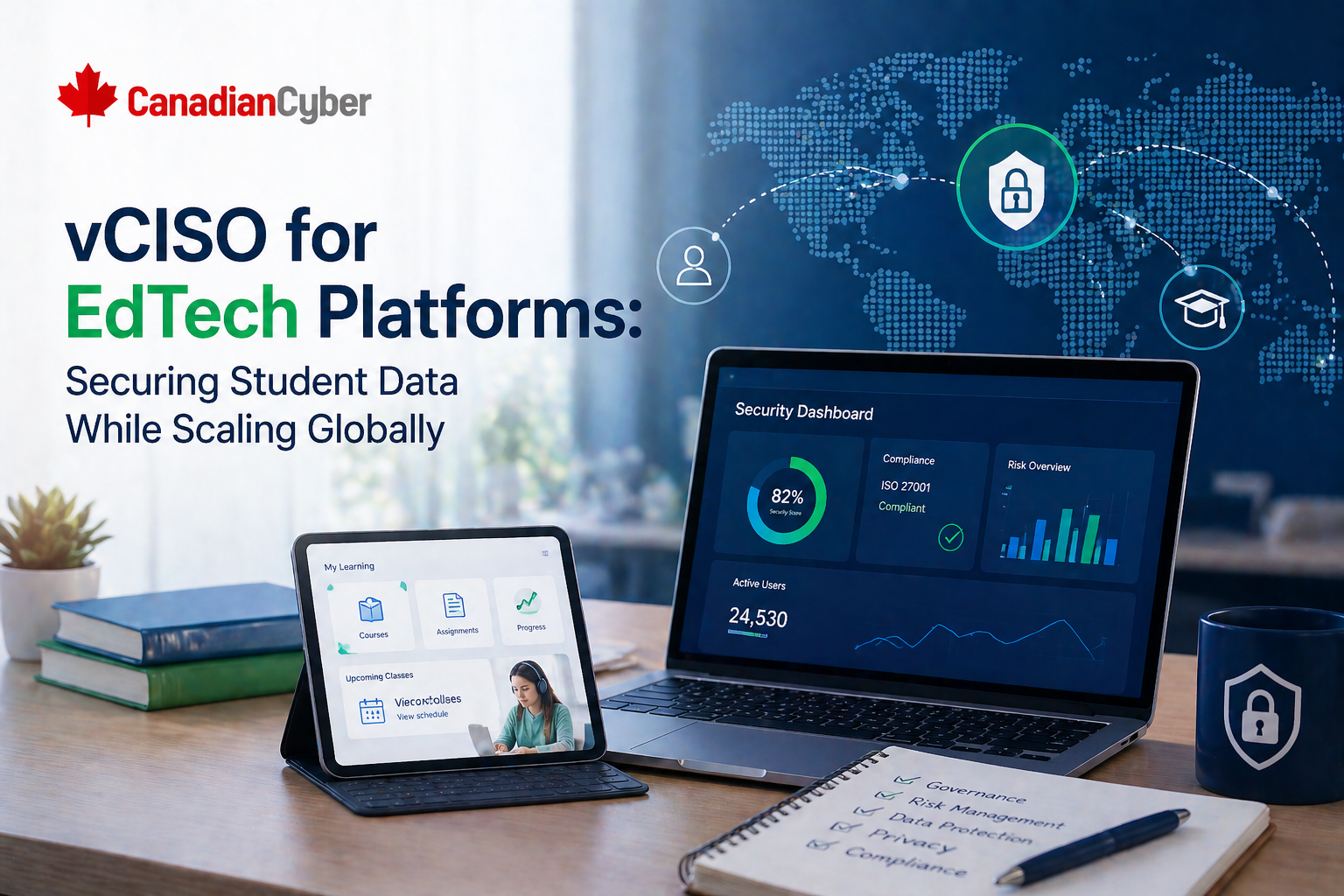
vCISO for EdTech Platforms: Securing Student Data While Scaling Globally
As EdTech platforms expand across schools, districts, regions, and countries, student data protection becomes a leadership issue. A vCISO helps scale security, privacy, and buyer trust without slowing product growth.

Quick Snapshot
| Category | Detail |
|---|---|
| Best for | EdTech startups, SaaS platforms, school technology providers, and global learning platforms |
| Main challenge | Protecting student data while adding regions, vendors, integrations, support workflows, and buyer requirements |
| vCISO value | Experienced security leadership without needing a full-time CISO hire |
| Outcome | Stronger student data governance, buyer trust, audit readiness, and global security planning |
Introduction
EdTech platforms grow quickly when they solve a real education problem.
A few schools become districts. One region becomes multiple regions. A local platform becomes international. More students log in. More teachers upload content. More parents receive notifications. More integrations are added. More vendors support the platform.
Growth is exciting.
But for EdTech companies, growth also increases one of the most sensitive responsibilities in the business: protecting student data.
A vCISO helps EdTech platforms protect student data, answer buyer security questions, and build a security program that can support global growth.
Student information may include names, class rosters, grades, attendance, assignments, parent details, learning progress, support messages, and activity data. As the platform expands globally, this data starts moving across more cloud services, more jurisdictions, more support workflows, and more third-party tools.
Why EdTech Security Gets Harder as the Platform Scales
A small EdTech platform may start with a simple environment: student accounts, teacher dashboards, school admin access, basic file uploads, cloud hosting, and support tickets.
But as the company grows, complexity increases. The platform may add:
- parent portals and mobile apps
- learning analytics and AI-powered features
- video or messaging tools
- district-level reporting
- payment or subscription systems
- LMS and SIS integrations
- global cloud regions
- third-party vendors and subprocessors
Now the security challenge is no longer just “protect the app.” It becomes:
- who can access student data?
- where is student data stored?
- which vendors process it?
- how is data separated by school, district, or region?
- how are support teams controlled?
- how do we respond to security incidents?
- how do we prove security to buyers in different countries?
Scaling an EdTech Platform?
Canadian Cyber helps EdTech companies build practical security programs around student data, vendor governance, incident readiness, and buyer trust.
Why Student Data Needs Special Attention
Student data is not ordinary business data.
It can reveal:
- identity
- age or grade level
- academic performance
- attendance patterns
- learning difficulties
- parent or guardian information
- behavioral notes
- device and usage patterns
That means EdTech platforms need security controls that match the sensitivity of the data.
A strong program should protect student data across:
- production systems
- support workflows
- exports and reports
- analytics tools
- backups
- vendor systems
- development and testing environments
The biggest risks often appear outside the main application, especially in support tickets, admin exports, analytics dashboards, and third-party tools.
A Common Scenario
Picture this: an EdTech startup has grown from serving local schools to selling into multiple countries.
The platform now supports:
- students
- teachers
- parents
- school administrators
- district leadership
- customer support teams
- third-party integrations
Sales are growing, but security questions are becoming harder. Buyers ask:
- Do you have a security program?
- How do you protect student data?
- Can support staff see student records?
- Where is data stored?
- Do you use third-party processors?
- How do you handle deletion requests?
- What happens if there is a breach?
- Are you preparing for ISO 27001, SOC 2, or privacy reviews?
What a vCISO Does for an EdTech Platform
A vCISO helps turn scattered security activities into a structured program.
| vCISO Focus Area | Why It Matters for EdTech |
|---|---|
| Security roadmap planning | Prioritizes security work without slowing product growth |
| Student data governance | Clarifies where student data lives, moves, and needs stronger protection |
| Access control improvement | Reduces risk from broad internal, support, or admin access |
| Vendor oversight | Supports stronger control over subprocessors and third-party tools |
| Incident response planning | Prepares the company to respond responsibly if student data is affected |
| Buyer evidence support | Helps answer questionnaires and procurement reviews with confidence |
1. Building a Student Data Protection Map
The first thing a vCISO usually needs is visibility. That means mapping where student data lives and moves.
| Area | Example |
|---|---|
| Core platform | accounts, classes, assignments, grades |
| Support tools | tickets, screenshots, troubleshooting notes |
| Analytics | dashboards, activity reports, engagement data |
| Exports | CSV reports, school admin downloads |
| Backups | recovery copies and archives |
| Vendors | messaging, hosting, monitoring, LMS/SIS integrations |
Need a Student Data Map?
Canadian Cyber helps EdTech platforms map student data across applications, support tools, analytics, vendors, backups, and exports.
2. Strengthening Access Control
Access control is one of the most important areas for EdTech security.
The vCISO helps answer:
- who can access student data internally?
- can support staff view full records?
- are admin roles reviewed regularly?
- are school and district users separated properly?
- are former employees and contractors removed quickly?
- are privileged actions logged?
A stronger access model usually includes:
- role-based access
- least privilege
- MFA for internal users
- periodic access reviews
- restricted support access
- logging of sensitive admin actions
- clear offboarding workflows
3. Controlling Support Workflows
Support teams often become a hidden privacy risk.
They may see:
- screenshots
- student names
- assignment details
- parent messages
- school records
- troubleshooting exports
A vCISO helps design safer support workflows by:
- limiting access to only what support needs
- reducing student data in tickets
- controlling screenshots and attachments
- setting retention rules for support evidence
- logging sensitive support access
- training support staff on student data handling
4. Managing Vendors and Subprocessors
As EdTech platforms scale globally, vendors multiply.
Common vendors may include:
- cloud hosting providers
- email and notification platforms
- analytics tools
- support ticketing systems
- video or messaging services
- LMS and SIS integration providers
- monitoring and logging tools
A vCISO helps create a vendor risk process that tracks what data the vendor handles, whether student data is involved, available security evidence, contract and privacy terms, subprocessor exposure, review frequency, and internal owner.
This helps the company answer school and district questions with confidence.
5. Preparing for Global Buyer Requirements
Global scaling means different buyers may expect different proof.
Some may ask for:
- SOC 2
- ISO 27001
- ISO 27018
- privacy impact documentation
- vendor security questionnaires
- data processing agreements
- incident response details
- data residency information
| Business Goal | Likely Priority |
|---|---|
| Selling to North American SaaS buyers | SOC 2 readiness |
| Expanding internationally | ISO 27001 planning |
| Handling student data in cloud platforms | ISO 27018 alignment |
| Responding to school district reviews | Questionnaire and evidence readiness |
| Scaling enterprise procurement | Security roadmap and trust documentation |
6. Improving Incident Response
EdTech platforms need a practical incident response plan because student data incidents can create serious trust issues.
A vCISO helps define:
- who leads the response
- how incidents are classified
- when legal and privacy teams are involved
- how schools are notified
- how evidence is preserved
- how support and communications teams respond
- how lessons learned are tracked
7. Creating Executive Visibility
Security cannot stay buried in engineering tickets.
Leadership needs to understand:
- top student data risks
- open corrective actions
- vendor concerns
- audit readiness
- incident trends
- access review results
- roadmap progress
- budget needs
What EdTech Companies Usually Get Wrong
- treating student data like ordinary customer data
- focusing only on the main application
- ignoring support tickets, exports, and analytics
- allowing broad internal access for convenience
- adding vendors without enough review
- waiting for buyer questionnaires before organizing evidence
- writing policies that do not match real workflows
- delaying incident response planning until something happens
Canadian Cyber’s Take
At Canadian Cyber, we often see EdTech companies with strong product vision but immature security governance.
The platform may be growing fast, but the security program has not caught up.
The strongest EdTech security programs usually focus early on:
- student data mapping
- internal access control
- support workflow governance
- vendor oversight
- incident readiness
- audit and buyer evidence
- executive-level security reporting
A vCISO creates value not by adding bureaucracy, but by helping the company build a security program that supports trust, growth, and global expansion.
Takeaway
For EdTech platforms, scaling globally means security must scale too.
Student data moves through applications, support tools, vendors, analytics, exports, backups, and cloud systems. If those areas are not governed clearly, buyer trust becomes harder to earn.
Global EdTech growth depends on more than product adoption. It depends on proving that student data is protected everywhere the platform goes.
How Canadian Cyber Can Help
We help EdTech platforms build practical security programs that protect student data while supporting global growth.
- vCISO services for EdTech companies
- student data security and privacy reviews
- cloud and SaaS control assessments
- vendor and subprocessor governance
- SOC 2, ISO 27001, and ISO 27018 readiness
- incident response planning
- buyer questionnaire and evidence support
Stay Connected With Canadian Cyber
Follow Canadian Cyber for practical guidance on EdTech security, vCISO leadership, student data privacy, SOC 2, ISO 27001, and ISO 27018 readiness.