DIY Security Roadmap • vCISO Strategy • Cyber Maturity
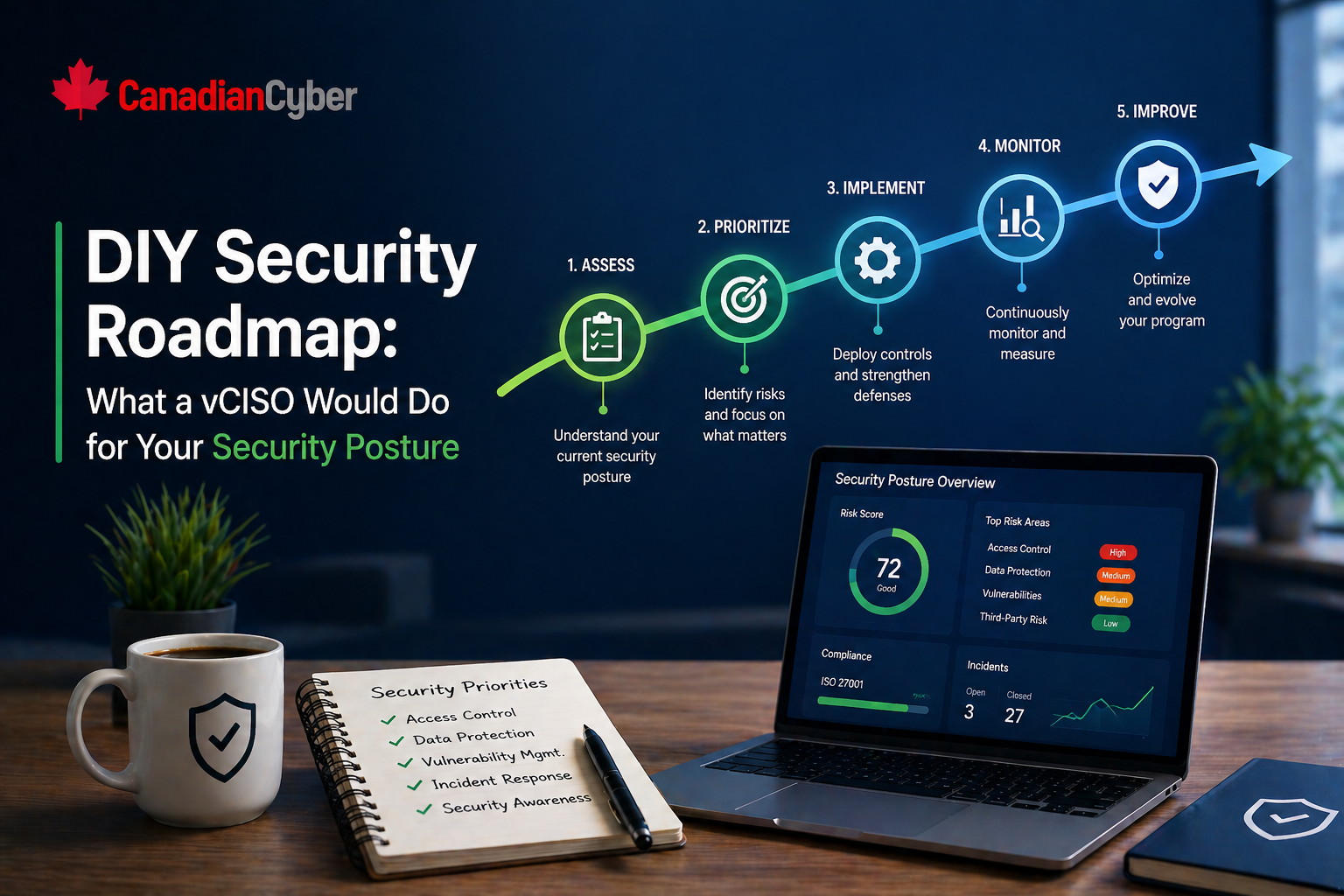
DIY Security Roadmap: What a vCISO Would Do for Your Security Posture
A practical vCISO-style roadmap helps you stop reacting to every security request and start improving your posture in the right order.
Quick Snapshot
| Roadmap Area | Why It Matters |
|---|---|
| Identity & Access | Reduces one of the fastest paths to compromise |
| Endpoints & Devices | Protects the laptops and systems employees use every day |
| Cloud & SaaS | Controls sensitive data across modern business platforms |
| Incident & Evidence Readiness | Helps prove progress to leaders, customers, insurers, and auditors |
Introduction
Most organizations know they need better cybersecurity.
The harder question is:
What should we do first?
Should you start with MFA? Endpoint security? Policies? SOC 2? ISO 27001? Vendor reviews? Incident response? Cloud hardening? Security awareness? A risk register?
Without a roadmap, security improvement becomes reactive.
One month, the priority is phishing. Next month, it is a customer questionnaire. Then cyber insurance asks for evidence. Then an audit finding appears. Then a vendor incident forces new questions.
That is exactly why a vCISO-style security roadmap is so useful.
A DIY security roadmap helps you think like a vCISO, so your next security steps are based on risk, maturity, and business goals — not panic or guesswork.
Want to Stop Guessing Your Next Security Move?
Canadian Cyber can help you turn scattered security tasks into a practical 12-month roadmap with owners, priorities, and evidence.
Why Security Roadmaps Fail
Many security roadmaps fail because they are built around wish lists instead of priorities.
They include things like:
- deploy more tools
- improve cloud security
- update policies
- run training
- review vendors
- prepare for compliance
Those are not bad goals. But they are too broad.
A useful roadmap should answer:
- What risk are we reducing?
- Why does this matter now?
- Who owns it?
- What evidence proves it is done?
- What should happen first?
- What can wait?
What a vCISO Would Do First
A vCISO usually starts with visibility.
Before recommending tools or projects, they would ask:
- What systems support the business?
- What sensitive data do we handle?
- Who has access to critical systems?
- What security controls already exist?
- What incidents or near misses have happened?
- What do customers, insurers, or auditors keep asking for?
- What would hurt the business most if it failed?
Step 1: Define Business Priorities
Security should support the business, not sit apart from it.
Start by identifying what the organization needs over the next 12 months. Examples include:
- win larger customers
- prepare for SOC 2 or ISO 27001
- reduce cyber insurance friction
- support remote work
- expand into new markets
- improve incident readiness
- protect customer data
DIY Leadership Questions
- What are our biggest business goals this year?
- Which customers or partners are asking about security?
- What compliance pressure is coming?
- What systems create the most revenue dependency?
- What data would cause the most harm if exposed?
Step 2: Build a Simple Security Baseline
A vCISO would then benchmark the current posture. You do not need a complicated maturity model to start.
| Score | Meaning |
|---|---|
| 1 | Ad hoc and undocumented |
| 2 | Basic controls exist, but inconsistent |
| 3 | Defined and repeatable |
| 4 | Managed and measured |
| 5 | Optimized and continuously improved |
Assess core areas like governance, risk management, asset inventory, identity and access, endpoint security, cloud and SaaS security, vendor risk, incident response, backup and recovery, awareness training, and compliance evidence.
Not Sure Where Your Security Stands?
Start with a practical cyber maturity assessment and find out which gaps deserve attention first.
Step 3: Identify Your Critical Assets and Data
A roadmap should be built around what matters most.
| Critical Assets | Sensitive Data |
|---|---|
| production systems | customer data |
| cloud environments | personal information |
| customer databases | financial records |
| source code repositories | credentials and contracts |
| email and identity platforms | payroll data and confidential files |
Step 4: Fix Identity and Access First
Most vCISOs prioritize access early because it reduces risk quickly.
Common access improvements include:
- enforce MFA on all critical systems
- centralize identity through SSO where possible
- remove unused accounts
- review privileged access
- restrict admin roles
- improve joiner, mover, leaver workflows
- document access review evidence
| DIY Access Checklist | Status |
|---|---|
| MFA enabled for email and critical SaaS | ☐ |
| Admin accounts reviewed | ☐ |
| Former employee access removed | ☐ |
| Shared accounts identified | ☐ |
| Quarterly access review scheduled | ☐ |
Step 5: Secure Laptops and Endpoints
Remote and hybrid work make endpoint security essential.
Start with practical, audit-friendly improvements:
- device inventory
- encryption enforcement
- endpoint protection coverage
- patch reporting
- offboarding device recovery or wipe process
Step 6: Review Cloud and SaaS Security
Most companies now run on cloud and SaaS tools.
Common priorities include:
- cloud admin access review
- logging for critical platforms
- public storage checks
- backup verification
- SaaS admin review
- integration and API token review
Do not only review AWS or Azure. Microsoft 365, Google Workspace, GitHub, Jira, Slack, HubSpot, Zendesk, and similar tools may hold sensitive business data too.
Step 7: Build a Vendor Risk Process
A vCISO would not treat every vendor equally. They would rank vendors by risk.
| Vendor Type | Example | Review Level |
|---|---|---|
| Critical | cloud provider, identity provider | formal review |
| High | support tool, payroll, CRM | security and privacy review |
| Moderate | internal operations tool | lighter review |
| Low | limited data exposure tool | basic tracking |
Need a Roadmap Buyers and Auditors Can Trust?
We can help organize your access, endpoint, cloud, vendor, incident, and evidence work into a roadmap that supports SOC 2, ISO 27001, insurance, and customer reviews.
Step 8: Prepare for Incidents Before They Happen
A vCISO would never wait for a real breach to test response readiness.
At minimum, build:
- incident response plan
- severity levels
- escalation contacts
- decision log template
- communication rules
- evidence preservation steps
- post-incident review template
Step 9: Test Backup and Recovery
Backups are not enough. A vCISO would ask: Can we restore?
Your roadmap should include:
- identify critical systems
- confirm backup coverage
- restrict backup access
- document retention settings
- run restore tests
- store restore evidence
- fix issues found during testing
Step 10: Organize Policies and Evidence
Policies matter, but only if they match reality.
A vCISO would usually standardize key documents such as:
- information security policy
- access control policy
- incident response plan
- vendor management policy
- acceptable use policy
- data classification policy
- backup and recovery procedure
- secure development policy
Evidence should be easy to find by control area, owner, review period, system, and audit requirement.
Step 11: Create a 12-Month Security Roadmap
Now turn the findings into a plan.
| Quarter | Focus | Example Outcomes |
|---|---|---|
| Q1 | Access and endpoint foundation | MFA, admin review, device inventory, encryption |
| Q2 | Cloud, SaaS, and backup controls | cloud review, SaaS admin cleanup, restore test |
| Q3 | Vendor risk and incident readiness | vendor register, tabletop exercise, IR updates |
| Q4 | Compliance and evidence maturity | policies, internal audit, management reporting |
Step 12: Report Progress to Leadership
A vCISO would keep leadership informed with simple metrics.
- MFA coverage
- privileged accounts reviewed
- endpoint encryption coverage
- overdue corrective actions
- critical vendors reviewed
- backup restore tests completed
- open high-risk findings
- policy reviews completed
What to Prioritize First
If you are starting from scratch, prioritize:
- MFA and privileged access cleanup
- device inventory and endpoint protection
- critical asset and SaaS inventory
- backup restore testing
- incident response planning
- vendor risk ranking
- policy and evidence organization
- cloud configuration review
Common DIY Roadmap Mistakes
- Buying tools before defining risk: Tools do not fix unclear priorities.
- Trying to do everything at once: Too many projects create stalled progress.
- Ignoring ownership: Every roadmap item needs an owner.
- Forgetting evidence: If you cannot prove the control, it may not help in audits or customer reviews.
- Treating policies as the whole program: Policies must match real operations.
- Skipping leadership reporting: Security needs executive visibility to stay funded and prioritized.
Make Your Roadmap Real, Not Theoretical
We help turn security goals into a practical execution plan with clear owners, realistic timelines, leadership reporting, and proof of progress.
Canadian Cyber’s Take
At Canadian Cyber, we often see organizations work hard on cybersecurity but still feel unsure whether they are improving in the right order.
That usually happens because they are reacting to pressure instead of following a roadmap.
A vCISO-style roadmap brings structure. It helps the company understand maturity, focus on business risk, fix foundational gaps first, and show leadership measurable progress.
Takeaway
A DIY security roadmap should help you think like a vCISO.
Improving your security posture is not about doing everything at once. It is about doing the right things in the right order and proving progress over time.
How Canadian Cyber Can Help
We help organizations build practical security roadmaps that improve maturity without overwhelming the team.
- vCISO services
- cyber maturity assessments
- 12-month security roadmap planning
- access, endpoint, cloud, and vendor reviews
- incident response and tabletop exercises
- SOC 2 and ISO 27001 readiness
- SharePoint-based evidence and corrective action tracking
Stay Connected With Canadian Cyber
Follow Canadian Cyber for practical guidance on vCISO strategy, cyber maturity, ISO 27001, SOC 2, security roadmaps, and evidence readiness.