SharePoint ISMS • ISO 27001 • Audit Readiness • Simplicity • User Adoption
Common Mistakes: Overcomplicating ISMS SharePoint Sites Until Teams Stop Using Them
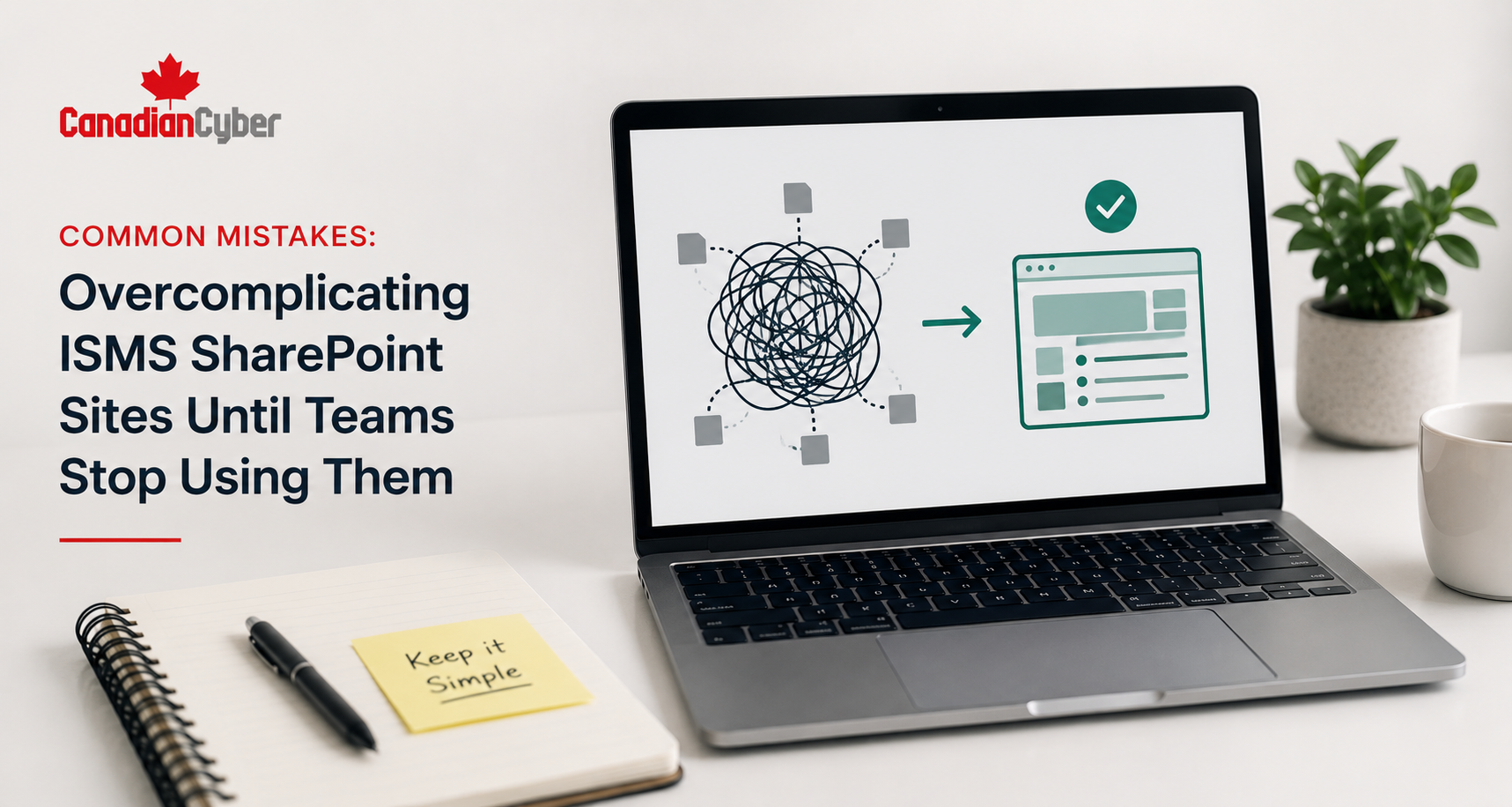
A SharePoint ISMS should make compliance work easier. But when the site becomes too complex, teams stop using it.
Quick Snapshot
| Problem Area | What Usually Goes Wrong |
|---|---|
| Site Structure | Too many libraries, folders, pages, and dashboards confuse users. |
| Metadata | Too many required fields slow down evidence uploads. |
| Workflows | Automation becomes harder to understand than the manual process. |
| Permissions | Access rules become so complex that owners avoid using the site. |
| Outcome | A SharePoint ISMS that looks built out but fails in daily use. |
Introduction
SharePoint can be a powerful ISMS platform.
It can help your team:
- manage policies
- track risks
- store audit evidence
- route approvals
- send review reminders
- support internal audits
- track corrective actions
But there is a trap.
Many organizations overbuild their SharePoint ISMS.
They create too many libraries, lists, folders, required fields, dashboards, workflows, approval steps, and naming rules. At first, the site looks mature. Then teams stop using it.
Why SharePoint ISMS Sites Become Overcomplicated
Most SharePoint ISMS sites become complicated for good reasons.
The compliance team wants strong evidence. The auditor asks for traceability. Leadership wants dashboards. Control owners need reminders. Policies need approval workflows.
Each request makes sense on its own. But when everything is added without a clear design, the site becomes heavy.
| Stage | What Happens |
|---|---|
| Stage 1 | A simple policy and evidence site is created. |
| Stage 2 | New libraries are added for risks, audits, vendors, and CAPA. |
| Stage 3 | Metadata fields are added for every possible reporting need. |
| Stage 4 | Workflows are added for reminders, approvals, and escalations. |
| Stage 5 | Users get confused and compliance work moves back into emails and spreadsheets. |
The site did not fail because SharePoint is bad. It failed because the process became harder than the work.
Mistake 1: Creating Too Many Libraries
A common mistake is creating a separate document library for every topic.
One for policies. One for procedures. One for evidence. One for ISO evidence. One for SOC 2 evidence. One for access reviews. One for vendor reviews.
Soon, nobody knows where to upload anything.
| Problem | User Impact |
|---|---|
| Too many choices. | Users hesitate or upload to the wrong place. |
| Duplicate libraries. | Evidence gets split across locations. |
| No clear owner. | Nobody maintains old areas. |
| Confusing navigation. | Users ask the compliance lead every time. |
Better Approach
Use fewer libraries with better metadata and views.
| Library / List | Purpose |
|---|---|
| Policy Library | Controlled policies, procedures, standards, and approval history. |
| Evidence Vault | Audit evidence organized by control area, period, owner, and system. |
| Risk Register | Risks, owners, treatment plans, residual risk, and evidence links. |
| Internal Audit Tracker | Audit questions, evidence requests, findings, and status. |
| Corrective Action Register | Findings, actions, owners, due dates, and closure evidence. |
Practical rule: If users cannot explain the difference between two libraries, one of them probably does not need to exist.
Mistake 2: Using Folder Structures That Are Too Deep
Folders are familiar, but deep folders create problems.
A path like ISMS Evidence → ISO 27001 → Annex A → A.5 → A.5.15 → Access Control → Quarterly Reviews → 2026 → Q1 → Entra ID → Final Evidence → Approved may look organized.
But a control owner will not want to click through ten levels to upload one access review.
| Folder Problem | Result |
|---|---|
| Too many levels. | Users upload files in the wrong place. |
| Similar folder names. | Evidence is duplicated. |
| Framework-based folders only. | Operational teams do not know where evidence belongs. |
| Files get buried. | Audit retrieval becomes harder. |
Better Approach
Use a shallow folder structure and metadata.
| Top-Level Folder | Examples |
|---|---|
| Access Control | Access reviews, MFA reports, offboarding samples. |
| Vendor Management | Vendor reviews, approval decisions, SOC report reviews. |
| Backup and Recovery | Backup settings, restore tests, recovery notes. |
| Policy Review | Approval records, review notes, acknowledgements. |
| Internal Audit | Audit plans, evidence requests, findings. |
Folders should help people upload. Metadata should help people audit.
Mistake 3: Requiring Too Many Metadata Fields
Metadata is useful. Too much metadata kills adoption.
If every upload requires 15 fields, users may avoid the site, enter random values, or save the evidence somewhere else.
| Required Field | Why It Matters |
|---|---|
| Control Area | Helps organize evidence. |
| Evidence Type | Shows what the file proves. |
| Period Covered | Shows audit relevance. |
| Owner | Assigns accountability. |
| System or Process | Shows what the evidence relates to. |
Practical rule: Only make a field required if the ISMS cannot function without it.
Mistake 4: Building Dashboards Nobody Uses
Dashboards can make an ISMS look mature.
But many dashboards are not useful. They show too much, use unclear colours, duplicate reports, or display metrics nobody acts on.
The better approach is to build role-based dashboards.
| Dashboard | Audience | What It Should Show |
|---|---|---|
| ISMS Home Dashboard | Everyone involved | Overdue items, key links, upcoming reviews. |
| Compliance Dashboard | ISMS owner | Evidence gaps, audit status, open CAPA. |
| Control Owner Dashboard | Control owners | Assigned tasks, due dates, evidence needed. |
| Leadership Dashboard | Executives | Top risks, overdue actions, readiness status. |
Every dashboard should answer a specific question for a specific audience.
Mistake 5: Automating Before the Process Is Clear
Power Automate is useful, but automation can make a bad process worse.
If the policy review process is unclear, reminders will not fix it. If risk owners are wrong, escalation workflows will annoy the wrong people.
| Good Automation Candidate | Why It Helps |
|---|---|
| Policy review reminders | Prevents missed review dates. |
| Approval routing | Captures sign-off evidence. |
| Access review reminders | Keeps quarterly reviews on schedule. |
| CAPA due date reminders | Prevents findings from drifting. |
| Overdue escalation | Creates accountability. |
Mistake 6: Making Permissions Too Complex
Permissions matter.
But overcomplicated permissions create support issues. Users cannot access what they need, owners cannot upload evidence, and the compliance lead becomes the permission help desk.
| Role | Access |
|---|---|
| ISMS Admin | Full control over the ISMS site. |
| Policy Owners | Edit assigned policies. |
| Control Owners | Upload and update evidence for assigned controls. |
| Leadership | Read dashboards, reports, and management review records. |
| Auditors | Read-only access to relevant evidence. |
Permissions should protect sensitive information without stopping normal ISMS work.
Mistake 7: Designing for Auditors but Not for Control Owners
A SharePoint ISMS must satisfy auditors.
But it must also work for the people who use it every month, including IT, HR, operations, engineering, finance, procurement, customer support, management, policy owners, and vendor owners.
| Auditor Needs | Control Owner Needs |
|---|---|
| Control traceability. | Simple upload process. |
| Evidence by period. | Clear due dates. |
| Approval records. | Minimal clicks. |
| Finding closure proof. | Clear owner dashboard. |
If control owners need a 30-minute explanation to upload evidence, the site is too complicated.
Mistake 8: Adding Every Framework Too Early
Many organizations want one SharePoint ISMS to support everything.
ISO 27001, SOC 2, ISO 27017, ISO 27018, NIST CSF, CIS Controls, cyber insurance, privacy law, and client questionnaires.
That may be possible, but adding every framework too early can overwhelm the site.
| Problem | Impact |
|---|---|
| Too many control mappings. | Users do not know which control matters. |
| Duplicate evidence requests. | Control owners get frustrated. |
| Confusing terminology. | Framework language clashes. |
| Excessive metadata. | Uploads become slow. |
Start with the primary framework. Then map additional frameworks behind the scenes as optional metadata or in a separate control mapping list.
Need a SharePoint ISMS Cleanup?
Canadian Cyber can review your existing SharePoint ISMS, remove unnecessary complexity, improve adoption, and rebuild it around evidence, workflows, dashboards, and audit readiness.
Mistake 9: Creating Lists That Nobody Maintains
SharePoint Lists are powerful.
But every list needs an owner and a purpose. A stale risk register, vendor register, audit tracker, or CAPA tracker creates audit risk.
| Question to Ask Before Creating a List | Why It Matters |
|---|---|
| Who owns this list? | Prevents abandonment. |
| How often will it be updated? | Defines cadence. |
| What decision does it support? | Avoids busywork. |
| What fields are truly needed? | Keeps it simple. |
Practical rule: A list without an owner becomes audit risk.
Mistake 10: Overloading the ISMS Home Page
The ISMS home page should help people move quickly.
It should not look like a control room full of buttons, dashboards, colours, embedded lists, and long instructions.
| Home Page Section | Purpose |
|---|---|
| Quick Links | Policies, evidence vault, risks, audits, and CAPA. |
| My Tasks | Assigned actions and due dates. |
| Overdue Items | What needs attention. |
| Key Contacts | ISMS owner, compliance lead, support contact. |
| Guidance Box | How to upload evidence or request help. |
The ISMS home page should answer: Where do I go? What do I owe? What is overdue? Who do I contact?
Mistake 11: Using SharePoint as Storage Instead of an ISMS
Some teams avoid complexity by doing almost nothing.
They create folders and upload documents. That is simple, but it may not be enough.
A working ISMS needs structure.
| Storage Site | Working ISMS Site |
|---|---|
| Folders and random uploads. | Controlled policies and evidence vault. |
| Manual reminders. | Review dates and simple workflows. |
| Email approvals. | Approval records and version history. |
| Limited traceability. | Risk register, audit tracker, CAPA, and dashboards. |
Do not overbuild. But do not underbuild either. The goal is a lean ISMS that supports real compliance work.
Signs Your SharePoint ISMS Is Too Complicated
Use this checklist to spot adoption problems early.
| Warning Sign | Yes / No |
|---|---|
| Users ask where to upload evidence every time. | |
| Control owners avoid the site. | |
| Evidence is still being sent by email. | |
| Too many dashboards exist and few are used. | |
| Permissions frequently block normal work. | |
| The compliance lead updates everything manually. | |
| The site looks impressive but daily usage is low. |
Canadian Cyber ISMS SharePoint Solution
Canadian Cyber’s ISMS SharePoint solution is designed to balance audit readiness with user adoption. We help build practical sites that are structured enough for auditors and simple enough for teams to use.
How to Simplify an Overbuilt SharePoint ISMS
You do not need to rebuild everything.
Start by reducing friction.
| Step | What to Do |
|---|---|
| 1. Review what is actually used | Look at libraries, lists, views, dashboards, workflows, metadata, permissions, and pages. |
| 2. Reduce required metadata | Keep only the fields that matter for audit and operations. |
| 3. Simplify navigation | Group links by user task, not by compliance theory. |
| 4. Create owner views | Give control owners a simple view of their work. |
| 5. Clean up workflows | Remove duplicate reminders and make approval flows easy to understand. |
The Simple SharePoint ISMS Model That Works
A practical ISMS SharePoint site does not need to be huge.
It needs the right core components.
| Component | Purpose |
|---|---|
| ISMS Home Page | Navigation, tasks, status, and key contacts. |
| Policy Library | Controlled documents, approvals, and review dates. |
| Evidence Vault | Audit evidence by control area and period. |
| Risk Register | Risks, owners, treatment plans, and residual risk. |
| Corrective Action Register | Actions, owners, due dates, and closure evidence. |
| Simple Dashboards | Overdue work, evidence gaps, and audit readiness. |
What Good Looks Like
A good SharePoint ISMS is:
- easy to navigate
- simple to use
- clear on ownership
- structured for audits
- light on unnecessary fields
- supported by useful workflows
- built around real processes
- used by control owners
- visible to leadership
- easy to maintain
A SharePoint ISMS only works if people use it. Adoption matters as much as structure.
Canadian Cyber’s Take
At Canadian Cyber, we often see SharePoint ISMS sites fail for two opposite reasons.
Some are too basic. They are just folders.
Others are too complex. They are built like enterprise GRC platforms, but without the training, support, and process maturity to match.
The strongest SharePoint ISMS sites sit in the middle. They are structured but simple.
Use metadata, but not too much. Use workflows, but only where they help. Use dashboards, but only for decisions.
Takeaway
Overcomplicating an ISMS SharePoint site can quietly damage compliance.
When teams stop using the site, evidence gets scattered, reviews get missed, risks become stale, and audits become harder.
The answer is not to abandon SharePoint. The answer is to simplify it:
- use fewer libraries
- use shallow folders
- use only necessary metadata
- build role-based views
- keep workflows understandable
- create a clean home page
- train users on the basics
A SharePoint ISMS should make compliance easier. If it makes compliance harder, it needs redesign.
How Canadian Cyber Can Help
Canadian Cyber helps organizations design, simplify, and improve SharePoint ISMS sites that teams actually use.
- SharePoint ISMS design
- SharePoint ISMS cleanup
- evidence vault simplification
- policy library setup
- risk register setup
- vendor register setup
- internal audit tracker design
- corrective action tracking
- management review libraries
- Power Automate workflow design
- metadata and view optimization
- vCISO support for ISMS governance
Stay Connected With Canadian Cyber
Follow Canadian Cyber for practical guidance on SharePoint ISMS, ISO 27001, SOC 2, audit readiness, evidence management, and vCISO support.