ISO 27001 • Multi-Product SaaS • ISMS Scaling • Software Security • Audit Readiness
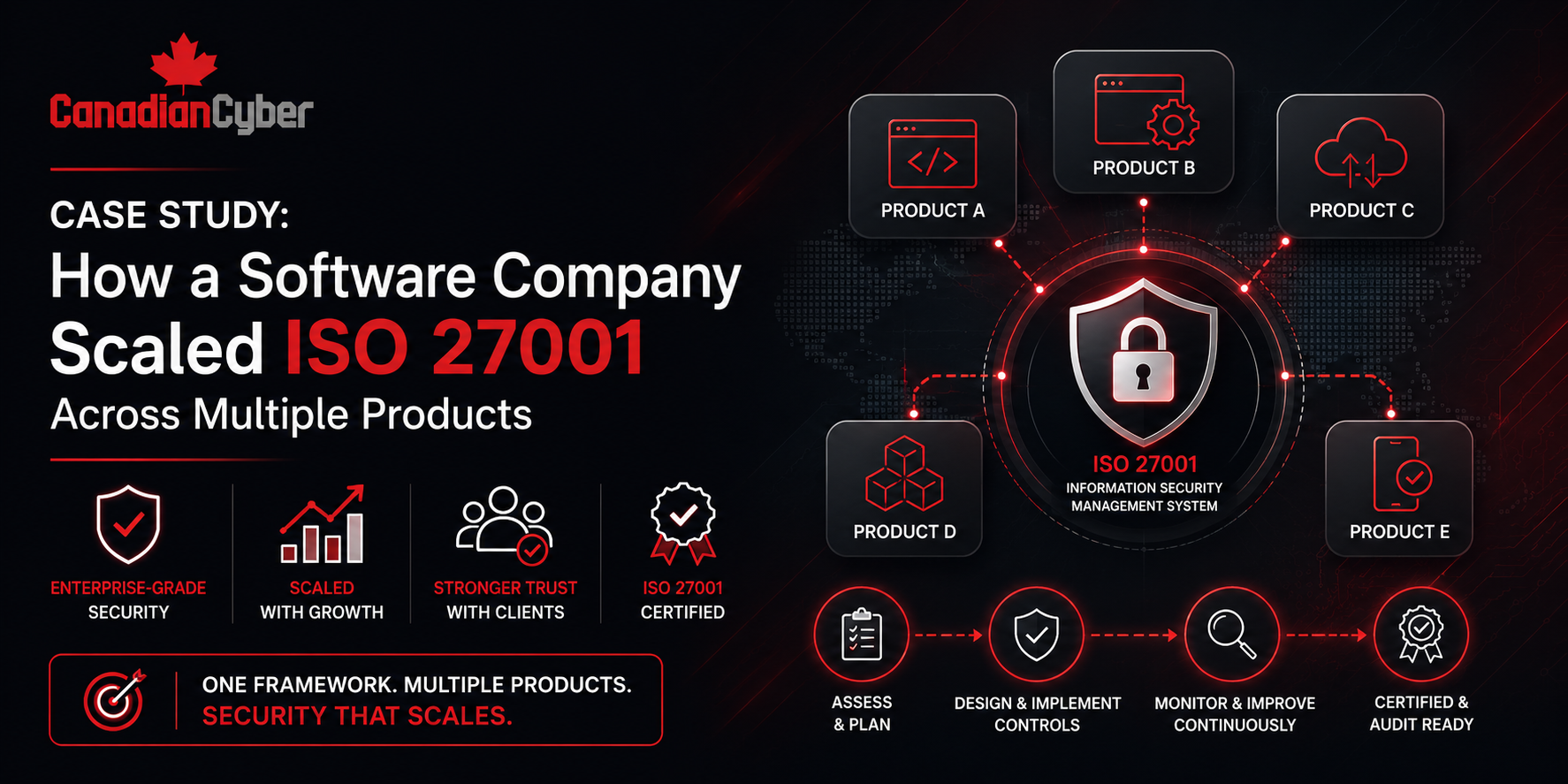
Case Study: How a Software Company Scaled ISO 27001 Across Multiple Products
Scaling ISO 27001 across one product is hard. Scaling it across several products is harder. This case study shows how one software company moved from a product-led ISMS to a repeatable security management system.
Quick Snapshot
| Case Study Area | What Changed |
|---|---|
| Business Context | A software company had several SaaS products and shared engineering teams. |
| Main Challenge | ISO 27001 evidence was built around one product, but the business needed wider scope. |
| Biggest Risk | Each product had different access, vendor, logging, release, and evidence practices. |
| Solution | Create one central ISMS with product-specific ownership and evidence packs. |
| Key Outcome | ISO 27001 became scalable instead of being rebuilt for every new product. |
Introduction
Let’s tell this like a story.
A software company finally achieved ISO 27001 readiness for its first product.
The team was proud. The scope was clear. The policies were approved. The risk register was active. The access reviews were done. The evidence pack looked clean.
Then leadership asked one simple question:
“Can we add our other products into the same ISO 27001 program?”
That is when the real challenge started.
The company had multiple SaaS products, shared cloud infrastructure, different product teams, and different customer data flows.
The first ISO 27001 project worked. But it was not yet scalable.
Need to Scale ISO 27001 Across Multiple Products?
Canadian Cyber helps SaaS and software companies scale ISO 27001 with product evidence packs, risk registers, SharePoint ISMS workspaces, access reviews, and audit-ready governance.
Meet the Software Company
Let’s call the company CloudWorks Software.
CloudWorks started with one SaaS product for workflow automation. Over time, it launched more products.
- a client portal product
- a reporting and analytics product
- an enterprise automation platform
Each product had its own team, tools, backlog, integrations, and customer requests.
At first, ISO 27001 only covered the original product. That made sense because it handled the most customer data.
But as CloudWorks grew, larger customers started asking harder questions:
- Does ISO 27001 cover all products?
- Are all products using the same access controls?
- Are vendors reviewed consistently?
- Are product risks tracked in one risk register?
- Are engineering teams following the same change process?
- Are logs reviewed for every product?
CloudWorks realized it needed one scalable ISMS, not a new compliance project for every product.
The Starting Problem
The company had a working ISMS.
But the ISMS was built around one product. That created problems when the company tried to scale.
| Area | What Was Happening |
|---|---|
| Scope | Only one product was clearly included. |
| Risk Register | Product risks were not tracked consistently. |
| Access Reviews | Some teams reviewed access. Others did not. |
| Change Management | Engineering teams used different approval habits. |
| Vendors | Product teams added vendors without one central review process. |
| Evidence | Evidence was stored by team, not by control area. |
The issue was not poor security. The issue was inconsistency. And inconsistency is what makes ISO 27001 hard to scale.
The Turning Point
The leadership team had a choice.
They could create a separate ISMS for each product. Or they could build one central ISMS that supported all products.
Separate ISMS programs would create more work, more audits, more evidence folders, and more confusion.
So the company chose a better path.
CloudWorks built one central ISO 27001 ISMS with product-specific evidence and ownership.
| Layer | Purpose |
|---|---|
| Central ISMS | Policies, risk method, audit, management review, and governance. |
| Shared Controls | Identity, HR, vendor management, incident response, training, and backups. |
| Product Controls | Product access, logging, data flows, cloud resources, and release evidence. |
| Product Evidence Packs | Evidence organized by product and control area. |
| Leadership Reporting | One view of risks, gaps, and audit readiness across products. |
Workstream 1: Expand Scope Without Losing Control
The first step was scope.
CloudWorks did not add every product overnight. Instead, it created a phased scope expansion plan.
| Scope Question | Why It Mattered |
|---|---|
| Which products handle customer data? | This helped set priority. |
| Which products share infrastructure? | This identified shared controls. |
| Which teams support each product? | This assigned ownership. |
| Which vendors support each product? | This clarified supplier risk. |
| Which gaps must be fixed first? | This created the roadmap. |
Lesson: Scope is not just a line in a document. It is a business decision.
Workstream 2: Build One Risk Register With Product Tags
The old risk register worked for one product.
But it was not enough for several products.
CloudWorks created one central risk register with product tags. This gave leadership one risk view with product-level detail.
| Field | Purpose |
|---|---|
| Product | Shows which product the risk affects. |
| Asset or Process | Links the risk to a system, vendor, workflow, or data flow. |
| Risk Owner | Assigns accountability. |
| Treatment Action | Shows what will be done. |
| Evidence Link | Connects the risk to proof of treatment. |
Example Product Risks
| Product | Risk | Treatment |
|---|---|---|
| Client Portal | External sharing exposes client files. | Review permissions and restrict anonymous links. |
| Analytics Product | Reports include more data than needed. | Review data minimization and retention. |
| Automation Platform | API token misuse affects integrations. | Add token review and logging. |
Need a Product-Tagged ISO 27001 Risk Register?
Canadian Cyber helps software teams build practical risk registers that support multiple products, shared services, owners, treatment actions, and audit evidence links.
Workstream 3: Standardize Access Reviews
Access control became one of the biggest scaling issues.
Each product had different systems, admin roles, support tools, repositories, cloud resources, and customer data paths.
CloudWorks created one access review standard for every product.
| Access Area | What Had to Be Reviewed |
|---|---|
| Production Access | Users with production system access. |
| Cloud Admin Roles | Privileged cloud users and admins. |
| Source Code Access | GitHub or GitLab permissions. |
| Support Tools | Users who could view or support customer records. |
| Service Accounts | Non-human accounts and break-glass accounts. |
Access Review Evidence
| Evidence | What It Proved |
|---|---|
| User export | Who had access. |
| Reviewer sign-off | Access was reviewed. |
| Removed user list | Unneeded access was removed. |
| Exception register | Access exceptions were approved and tracked. |
Lesson: Every product does not need to work the same way. But every product needs to meet the same access control expectation.
Workstream 4: Build Product Evidence Packs
Before the project, evidence was scattered.
Some evidence lived in Jira. Some lived in GitHub. Some lived in SharePoint. Some lived in cloud consoles. Some lived in emails.
That did not scale. So CloudWorks created product evidence packs.
| Evidence Area | Product Evidence Examples |
|---|---|
| Access Control | Access review, admin role export, and exceptions. |
| Change Management | Pull request samples and deployment approvals. |
| Logging and Monitoring | Log source list, alert samples, and review record. |
| Vendor Management | Product vendors and review decisions. |
| Data Protection | Data flow, encryption settings, and retention notes. |
Evidence Naming Examples
- AccessControl-ClientPortal-AccessReview-2026-Q1.pdf
- ChangeManagement-AnalyticsProduct-PRSample-2026-Q1.pdf
- LoggingMonitoring-AutomationPlatform-AlertReview-2026-04.pdf
- BackupRecovery-WorkflowProduct-RestoreTest-2026-Q2.pdf
Need Product Evidence Packs for ISO 27001?
Canadian Cyber helps SaaS teams organize audit evidence by product, control area, owner, period, risk, and corrective action.
Workstream 5: Standardize Change Management Across Teams
Engineering teams had different workflows.
One team used GitHub issues. Another used Jira. Another used pull request approvals. Another had emergency fixes with limited documentation.
The goal was not to force every team into the same tool. The goal was to define one control standard.
| Change Management Requirement | Evidence Source |
|---|---|
| Clear change record | Jira, GitHub issue, or ticket. |
| Review before merge | Pull request approval. |
| Testing or validation | CI/CD pipeline or QA record. |
| Deployment record | CI/CD system. |
| Emergency change note | Ticket or incident record. |
Lesson: Standardize the control expectation, not every team’s working style.
Workstream 6: Create One Vendor Review Process
Each product team used different vendors.
One product used an analytics tool. Another used a customer messaging platform. Another added an AI feature vendor.
Before the change, vendor reviews were inconsistent. After the change, every vendor had to follow one review process.
| Vendor Review Field | Why It Matters |
|---|---|
| Product Supported | Shows which product depends on the vendor. |
| Data Handled | Shows privacy and security risk. |
| Criticality | Prioritizes review depth. |
| Assurance Evidence | SOC 2, ISO certificate, or security questionnaire. |
| Approval Decision | Shows whether risk was accepted or action was needed. |
A multi-product ISO 27001 program needs one vendor register. But that register should show which product each vendor supports.
Workstream 7: Create One Management Review View
Before scaling, management review focused mostly on the first product.
That was no longer enough.
Leadership needed one view of ISO 27001 readiness across the company.
| Dashboard Area | What Leadership Saw |
|---|---|
| Product Readiness | Which products were ready, partial, or blocked. |
| Top Risks | Highest risks across all products. |
| Access Reviews | Status by product and system. |
| Evidence Gaps | Missing or overdue evidence. |
| Resource Needs | Where teams needed support. |
Lesson: Scaling ISO 27001 requires leadership visibility. Without it, the compliance lead becomes the only person holding the system together.
Workstream 8: Use SharePoint as the ISMS Hub
CloudWorks needed a central workspace.
The team used SharePoint as the ISMS hub. This helped keep policies, risks, evidence, audits, and corrective actions connected.
| SharePoint ISMS Area | Purpose |
|---|---|
| ISMS Home Page | Dashboard and quick links. |
| Policy Library | Approved policies and review dates. |
| Risk Register | Central risk list with product tags. |
| Evidence Vault | Control evidence by product and period. |
| Vendor Register | Vendor reviews and approvals. |
| CAPA Register | Corrective actions and closure evidence. |
Build a SharePoint ISMS That Scales
Canadian Cyber helps software companies build SharePoint ISMS workspaces that scale across products, teams, risks, controls, evidence, audits, and corrective actions.
The Results
After the scaling project, CloudWorks had a stronger ISO 27001 operating model.
The ISMS was no longer tied to one product. It could support growth.
| Before | After |
|---|---|
| ISO 27001 built around one product. | ISMS scaled across multiple products. |
| Product risks tracked inconsistently. | Central risk register with product tags. |
| Access reviews varied by team. | Standard access review cadence. |
| Evidence was scattered. | Product evidence packs. |
| Management review was limited. | Leadership dashboard across products. |
Business Impact
- The company could answer buyer questions faster.
- It could show which products were in scope.
- It could explain shared controls clearly.
- It could prove product-specific controls.
- It could onboard new products into the ISMS without starting over.
Most importantly, ISO 27001 became scalable.
Key Lessons for Software Companies
| Lesson | What It Means |
|---|---|
| Do not rebuild ISO 27001 for every product. | Build one ISMS with product-specific evidence. |
| Use product tags in the risk register. | Keep the risk model central but detailed. |
| Standardize control expectations. | Teams can use different tools, but the control standard should be consistent. |
| Build product evidence packs. | Auditors and buyers need product-level proof. |
| Keep leadership involved. | Scaling ISO 27001 needs decisions, not just documentation. |
Common Mistakes to Avoid
- Mistake 1: Expanding scope too fast. Add products in phases. Do not create a scope you cannot evidence.
- Mistake 2: Treating all products the same. Some products handle more sensitive data. Prioritize by risk.
- Mistake 3: Letting each team invent its own process. Flexibility is fine. Inconsistency is not.
- Mistake 4: Forgetting shared controls. Identity, HR, training, vendors, and incident response may support all products.
- Mistake 5: Not separating product evidence. Shared controls help, but product-specific evidence is still needed.
- Mistake 6: Leaving management review too high-level. Leadership should see readiness by product.
What Good Looks Like
A software company has scaled ISO 27001 well when it can show:
- clear multi-product scope
- central ISMS governance
- product-specific risk views
- standard access review process
- shared vendor register
- product evidence packs
- consistent change management expectations
- internal audit tracker
- corrective action register
- management review dashboard
The ISMS should not slow product teams down. It should give them a repeatable way to prove security.
Canadian Cyber’s Take
At Canadian Cyber, we often see software companies succeed with ISO 27001 for one product, then struggle when the business grows.
The first implementation is usually manageable. The second and third products expose the weaknesses.
Evidence becomes inconsistent. Risk registers become fragmented. Vendors multiply. Access reviews get missed. Internal audit becomes harder. Leadership loses visibility.
The answer is not to create a separate ISMS for every product.
The answer is to build a scalable ISMS model with shared controls where possible and product-specific evidence where needed.
One governance structure. Clear ownership. Clean dashboards. Repeatable workflows. That is how ISO 27001 grows with the business.
Takeaway
Scaling ISO 27001 across multiple products is possible.
But it requires structure.
Start with scope. Then tag risks by product. Standardize access reviews. Build product evidence packs. Create one vendor register. Align change management. Use one ISMS hub. Give leadership a multi-product dashboard.
The goal is not to make every product identical. The goal is to make security governance consistent and evidence easy to prove.
How Canadian Cyber Can Help
Canadian Cyber helps software companies scale ISO 27001 across multiple products, teams, risks, controls, and evidence streams.
- multi-product ISO 27001 scope design
- ISMS scaling roadmaps
- risk register setup with product tagging
- SharePoint ISMS workspace setup
- product evidence pack design
- access review workflows
- vendor register design
- internal audit preparation
- management review dashboards
- vCISO support for software companies
Stay Connected With Canadian Cyber
Follow Canadian Cyber for practical guidance on ISO 27001, SaaS security, SharePoint ISMS, audit readiness, evidence management, vendor risk, and vCISO support.