ISO 27001 • Law Firms • Professional Services • Client Trust
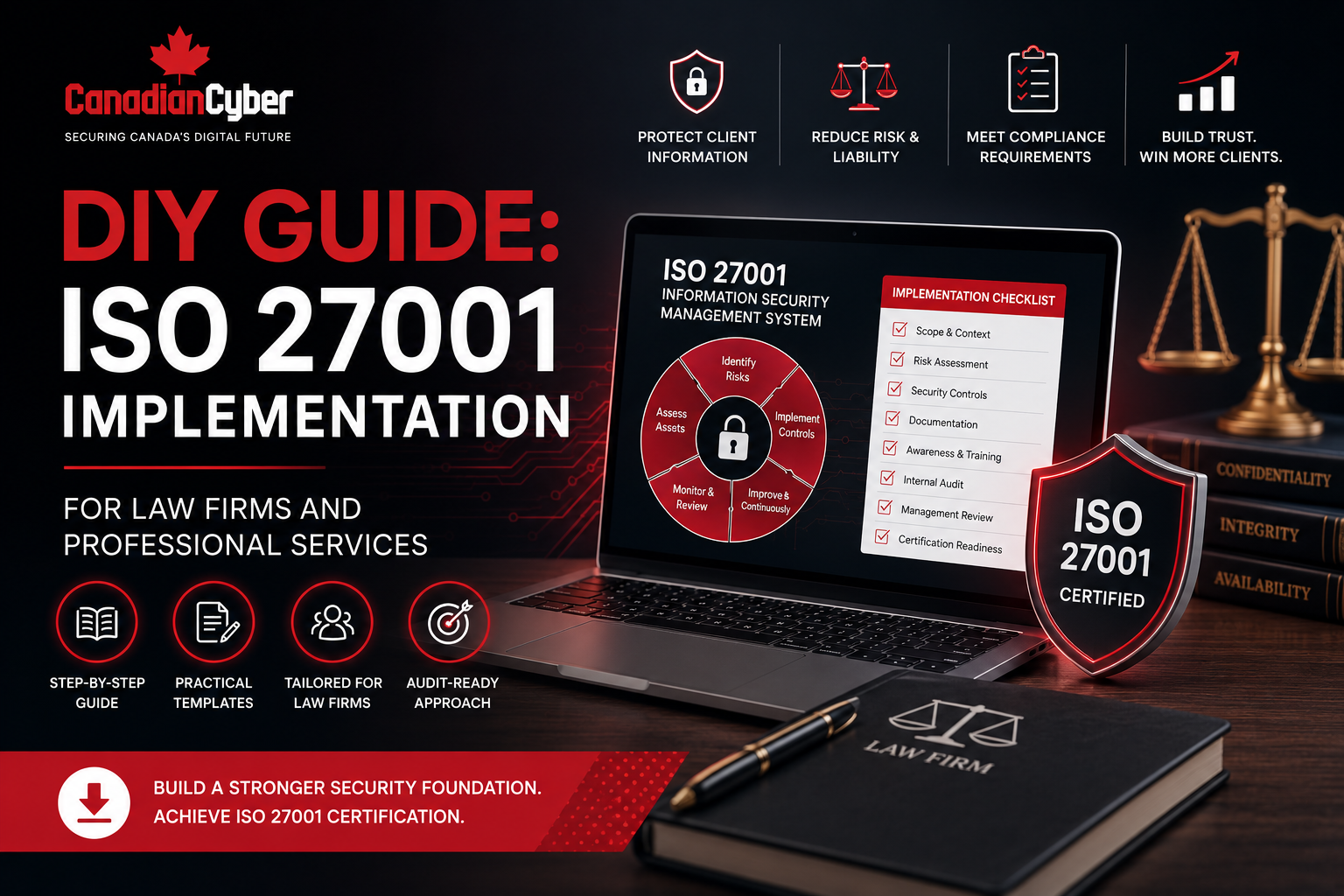
DIY Guide: ISO 27001 Implementation for Law Firms and Professional Services
Law firms and professional services firms handle highly sensitive client information. ISO 27001 helps prove that confidential files, contracts, financial records, privileged advice, and client data are protected by a real security management system.
Quick Snapshot
| Implementation Area | What Firms Need to Do |
|---|---|
| Scope | Define which offices, teams, systems, client files, and services are covered. |
| Client Data Protection | Map where confidential client information is stored, shared, accessed, and archived. |
| Access Control | Review Microsoft 365, SharePoint, case management tools, client portals, and admin accounts. |
| Vendor Risk | Review cloud providers, IT providers, legal software, payroll, e-signature, and document tools. |
| Outcome | A practical ISO 27001 program that helps win client trust and pass security reviews. |
Introduction
Law firms and professional services firms are being asked harder security questions.
- Clients want proof that confidential information is protected.
- Enterprise buyers want security questionnaires answered.
- Insurers want stronger cyber controls.
- Regulators expect better governance.
- Partners want less risk.
- Auditors want evidence.
For many firms, the pressure is growing faster than the security program.
You may already have Microsoft 365, MFA, endpoint protection, backups, policies, managed IT support, and a few security tools.
But ISO 27001 asks a bigger question:
Can you prove that information security is managed, reviewed, improved, and supported by evidence?
That is where many firms struggle.
They have security activity. They do not always have a working ISMS.
An ISMS, or Information Security Management System, is the operating structure behind ISO 27001. It connects risk, policies, controls, evidence, internal audits, management review, and continual improvement.
Why ISO 27001 Matters for Law Firms and Professional Services
Law firms and advisory firms are built on trust.
Clients share information they would not share with most vendors. That may include:
- legal strategy
- merger and acquisition documents
- contracts and litigation files
- employment records
- financial statements and tax records
- intellectual property
- client identity documents
- privileged communication and commercially sensitive advice
If that information is exposed, the damage can affect client trust, legal privilege, reputation, regulatory duties, insurance, and revenue.
| Pressure | What It Means |
|---|---|
| Client Security Questionnaires | Larger clients ask for proof of controls before signing. |
| Cyber Insurance | Insurers ask about MFA, backups, EDR, incidents, and vendors. |
| Remote Work | Staff access client data from more locations and devices. |
| Microsoft 365 Risk | Email, SharePoint, Teams, and OneDrive hold sensitive files. |
| Ransomware | Firms are high-value targets because client data is sensitive. |
ISO 27001 helps turn security pressure into a structured, governed, evidence-backed program.
ISO 27001 Is Not Just Compliance
Many firms think ISO 27001 is only about certification.
That is too narrow.
ISO 27001 can support:
- client acquisition
- enterprise RFPs
- security questionnaires
- cyber insurance renewal
- partner confidence
- vendor due diligence
- incident readiness
- firm reputation
| Client Concern | ISO 27001 Helps You Show |
|---|---|
| Can we trust you with confidential files? | Client data is protected through defined controls. |
| Who can access our documents? | Access is approved, limited, and reviewed. |
| What happens if there is an incident? | Incident response is planned and tested. |
| Are your vendors secure? | Critical vendors are reviewed and tracked. |
| Can you prove your controls? | Evidence is organized and audit-ready. |
Turn ISO 27001 Readiness Into a Client Trust Advantage
If your firm is losing deals or delaying client onboarding because security questions take too long to answer, ISO 27001 readiness can become a business development advantage.
Book a 30-Minute ISO 27001 Readiness Call
Explore Canadian Cyber Services
Step 1: Define the Right ISO 27001 Scope
Scope is the first major decision.
For law firms and professional services firms, scope should be practical. Do not include everything just because it exists.
Start with the systems and teams that handle client confidential information.
| System / Process | Why It Matters |
|---|---|
| Microsoft 365 | Email, Teams, SharePoint, OneDrive, and identity. |
| Document Management System | Client files and work product. |
| Client Portal | Secure document exchange. |
| Managed IT Provider | Access to systems and support operations. |
| Backup Platform | Recovery of client and firm data. |
Scope Statement Example
“The ISMS covers the people, processes, systems, and third-party services used to deliver legal and professional services to clients, including Microsoft 365, SharePoint, client document repositories, matter management tools, endpoint devices, managed IT support, backup systems, and the supporting governance processes for client confidential information.”
Scope mistake to avoid: Do not forget SharePoint, Teams, outsourced IT, backups, archives, or remote access.
Step 2: Map Client Confidential Information
Before writing policies, map the data.
Client files may appear in:
- SharePoint and Teams
- OneDrive
- document management systems
- case systems and client portals
- billing tools
- e-signature tools
- backups, archives, and mobile devices
| Data Location | What to Check |
|---|---|
| Client files, attachments, and privileged communication. | |
| SharePoint | Client folders, matter sites, and evidence libraries. |
| Teams | Chats, shared files, and meeting recordings. |
| Client Portal | Uploads, downloads, permissions, and access logs. |
| Backup Platform | Backup coverage, encryption, and restore testing. |
You cannot protect what you have not mapped.
Step 3: Build a Simple Risk Register
ISO 27001 is risk-based.
Your risk register does not need to be complicated. It does need to be real.
| Law Firm Risk Example | Why It Matters |
|---|---|
| Former staff retain access to client files. | Client confidentiality risk. |
| SharePoint client folders are overshared. | Unauthorized access to sensitive matter data. |
| Managed IT provider access is not reviewed. | Third-party access risk. |
| Backup restore is untested. | Ransomware recovery may fail. |
| Staff use personal email or unmanaged storage. | Data leakage risk. |
Risk Register Fields
| Field | Purpose |
|---|---|
| Risk ID | Tracks the risk. |
| Risk Description | Explains what could go wrong. |
| Asset / Process | Links risk to client data or firm systems. |
| Owner | Assigns accountability. |
| Evidence Link | Proves treatment happened. |
A good risk register should help partners make decisions. It should not be a spreadsheet nobody reads.
Step 4: Create the Core Policy Set
Policies are required, but they should not be generic.
They should match how your firm actually works.
| Policy / Procedure | Why It Matters |
|---|---|
| Information Security Policy | Sets firm-wide security direction. |
| Access Control Policy | Defines MFA, permissions, access reviews, and offboarding. |
| Client Data Handling Policy | Explains how confidential client data is stored and shared. |
| Supplier Security Policy | Defines vendor review requirements. |
| Incident Response Plan | Explains how security events are handled. |
| Backup and Recovery Procedure | Defines backup coverage and restore testing. |
Need a Lean ISO 27001 Policy Pack?
Canadian Cyber can help your firm build a lean ISO 27001 policy pack that matches real operations, not generic templates.
Step 5: Review Microsoft 365 and SharePoint Access
For many firms, Microsoft 365 is the core risk area.
It holds email, files, Teams chats, calendars, client documents, and identity controls.
| Microsoft 365 Audit Question | Evidence Needed |
|---|---|
| Is MFA enforced for all users? | MFA report. |
| Are admin roles limited? | Entra ID role export. |
| Are SharePoint client folders reviewed? | Site permission review. |
| Are former staff removed quickly? | Offboarding tickets. |
| Are audit logs retained? | Audit log settings. |
SharePoint Access Review Checklist
- client matter sites
- HR folders
- finance folders
- partner-only folders
- audit evidence libraries
- external guest access
- anonymous links
- old staff accounts
If your firm stores client files in SharePoint, SharePoint permissions are a core ISO 27001 control.
Organize ISO 27001 Evidence in SharePoint
Canadian Cyber’s ISMS SharePoint solution helps firms manage policies, risks, evidence, audits, access reviews, and management review records in one structured workspace.
Explore the ISMS SharePoint Solution
Request a SharePoint ISMS Review
Step 6: Formalize Vendor Risk Management
Professional services firms depend on vendors.
Your vendors may include:
- managed IT provider
- cloud provider
- legal practice management system
- document management tool
- e-signature platform
- payroll or HR platform
- backup provider
- AI transcription or document tools
| Vendor Review Question | Evidence |
|---|---|
| Does the vendor process client data? | Vendor register. |
| Is the vendor critical? | Criticality rating. |
| Has assurance been reviewed? | SOC 2, ISO certificate, or questionnaire. |
| Was the vendor approved? | Approval decision. |
| When is the next review? | Review date. |
Vendor risk is not just collecting SOC 2 reports. It is making and recording a decision.
Step 7: Build Evidence Packs Early
Do not wait until audit month.
Evidence should be collected as controls operate.
| Evidence Pack | What to Include |
|---|---|
| Access Control | MFA report, access reviews, and offboarding samples. |
| Policy Review | Approved policies, review dates, and version history. |
| Vendor Management | Vendor register, reviews, and approval decisions. |
| Incident Response | Incident plan, tabletop record, and incident log. |
| Management Review | Minutes, decisions, and action items. |
Evidence Naming Examples
- AccessControl-SharePoint-ClientFolderReview-2026-Q1.pdf
- VendorManagement-ManagedITProvider-Review-2026-Q1.pdf
- IncidentResponse-TabletopRecord-2026-Q2.docx
- BackupRecovery-FileServer-RestoreTest-2026-03.pdf
If the control happened, save the proof that week.
Step 8: Test Incident Response
Law firms and professional services firms need an incident plan.
But a plan is not enough.
Test it.
| Tabletop Scenario | Why It Matters |
|---|---|
| Partner mailbox compromised. | High client communication risk. |
| Client file sent to wrong recipient. | Confidentiality and notification issue. |
| Ransomware affects document access. | Business continuity and recovery. |
| Vendor breach affects client portal. | Third-party incident coordination. |
| Suspicious SharePoint download activity. | Insider or compromised account risk. |
Step 9: Complete Internal Audit and Management Review
Before certification, you need internal audit and management review.
These are not just formalities. They prove that your ISMS is being checked and improved.
| Internal Audit Should Test | Management Review Should Cover |
|---|---|
| Scope | Top risks |
| Policies | Audit findings |
| Risk register | Incidents and vendor issues |
| Access reviews | Training and policy status |
| Evidence quality | Corrective actions and resource needs |
Management review should show decisions, not just discussion.
90-Day ISO 27001 Starter Plan for Law Firms
Use this as your first implementation sprint.
| Timeline | Focus | Outputs |
|---|---|---|
| Days 1–30 | Foundation | Scope statement, ISMS owner, client data map, system inventory, initial risk register, policy drafts, evidence workspace. |
| Days 31–60 | Control Operation | Microsoft 365 review, SharePoint permission review, vendor register, policy approvals, backup evidence, restore test, training report. |
| Days 61–90 | Audit Readiness | Incident tabletop, updated risk register, corrective action evidence, internal audit checklist, management review minutes, certification roadmap. |
Free Download: ISO 27001 Law Firm Readiness Checklist
Use this practical checklist to review your firm’s ISO 27001 scope, client data protection, Microsoft 365 access, SharePoint permissions, vendor risk, incident response, evidence packs, and audit readiness.
Download the ISO 27001 Law Firm Checklist
Common Mistakes to Avoid
- Mistake 1: Starting with templates instead of scope. Templates help, but scope drives the ISMS.
- Mistake 2: Ignoring SharePoint permissions. If client files live in SharePoint, permissions need review.
- Mistake 3: Leaving vendors informal. Managed IT, cloud tools, legal software, and client portals need risk review.
- Mistake 4: Treating policies as the whole project. Policies are only one part of ISO 27001. Evidence matters.
- Mistake 5: Forgetting partners and leadership. ISO 27001 needs management commitment and decisions.
- Mistake 6: Not testing incident response. A plan without a tabletop is weak evidence.
- Mistake 7: Waiting too long to collect evidence. Evidence should be built during the year, not before the audit.
What Good Looks Like
A law firm or professional services firm is ISO 27001-ready when it can show:
- clear ISMS scope
- client data map
- risk register
- approved policies
- Microsoft 365 access reviews
- SharePoint permission reviews
- vendor register
- incident response plan
- tabletop record
- backup restore evidence
- staff training
- internal audit findings
- management review minutes and corrective actions
The firm does not need to look like a large bank. It needs to show that client information is protected by a managed, reviewed, and evidence-backed system.
Canadian Cyber’s Take
At Canadian Cyber, we often see law firms and professional services firms with strong client service and weak security evidence.
The firm cares about confidentiality. The team protects client relationships. The partners understand trust. The IT provider keeps systems running.
But when a client asks for proof, the evidence is scattered.
ISO 27001 helps solve that.
It gives the firm a structured way to manage information security, assign ownership, review risks, protect client data, test incidents, govern vendors, and show evidence.
For firms that want to win larger clients, pass security reviews, and reduce cyber risk, ISO 27001 is more than a certificate. It is a trust system.
Takeaway
Law firms and professional services firms are high-trust businesses.
That trust now needs evidence.
ISO 27001 helps firms show that client confidential information is protected through a structured ISMS.
Start with the practical steps:
- define scope
- map client data
- build the risk register
- review Microsoft 365 and SharePoint access
- formalize vendors
- approve policies
- test incident response
- collect evidence early
- run internal audit and management review
The goal is not paperwork. The goal is client trust, audit readiness, and stronger security governance.
How Canadian Cyber Can Help
Canadian Cyber helps law firms and professional services firms implement ISO 27001 in a practical, evidence-focused way.
- ISO 27001 readiness assessments
- law firm ISO 27001 implementation planning
- ISMS scope definition
- client data mapping
- risk register setup
- policy pack development
- Microsoft 365 and Entra ID reviews
- SharePoint permission reviews
- vendor risk reviews
- incident response tabletop exercises
- internal audit preparation
- management review preparation
- SharePoint ISMS workspace setup
- vCISO support for professional services firms
Stay Connected With Canadian Cyber
Follow Canadian Cyber for practical guidance on ISO 27001, law firm cybersecurity, SharePoint ISMS, audit readiness, vendor risk, client trust, and vCISO support.