Internal Audit • SaaS Security • ISO 27001 • SOC 2 • Risk Reduction
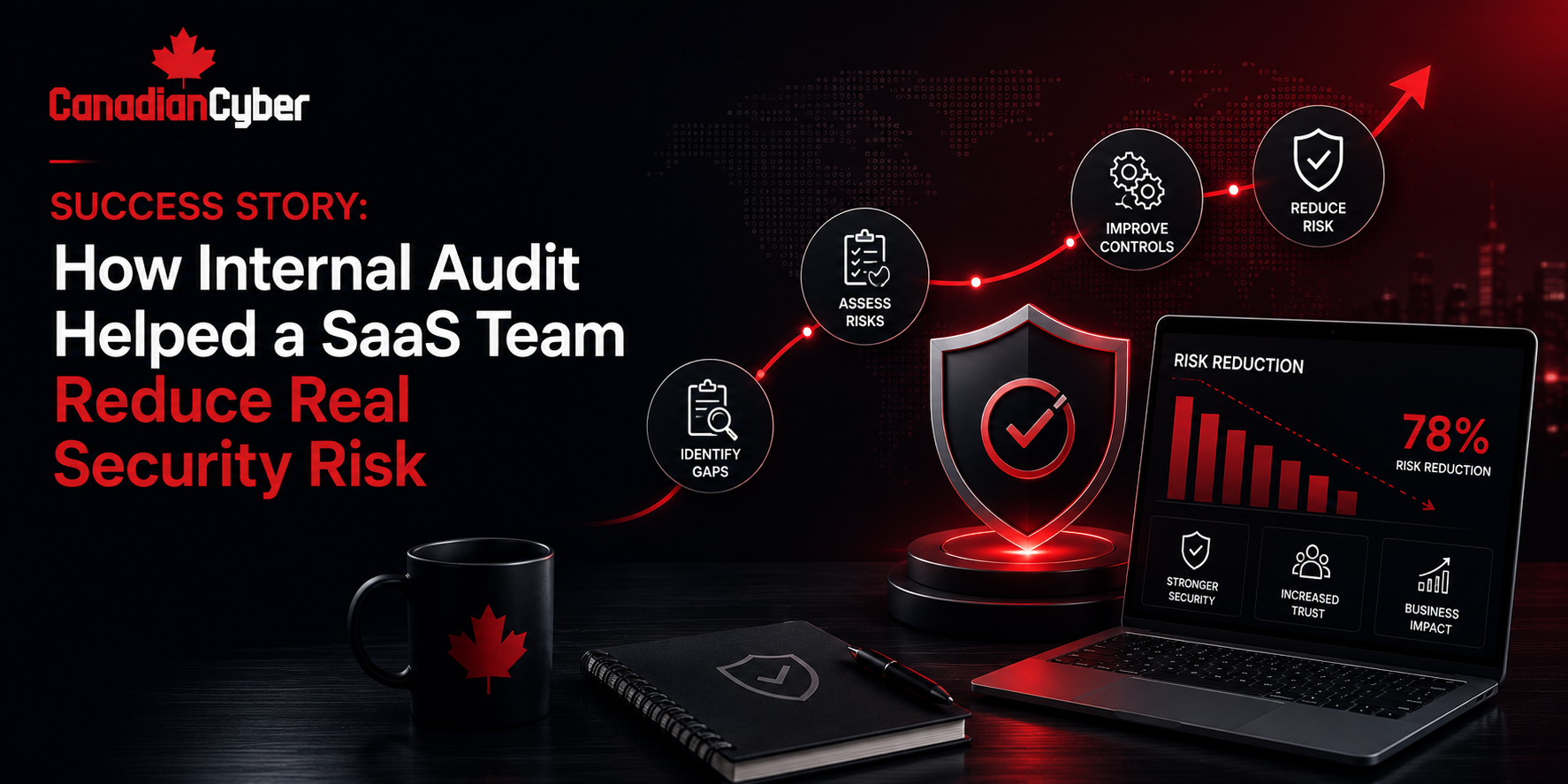
Success Story: How Internal Audit Helped a SaaS Team Reduce Real Security Risk
Internal audit should not feel like a paperwork exercise. When done well, it helps SaaS teams find real weaknesses, fix risky gaps, and prove that controls work before customers, auditors, or incidents expose the problem.
Quick Snapshot
| Success Area | What Improved |
|---|---|
| Business Context | A growing SaaS company was preparing for SOC 2 and ISO 27001 readiness. |
| Main Challenge | Security controls existed, but evidence, ownership, and follow-through were inconsistent. |
| Internal Audit Focus | Access, vendors, cloud security, incident response, backups, logging, and corrective actions. |
| Key Outcome | The team reduced real security risk instead of only collecting audit evidence. |
| Main Lesson | Internal audit is most valuable when it leads to action, not just findings. |
Introduction
Many SaaS teams hear “internal audit” and think of more screenshots, more evidence requests, more meetings, and more stress before the external audit.
But internal audit can be much more useful than that.
For a SaaS company, a strong internal audit can reveal real security risks before they become customer issues, audit findings, or incidents.
It can show:
- where access is too broad
- where vendor reviews are missing
- where cloud logs are not reviewed
- where backups are assumed but not tested
- where incident response is not ready in practice
- where policies say one thing and teams do another
This success story shows how one SaaS team used internal audit to reduce real security risk, strengthen evidence, and prepare for SOC 2 and ISO 27001 without turning compliance into a separate nightmare.
Want Internal Audit to Reduce Risk, Not Just Create Findings?
Canadian Cyber helps SaaS teams run practical internal audits that test real controls, identify business risk, track corrective actions, and prepare for ISO 27001, SOC 2, and customer security reviews.
Meet the SaaS Team
Let’s call the company TaskFlow Cloud.
TaskFlow Cloud is a growing B2B SaaS company. It helps customers manage workflows, approvals, documents, and team collaboration.
The company stores and processes:
- customer account data
- workflow records
- uploaded documents
- approval history
- user activity logs
- support tickets
- API integration data
The company was preparing for larger enterprise customers. That meant more security questions.
Prospects wanted to know:
- Do you have SOC 2?
- Are you ISO 27001-ready?
- Who can access customer data?
- How do you review vendors?
- Do you test incident response?
- Are backups tested?
- Can you prove your controls operate over time?
Leadership asked the right question: “Are we actually reducing risk, or are we just preparing for an audit?”
The Starting Point
TaskFlow was not starting from zero.
The team already had several important controls in place.
| Area | Existing Control |
|---|---|
| Identity | MFA enabled for most staff. |
| Development | Pull requests used before production changes. |
| Cloud | Production hosted in a major cloud provider. |
| Backups | Automated backups configured. |
| Incidents | Incident response plan drafted. |
| Policies | Core policies created for SOC 2 readiness. |
On paper, this looked strong.
But internal audit tested a different question: can the company prove these controls are operating, owned, reviewed, and improving?
What the Internal Audit Found
The audit found several issues that were not just documentation gaps.
They were real risk indicators.
| Finding | Real Risk |
|---|---|
| Some privileged roles had not been reviewed recently. | Excessive access to production systems. |
| Vendor reviews were inconsistent. | Third-party risk was not fully understood. |
| Restore testing was not documented. | Recovery capability was assumed, not proven. |
| Incident response was untested. | The team might respond slowly during a real event. |
| Logging existed, but review evidence was weak. | Suspicious activity could be missed. |
The internal audit did not stop at finding problems. It helped the team fix them.
Workstream 1: Reducing Access Risk
Access control became the first priority.
Why? Because SaaS access risk can become customer data risk quickly.
TaskFlow reviewed access across:
- identity provider
- Microsoft 365
- cloud console
- source code repositories
- CI/CD tools
- production database
- support platform
| Access Audit Question | Evidence Requested |
|---|---|
| Who has privileged access? | Admin role export. |
| Is MFA enforced? | MFA report. |
| Are former users removed? | Offboarding samples. |
| Are service accounts owned? | Service account register. |
| Is support access logged? | Support access log sample. |
What Changed
- The team removed unnecessary admin access.
- It created a quarterly access review process.
- It assigned system owners.
- It created a service account register.
- It documented access exceptions.
- It improved offboarding evidence.
Lesson: Internal audit reduced risk because it asked, “Who still has access, and is it still needed?”
Can You Prove Access Is Still Appropriate?
Canadian Cyber helps SaaS teams review privileged access, production roles, service accounts, offboarding evidence, and access review workflows.
Workstream 2: Fixing Vendor Risk Before Customers Asked
Vendor risk was the next major area.
TaskFlow knew its vendors, but the reviews were informal. That was a problem.
Enterprise buyers often ask for sub-processors, vendor assurance, and third-party risk management.
| Vendor Audit Question | Evidence Requested |
|---|---|
| Which vendors process customer data? | Vendor register. |
| Which vendors are critical? | Criticality rating. |
| Has assurance been reviewed? | SOC 2 or ISO review notes. |
| Was the vendor approved? | Approval decision. |
| When is the next review? | Review date. |
What Changed
- The team built a vendor register.
- It tiered vendors by risk.
- It reviewed critical vendors first.
- It documented approval decisions.
- It added next review dates.
- It created a sub-processor list for buyers.
Need Help Turning Vendor Lists Into Audit-Ready Evidence?
Canadian Cyber helps SaaS teams build vendor registers, risk ratings, assurance reviews, approval decisions, and sub-processor evidence for SOC 2 and ISO 27001 readiness.
Workstream 3: Proving Backup and Recovery
Backups were configured.
But the audit asked a harder question: can we restore what matters?
That changed the conversation. A backup job report is useful. A successful restore test is stronger.
| Backup Audit Question | Evidence Requested |
|---|---|
| Which systems are backed up? | Backup coverage report. |
| Are backups encrypted? | Encryption setting. |
| Who can access backups? | Backup admin review. |
| Has restore testing been completed? | Restore test record. |
| Were issues found and fixed? | Corrective action evidence. |
Lesson: Internal audit helped the team move from “backups exist” to “recovery is proven.”
Workstream 4: Turning Incident Response Into a Tested Control
TaskFlow had an incident response plan.
But it had never been tested. That is common, and it is risky.
A plan that has not been tested may fail when people are under pressure.
A support user account is compromised. The attacker views several customer tickets and attempts to access customer documents. The team must investigate, contain the account, review logs, assess customer impact, escalate internally, and decide whether customer notification is required.
The tabletop tested:
- account containment
- log review
- customer impact analysis
- executive escalation
- legal and privacy involvement
- evidence preservation
Need a SaaS Incident Tabletop?
Canadian Cyber can run a SaaS incident tabletop and turn the results into ISO 27001 or SOC 2 evidence with decisions, lessons learned, and corrective actions.
Workstream 5: Improving Logging and Monitoring Evidence
TaskFlow collected logs.
But the audit found weak review evidence. That matters because logs only help if someone can use them.
| Logging Audit Question | Evidence Requested |
|---|---|
| What logs are collected? | Log source inventory. |
| How long are logs retained? | Retention setting. |
| Are high-risk alerts configured? | Alert rule list. |
| Are alerts reviewed? | Ticket samples. |
| Are admin actions monitored? | Admin activity review. |
Lesson: Internal audit turned logging from “we collect it” into “we review and act on it.”
Workstream 6: Linking Policies to Real Controls
TaskFlow had policies.
But some policies were too generic. Others promised controls that were not operating consistently.
The team improved policy governance by:
- assigning policy owners
- updating unrealistic language
- adding review dates
- creating approval records
- linking policies to evidence packs
- creating a policy exception process
Workstream 7: Creating a Corrective Action System
The biggest success was not finding issues.
It was closing them.
TaskFlow created a corrective action register so findings did not disappear after the audit report.
| Finding | Corrective Action |
|---|---|
| GitHub access review missing. | Add GitHub to quarterly access review tracker. |
| Vendor register incomplete. | Review critical vendors and document decisions. |
| Restore test missing. | Run restore test and record result. |
| Incident response untested. | Complete tabletop and track lessons learned. |
Corrective actions turned audit results into security improvements. That is where internal audit created real value.
Results After the Internal Audit
The internal audit changed how TaskFlow operated security.
Before the audit, several controls existed but were not fully proven. After the audit, the team had stronger evidence, clearer ownership, and better risk visibility.
| Before Internal Audit | After Internal Audit |
|---|---|
| Access controls existed but were not fully reviewed. | Quarterly access reviews with evidence. |
| Vendor knowledge was informal. | Vendor register with risk ratings and approvals. |
| Backups were configured. | Restore testing was completed and documented. |
| Incident plan existed. | Tabletop tested the process. |
| Findings were scattered. | Corrective action register tracked closure. |
Business Impact
- The company reduced excessive access.
- It improved vendor oversight.
- It proved recovery capability.
- It tested incident response.
- It strengthened audit evidence.
- It answered customer questions faster.
- It prepared better for SOC 2 and ISO 27001.
Run a Focused SaaS Internal Audit Before the External Audit
Canadian Cyber can help your SaaS team run a focused internal audit that supports SOC 2, ISO 27001, customer security reviews, corrective actions, and risk reduction.
Why This Worked
The internal audit worked because it was practical.
It did not only ask whether documents existed. It tested whether controls operated.
| Success Factor | Why It Helped |
|---|---|
| Risk-based scope | Focused on controls that mattered most. |
| SaaS-specific testing | Reviewed real systems and workflows. |
| Evidence focus | Showed whether controls could be proven. |
| Control owner involvement | Made teams accountable. |
| Corrective action tracking | Turned findings into fixes. |
Practical rule: Internal audit should not be a scavenger hunt. It should be a control improvement exercise.
Internal Audit Areas SaaS Teams Should Prioritize
If your SaaS team is preparing for SOC 2, ISO 27001, or enterprise security reviews, start with high-risk areas.
| Audit Area | Why It Matters |
|---|---|
| Access Control | Direct impact on customer data risk. |
| Offboarding | Common source of lingering access. |
| Vendor Risk | Buyers and auditors ask about sub-processors. |
| Change Management | Shows production changes are controlled. |
| Logging and Monitoring | Supports detection and investigation. |
| Backup and Recovery | Supports availability and resilience. |
Common Mistakes to Avoid
- Mistake 1: Treating internal audit as paperwork. Internal audit should test real controls, not just documents.
- Mistake 2: Waiting until the external audit is close. Run internal audit early enough to fix issues.
- Mistake 3: Not involving control owners. The people who operate controls must be part of the audit.
- Mistake 4: Ignoring evidence quality. A control that happened but cannot be proven will still create audit friction.
- Mistake 5: Creating findings without closing them. Findings only help when actions are tracked and verified.
- Mistake 6: Not reporting to leadership. High-risk findings need management attention and support.
- Mistake 7: Auditing every control with equal depth. Focus deeper testing on high-risk systems and customer data paths.
What Good Looks Like
A strong SaaS internal audit should show:
- who owns each control
- which systems were tested
- what evidence was reviewed
- which gaps create real risk
- which corrective actions are needed
- who owns each action
- when actions are due
- what evidence will close them
- which risks leadership must review
The audit should help the company become safer, not just more documented.
Canadian Cyber’s Take
At Canadian Cyber, we often see SaaS teams treat internal audit as a required step before SOC 2 or ISO 27001.
That is understandable. But it misses the bigger opportunity.
Internal audit is one of the best ways to find real security risk before customers, auditors, or incidents do.
When done well, it shows where the control environment is strong and where it is only assumed.
It turns vague concerns into findings. It turns findings into corrective actions. Then it turns corrective actions into risk reduction and stronger customer trust.
That is how internal audit becomes valuable. Not because it checks a box, but because it helps the business improve.
Takeaway
Internal audit can reduce real security risk for SaaS teams.
But only if it tests how controls actually operate.
Do not stop at policies. Instead:
- review access
- test vendors
- check logging
- verify restore testing
- run tabletop exercises
- sample change approvals
- review offboarding
- track corrective actions
- report risk to leadership
A good internal audit does not just prepare you for SOC 2 or ISO 27001. It makes your SaaS company safer, more trustworthy, and more enterprise-ready.
How Canadian Cyber Can Help
Canadian Cyber helps SaaS companies run practical internal audits that reduce real risk and support audit readiness.
- SaaS internal audits
- SOC 2 readiness reviews
- ISO 27001 internal audits
- access control reviews
- privileged access reviews
- vendor risk reviews
- cloud security evidence reviews
- incident response tabletop exercises
- backup and restore evidence reviews
- logging and monitoring reviews
- policy-to-evidence mapping
- corrective action tracking
- SharePoint evidence workspace setup
- vCISO support for SaaS security governance
Stay Connected With Canadian Cyber
Follow Canadian Cyber for practical guidance on internal audit, SOC 2, ISO 27001, SaaS security, SharePoint ISMS, vendor risk, incident response, evidence workflows, and vCISO support.