Incident Readiness • CleanTech Cybersecurity • OT Security • Cloud Systems • vCISO
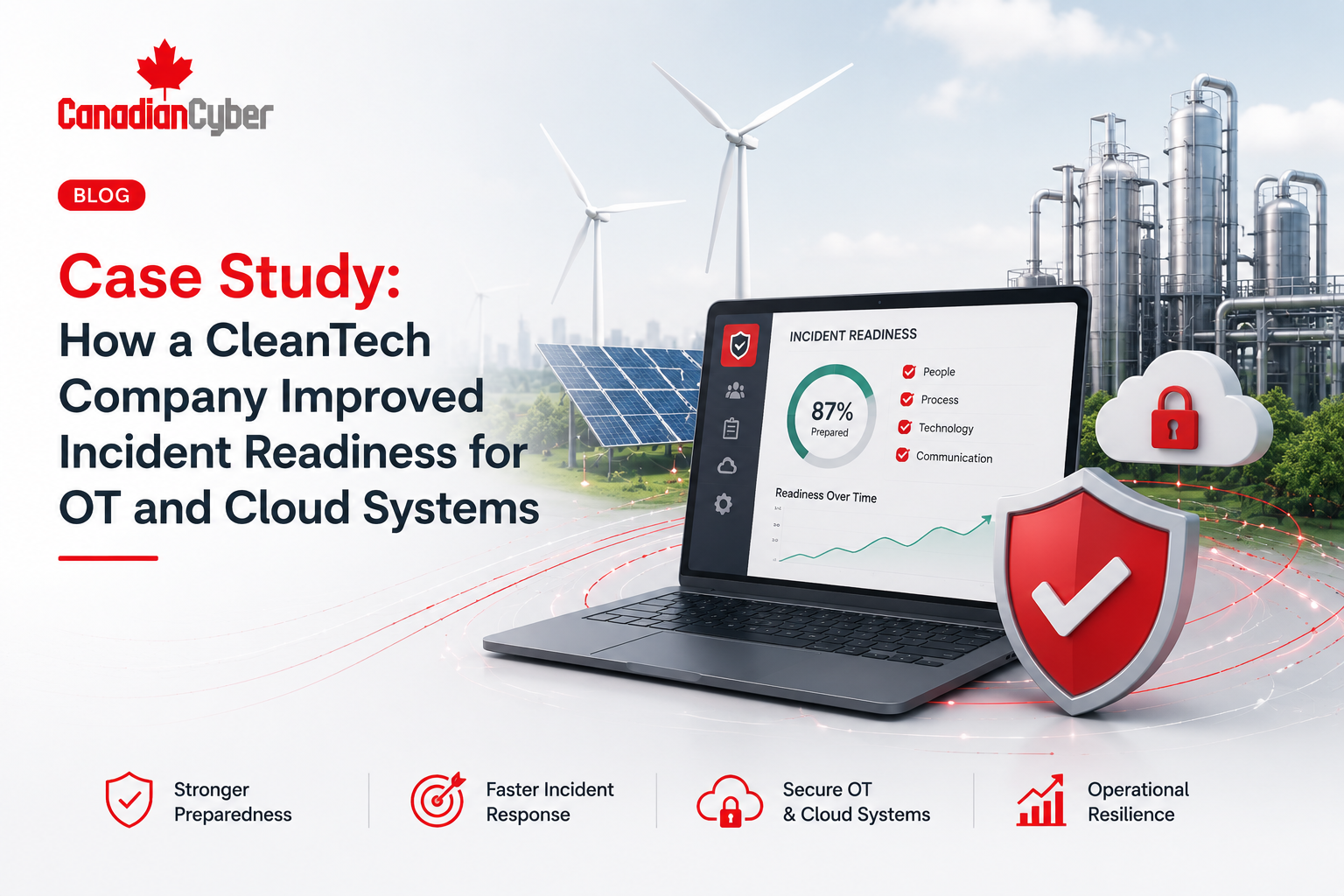
Case Study: How a CleanTech Company Improved Incident Readiness for OT and Cloud Systems
CleanTech companies often sit between two worlds: operational technology that keeps physical systems running, and cloud platforms that collect data, support customers, and power remote operations. Incident readiness must cover both.
Quick Snapshot
| Case Study Area | What Improved |
|---|---|
| Business Context | CleanTech company operating cloud dashboards and connected field systems. |
| Main Challenge | Incident response was cloud-focused and did not fully cover OT systems, field devices, vendors, and customer impact. |
| Key Risk | A cyber event could affect monitoring, remote access, operational visibility, or customer reporting. |
| Solution | Run OT and cloud tabletop exercises, clarify roles, improve escalation, test evidence, and strengthen recovery planning. |
| Outcome | Better executive readiness, clearer response roles, stronger OT-cloud coordination, and audit-ready incident evidence. |
Introduction
The CleanTech company had strong growth.
Its platform helped customers monitor energy performance, environmental systems, field equipment, and operational data through a cloud dashboard.
The business had:
- cloud infrastructure
- connected field devices
- remote monitoring tools
- customer dashboards
- vendor-managed systems
- support access
- operational data streams
- customer reporting tools
The technology was strong. But leadership had one important concern.
“If something goes wrong, do we know how to respond across both OT and cloud systems?”
The incident response plan existed. But it was mostly written for IT and cloud events. It did not fully cover OT disruption, field device access, vendor escalation, customer operational impact, or executive decision-making during a hybrid incident.
Need Incident Readiness for OT and Cloud?
Canadian Cyber helps CleanTech and technology companies run tabletop exercises, review incident response plans, map OT and cloud risks, improve escalation, and prepare evidence for ISO 27001, SOC 2, cyber insurance, and customer reviews.
Meet the CleanTech Company
Let’s call the company EcoGrid Analytics.
EcoGrid provided a SaaS platform for customers managing distributed clean energy assets and environmental systems.
Its platform collected and displayed:
- device telemetry
- energy performance data
- environmental readings
- equipment status
- alerts and maintenance records
- customer reports
- remote access logs
- vendor support activity
EcoGrid did not directly operate every customer asset. But customers depended on the platform for visibility, reporting, and operational decisions.
That created a serious incident readiness question. If cloud systems were compromised, customers could lose visibility. If field device access was abused, operations could be affected. If vendor support credentials were compromised, multiple customers could be exposed.
The Starting Problem
EcoGrid had an incident response plan. But the plan focused on standard IT incidents.
It covered:
- phishing
- malware
- lost laptop
- cloud account compromise
- suspicious login
- customer data exposure
- ransomware
Those scenarios were important. But they were not enough.
| Missing OT and Cloud Question | Why It Mattered |
|---|---|
| OT roles were unclear | Nobody knew who assessed operational impact. |
| Field device escalation was missing | Device-related incidents could stall. |
| Vendor contact paths were incomplete | Some OT vendors had unclear response contacts. |
| Cloud and OT logs were separate | Investigation could become fragmented. |
| Customer impact criteria were vague | Leadership might notify too early or too late. |
| Recovery focused on cloud only | Field operations needed separate planning. |
The company did not just need a better document. It needed a tested response model.
Workstream 1: Map the OT and Cloud Incident Surface
The first step was understanding where incidents could happen.
EcoGrid mapped systems into three layers.
| Layer | Examples |
|---|---|
| Cloud Systems | SaaS dashboard, databases, APIs, identity provider, logs, cloud storage. |
| OT / Field Systems | Connected devices, gateways, sensors, controllers, remote monitoring tools. |
| Business Systems | Email, support platform, ticketing, vendor portals, laptops, collaboration tools. |
The team asked:
- Which systems are customer-facing?
- Which systems affect operational visibility?
- Which vendors support field technology?
- Who can access customer environments?
- Which systems support alerts and reporting?
- Which systems are needed during recovery?
Workstream 2: Clarify Roles Across IT, OT, Cloud, and Leadership
The old incident plan had generic roles. That was not enough.
EcoGrid needed role clarity across technical and business teams.
| Role | Responsibility |
|---|---|
| Executive Sponsor | Business decisions and customer trust. |
| Incident Commander | Coordinates response. |
| Cloud Lead | Cloud containment, logs, recovery. |
| OT / Field Operations Lead | Operational impact and field system status. |
| Vendor Lead | Third-party escalation and evidence. |
| Legal Lead | Contract, privacy, notification, insurance. |
| Communications Lead | Customer and internal messaging. |
| Customer Success Lead | Customer prioritization and outreach. |
Practical rule: If your incident may affect operational visibility or field systems, OT leadership must be in the room.
Need Help Mapping OT and Cloud Response Roles?
Canadian Cyber can help define incident roles, escalation paths, evidence ownership, vendor contacts, and customer communication workflows for hybrid OT-cloud environments.
Workstream 3: Run an OT and Cloud Tabletop Exercise
EcoGrid ran a tabletop exercise with executives, IT, cloud engineering, field operations, legal, customer success, communications, and vendor management.
Scenario:
A support engineer reports unusual activity in the remote monitoring environment. At the same time, several customers see missing telemetry in the cloud dashboard. Cloud logs show abnormal API activity. A vendor account may be involved.
| Group | Questions Asked |
|---|---|
| Executives | When do we declare a major incident? |
| Cloud Team | What logs prove what happened? |
| OT Team | Are field systems affected or only visibility? |
| Legal | Are customer notification duties triggered? |
| Communications | What do we say before root cause is confirmed? |
| Customer Success | Which customers need priority updates? |
The exercise exposed gaps without causing real damage. That is exactly what a tabletop should do.
Workstream 4: Improve Remote Access Controls
Remote access was one of the highest-risk areas.
EcoGrid had support users, vendors, and internal engineers who could access systems for troubleshooting. The team reviewed remote access controls across cloud and field support workflows.
| Remote Access Question | Why It Mattered |
|---|---|
| Who can access customer environments? | Customer data and operational risk. |
| Is MFA enforced? | Account compromise risk. |
| Are vendor accounts reviewed? | Third-party risk. |
| Are sessions logged? | Investigation readiness. |
| Is access time-bound? | Least privilege. |
| Is emergency access documented? | Audit trail. |
Improvements made:
- MFA confirmed for support access
- shared accounts removed where possible
- vendor access reviewed
- remote access logs identified
- support access approval process improved
- quarterly access reviews scheduled
Remote access is not just an IT control. For CleanTech companies, it can become an operational risk control.
Workstream 5: Connect Cloud Logs and OT Evidence
The team discovered that cloud logs and OT evidence lived in different places. That could slow investigation.
| Evidence Source | Purpose |
|---|---|
| Identity Provider Logs | User logins and MFA events. |
| Cloud Activity Logs | Admin actions and API activity. |
| Application Logs | Customer and system activity. |
| Device Telemetry Logs | Field device behavior. |
| Remote Access Logs | Support and vendor access. |
| Ticketing System | Customer issues and incident tasks. |
| Backup Logs | Recovery evidence. |
EcoGrid created a log source inventory. It defined who owns each log source, how long logs are retained, how logs are accessed during incidents, which logs are critical, and how evidence is preserved.
Need an Incident Evidence Workspace?
Canadian Cyber can help build SharePoint-based evidence workspaces for tabletop records, incident logs, vendor escalation, corrective actions, and audit-ready incident response evidence.
Workstream 6: Update Customer Communication Rules
CleanTech customers may be highly sensitive to operational disruption.
A cloud dashboard outage may not mean field equipment has failed. A telemetry gap may not mean data is lost. A vendor issue may not mean customer data is exposed.
| Bad Message | Why It Creates Risk |
|---|---|
| “No customer data was affected.” | May be wrong before investigation is complete. |
| “Operations are unaffected.” | Could mislead customers without OT confirmation. |
| “It was only a vendor issue.” | Avoids accountability. |
| “We are fully restored.” | Creates trust risk before validation. |
| “There is no risk.” | Overpromises. |
Better holding message:
“We are investigating an issue affecting platform visibility for some customers. Our technical and operations teams are assessing system impact, data integrity, and service status. We will provide updates as confirmed information becomes available.”
Workstream 7: Improve Vendor Escalation
Vendors played a major role in EcoGrid’s environment. Some vendors supported field devices, remote access tools, cloud infrastructure, monitoring, communications, support platforms, data processing, and network connectivity.
| Vendor Incident Question | Why It Matters |
|---|---|
| Which vendors support critical systems? | Prioritizes escalation. |
| Who is the emergency contact? | Speeds response. |
| What logs can vendors provide? | Supports investigation. |
| How fast must vendors respond? | Supports operational continuity. |
| Are vendor accounts reviewed? | Supports access control. |
The company updated its critical vendor list, added emergency contacts, reviewed vendor incident terms, scheduled vendor access reviews, and updated the supplier risk register.
Workstream 8: Strengthen Recovery Planning
EcoGrid had cloud backups. But the tabletop asked harder questions.
Can customer reporting data be restored? Can dashboard access be restored quickly? Can telemetry gaps be reconciled? Can field device configuration be validated? Can customers trust restored data?
| Area | Recovery Improvement |
|---|---|
| Cloud Platform | Backup coverage confirmed. |
| Data Integrity | Reconciliation steps defined. |
| Customer Reports | Recovery priority assigned. |
| Field Operations | Operational validation process documented. |
| Vendor Systems | Escalation and recovery contacts added. |
| Restore Testing | Evidence created for critical systems. |
Recovery is not complete when the system turns back on. It is complete when data, access, and customer impact are validated.
Results After the Readiness Project
EcoGrid became much more prepared.
| Before | After |
|---|---|
| Incident plan focused on IT/cloud | Plan included OT, cloud, vendors, and customers. |
| OT roles unclear | Field operations role defined. |
| Vendor escalation informal | Critical vendor contacts documented. |
| Remote access review inconsistent | Support and vendor access reviewed. |
| Logs scattered | Log source inventory created. |
| Customer messaging improvised | Approved templates created. |
| No OT-cloud tabletop | Tabletop completed and action items tracked. |
The company improved executive confidence, response speed, customer communication, vendor escalation, remote access governance, log readiness, recovery planning, audit evidence, cyber insurance readiness, and customer security review answers.
Incident Readiness Checklist for OT and Cloud
| Question | Yes / No |
|---|---|
| Does the incident response plan include OT and cloud scenarios? | |
| Are OT, IT, cloud, legal, and communications roles defined? | |
| Are remote access accounts reviewed? | |
| Are vendor emergency contacts documented? | |
| Are cloud and OT logs identified? | |
| Are customer communication templates approved? | |
| Is backup and restore testing documented? | |
| Is data integrity validation included in recovery? | |
| Has the team run an OT-cloud tabletop exercise? |
If several answers are “no,” your incident readiness may be too cloud-focused or too informal.
Common Mistakes to Avoid
- Treating OT and cloud as separate worlds. CleanTech incidents often cross both.
- Assuming dashboard downtime has no operational impact. Customers may depend on visibility.
- Ignoring vendor access. Vendors may have support access or system knowledge.
- Not testing communications. Bad messaging can damage trust even when technical impact is limited.
- Focusing only on backups. Recovery also needs validation and customer confidence.
- Leaving legal out too late. Contracts, notification duties, insurance, and customer obligations matter.
- Not saving tabletop evidence. Tabletop records support audits, insurance, and customer reviews.
What Good Looks Like
A CleanTech company with strong incident readiness can show:
- OT and cloud incident scenarios
- clear response roles
- executive decision process
- remote access review evidence
- vendor escalation contacts
- cloud and OT log source inventory
- backup and restore evidence
- data integrity validation steps
- customer communication templates
- legal and insurance escalation process
- tabletop exercise evidence
- corrective action tracker
That is the difference between having a plan and being ready.
Canadian Cyber’s Take
At Canadian Cyber, we often see CleanTech companies with strong technology but incomplete incident readiness.
The cloud team knows the platform. The field team knows operational systems. Vendors know their tools. Executives know customer pressure.
But unless those groups practice together, the response can break under pressure.
Incident readiness is not only about cybersecurity. It is about coordination. For CleanTech companies, that means connecting OT, cloud, vendors, legal, communications, and leadership before the incident happens.
Takeaway
CleanTech companies need incident response plans that reflect both OT and cloud realities.
Prepare for:
- cloud compromise
- telemetry disruption
- remote access misuse
- vendor incidents
- field system impact
- data integrity concerns
- customer reporting issues
- AI or analytics errors
- support account compromise
Run the tabletop. Ask hard questions. Track corrective actions. That is how incident response becomes readiness, not paperwork.
How Canadian Cyber Can Help
Canadian Cyber helps CleanTech and technology companies improve incident readiness across OT, cloud, vendors, and customer-facing systems.
- OT and cloud incident response reviews
- CleanTech tabletop exercises
- ransomware readiness exercises
- vendor breach simulations
- remote access reviews
- cloud logging and evidence reviews
- backup and restore evidence reviews
- customer communication templates
- cyber insurance readiness
- ISO 27001 incident evidence
- SOC 2 incident response evidence
- corrective action tracking
- vCISO support for incident governance
Stay Connected With Canadian Cyber
Follow Canadian Cyber for practical guidance on CleanTech cybersecurity, OT incident readiness, cloud security, SOC 2, ISO 27001, SharePoint ISMS, vCISO leadership, vendor risk, and evidence management.