SOC 2 • Trust Services Criteria • SaaS Founders • Audit Readiness • Customer Trust
Checklist: Trust Services Criteria Explained for SaaS Founders
Trust Services Criteria are the backbone of SOC 2. For SaaS founders, they are not just audit language. They explain what buyers, auditors, and security teams expect your company to prove before they trust your platform with customer data.
Quick Snapshot
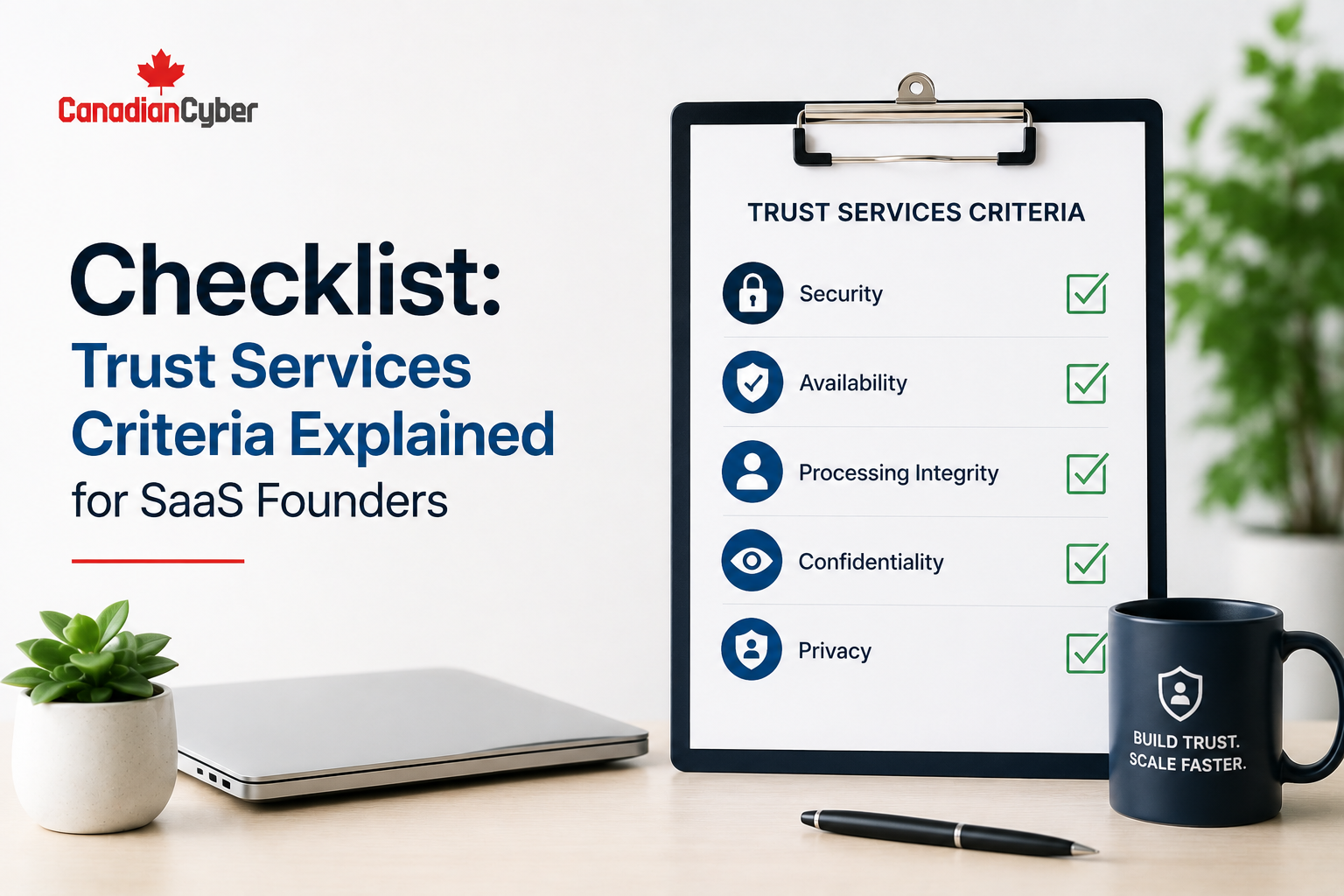
| Trust Services Criteria | What It Means for SaaS Founders |
|---|---|
| Security | Can you protect systems and customer data from unauthorized access? |
| Availability | Can your platform stay available and recover from disruption? |
| Processing Integrity | Does your system process data completely, accurately, and as expected? |
| Confidentiality | Can you protect confidential customer, business, or platform information? |
| Privacy | Can you manage personal information according to your commitments and privacy obligations? |
Introduction
Most SaaS founders hear about SOC 2 when an enterprise buyer asks for it.
At first, the request sounds simple.
“Do you have SOC 2?”
Then the security questionnaire arrives.
Suddenly, you are reading about:
- Trust Services Criteria
- CC controls
- availability commitments
- access reviews
- vendor management
- incident response
- audit evidence
- control testing
It gets confusing fast.
Many founders think SOC 2 is one big compliance badge.
It is not.
SOC 2 is built around Trust Services Criteria. These criteria help define what your auditor will test and what your customers expect you to prove.
You do not need to become an auditor. But you do need to understand what each criterion means for your SaaS business, your customer data, your product promises, and your sales process.
Preparing for SOC 2?
Canadian Cyber helps SaaS companies prepare for SOC 2 with readiness assessments, Trust Services Criteria scoping, evidence mapping, access reviews, vendor risk reviews, SharePoint evidence workspaces, and vCISO support.
What Are Trust Services Criteria?
Trust Services Criteria are the categories used in SOC 2 to evaluate whether a service organization has appropriate controls in place.
For SaaS companies, they help answer buyer questions like:
- Can your platform protect customer data?
- Can you control who has access?
- Can you detect and respond to incidents?
- Can you recover from outages?
- Can you protect confidential information?
- Can you process data correctly?
- Can you manage personal information responsibly?
Founder translation: Trust Services Criteria are the control categories behind SOC 2.
| Criteria | Founder Meaning | Usually Required? |
|---|---|---|
| Security | Protect systems and data from unauthorized access. | Yes |
| Availability | Keep the service available as promised. | Optional |
| Processing Integrity | Process information correctly and completely. | Optional |
| Confidentiality | Protect sensitive information from disclosure. | Optional |
| Privacy | Manage personal information properly. | Optional |
Simple rule: Do not include every Trust Services Criteria just to look mature. Choose the criteria that match your product, customer commitments, and buyer expectations.
1. Security: The Core SOC 2 Requirement
Security is the foundation of SOC 2.
It asks whether your systems and customer data are protected against unauthorized access, misuse, damage, or disruption.
For SaaS founders, Security usually includes:
- identity and access management
- MFA and SSO
- admin access control
- cloud security
- secure development
- vendor risk
- incident response
- logging and monitoring
- endpoint protection
- vulnerability management
- offboarding
- security awareness training
What Buyers Want to Know
| Buyer Question | Evidence You Need |
|---|---|
| Do you enforce MFA? | MFA report, Conditional Access settings, exception register. |
| Who can access customer data? | Access review, admin role export, support access logs. |
| How do you manage vendors? | Vendor register, risk reviews, approval decisions. |
| How do you respond to incidents? | Incident response plan, tabletop record, incident log. |
| How do you secure code changes? | Pull request approvals, deployment records, scan results. |
| How do you remove former employees? | Offboarding checklist and access removal samples. |
Founder Checklist for Security
| Question | Yes / No |
|---|---|
| Is MFA enforced for staff and administrators? | |
| Are privileged accounts reviewed regularly? | |
| Is access to customer data limited by role? | |
| Are code changes reviewed before production deployment? | |
| Are critical vendors reviewed and approved? | |
| Is incident response documented and tested? |
Common founder mistake: assuming security tools are enough. SOC 2 asks whether controls are designed, operating, reviewed, and evidenced.
Need SOC 2 Security Readiness?
Canadian Cyber can help map your access controls, cloud controls, vendor reviews, incident response process, and SOC 2 evidence pack.
2. Availability: Can Your SaaS Platform Stay Up?
Availability is about whether your system is available for operation and use as committed.
This criterion matters if customers depend on your SaaS platform for daily work, reporting, operations, workflows, transactions, or critical decisions.
If your sales team promises uptime, resilience, backup, recovery, or business continuity, Availability may become important.
| Availability Control Area | Evidence Example |
|---|---|
| Backups | Backup configuration and job reports. |
| Restore Testing | Restore test results and review sign-off. |
| Monitoring | Availability alerts and incident tickets. |
| Business Continuity | Continuity plan, recovery objectives, tabletop evidence. |
| Disaster Recovery | Recovery procedures and recovery test records. |
Founder warning: Do not include Availability just because it sounds good. Include it when availability commitments matter to customers and your team can prove backup, monitoring, recovery, and incident controls.
3. Processing Integrity: Does the Platform Process Data Correctly?
Processing Integrity focuses on whether system processing is complete, valid, accurate, timely, and authorized.
This criterion matters when customers rely on your platform to process important transactions, calculations, workflows, reports, decisions, or automated outputs.
| Platform Type | Why Processing Integrity May Matter |
|---|---|
| Fintech SaaS | Calculations, payments, reconciliations, and financial records must be accurate. |
| Workflow Automation | Approvals and routing must happen correctly. |
| AI Platforms | Model outputs, transformations, and recommendations may need validation. |
| Reporting Platforms | Reports must be complete, accurate, and based on correct data. |
| HR SaaS | Employee records, payroll workflows, and approvals must be accurate. |
Evidence Examples
- input validation rules
- automated test results
- quality assurance records
- data reconciliation reports
- change approval records
- error handling procedures
- customer issue tracking
- model output validation records
Security asks, “Can unauthorized users access or change the system?” Processing Integrity asks, “Does the system process information correctly?”
Not Sure Whether Processing Integrity Applies?
Canadian Cyber can help you decide whether Processing Integrity belongs in your SOC 2 scope and what evidence your product, engineering, and QA teams need to collect.
4. Confidentiality: Can You Protect Sensitive Information?
Confidentiality applies when your SaaS platform handles information that must be protected from unauthorized disclosure.
This may include:
- customer documents
- contracts
- financial records
- business plans
- source code
- legal files
- AI prompts
- model outputs
- proprietary datasets
| Confidentiality Control | Evidence |
|---|---|
| Data Classification | Classification policy and data handling rules. |
| Encryption | Encryption settings for data at rest and in transit. |
| Access Restriction | Access review and privileged access evidence. |
| Retention and Deletion | Retention rules, deletion workflow, archive controls. |
| Support Access Control | Support access logs and approval process. |
AI platform note: Confidentiality may be critical if prompts, uploaded files, embeddings, training data, or model outputs contain sensitive customer information.
5. Privacy: Do You Manage Personal Information Properly?
Privacy focuses on personal information.
This criterion may matter if your SaaS platform collects, uses, stores, processes, or shares personal information.
Privacy is often more complex than founders expect because it connects legal commitments, product design, security controls, consent, retention, deletion, and customer obligations.
| Privacy Question Buyers May Ask | Evidence You Need |
|---|---|
| What personal data do you collect? | Data inventory and privacy notice. |
| Why do you collect it? | Processing purpose documentation. |
| Can users request deletion? | Deletion workflow and request records. |
| Do vendors process personal data? | Vendor register and DPA records. |
| How do you handle privacy incidents? | Incident response and notification process. |
Practical rule: Security protects systems and data. Privacy governs how personal information is collected, used, shared, retained, and deleted.
Which Trust Services Criteria Should Your SaaS Company Choose?
Most SaaS companies start with Security.
Then they add other criteria based on buyer expectations, product commitments, data sensitivity, and contract requirements.
| If Your SaaS Platform… | Consider This Criteria |
|---|---|
| Handles customer data and access control matters. | Security |
| Has uptime or availability commitments. | Availability |
| Processes transactions, calculations, workflows, or AI outputs. | Processing Integrity |
| Stores confidential documents, prompts, reports, or client files. | Confidentiality |
| Processes personal information. | Privacy |
Founder Decision Questions
- What are customers asking for?
- What does our platform actually do?
- What data do we handle?
- Do we make uptime commitments?
- Do we process important transactions or outputs?
- Do we store confidential information?
- Do we process personal data?
- What evidence can we actually provide?
- Which criteria will create unnecessary audit burden?
Not Sure Which SOC 2 Criteria You Need?
Canadian Cyber can help you scope the right Trust Services Criteria based on your SaaS platform, customer data, AI features, buyer requirements, uptime commitments, and audit goals.
SOC 2 Evidence Checklist for SaaS Founders
No matter which criteria you choose, buyers and auditors will expect evidence.
Start building it early.
| Evidence Area | Examples |
|---|---|
| Access Control | MFA report, access reviews, admin role exports, offboarding samples. |
| Vendor Risk | Vendor register, security reviews, approval decisions, DPAs. |
| Incident Response | Incident response plan, tabletop records, lessons learned. |
| Change Management | Pull requests, approvals, deployment records, ticket samples. |
| Backup and Recovery | Backup settings, restore tests, recovery records. |
| Logging and Monitoring | Log inventory, retention settings, alert reviews, incident tickets. |
| Management Review | Meeting minutes, risk decisions, action items. |
Evidence Naming Examples
- AccessControl-EntraID-MFAReport-2026-Q1.pdf
- VendorRisk-CriticalVendorReview-2026-Q2.xlsx
- IncidentResponse-TabletopRecord-2026-Q1.docx
- BackupRecovery-ProductionRestoreTest-2026-03.pdf
- ChangeManagement-GitHub-PRSample-2026-Q1.pdf
- LoggingMonitoring-AlertReview-2026-04.pdf
Practical rule: Do not wait until the audit to collect evidence. Evidence should be created while controls operate.
Common Mistakes SaaS Founders Make
- Mistake 1: Including too many criteria. More criteria does not automatically mean more trust. It can mean more cost, more evidence, and more audit complexity.
- Mistake 2: Starting with policies instead of scope. Policies matter, but scope comes first.
- Mistake 3: Forgetting vendor risk. Cloud providers, AI vendors, support tools, analytics tools, payment processors, and development platforms may all affect SOC 2 readiness.
- Mistake 4: Treating SOC 2 as a badge. SOC 2 should support buyer trust, security reviews, risk reduction, and sales.
- Mistake 5: Waiting until audit month to collect evidence. Last-minute evidence collection creates stress and exposes gaps too late.
- Mistake 6: Overpromising in policies. Do not write policies that promise controls your team does not operate.
- Mistake 7: Letting sales invent security answers. Create approved answers for common buyer questions.
What Good Looks Like
A SOC 2-ready SaaS company can show:
- clear SOC 2 scope
- selected Trust Services Criteria with business justification
- access control evidence
- vendor risk reviews
- incident response readiness
- backup and recovery evidence
- logging and monitoring evidence
- approved policies
- change management records
- security training evidence
- customer-ready security answers
- organized evidence vault
The company does not just say it is secure. It proves how controls operate.
Canadian Cyber’s Take
At Canadian Cyber, we often see SaaS founders delay SOC 2 because the terminology feels overwhelming.
Trust Services Criteria sound technical.
But the business meaning is simple.
- Security protects customer data.
- Availability proves reliability.
- Processing Integrity proves the system works correctly.
- Confidentiality protects sensitive information.
- Privacy governs personal information.
The best SOC 2 projects start with the right scope, the right criteria, and the right evidence plan. That keeps the audit focused. It also helps the company use SOC 2 as a trust asset, not just a compliance badge.
SOC 2 works best when it reflects your real business. Not someone else’s checklist.
Takeaway
Trust Services Criteria are the foundation of SOC 2.
For SaaS founders, they should not feel like abstract audit terms.
They should help answer practical business questions:
- What do buyers expect?
- What data do we handle?
- What promises do we make?
- What controls do we operate?
- What evidence can we prove?
Start with Security. Then add Availability, Processing Integrity, Confidentiality, or Privacy only when they match your product and customer expectations.
How Canadian Cyber Can Help
Canadian Cyber helps SaaS companies prepare for SOC 2 with practical, evidence-focused support.
- SOC 2 readiness assessments
- Trust Services Criteria scoping
- SOC 2 control mapping
- evidence pack design
- vendor risk reviews
- access review workflows
- incident response tabletop exercises
- policy review and approval support
- SharePoint evidence vault setup
- security questionnaire support
- customer trust pack development
- vCISO support for SaaS compliance
Stay Connected With Canadian Cyber
Follow Canadian Cyber for practical guidance on SOC 2, Trust Services Criteria, ISO 27001, SharePoint ISMS, vCISO leadership, vendor risk, evidence management, and customer trust.