ISO 27001 • Internal Audit • Law Firm Cybersecurity • Client Matter Confidentiality • Legal Sector
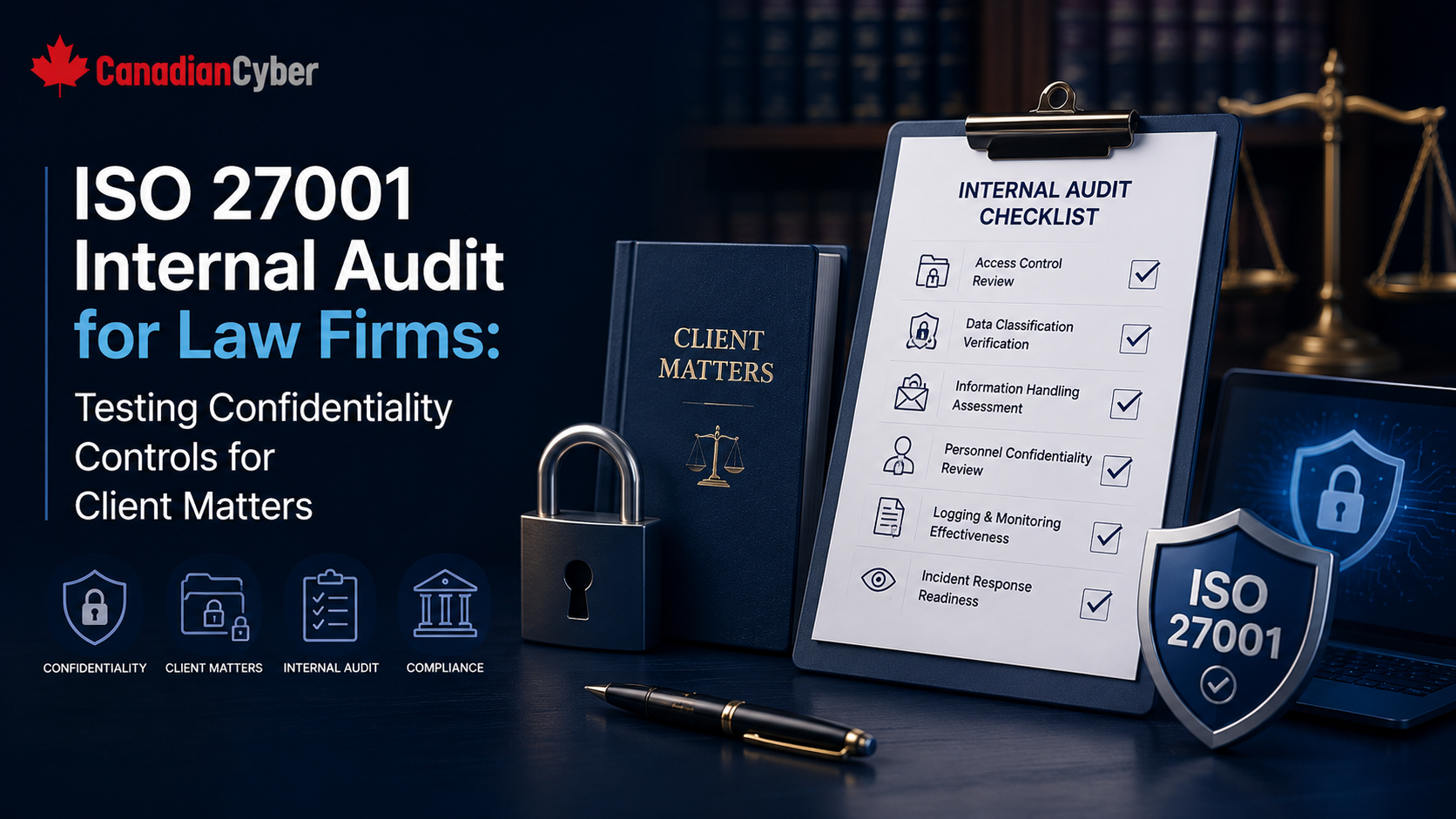
ISO 27001 Internal Audit for Law Firms: Testing Confidentiality Controls for Client Matters
Law firms handle litigation strategy, privileged communications, financial records, intellectual property, investigations, M&A files, employment disputes, and personal information. During an ISO 27001 internal audit, firms must prove that confidentiality controls are not only documented, but working in practice.
Canadian Cyber for Legal Sector ISO 27001
ISO 27001 Internal Audit Readiness for Law Firms
Canadian Cyber helps law firms test client matter confidentiality controls, review ethical walls, assess document management permissions, validate Microsoft 365 sharing settings, review vendor access, prepare audit evidence, and organize ISO 27001 records in a SharePoint ISMS workspace.
Quick Snapshot
| Audit Area | Why It Matters for Law Firms |
|---|---|
| Client Matter Access | Ensures only authorized lawyers, staff, and support teams can access matter files. |
| Ethical Walls | Protects restricted matters where conflicts, confidentiality restrictions, or need-to-know access apply. |
| Document Management | Tests whether DMS permissions, version history, and sharing controls are working. |
| Email and Collaboration | Reviews how confidential matter information is shared, stored, and protected. |
| Third-Party Access | Checks vendors, eDiscovery platforms, consultants, and outsourced support access. |
| Audit Evidence | Helps law firms prove ISO 27001 control effectiveness before certification or surveillance audits. |
Introduction
Confidentiality is central to legal services.
Law firms do not only store documents. They store trust.
Every client matter may include sensitive facts, legal advice, settlement strategy, privileged communication, financial information, personal data, contracts, board documents, regulatory records, or business secrets.
That is why ISO 27001 internal audits for law firms should test confidentiality controls carefully. A policy that says “client information must be protected” is not enough.
Auditors want evidence that controls are working:
- Can the firm prove who has access to each client matter?
- Are matter permissions reviewed?
- Are ethical walls enforced?
- Are former staff removed from matter workspaces?
- Are external sharing links controlled?
- Are vendors reviewed before accessing matter data?
- Are exceptions approved and tracked?
Need Help With ISO 27001 Internal Audit for Your Law Firm?
Canadian Cyber helps law firms assess ISO 27001 readiness, test confidentiality controls, review client matter access, prepare internal audit evidence, build risk registers, and organize audit records in SharePoint ISMS workspaces.
Why Client Matter Confidentiality Needs Specific Audit Testing
Many ISO 27001 programs test general security controls. That is useful, but law firms need matter-specific testing.
A law firm may have strong Microsoft 365 security, MFA, endpoint protection, and backup processes. Still, matter confidentiality can fail if:
- too many people can access a matter folder
- ethical wall permissions are not enforced
- external links remain active
- former staff remain in groups
- vendors receive excessive access
- matter files are copied into uncontrolled locations
- emails are forwarded without protection
- client-specific restrictions are not documented
Practical rule: For law firms, confidentiality control testing should follow the client matter, not only the IT system.
What ISO 27001 Internal Audit Should Test
An internal audit should verify that controls are designed, implemented, and operating. For law firms, the audit should test whether client matter confidentiality is protected across systems and workflows.
| Control Area | What to Test |
|---|---|
| Matter Access Control | Who has access and whether access is appropriate. |
| Ethical Walls | Whether restricted matters are technically and operationally segregated. |
| Joiner / Mover / Leaver Process | Whether access changes when people join, move, leave, or change matter teams. |
| Document Management | Whether DMS permissions and sharing rules work. |
| Email and Collaboration | Whether client data is protected in communication tools. |
| Vendor Access | Whether third parties have approved and limited access. |
| Logging and Monitoring | Whether access and sharing activity can be reviewed. |
| Retention and Disposal | Whether matter records follow retention rules. |
A good internal audit does not only ask “is there a policy?” It asks “can we prove the control worked?”
1. Client Matter Access Review
Matter access is one of the most important confidentiality controls. Every sensitive matter should have a clear access owner and review history.
| Internal Audit Question | Yes / No |
|---|---|
| Is each client matter assigned an owner or responsible partner? | |
| Is access granted based on role and need-to-know? | |
| Are matter team members documented? | |
| Are support staff access rights justified? | |
| Are privileged or sensitive matters clearly identified? | |
| Are access changes approved? | |
| Are matter permissions reviewed periodically? | |
| Are exceptions documented and approved? |
Evidence to review:
DMS permissions export
Microsoft 365 group membership
Approval records
Access review sign-off
Exception register
2. Ethical Wall Testing
Ethical walls are critical for confidentiality, conflicts management, and need-to-know restrictions. An ISO 27001 internal audit should test whether ethical walls work technically and operationally.
| Internal Audit Question | Yes / No |
|---|---|
| Are matters requiring ethical walls identified? | |
| Is there a documented ethical wall approval process? | |
| Are restricted users clearly defined? | |
| Are DMS permissions configured to enforce the restriction? | |
| Are email and collaboration permissions aligned with the ethical wall? | |
| Are exceptions approved by authorized personnel? | |
| Are ethical walls reviewed periodically? |
Evidence to review:
Restricted matter list
DMS permission evidence
Teams / SharePoint permission evidence
Training evidence
Test access results
Practical rule: Ethical walls should be tested, not assumed.
Test Client Matter Access and Ethical Walls Before the Auditor Does
Canadian Cyber helps law firms review matter permissions, validate ethical walls, test restricted workspaces, document exceptions, and prepare ISO 27001 internal audit evidence.
3. Document Management System Controls
Many law firms rely on a document management system such as iManage, NetDocuments, SharePoint, OneDrive, or another platform. The internal audit should verify that DMS controls support confidentiality.
| DMS Audit Question | Yes / No |
|---|---|
| Are matters created using approved workspace templates? | |
| Are permissions inherited correctly? | |
| Are restricted matters separated from general access? | |
| Is version history enabled? | |
| Are external sharing settings restricted? | |
| Are sensitive documents labeled or classified? | |
| Are access logs available for investigation? |
Evidence to review:
- matter workspace template
- DMS permission export
- sample matter folder permissions
- external sharing report
- version history sample
- audit log sample
- retention configuration
- classification or label evidence
Practical rule: A DMS should not be treated as secure only because it is a legal industry tool. Permissions still need testing.
4. Email and Collaboration Confidentiality Controls
Law firms often share matter information through email, Teams, SharePoint, OneDrive, and client portals. This creates confidentiality risk.
| Audit Question | Yes / No |
|---|---|
| Are email security controls enabled for sensitive communications? | |
| Are external forwarding rules monitored? | |
| Are sensitive attachments protected where required? | |
| Are Teams and SharePoint spaces created using approved rules? | |
| Are external guests reviewed? | |
| Are sharing links time-limited where appropriate? | |
| Are accidental sharing incidents tracked? |
Evidence to review:
External user report
Email forwarding rule review
DLP policy evidence
Sensitivity label configuration
Client portal access list
5. Joiner, Mover, and Leaver Testing
Law firms often have changing matter teams. Associates, clerks, paralegals, partners, contractors, and support staff may join or leave matters quickly.
| Audit Question | Yes / No |
|---|---|
| Is matter access granted through an approved process? | |
| Are role changes reflected in matter access? | |
| Are departing users removed from firm systems promptly? | |
| Are users removed from matter-specific groups when they leave a matter? | |
| Are contractors and temporary staff time-limited? | |
| Are leaver samples tested? |
Practical rule: Offboarding from the firm is not enough. Law firms should also remove users from matters they no longer support.
6. Third-Party and Vendor Access
Law firms use many third parties, including eDiscovery platforms, court filing systems, document review vendors, managed IT providers, forensic consultants, translation vendors, expert witnesses, legal research platforms, printing vendors, data room providers, external counsel, and contract lawyers.
| Vendor Access Audit Question | Yes / No |
|---|---|
| Is there a vendor register? | |
| Are vendors with client matter access identified? | |
| Are vendor security reviews performed? | |
| Is access approved before being granted? | |
| Is vendor access limited to the required matter or system? | |
| Are contracts, NDAs, or confidentiality terms in place? | |
| Is vendor access removed after the engagement ends? |
Review Vendor Access to Client Matter Information
Canadian Cyber helps law firms review vendors, external counsel, eDiscovery platforms, client portals, outsourced support, and third-party access evidence before ISO 27001 audit pressure starts.
7. Confidentiality Incident Testing
The internal audit should check how confidentiality incidents are handled, even when they seem minor.
Possible confidentiality incidents include:
Wrong client file shared externally
Unauthorized matter workspace access
Ethical wall breach
Vendor access error
Misconfigured SharePoint link
| Audit Question | Yes / No |
|---|---|
| Is there an incident response plan? | |
| Are confidentiality incidents defined? | |
| Are incidents logged and classified? | |
| Are legal, privacy, and client notification steps defined? | |
| Are corrective actions tracked? | |
| Are staff trained to report incidents quickly? |
8. Retention and Disposal of Client Matter Records
Law firms must retain matter records according to legal, contractual, regulatory, and business requirements. Confidentiality continues after a matter closes.
| Audit Question | Yes / No |
|---|---|
| Are retention requirements defined for client matters? | |
| Are client-specific retention obligations documented? | |
| Are closed matters archived securely? | |
| Are disposal approvals documented? | |
| Are litigation holds or preservation needs considered? | |
| Are disposal actions logged? |
9. Logging and Monitoring for Matter Access
Law firms should be able to investigate access concerns. The internal audit should check whether relevant logs exist and can be reviewed.
| Audit Question | Yes / No |
|---|---|
| Are matter access logs available for key systems? | |
| Are external sharing activities logged? | |
| Are admin actions logged? | |
| Are logs retained for a defined period? | |
| Are suspicious sharing or access events reviewed? | |
| Can the firm investigate a confidentiality concern? |
Practical rule: If the firm cannot investigate matter access, confidentiality monitoring is weak.
Sample Internal Audit Testing Plan
Use a sample-based approach. Sampling should include normal matters and higher-risk matters.
| Matter Type | Why Include It |
|---|---|
| High-value corporate matter | Sensitive commercial information. |
| Litigation matter | Strategy and privileged material. |
| Employment matter | Personal and HR data. |
| Restricted / ethical wall matter | Need-to-know access. |
| Closed matter | Retention and archive testing. |
| Matter with external collaboration | Sharing control testing. |
Testing Steps
- Confirm matter owner.
- Export matter access list.
- Compare access to matter team list.
- Check external users.
- Review sharing links.
- Confirm ethical wall restrictions if applicable.
- Review access approval evidence.
- Test leaver or mover access removal.
- Check vendor access.
- Review logs or activity evidence.
- Document exceptions.
- Create corrective actions.
Organize Law Firm Internal Audit Evidence in SharePoint ISMS
Canadian Cyber helps law firms organize ISO 27001 evidence, matter access reviews, ethical wall testing, vendor reviews, incident records, corrective actions, and management review inputs inside a structured SharePoint ISMS workspace.
ISO 27001 Internal Audit Evidence Checklist for Law Firms
Access Control
| Evidence | Ready? |
|---|---|
| Matter access list | |
| DMS permission export | |
| Access approval records | |
| Matter access review sign-off |
Ethical Walls
| Evidence | Ready? |
|---|---|
| Ethical wall register | |
| Restricted matter permissions | |
| Access test evidence | |
| Staff training evidence |
Collaboration and Vendors
| Evidence | Ready? |
|---|---|
| External sharing report | |
| Guest user review | |
| Vendor register | |
| Vendor security review | |
| Vendor offboarding evidence |
Common Mistakes to Avoid
- Auditing only IT systems. Matter confidentiality should be tested at the matter level.
- Assuming DMS permissions are correct. Permissions should be sampled and verified.
- Ignoring ethical walls. Restricted matters need specific testing.
- Forgetting external sharing. Confidential information may leave through Teams, SharePoint, OneDrive, or email.
- No vendor access review. Third parties with matter access need review and offboarding.
- No evidence of access reviews. If access reviews are not documented, the control is difficult to prove.
- Not testing closed matters. Closed matters still carry confidentiality and retention risk.
What Good Looks Like
A strong ISO 27001 internal audit for law firm confidentiality controls can show:
- matter access reviews
- ethical wall testing
- DMS permission evidence
- external sharing reports
- guest user reviews
- vendor access reviews
- offboarding evidence
- incident response records
- retention and disposal evidence
- log review samples
- exception tracking
- corrective action register
- SharePoint ISMS evidence workspace
This gives leadership confidence before external audits. It also helps protect client trust.
Canadian Cyber’s Take
At Canadian Cyber, we see law firms focus heavily on policy creation during ISO 27001 readiness. Policies matter, but confidentiality controls must be tested.
For law firms, the most important question is often simple:
Can the firm prove that client matter information is only accessible to the right people?
That proof requires more than a policy. It requires access reviews, permission exports, ethical wall testing, vendor reviews, sharing reports, incident records, and corrective actions. An internal audit should help the firm find weak spots before an external auditor or client does.
Takeaway
ISO 27001 internal audits for law firms should test confidentiality controls at the client matter level.
Focus on:
- matter access
- ethical walls
- DMS permissions
- email and collaboration sharing
- joiner, mover, leaver controls
- vendor access
- incident response
- retention and disposal
- logging and monitoring
- audit evidence
Client confidentiality is not only a legal obligation. It is a security control. It should be tested, evidenced, and improved.
How Canadian Cyber Can Help
Canadian Cyber helps law firms prepare for ISO 27001 internal audits and confidentiality control reviews.
- ISO 27001 readiness assessments for law firms
- law firm internal audit planning
- client matter confidentiality testing
- ethical wall control testing
- DMS permission review
- SharePoint and Microsoft 365 access review
- vendor access review
- incident response readiness
- retention and disposal control review
- risk register development
- corrective action tracking
- management review preparation
- SharePoint ISMS evidence workspace setup
- external audit readiness support
Stay Connected With Canadian Cyber
Follow Canadian Cyber for practical guidance on ISO 27001, law firm cybersecurity, internal audits, confidentiality controls, client matter security, SharePoint ISMS, SOC 2, ISO 42001, and vCISO support.