ISO 42001 • AI Release Readiness • SaaS AI Governance • Product Security • Responsible AI
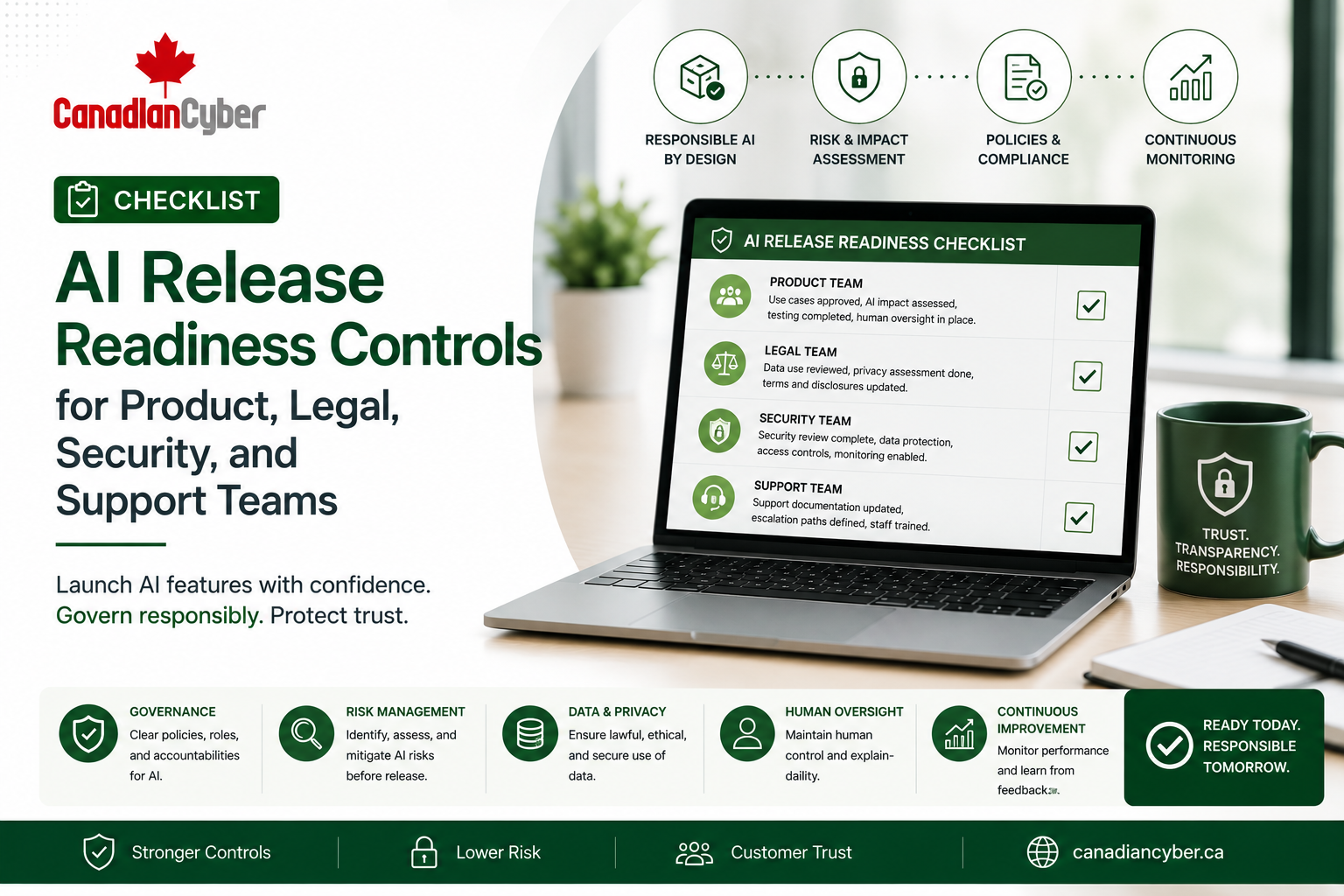
Checklist: AI Release Readiness Controls for Product, Legal, Security, and Support Teams
AI features should not move from development to customer use without release readiness controls. Product, legal, security, privacy, support, compliance, and leadership teams should confirm that purpose, risk, data use, vendor terms, oversight, monitoring, and evidence are ready before launch.
Canadian Cyber AI Release Readiness Support
Launch AI Features With ISO 42001-Ready Governance
Canadian Cyber helps SaaS companies build AI release checklists, AI risk registers, impact assessments, vendor reviews, human oversight controls, support readiness workflows, and SharePoint AI governance workspaces.
Quick Snapshot
| Team | AI Release Readiness Focus |
|---|---|
| Product | Use case, customer impact, feature limits, user experience, monitoring, and feedback. |
| Legal | Customer terms, privacy notices, AI vendor contracts, data use, retention, and disclaimers. |
| Security | Access controls, data protection, prompt security, logging, vendor security, and incident response. |
| Support | Customer questions, escalation paths, AI errors, support scripts, and privacy-safe troubleshooting. |
| Compliance | ISO 42001 evidence, risk assessment, impact assessment, approval records, and issue tracking. |
| Business Outcome | Safer AI launch, stronger customer trust, fewer surprises after release, and better audit readiness. |
Introduction
AI product launches are exciting. They can help SaaS companies deliver faster workflows, smarter search, better summaries, automated support, document analysis, recommendations, risk scoring, reporting, and customer insights.
But AI launches also create new questions. What exactly does the AI feature do? What data does it process? Can it make mistakes? Could customers rely on the output? Is a third-party AI vendor involved? Are vendor training terms reviewed? Is human review required? What happens if the AI produces a wrong answer?
If these questions are answered after launch, the company is already behind. An AI release readiness checklist helps teams review the right controls before customers use the feature.
AI release readiness should happen before launch, not after customer complaints.
Need AI Release Readiness Support?
Canadian Cyber helps SaaS companies build ISO 42001-ready AI governance programs, AI release checklists, AI risk registers, impact assessments, vendor reviews, human oversight controls, and SharePoint AI governance workspaces.
Why AI Release Readiness Matters
Traditional software releases already require testing, approvals, security reviews, and support readiness. AI releases need all of that plus extra governance.
AI systems can behave unpredictably. Outputs may vary. Models may change. Prompts may expose sensitive data. Vendors may retain data. Customers may misunderstand limitations. AI-generated answers may sound confident but be wrong. Support teams may receive new types of complaints.
| AI Release Risk | Example |
|---|---|
| Inaccurate Output | AI summary misses a key clause, transaction, or customer detail. |
| Customer Overreliance | User treats an AI suggestion as a final decision. |
| Privacy Exposure | Customer data is sent to an unapproved AI vendor. |
| Security Weakness | Prompt injection exposes sensitive information. |
| Legal Gap | Terms do not explain AI feature limitations. |
| Vendor Risk | AI provider uses customer data for training. |
| Support Gap | Support team cannot handle AI error reports. |
| Evidence Gap | Company cannot prove the release was reviewed. |
What Is an AI Release Readiness Checklist?
An AI release readiness checklist is a structured review used before an AI feature is launched. It confirms that the feature has been reviewed by the right teams and that required evidence is stored for ISO 42001 readiness.
| Checklist Should Confirm | Why It Matters |
|---|---|
| What the AI feature does | Defines purpose and scope. |
| Who owns it | Assigns accountability. |
| What data it processes | Identifies privacy, security, and vendor risk. |
| What risks it creates | Supports risk treatment and launch decisions. |
| What human review is required | Prevents unchecked high-impact decisions. |
| What monitoring happens after launch | Ensures issues are tracked and corrected. |
AI release readiness should combine product, legal, security, support, and compliance review.
AI Release Readiness Roles
AI launch governance works best when each team owns a clear part of the checklist. Readiness fails when everyone assumes another team has reviewed the risk.
| Team | Responsibility |
|---|---|
| Product | Define use case, user journey, limits, release criteria, rollback, and feedback. |
| Legal | Review terms, privacy, customer notices, data use, and vendor contracts. |
| Security | Review data protection, access, logging, prompt security, and vendor security. |
| Support | Prepare support workflows, escalation, customer response guidance, and issue categories. |
| Compliance | Maintain ISO 42001 evidence, risk register, impact assessment, and approvals. |
| Leadership | Approve high-risk releases and accept residual risk. |
Checklist 1: Product Readiness Controls
Product teams should define what the AI feature is allowed to do, what it should not do, how users should experience it, and how feedback will be captured.
| Product Readiness Control | Ready? |
|---|---|
| AI feature name documented | |
| Product owner assigned | |
| Technical owner assigned | |
| Intended use case documented | |
| Prohibited use cases documented | |
| Customer impact assessed | |
| Output limitations displayed where needed | |
| Rollback or disable option defined |
Product Readiness Should Be Documented Before Launch
Canadian Cyber helps product and engineering teams document AI use cases, limitations, release criteria, rollback options, monitoring ownership, and customer impact evidence.
Checklist 2: Legal Readiness Controls
Legal teams should review customer commitments, privacy notices, contracts, disclaimers, AI feature descriptions, and vendor terms before launch.
| Legal Readiness Control | Ready? |
|---|---|
| Customer terms reviewed | |
| Privacy notice reviewed | |
| Disclaimer or limitation language reviewed | |
| Customer data use documented | |
| Training data use terms reviewed | |
| AI vendor contract reviewed | |
| Subprocessor list reviewed | |
| Regulated use restrictions reviewed |
Checklist 3: Security Readiness Controls
Security teams should review how the AI feature handles data, access, prompts, outputs, logs, abuse scenarios, vendors, and incident response.
| Security Readiness Control | Ready? |
|---|---|
| Security owner assigned | |
| Data flow reviewed | |
| Customer data classification completed | |
| Access controls reviewed | |
| Tenant isolation reviewed | |
| Prompt injection risk reviewed | |
| Prompt and output retention reviewed | |
| Incident response path defined |
AI security review should include data flows, access, prompts, outputs, logs, vendors, and abuse scenarios.
Checklist 4: Privacy Readiness Controls
Privacy review should confirm that personal information is processed lawfully, minimally, transparently, and with clear retention and deletion controls.
| Privacy Readiness Control | Ready? |
|---|---|
| Personal data use identified | |
| Purpose documented | |
| Data minimization reviewed | |
| Sensitive data restrictions documented | |
| Retention rules defined | |
| Deletion process reviewed | |
| Privacy impact assessment completed where needed |
Legal, Security, and Privacy Reviews Should Happen Before Launch
Canadian Cyber helps SaaS teams review AI data flows, customer data use, vendor terms, prompt security, privacy impact, retention, deletion, and release approval evidence.
Checklist 5: Support Readiness Controls
Support teams must be ready before AI features go live. Customers may ask what the feature does, why it gave an answer, how to report an issue, whether data is used for training, or how to disable the feature.
| Support Readiness Control | Ready? |
|---|---|
| Support team trained on AI feature | |
| Support article or FAQ prepared | |
| AI limitation script prepared | |
| Escalation path defined | |
| AI error reporting process created | |
| Privacy-safe troubleshooting guidance created | |
| Support access to AI logs reviewed |
Checklist 6: AI Risk Assessment
No AI feature should launch without documented risk review. The risk assessment should identify what could go wrong, what controls are in place, who owns the risk, and what residual risk remains.
| AI Risk Assessment Field | Purpose |
|---|---|
| AI Feature | Name of feature. |
| Use Case | What it does. |
| Customer Impact | Low, medium, or high. |
| Risk Description | What could go wrong. |
| Controls | Mitigations in place. |
| Approval | Release decision. |
Checklist 7: AI Impact Assessment
An impact assessment reviews how the AI feature may affect people, customers, business processes, and compliance.
| Impact Assessment Question | Yes / No |
|---|---|
| Could the feature affect customer decisions? | |
| Could the feature affect financial, legal, HR, health, or regulated workflows? | |
| Could the feature process personal or confidential data? | |
| Could the feature produce biased or unfair outputs? | |
| Is human review required? | |
| Is monitoring defined after launch? |
Checklist 8: Human Oversight Controls
Human oversight is essential for higher-risk AI features. It should be more than a checkbox. It should change how risky AI outputs are reviewed before action.
| Human Oversight Control | Ready? |
|---|---|
| Human review requirement defined | |
| Reviewer role assigned | |
| Review checklist created | |
| Escalation criteria defined | |
| Override process documented | |
| Output approval evidence stored |
Checklist 9: Vendor AI Review
If the AI feature uses a third-party model or AI provider, vendor review should happen before customer data flows to the vendor.
| Vendor AI Review Evidence | Ready? |
|---|---|
| AI vendor name and service description | |
| Data processed | |
| Contract or DPA | |
| Security assurance report | |
| Training data terms | |
| Retention and deletion terms | |
| Vendor risk rating |
Checklist 10: Monitoring and Issue Tracking
AI launch approval is incomplete without post-launch monitoring. AI issues should be categorized, reviewed, and linked to corrective action where needed.
unsafe output
hallucination
biased result
customer complaint
privacy concern
security concern
vendor incident
human override
Checklist 11: Release Approval Evidence
The final step is documenting release approval. If approval is not documented, it will be difficult to prove during ISO 42001 readiness or customer review.
| Release Approval Evidence | Ready? |
|---|---|
| Product approval | |
| Legal approval | |
| Security approval | |
| Privacy approval | |
| Support readiness approval | |
| AI risk assessment | |
| AI impact assessment | |
| Management approval for high-risk AI |
SharePoint AI Release Readiness Workspace
Canadian Cyber’s ISMS SharePoint solution can help SaaS teams manage AI release readiness evidence in one place. This gives product, legal, security, support, compliance, and leadership teams a shared workflow for AI launch approvals.
| Recommended SharePoint Section | Purpose |
|---|---|
| AI Feature Inventory | Tracks AI features, owners, status, and risk. |
| AI Release Checklist | Tracks product, legal, security, privacy, and support readiness. |
| AI Risk Register | Tracks risks and treatment plans. |
| AI Impact Assessments | Stores customer impact reviews. |
| AI Vendor Register | Tracks AI suppliers and contracts. |
| AI Testing Evidence | Stores accuracy, security, and privacy test results. |
| Human Oversight Evidence | Stores review rules and approval records. |
| Management Review Dashboard | Shows high-risk AI items and launch decisions. |
Recommended Metadata
product owner
technical owner
risk level
release status
approval status
vendor
data type
human review required
evidence link
Build an AI Release Readiness Workspace in SharePoint
Canadian Cyber helps SaaS companies build AI release readiness workflows in SharePoint for ISO 42001, AI governance, product approvals, vendor reviews, human oversight, and post-launch monitoring.
AI Release Readiness Checklist Summary
Use this summary before launch to confirm that key teams are ready.
| Area | Questions to Confirm | Yes / No |
|---|---|---|
| Product | Is the AI use case documented? Are limitations defined? Is the product owner assigned? Is rollback or disablement possible? | |
| Legal and Privacy | Are customer terms reviewed? Is customer data use documented? Are training, retention, deletion, and customer notices reviewed? | |
| Security | Are AI data flows reviewed? Are access controls reviewed? Is prompt injection risk reviewed? Are logs and outputs protected? | |
| Support | Is support trained? Is the AI issue category ready? Is escalation defined? Are customer response scripts prepared? | |
| Governance | Is risk assessment complete? Is impact assessment complete? Is vendor review complete? Is human oversight defined? Is post-launch monitoring ready? |
Common Mistakes to Avoid
- Treating AI like a normal feature. AI needs additional review for accuracy, customer impact, privacy, security, and oversight.
- Legal review happens too late. Customer terms and privacy notices should be reviewed before launch.
- Security does not review prompts and outputs. AI security includes prompts, outputs, logs, and data flows.
- Support is not prepared. Support teams need scripts, escalation paths, and issue categories.
- Vendor training terms are ignored. Customer data use for training must be reviewed.
- No human oversight. High-impact AI outputs need review and accountability.
- No post-launch monitoring. AI risks continue after release.
What Good Looks Like
A strong AI release readiness process can show:
- AI feature inventory
- product owner
- technical owner
- approved use case
- prohibited use cases
- AI risk assessment
- AI impact assessment
- legal review
- privacy review
- security review
- vendor AI review
- human oversight rules
- testing evidence
- support readiness plan
- launch approval record
- AI issue tracker
- post-launch monitoring
- SharePoint evidence workspace
This helps SaaS companies launch AI features with stronger trust, accountability, and ISO 42001 readiness.
Canadian Cyber’s Take
At Canadian Cyber, we see SaaS companies moving quickly to launch AI features. That speed can create opportunity, but it also creates risk.
The strongest AI launches involve more than product and engineering. Legal needs to review terms and data use. Security needs to review data flows and abuse risk. Privacy needs to review personal data and retention. Support needs to prepare for customer questions and AI errors. Compliance needs to retain evidence. Leadership needs visibility into high-risk decisions.
ISO 42001 gives SaaS companies a practical structure for this governance. The goal is not to slow AI innovation. The goal is to make AI launch safer, clearer, and easier to defend.
AI features should not launch only because they work. They should launch because they are governed.
Takeaway
AI release readiness helps SaaS companies launch AI features responsibly. Before launch, confirm product purpose, customer impact, legal terms, privacy controls, security review, vendor AI review, human oversight, support readiness, risk assessment, impact assessment, testing evidence, monitoring plan, and release approval.
AI features should launch with clear ownership, documented controls, and evidence that the right teams reviewed the risk before customers used the feature.
How Canadian Cyber Can Help
Canadian Cyber helps SaaS companies design AI release readiness controls for ISO 42001 and responsible AI governance.
- AI release readiness assessments
- ISO 42001 readiness reviews
- AI governance program design
- AI feature inventory creation
- AI risk register development
- AI impact assessments
- AI vendor reviews
- AI data flow reviews
- AI security and privacy reviews
- human oversight design
- support readiness planning
- AI issue tracker setup
- SharePoint AI governance workspace setup
- management review dashboards
- client-ready AI governance evidence packs
Stay Connected With Canadian Cyber
Follow Canadian Cyber for practical guidance on ISO 42001, AI release readiness, SaaS AI governance, responsible AI, SharePoint ISMS, SOC 2, ISO 27001, ISO 27018, and vCISO support.