SOC 2
ISO 27001
Internal Audit
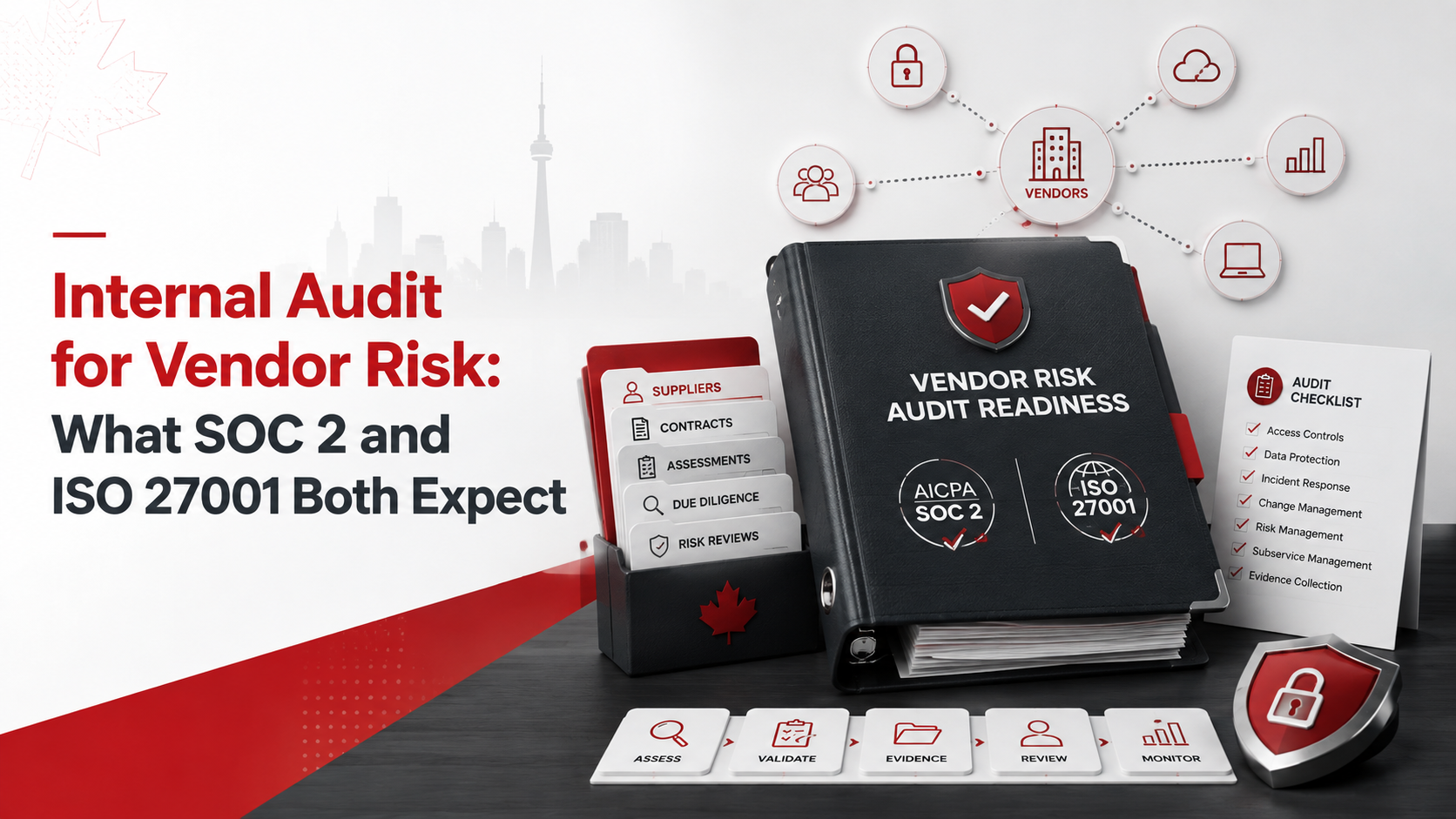
Internal Audit for Vendor Risk: What SOC 2 and ISO 27001 Both Expect
Vendor risk is not only a procurement issue. It is a security, privacy, service delivery, and customer trust issue.
Quick Answer
What do SOC 2 and ISO 27001 expect for vendor risk?
Both expect a structured vendor risk process.
Internal audit should check the vendor register, risk ratings, owners, contracts, DPAs, vendor security evidence, subprocessors, AI vendors, vendor access, and corrective actions.
SOC 2 focuses on vendors that affect service commitments.
ISO 27001 focuses on supplier risk through the ISMS.
Canadian Cyber Vendor Risk Support
Build Vendor Evidence That Works for SOC 2 and ISO 27001
Canadian Cyber helps organizations audit vendor risk and organize evidence for SOC 2, ISO 27001, customer reviews, and AI governance.
We review vendor registers, contracts, DPAs, security reports, subprocessors, access records, AI vendors, and corrective actions.
Quick Snapshot
| Vendor Risk Area | SOC 2 Expectation | ISO 27001 Expectation |
|---|---|---|
| Vendor Register | Identify key vendors and subservice organizations. | Identify suppliers that affect information security. |
| Risk Rating | Understand impact on service commitments. | Assess supplier risk through the ISMS. |
| Contracts and DPAs | Support commitments and data protection. | Define supplier security requirements. |
| Security Reviews | Review relevant vendor controls. | Review supplier controls based on risk. |
| AI Vendors | Review tools that process data or affect outputs. | Include AI vendor risk in supplier and risk processes. |
| Corrective Actions | Track vendor issues and remediation. | Track nonconformities and improvement actions. |
Why Vendor Risk Matters in Internal Audit
Most companies do not operate alone.
They use cloud providers, SaaS tools, payroll systems, backup vendors, security platforms, AI tools, payment processors, MSPs, and consultants.
Each vendor can create risk.
Some vendors store data. Some process data. Some can access systems. Some affect availability. Some support customer commitments.
A vendor list is not enough. Internal audit should test whether vendors are risk-rated, reviewed, owned, and monitored.
Who This Blog Is For
- SaaS companies preparing for SOC 2.
- Organizations preparing for ISO 27001 certification.
- MSPs managing client tools and vendor platforms.
- FinTech, HealthTech, AI, and professional services firms.
- Security managers, IT managers, procurement teams, and compliance teams.
- Companies using SharePoint or Microsoft 365 for evidence management.
The Main Vendor Risk Audit Question
Do not stop at this question:
“Do we have vendors?”
Every organization does.
Ask a stronger question:
“Can we prove that important vendors are identified, risk-rated, reviewed, contractually controlled, monitored, and included in our risk process?”
1. Audit Vendor Register Completeness
The vendor register is the foundation.
If it is incomplete, the rest of the audit will be weak.
Questions to Ask
- Is there a current vendor register?
- Are critical vendors included?
- Are SaaS and cloud providers included?
- Are AI tools included?
- Are subcontractors included?
- Are vendor owners assigned?
Evidence to Review
- Vendor register.
- SaaS inventory.
- Cloud asset inventory.
- Procurement records.
- AI tool inventory.
- Contract repository.
2. Audit Vendor Criticality and Risk Rating
Not every vendor needs the same review depth.
Internal audit should check whether vendor reviews match vendor risk.
Risk Factors to Review
Practical rule: vendor review depth should match vendor risk.
Need to Audit Vendor Risk for SOC 2 and ISO 27001?
Canadian Cyber can review your vendor register, vendor risk ratings, contracts, DPAs, AI vendors, subcontractors, vendor access, and corrective actions.
For senior advisory support, view Waqar Mehboob’s profile.
3. Audit Vendor Ownership
Vendor risk fails when no one owns the relationship.
Each critical vendor should have a named owner.
| Ownership Question | Evidence to Review |
|---|---|
| Who owns the vendor? | Vendor register with owner fields. |
| Who reviews vendor evidence? | Security review workflow. |
| Who approves vendor risk? | Risk owner list and approval records. |
| Who tracks renewals? | Renewal tracker and contract owner list. |
4. Audit Vendor Due Diligence Before Approval
Vendor review should happen before the vendor is used.
If review happens after onboarding, risk may already be inside the business process.
Evidence to Review
5. Audit Contracts, DPAs, and Security Requirements
Contracts are part of vendor risk evidence.
They show whether security and privacy expectations are documented.
Contracts should turn vendor risk expectations into enforceable obligations.
6. Audit Vendor Security Evidence
For high-risk vendors, internal audit should check security evidence.
This may include SOC 2 reports, ISO certificates, questionnaires, or penetration test summaries.
| Evidence Type | Audit Check |
|---|---|
| SOC 2 report | Was it reviewed, not just collected? |
| ISO certificate | Is the scope valid for the service used? |
| Security questionnaire | Were answers reviewed and accepted? |
| Penetration test summary | Were major findings considered? |
Practical rule: collecting vendor security evidence is not enough. Someone must review it and document the conclusion.
7. Audit Subprocessors and Fourth-Party Risk
Vendor risk does not stop with the direct vendor.
Many vendors rely on cloud providers, AI platforms, analytics tools, support partners, and subcontractors.
Audit Questions
- Are subprocessors identified for critical vendors?
- Are subprocessor lists reviewed?
- Are cloud hosting dependencies known?
- Are AI subprocessors reviewed where relevant?
- Are changes monitored where required?
8. Audit Vendor Access to Systems and Data
Some vendors have system access.
Some vendors even have admin access. This should be reviewed carefully.
Vendor access should be reviewed like employee access. Admin vendor access should be reviewed like privileged access.
9. Audit AI Vendor Risk
AI vendor risk is now a common internal audit topic.
Many teams use AI for writing, coding, meeting notes, customer support, analytics, security workflows, and productivity.
If AI tools process business data, they should be reviewed as vendors.
AI Vendor Evidence to Review
10. Audit Ongoing Vendor Monitoring
Vendor review is not a one-time task.
Critical vendors should be monitored after onboarding.
| Monitoring Area | Evidence |
|---|---|
| Planned reviews | Vendor review schedule. |
| Vendor incidents | Vendor incident log. |
| Renewals | Renewal tracker and review notes. |
| Security updates | Updated SOC 2 reports or certificates. |
11. Link Vendor Risk to the Risk Register
Vendor risks should not live only in procurement files.
They should connect to the ISMS risk register and management review.
Example Vendor Risks
12. Audit Vendor Corrective Actions
Vendor findings should be tracked and fixed.
They should not be closed without evidence.
Practical rule: vendor risk findings should close only when evidence proves the gap was fixed.
SOC 2 and ISO 27001 Vendor Evidence Overlap
| Evidence Type | SOC 2 Use | ISO 27001 Use |
|---|---|---|
| Vendor register | Identifies vendors and subservice organizations. | Identifies suppliers and supplier relationships. |
| Vendor risk assessment | Supports vendor oversight. | Supports supplier risk treatment. |
| Contracts and DPAs | Supports commitments and data protection. | Supports security requirements. |
| Vendor access register | Supports logical access control. | Supports access and supplier controls. |
| AI vendor assessment | Supports customer assurance questions. | Supports supplier, privacy, and AI governance. |
Vendor Risk Internal Audit Checklist
| Checklist Item | Ready? |
|---|---|
| Vendor register is current. | |
| SaaS tools and cloud providers are included. | |
| AI vendors are included. | |
| Critical vendors are identified. | |
| Vendor owners are assigned. | |
| Risk rating criteria are defined. | |
| Security review is completed before onboarding. | |
| Contracts and DPAs are stored. | |
| Vendor security evidence is reviewed. | |
| Subprocessor lists are reviewed. | |
| Vendor access is tracked and reviewed. | |
| Vendor risks are in the risk register. | |
| Vendor findings are tracked through corrective actions. | |
| Management reviews high-risk vendor issues. |
Common Vendor Risk Internal Audit Findings
Tools are used but missing from the official register.
Critical vendors are not classified by impact.
AI tools are used without security or privacy review.
No one documents what vendor evidence means.
Fourth-party dependencies are unclear.
Third-party accounts remain active without review.
How SharePoint Can Help Manage Vendor Risk Evidence
A SharePoint ISMS workspace can make vendor risk easier to audit.
It helps keep owners, evidence, review dates, and risk status visible.
SharePoint Can Track
How Canadian Cyber Helps
Canadian Cyber helps organizations audit vendor risk for SOC 2, ISO 27001, enterprise security reviews, and customer due diligence.
We help teams move from basic vendor lists to structured vendor risk evidence.
Frequently Asked Questions
What is vendor risk internal audit?
It reviews whether vendors are identified, risk-rated, reviewed, owned, monitored, and tracked through corrective actions.
What does SOC 2 expect for vendor risk?
SOC 2 expects organizations to understand vendors and subservice organizations that affect the service and related commitments.
What does ISO 27001 expect for vendor risk?
ISO 27001 expects supplier relationships to be managed through the ISMS, including risk assessment, security requirements, reviews, and improvement actions.
Can the same vendor evidence support SOC 2 and ISO 27001?
Yes. Vendor registers, risk ratings, contracts, DPAs, SOC 2 reports, ISO certificates, access reviews, and corrective actions can often support both.
Should AI vendors be included?
Yes. AI vendors should be reviewed when they process business data, client data, personal information, documents, transcripts, code, or other sensitive information.
Can SharePoint help with vendor risk audits?
Yes. SharePoint can manage vendor registers, risk ratings, contracts, DPAs, evidence, review dates, corrective actions, and dashboards.
Can Canadian Cyber audit vendor risk?
Yes. Canadian Cyber provides vendor risk internal audits, SOC 2 and ISO 27001 evidence mapping, AI vendor reviews, SharePoint tracker setup, and vCISO support.
Takeaway
Vendor risk is a shared expectation across SOC 2 and ISO 27001.
The frameworks use different language.
However, both expect organizations to know which vendors matter, what risks they create, and how those risks are managed.
A strong internal audit should test vendor completeness, risk ratings, contracts, DPAs, security reviews, subprocessors, AI vendors, vendor access, risk register alignment, corrective actions, and management oversight.
Vendor risk should not be managed as a folder of contracts. It should be managed as part of the security and trust program.
Ready to Audit Vendor Risk for SOC 2 and ISO 27001?
Canadian Cyber can help your organization review vendor risk evidence and prepare for audits, customer reviews, and AI governance expectations.
We provide vendor risk internal audits, ISO 27001 internal audit services, SOC 2 readiness support, AI vendor reviews, SharePoint vendor risk trackers, corrective action tracking, vCISO services, ISO 42001 AI governance readiness, ISO 27017 cloud control readiness, ISO 27018 privacy support, and cybersecurity assessments.
Stay Connected With Canadian Cyber
Follow Canadian Cyber for practical guidance on vendor risk, SOC 2, ISO 27001 internal audits, AI vendor reviews, SharePoint ISMS, vCISO services, ISO 42001, ISO 27017, ISO 27018, cybersecurity assessments, and certification readiness.