ISO 27001 Internal Audit
AI Policy
ISO 42001 Readiness
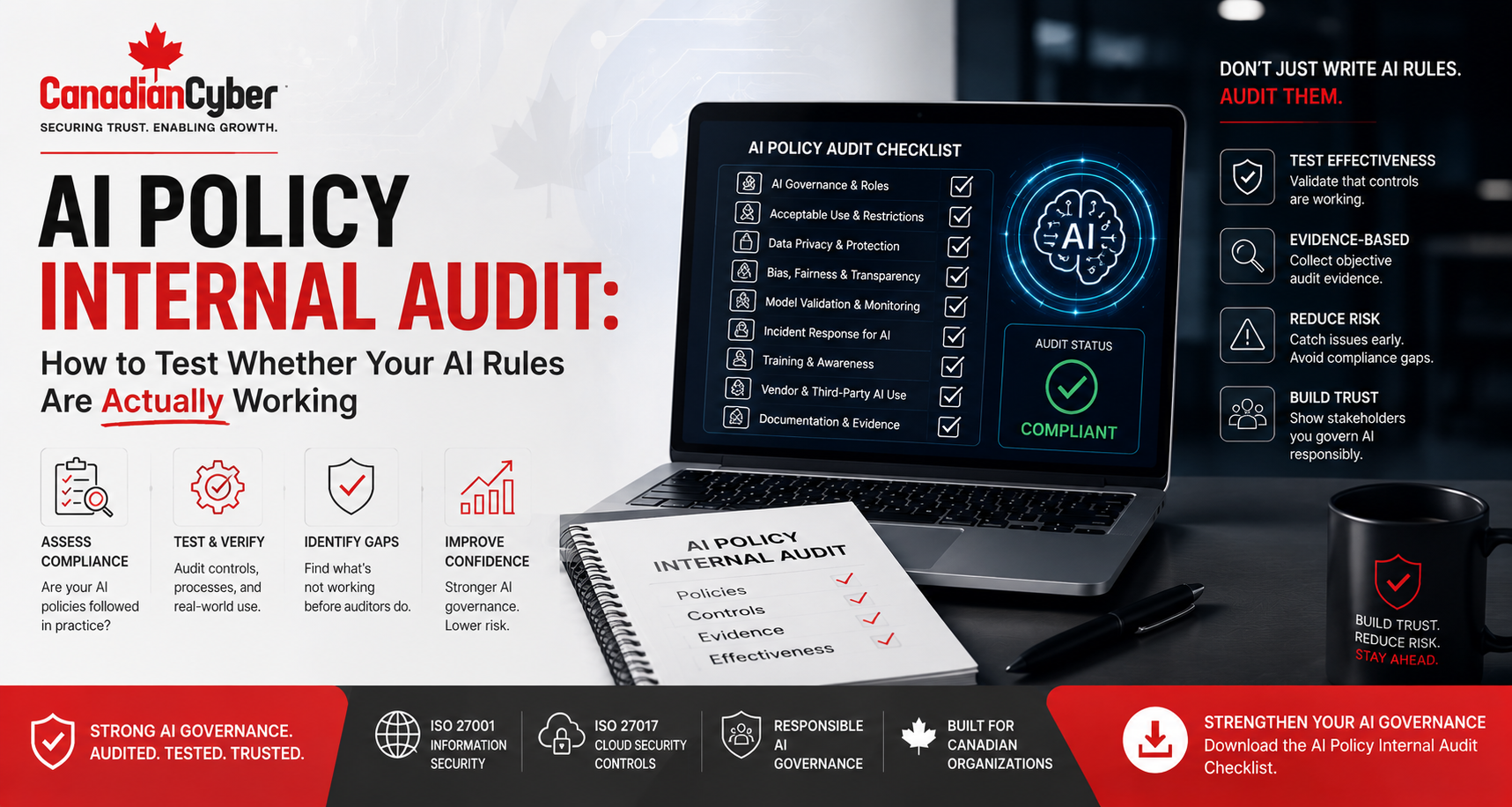
AI Policy Internal Audit: How to Test Whether Your AI Rules Are Actually Working
An AI policy is a good start. However, internal audit must test whether people follow it. This guide shows what to review, what evidence to collect, and what gaps to fix.
Quick Answer
What does an AI policy internal audit check?
It checks whether AI rules are approved, shared, understood, followed, evidenced, and improved.
The audit should review approved tools, prohibited data, training, vendor review, human oversight, Shadow AI, incidents, risks, and corrective actions.
Bottom line: the goal is not to prove that a policy exists. The goal is to prove that the policy works.
Canadian Cyber AI Audit Support
Move From AI Policy to AI Evidence
Canadian Cyber helps Canadian organizations audit AI policies under ISO 27001.
We review AI acceptable use, approved tools, data rules, vendor records, employee training, Shadow AI, incident reporting, and corrective actions.
Quick Snapshot
| Audit Area | What to Test |
|---|---|
| Policy Approval | Is the AI policy approved and owned? |
| Approved Tools | Do employees know which AI tools they can use? |
| Data Rules | Are client data, personal data, secrets, and source code restricted? |
| Training | Are employees trained and acknowledgments retained? |
| Vendor Review | Are AI vendors assessed before use? |
| Shadow AI | Are unapproved tools identified and managed? |
| Corrective Actions | Are gaps tracked to verified closure? |
Why AI Policies Need Internal Audit
Many organizations create AI policies quickly.
Customers ask about AI. Employees already use AI tools. Leadership wants control. Also, ISO 27001 audits now raise more AI questions.
However, a policy only helps when people follow it.
An AI policy is not audit-ready until you can prove that employees understand it and use it.
Who This Blog Is For
- Canadian businesses using AI tools.
- SaaS, MSP, FinTech, HealthTech, AI, and professional services teams.
- ISMS managers, internal auditors, privacy leads, and compliance teams.
- Organizations using Microsoft 365, Copilot, ChatGPT, or other AI tools.
- Teams preparing for ISO 27001, SOC 2, ISO 42001 readiness, or customer reviews.
The Main Audit Question
Do not stop at this question:
“Do we have an AI policy?”
Instead, ask this:
“Can we prove that our AI policy works in real business workflows?”
This means the audit must review departments, tools, records, vendors, incidents, and evidence.
1. Audit AI Policy Approval and Ownership
First, check whether the AI policy has clear ownership.
A policy without an owner becomes outdated fast.
Questions to Ask
- Who owns the AI policy?
- Was it approved by leadership?
- When was it last reviewed?
- Is there a next review date?
- Is the policy version-controlled?
Evidence to Review
- Approved AI policy.
- Policy approval record.
- Version history.
- Policy owner assignment.
- Policy change log.
2. Audit AI Policy Scope
Next, check who and what the policy covers.
A narrow policy can miss real AI use.
The Policy Should Cover
3. Audit Approved and Prohibited AI Tools
Employees cannot follow AI rules if the approved tool list is unclear.
Therefore, internal audit should check how tools are approved, restricted, and removed.
| Question | Evidence |
|---|---|
| Is there an approved AI tool list? | Approved AI tool register. |
| Who approves new AI tools? | Tool approval workflow. |
| Are restricted tools listed? | Restricted tool register. |
| Are prohibited tools listed? | Prohibited tool list. |
| Are unused tools removed? | Tool removal evidence. |
4. Audit Prohibited Data Rules
This is one of the highest-risk AI policy areas.
The policy should clearly explain what employees must not paste, upload, summarize, or analyze in AI tools.
Restricted or Prohibited Data
Avoid vague rules. “Do not enter sensitive data” is not enough.
Need an AI Policy Audit Before ISO 27001?
Canadian Cyber can review your AI policy, evidence records, department use, vendor review, Shadow AI risk, and corrective actions.
5. Audit AI Training and Awareness
A policy that employees have not seen is weak evidence.
So, internal audit should check training and acknowledgment records.
Ask
- Was the policy shared with employees?
- Did employees acknowledge it?
- Are new hires trained?
- Are contractors included?
- Are high-risk departments trained separately?
Review
- Training completion report.
- Employee acknowledgments.
- New hire checklist.
- Contractor training records.
- Awareness messages.
6. Audit AI Vendor Review
AI tools are vendors.
Therefore, they should not bypass procurement, privacy, security, or legal review.
Evidence to Review
7. Audit Human Review of AI Outputs
AI outputs can be wrong, biased, incomplete, or outdated.
As a result, human review should be required for important outputs.
AI can assist the work. However, people remain accountable for the final result.
8. Audit Shadow AI
Shadow AI means employees use AI tools without approval or visibility.
This can happen through personal accounts, browser extensions, meeting bots, plug-ins, or SaaS AI features.
9. Sample Real Department Use
A strong audit does not stay with the policy owner.
Instead, it samples real teams and real workflows.
| Department | Sample AI Policy Question |
|---|---|
| Marketing | Are AI-generated posts reviewed before publishing? |
| Sales | Are client details restricted in AI prompts? |
| Support | Are tickets summarized only in approved tools? |
| HR | Are people-impacting outputs reviewed by HR? |
| Engineering | Is AI-generated code reviewed before use? |
| Compliance | Are AI-assisted policies reviewed before approval? |
10. Review AI Incidents, Exceptions, and Risks
AI policy should connect to incident response.
It should also connect to exception management and the risk register.
Otherwise, AI problems stay informal.
Common AI Risks to Track
11. Include AI Governance in Management Review
Leadership should see AI risks, gaps, incidents, exceptions, and corrective actions.
This helps AI governance become a business issue, not only a policy issue.
Practical rule: AI risk affects the whole organization. Therefore, leadership should review it.
AI Policy Internal Audit Checklist
| Checklist Item | Ready? |
|---|---|
| AI policy is approved. | |
| AI policy has an owner. | |
| AI policy has a review date. | |
| Approved AI tool list exists. | |
| Restricted and prohibited tools are documented. | |
| Prohibited data rules are clear. | |
| Client data restrictions are defined. | |
| Personal information restrictions are defined. | |
| Credentials and secrets are prohibited in prompts. | |
| AI vendors are reviewed. | |
| AI risks are in the risk register. | |
| Employees are trained on AI rules. | |
| Employee acknowledgments are retained. | |
| Human review requirements are documented. | |
| Shadow AI risk is assessed. | |
| AI incidents can be reported. | |
| AI exceptions are approved and time-limited. | |
| Management review includes AI governance. |
Common AI Policy Audit Findings
Employees did not receive training or acknowledgment requests.
Employees do not know which tools they can use.
The policy does not explain client data, personal data, code, screenshots, or uploads.
Tools are used before privacy, security, or legal review.
Teams say they review AI outputs, but no proof exists.
Unapproved tools may be used without visibility.
Corrective Action Examples
| Finding | Immediate Correction | Long-Term Fix |
|---|---|---|
| Policy not communicated. | Send it to employees. | Add annual AI training and acknowledgment. |
| No approved tool list. | Publish the list. | Create an AI tool approval workflow. |
| Vague data rules. | Add examples. | Update training and data classification guidance. |
| AI vendor not reviewed. | Complete review. | Add AI tools to vendor onboarding. |
| Shadow AI found. | Restrict risky tool. | Run recurring AI discovery reviews. |
Practical rule: corrective actions should improve the governance process, not only update policy wording.
How SharePoint Can Help Manage AI Policy Evidence
A SharePoint ISMS workspace can keep AI evidence in one controlled place.
Also, it can help owners track reviews, due dates, risks, and corrective actions.
SharePoint Can Track
How Canadian Cyber Helps
Canadian Cyber helps organizations test whether AI policies work in practice.
We review documents, interview teams, test evidence, and build a clear corrective action roadmap.
Frequently Asked Questions
What is an AI policy internal audit?
It reviews whether the AI policy is approved, shared, followed, evidenced, and improved.
Is having an AI policy enough?
No. The organization must also prove that people understand the policy and follow it.
What evidence should auditors request?
Auditors should request the policy, approval records, tool list, training records, acknowledgments, vendor reviews, risks, incidents, exceptions, and corrective actions.
What is Shadow AI?
Shadow AI is the use of AI tools without approval or visibility.
Can SharePoint help manage AI audit evidence?
Yes. SharePoint can track tools, risks, vendors, training, incidents, exceptions, corrective actions, and dashboards.
Can Canadian Cyber audit our AI policy?
Yes. Canadian Cyber can review the policy, test evidence, interview departments, assess Shadow AI, and build corrective actions.
Takeaway
AI policy is now part of internal audit.
That is because most organizations now use AI tools.
Therefore, the real question is simple.
Can the organization prove that AI use is controlled?
A strong audit tests policy approval, tool approval, data rules, training, vendors, human review, Shadow AI, incidents, risks, corrective actions, and management review.
The goal is not more paperwork. The goal is responsible, secure, privacy-aware, and audit-ready AI use.
Ready to Test Whether Your AI Policy Works?
Canadian Cyber can help your organization review AI policy effectiveness before ISO 27001 audits, SOC 2 reviews, ISO 42001 readiness work, customer reviews, or board reporting.
We provide AI policy internal audits, ISO 27001 internal audit services, SharePoint ISMS workspaces, Shadow AI assessments, AI vendor review support, corrective action tracking, vCISO services, SOC 2 readiness alignment, ISO 42001 readiness, and cybersecurity assessments.
Stay Connected With Canadian Cyber
Follow Canadian Cyber for practical guidance on ISO 27001 internal audits, AI policy audits, AI governance, ISO 42001 readiness, SharePoint ISMS, SOC 2, vCISO services, cybersecurity assessments, and certification readiness.