

ISO 27001
Internal Audit
Security Exceptions
Risk Acceptance
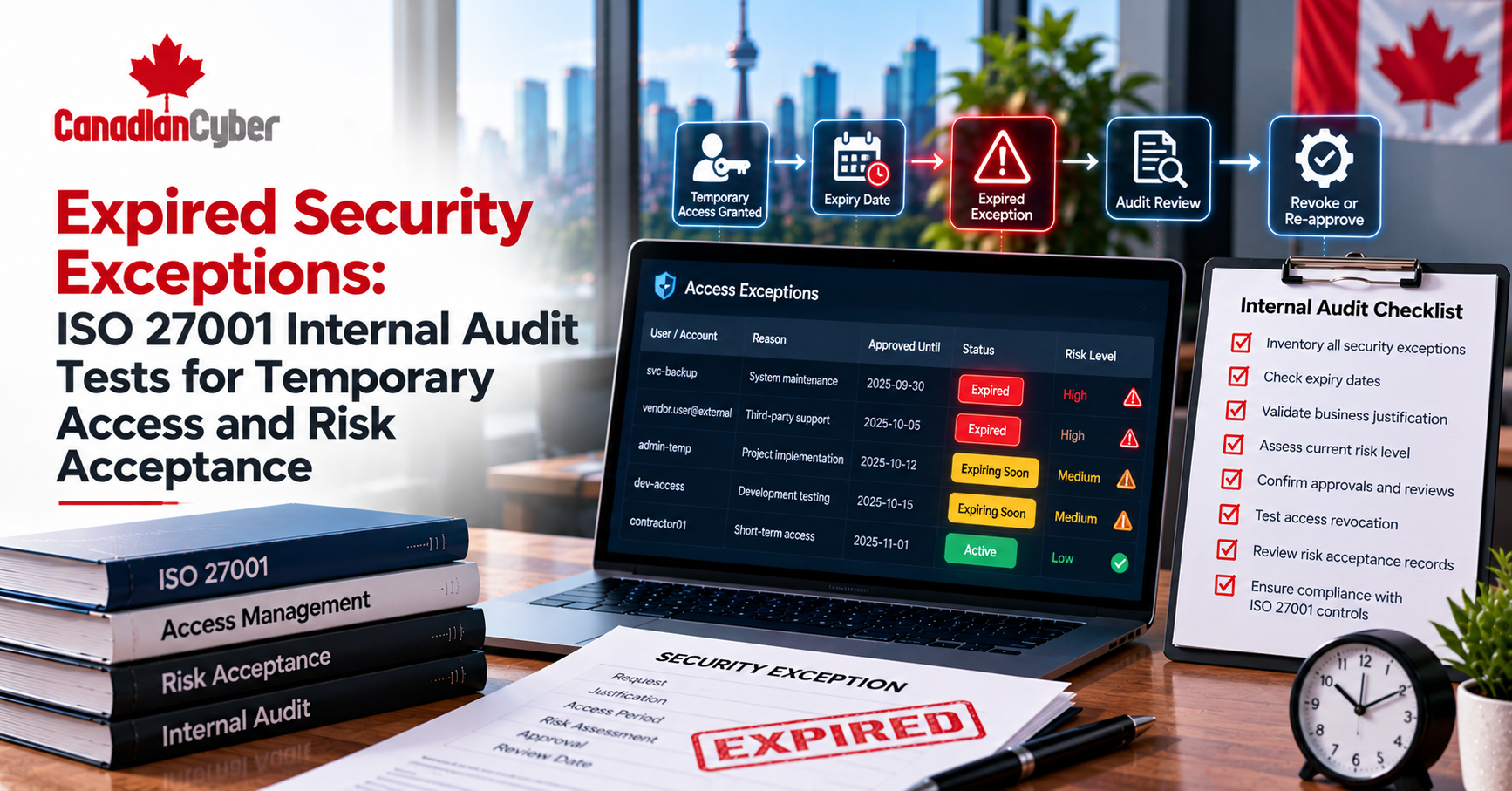
Expired Security Exceptions: ISO 27001 Internal Audit Tests for Temporary Access and Risk Acceptance
Learn how an ISO 27001 security exception audit can uncover expired approvals, forgotten privileged access, weak compensating controls, and outdated risk acceptance.
When Temporary Security Exceptions Become Permanent Risk
“Temporary admin access approved for 30 days.”
Six months later, the access still exists.
“Risk accepted until the new system goes live.”
The project was delayed, but the exception was never reviewed.
“Firewall rule approved as a temporary workaround.”
Nobody remembers why it is still open.
This is how temporary security exceptions become permanent risk.
Exceptions are not automatically bad.
Sometimes the business cannot meet a security requirement immediately.
A temporary approval or compensating control may therefore be reasonable.
The problem begins when the approval expires but the risk remains.
That is why an ISO 27001 security exception audit should test more than whether a register exists.
Quick Answer
What Should an ISO 27001 Security Exception Audit Test?
Internal auditors should review each exception for:
- A clear business justification.
- A named risk owner.
- Correct approval authority.
- Defined start and expiry dates.
- Temporary privileged access.
- Current residual risk.
- Working compensating controls.
- Periodic review.
- Closure evidence.
- Escalation of overdue exceptions.
ISO 27001 uses a risk-based approach.
Therefore, accepting risk should always be an informed decision.
What Is a Security Exception?
A security exception is a documented approval to temporarily operate outside a security requirement, control, standard, or access rule.
Examples include:
- Temporary administrator access.
- Delayed patching.
- Unsupported software.
- Firewall exceptions.
- MFA exceptions.
- Temporary vendor access.
- Excessive migration permissions.
- Security configuration deviations.
- Temporary unapproved software.
- Delayed remediation of an audit finding.
A related concept is risk acceptance.
The organization decides that remaining risk can be retained for a defined reason.
However, that decision should remain part of the risk-management process.
Why Expired Exceptions Create Audit Risk
Security exceptions often begin with legitimate business needs.
For example:
That may be reasonable for five days.
It becomes harder to justify five months later.
Expired exceptions may leave:
- Unnecessary privileged access.
- Weak authentication.
- Open firewall rules.
- Vulnerable systems.
- Unsupported applications.
- Uncontrolled vendor access.
- Unapproved software.
- Excessive residual risk.
Test 1: Can You Produce a Complete Exception Register?
Start with visibility.
Ask for the current security exception register.
It should include exceptions related to:
- Access control.
- Vulnerability remediation.
- Cloud configurations.
- Network security.
- MFA.
- Vendor access.
- Unsupported systems.
- Secure development.
- Endpoint controls.
- Policies and standards.
Useful Register Fields
| Field | What It Shows |
|---|---|
| Exception ID | Unique reference |
| Requirement / Control | What is being bypassed |
| Business Justification | Why the exception exists |
| Risk | What could happen |
| Risk Owner | Who accepts accountability |
| Compensating Control | What reduces temporary risk |
| Approval | Who authorized it |
| Start Date | When the exception began |
| Expiry Date | When approval ends |
| Review Date | When it must be reconsidered |
| Status | Active, Expired, or Closed |
| Closure Evidence | Proof the exception ended |
Internal Audit Test
Compare the register with:
- Access-management records.
- Vulnerability exceptions.
- The risk register.
- Firewall changes.
- Audit findings.
- Vendor exceptions.
Test 2: Find Every Expired Exception
This should be one of the easiest tests.
Filter for:
Every result needs attention.
Ask why it remains active.
- The project was delayed.
- The owner forgot.
- The exception was renewed informally.
- The issue was fixed but the record stayed open.
- The original owner no longer exists.
Test 3: Review Temporary Privileged Access
Temporary privileged access deserves extra scrutiny.
Examples include:
- Global Administrator access.
- Domain Administrator rights.
- Production database administration.
- Root access.
- Cloud subscription owner.
- Temporary security-admin roles.
Sample temporary privileged-access approvals.
Actual access: Still active October 14
Then ask:
- Why was privileged access required?
- Who approved it?
- Was the end date defined?
- Was access removed on time?
- Was privileged activity logged?
- Was continued access separately approved?
Test 4: Challenge the Risk Acceptance
A risk owner approved the exception.
Now ask whether the original decision is still valid.
Internal audit should ask:
- Has the threat changed?
- Has likelihood increased?
- Has business impact changed?
- Is the affected system more critical?
- Has the system become internet-facing?
- Is new threat intelligence available?
- Is the vulnerability now actively exploited?
- Has the original risk owner changed?
Test 5: Verify the Compensating Control
This is one of the most important tests.
Do not only read the compensating-control description.
Example: MFA Exception
Exception: MFA cannot be enabled.
Compensating control: Access restricted to corporate VPN.
Internal audit should verify:
- VPN enforcement exists.
- Bypass is not possible.
- Relevant users use it.
- Logs support the control.
- The configuration is still active.
Example: Delayed Patch
Exception: Critical patch delayed.
Compensating control: Vulnerable server isolated from internet access.
Verify the isolation.
Are Expired Exceptions Hiding in Your ISMS?
Canadian Cyber can independently test security exceptions, temporary access, risk acceptance, compensating controls, and closure evidence as part of an ISO 27001 internal audit.
Identify forgotten exceptions before they become certification findings.
Test 6: Verify That the Exception Has an Owner
Every exception should have someone accountable for the remaining risk.
Avoid vague owners such as:
Use a responsible person or role with decision authority.
Ask whether the owner:
- Still works for the organization.
- Still manages the business area.
- Understands the exception.
- Accepts the residual risk.
- Knows when the exception expires.
Test 7: Sample the Evidence Behind the Approval
A row in a spreadsheet is not enough.
Choose several exceptions and trace them from start to finish.
Request
↓
Business Justification
↓
Risk Assessment
↓
Compensating Controls
↓
Risk Owner Approval
↓
Technical Implementation
↓
Review
↓
Expiry or Closure
Useful evidence includes:
- Exception request.
- Email or workflow approval.
- Risk assessment.
- Change ticket.
- Access record.
- Firewall configuration.
- Vulnerability evidence.
- Compensating-control test.
- Review record.
- Closure evidence.
Test 8: Check Whether Renewals Are Real Reviews
Some organizations handle expired exceptions by changing the date.
Changing the date alone is not necessarily a review.
A renewal should ask:
- Is the exception still necessary?
- Has the risk changed?
- Is the workaround still appropriate?
- Are compensating controls working?
- Is a permanent solution available?
- Why has remediation not happened?
- Should management escalate the issue?
Repeated renewal should trigger a decision.
- Fix the issue.
- Change the control design.
- Reassess the risk.
- Update the relevant standard.
- Stop the underlying activity.
Test 9: Verify Closure
Closing the record in the tracker is not enough.
Verify that the technical exception actually ended.
Example: Vendor Administrator Access
The tracker says the exception is closed.
Internal audit should confirm:
- The vendor admin account is disabled.
- The privileged role is removed.
- Active sessions are terminated where relevant.
- Credentials are revoked.
- Access logs are retained.
Example: Delayed Patch
- The upgrade is complete.
- The vulnerability no longer exists.
- A rescan confirms remediation.
Test 10: Check Escalation and Management Oversight
Expired exceptions should not disappear into an aging report.
Create an escalation process.
Exception Expires
↓
Owner Notified
↓
Security Reviews
↓
Renew / Remediate / Close
↓
High-Risk Items Escalated
↓
Management Visibility
Useful Management Metrics
27
8
4
2
312 days
6
What About Access Rights?
Expired access exceptions connect directly to access governance.
Internal audit should compare the register with the actual identity platform.
Always test documented status against technical reality.
How Should Risk Acceptance Be Audited?
A risk acceptance record should contain enough context to support an informed decision.
Useful fields include:
- Risk description.
- Affected asset.
- Threat.
- Vulnerability.
- Potential impact.
- Current controls.
- Residual risk.
- Reason for acceptance.
- Risk owner.
- Approval date.
- Expiration date.
- Review requirement.
Relevant ISO 27001 Areas
| ISO 27001 Area | Audit Relevance |
|---|---|
| Clause 6.1.2 | Risk assessment |
| Clause 6.1.3 | Risk treatment |
| Clause 8.2 | Reassessment after relevant changes |
| Clause 8.3 | Risk treatment implementation |
| Clause 9.1 | Monitoring and evaluation |
| Clause 9.2 | Internal audit |
| Clause 10.2 | Corrective action |
| A.5.15 | Access control |
| A.5.16 | Identity management |
| A.5.17 | Authentication information |
| A.5.18 | Access rights |
| A.8.2 | Privileged access rights |
| A.8.3 | Information access restriction |
| A.8.8 | Technical vulnerability management |
| A.8.15 | Logging |
| A.8.16 | Monitoring |
Common Security Exception Audit Findings
The approval ended, but the exception remains.
“Temporary” access has no defined end.
Nobody is accountable for the remaining risk.
The compensating control has never been tested.
Dates change without reassessment.
The same temporary issue returns every quarter.
Accountability was never transferred.
The tracker says closed, but access still exists.
The record was closed without verification.
High-risk overdue exceptions remain buried.
Quick ISO 27001 Security Exception Audit Checklist
Before closing the audit, confirm:
- A centralized exception register exists.
- Exceptions have unique IDs.
- Business justification is documented.
- Every exception has an owner.
- Residual risk is understood.
- Approval authority is defined.
- Start dates are recorded.
- Expiry dates are mandatory.
- Temporary privileged access expires.
- Compensating controls are documented.
- Compensating controls are tested.
- Expired exceptions are identified.
- Renewals require reassessment.
- Repeat renewals trigger escalation.
- Technical access matches the register.
- Closed exceptions have evidence.
- Risk acceptance is time-bound where appropriate.
- High-risk overdue exceptions reach management.
- Evidence sampling confirms the process works.
Security Exception Audit Tracker
A simple tracker makes the review much easier.
| Exception ID | Exception | Owner | Risk | Compensating Control | Approved By | Expiry | Status | Last Review | Evidence |
|---|---|---|---|---|---|---|---|---|---|
| EX-001 | Temporary admin access | IT Manager | High | PAM + logging | CISO | 30-Oct | Active | 01-Oct | Link |
| EX-002 | Patch delay | App Owner | Medium | Network isolation | Risk Owner | 15-Sep | Expired | 15-Aug | Link |
| EX-003 | MFA exception | HR Director | High | VPN restriction | CISO | 01-Dec | Active | 01-Oct | Link |
Add filters for:
Expired
Expiring Soon
High Risk
Privileged Access
Repeated Renewals
Want an Editable Security Exception Audit Tracker?
Use an editable tracker to record exception owners, risk, compensating controls, approvals, expiry dates, reviews, and closure evidence.
Frequently Asked Questions
What is an ISO 27001 security exception audit?
It tests whether security deviations are justified, risk assessed, approved, time-bound, reviewed, and properly closed.
Does ISO 27001 require a security exception register?
ISO 27001 does not prescribe a document with that exact name.
However, a structured register can provide useful evidence for risk treatment, access management, corrective action, and internal audit.
Should security exceptions have expiry dates?
Temporary exceptions should normally have a defined review or end point, especially for privileged access.
What happens when a security exception expires?
The organization should reassess it.
- Close the exception.
- Remove temporary access.
- Complete remediation.
- Renew with new approval.
- Update compensating controls.
- Escalate remaining risk.
What is a compensating control?
It is another security measure used to reduce risk when the preferred control cannot currently be implemented.
Is risk acceptance permanent?
Not necessarily. Risk conditions can change, so important acceptance decisions should be reviewed when circumstances change.
What should auditors sample?
Prioritize higher-risk exceptions.
- Expired exceptions.
- Privileged access.
- High residual risk.
- Long-running exceptions.
- Repeated renewals.
- Missing owners.
- Weak compensating controls.
The Takeaway
Security exceptions are supposed to create controlled flexibility.
They should not create permanent blind spots.
Every exception should answer:
A strong process looks like:
An expired exception breaks that chain.
That is exactly where internal audit should look.
Find Expired Exceptions Before Your Certification Auditor Does
Canadian Cyber helps organizations independently test ISO 27001 risk management, access control, privileged access, risk acceptance, security exceptions, corrective actions, and audit evidence.
A focused internal audit can identify:
- Expired approvals.
- Forgotten temporary access.
- Weak compensating controls.
- Missing risk owners.
- Repeated exception renewals.
- Incomplete closure evidence.
- Certification-readiness gaps.
Stay Connected With Canadian Cyber
Follow Canadian Cyber for practical guidance on ISO 27001 internal audits, risk acceptance, access control, corrective actions, and certification readiness.