ISO 27001
SBOM
Software Supply Chain
Internal Audit
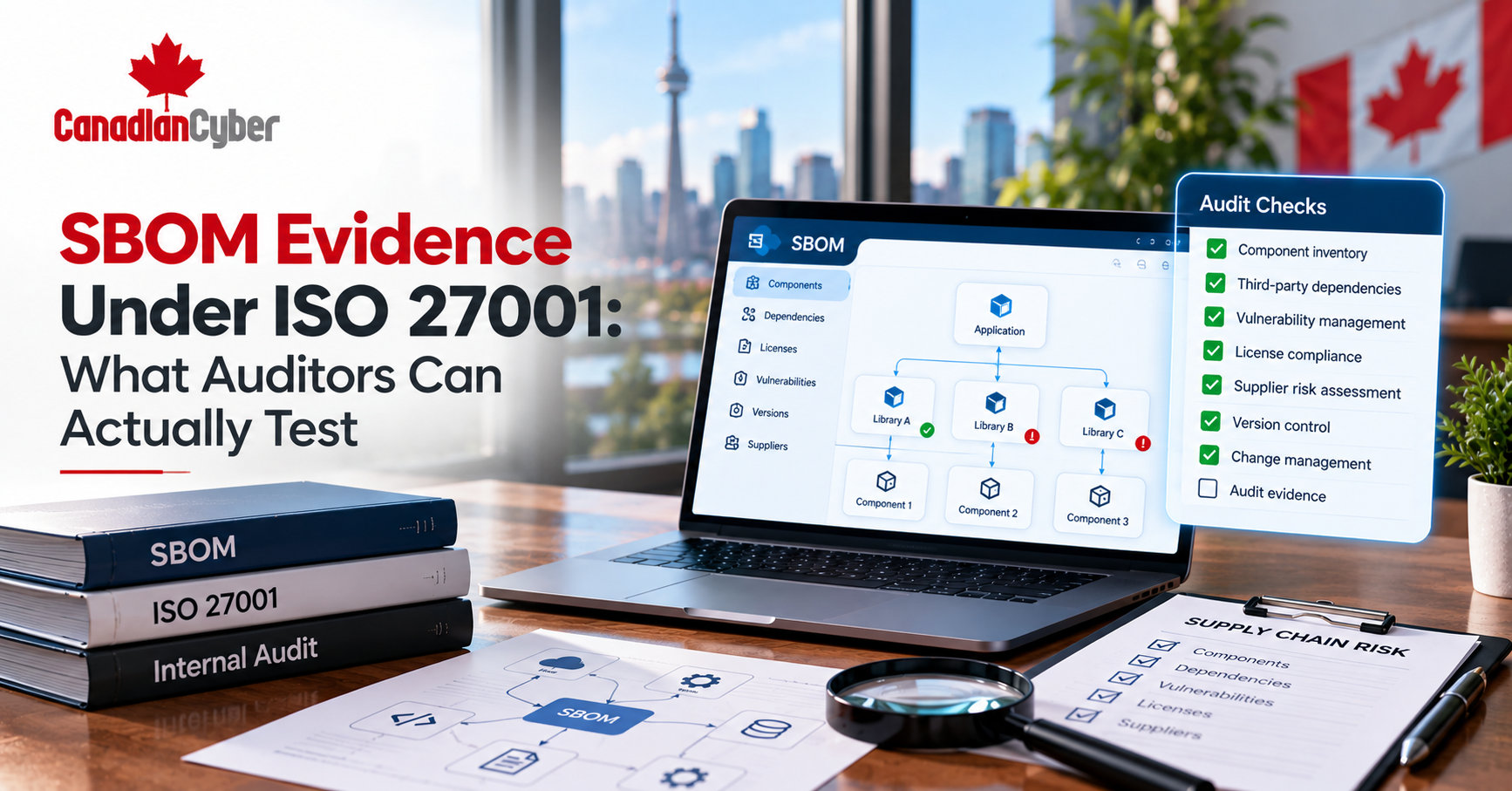
SBOM Evidence Under ISO 27001: What Auditors Can Actually Test
Having an SBOM is not enough. Learn how ISO 27001 internal auditors can test SBOM accuracy, coverage, vulnerabilities, ownership, suppliers, updates, and remediation.
Having an SBOM Does Not End the Audit
“Do you have an SBOM?”
“Yes.”
The development team opens a folder.
There is a JSON file inside.
Audit complete?
Not even close.
A Software Bill of Materials can provide valuable software visibility.
However, simply creating an SBOM does not prove that risk is controlled.
Instead, internal audit should test whether the SBOM works as part of the security process.
A stronger audit asks:
That is where SBOM evidence becomes useful.
Quick Answer
What SBOM Evidence Should an ISO 27001 Auditor Test?
Internal audit should verify that the organization’s SBOM:
- Covers relevant applications.
- Identifies software components and versions.
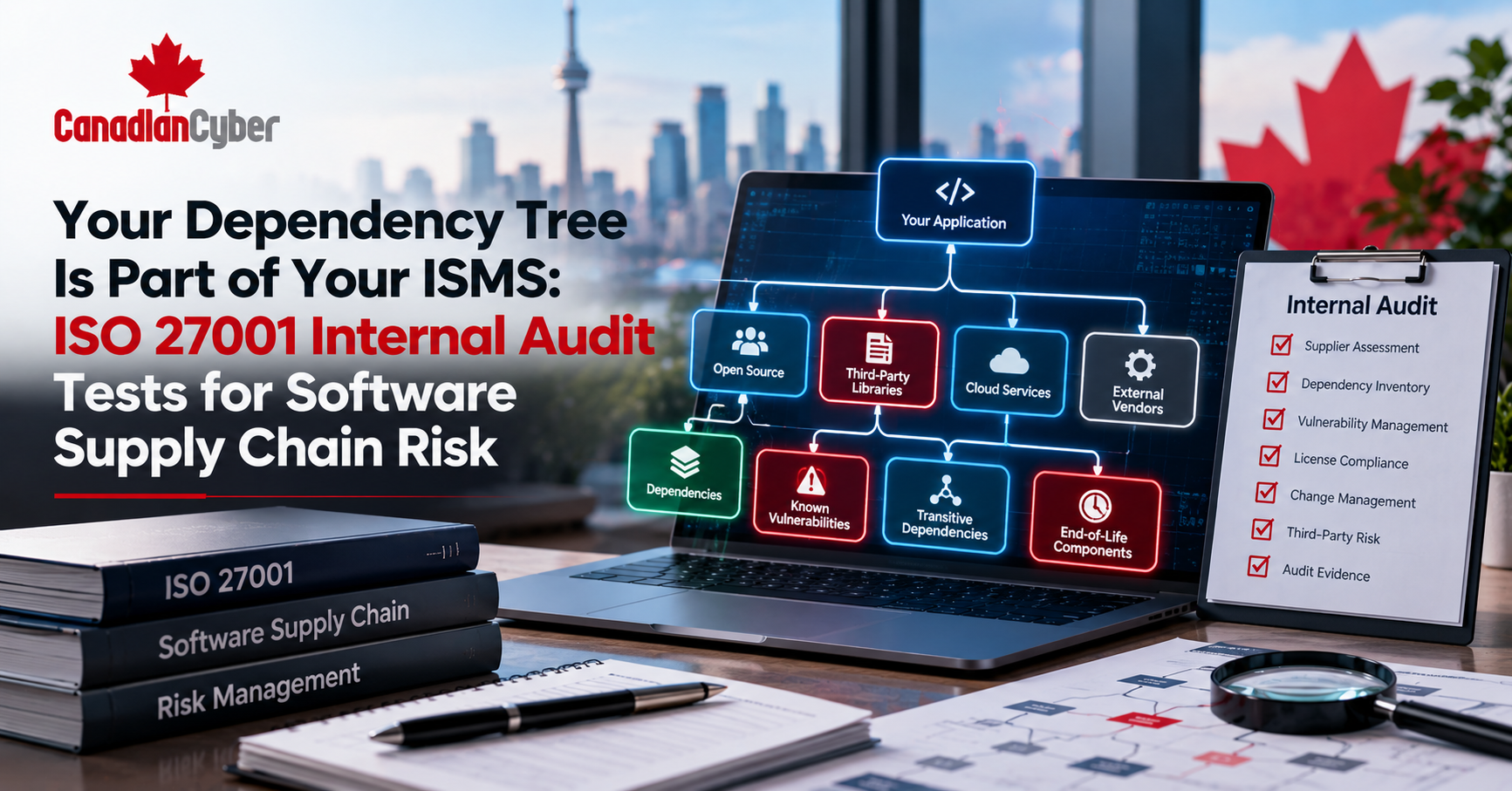
- Shows dependency relationships.
- Includes transitive dependencies where appropriate.
- Matches the current software release.
- Is regenerated after software changes.
- Connects to vulnerability monitoring.
- Has clear ownership.
- Supports fast impact analysis.
- Leads to tracked remediation.
CISA’s 2025 guidance links each software version or update with an associated SBOM.
It also calls for component and transitive dependency coverage.
Bottom line: test the SBOM as an operating security control, not simply as a file.
What Does an SBOM Actually Prove?
An SBOM is similar to an ingredient list for software.
It may identify:
However, an SBOM does not prove those components are secure.
It provides visibility.
The organization still needs to evaluate and act on that visibility.
Therefore, internal audit should look beyond the SBOM file.
1. Test Whether the SBOM Exists for the Right Applications
Do not begin by reviewing individual SBOM fields.
First, ask:
Then compare the answer with the application inventory.
| Application | Criticality | SBOM Available? |
|---|---|---|
| Customer Portal | High | Yes |
| Billing Platform | Critical | Yes |
| Internal Reporting Tool | Low | No |
| Customer API | High | No |
Now the auditor has something useful to investigate.
For example, why does the high-risk customer API have no SBOM?
Evidence to Request
- Application inventory.
- Software asset inventory.
- Criticality ratings.
- SBOM repository.
- Secure development procedure.
- Risk assessment.
Audit Test
Select several critical applications.
Then confirm that required SBOMs actually exist.
Do not simply accept the statement, “Our teams generate SBOMs.”
2. Verify That the SBOM Matches the Current Release
This is one of the most important checks.
An organization may have an SBOM.
However, it may describe software released six months ago.
Meanwhile, production may have changed many times.
Therefore, compare:
Also review:
- Build date.
- Release number.
- SBOM timestamp.
- Commit or build reference.
- Version information.
Production: Version 8.7.4
Latest SBOM: Version 8.2.0
The organization has an SBOM, but it may not describe its current risk.
3. Test Component Coverage
Next, ask what is actually inside the SBOM.
A weak SBOM may list only direct dependencies.
The real application may rely on hundreds of components.
CISA’s 2025 guidance calls for coverage of components that make up the target software.
This includes transitive dependencies.
Sample Audit Test
Choose one direct dependency.
Then trace its dependency tree.
Application
↓
Package A
↓
Package B
↓
Package C
If Package C is missing, ask why.
Useful Evidence
- SBOM.
- Package manifest.
- Lock file.
- Software composition analysis report.
- Build records.
- Container scan.
You do not need to inspect thousands of components manually.
Instead, use sampling to test whether the SBOM process is reliable.
4. Test the Component Version
A component name alone has limited security value.
For example:
Which version?
That detail may determine whether a known vulnerability applies.
Therefore, sample several components.
Compare:
If the values differ, investigate the SBOM generation process.
5. Test Dependency Relationships
An SBOM should show how components relate to the application.
For example:
This relationship becomes important during incident response.
If Package C becomes vulnerable, the organization needs to find every affected application.
6. Test How the SBOM Is Generated
Next, ask how the SBOM is created.
Common methods include:
- Build pipeline generation.
- Software composition analysis.
- Source repository scanning.
- Container analysis.
- Manual generation.
- Supplier-provided SBOMs.
Automated generation may improve repeatability.
However, automation does not guarantee accuracy.
Internal Audit Should Check
- When generation occurs.
- Which tool creates the SBOM.
- Whether failed generation blocks the build.
- Whether someone reviews the output.
- Where the SBOM is stored.
- How errors are corrected.
Stronger evidence: the CI/CD pipeline generates an SBOM for every approved release.
Can Your SBOM Actually Support an Audit?
Canadian Cyber can help test SBOM coverage, vulnerability response, software supply chain controls, supplier evidence, and remediation.
The goal is to prove that the SBOM supports real security decisions.
7. Test Whether the SBOM Connects to Vulnerabilities
This is where an SBOM becomes operational.
Ask the security team:
A mature process may look like this:
New CVE
↓
Affected Component Identified
↓
SBOM Searched
↓
Affected Applications Found
↓
Owners Notified
↓
Risk Assessed
↓
Remediation Tracked
The team should not need to email every developer to ask who uses a package.
Audit Test
Choose a previously disclosed vulnerability.
Ask the organization to show:
- Which component was affected.
- Which applications contained it.
- Who was notified.
- How risk was evaluated.
- What remediation occurred.
- How closure was verified.
This tests both the SBOM and the surrounding security process.
8. Test the Critical Vulnerability Today Scenario
A practical internal audit exercise is simple.
A critical vulnerability has just been announced in Component X. Show me how you determine whether we are exposed.
Then observe the process.
Can the team answer:
- Do we use the component?
- Which version do we use?
- Which applications contain it?
- Is it in production?
- Who owns those applications?
- Is the vulnerable function reachable?
- What action is required?
An SBOM should make this investigation faster.
If the team still relies on memory, the SBOM may not support vulnerability management.
9. Review Known Unknowns
No SBOM process is perfect.
The important point is whether the gaps are visible.
CISA’s 2025 guidance refers to incomplete dependency information as Known Unknowns.
Look for:
- Missing dependencies.
- Unsupported package types.
- Components intentionally excluded.
- Supplier components with limited visibility.
- Proprietary software with incomplete composition data.
A transparent incomplete SBOM may be better than one that falsely appears complete.
10. Test Supplier-Provided SBOM Evidence
Organizations do not build all their software.
Therefore, suppliers may also need to provide component transparency.
For critical suppliers, internal audit may review:
- Supplier SBOM requirements.
- Contract clauses.
- SBOM delivery method.
- Update frequency.
- Vulnerability notification process.
- Supplier security assessments.
Use a Risk-Based Approach
Not every supplier needs the same level of scrutiny.
A critical platform handling sensitive data deserves more attention than a low-risk utility.
11. Test What Happens After a Component Changes
Suppose a developer updates a package.
What happens next?
- Does the SBOM update?
- Does anyone verify the change?
- Does the new package add dependencies?
- Does vulnerability scanning run again?
- Does the build retain evidence?
This connects SBOM management with change management.
Evidence to Review
- Pull request.
- Dependency update.
- Build record.
- Security scan.
- Updated SBOM.
- Testing evidence.
- Deployment approval.
A good audit trail connects each software change with updated component evidence.
12. Test SBOM Ownership
An SBOM without an owner can quickly become stale.
Therefore, internal audit should identify clear responsibilities.
Determine who is responsible for:
- Generating the SBOM.
- Storing it.
- Maintaining it.
- Reviewing errors.
- Monitoring vulnerabilities.
- Responding to supplier updates.
Responsibility may be shared across several teams.
That is fine, but the responsibilities should be clear.
What Strong SBOM Evidence Looks Like
Strong evidence creates a clear chain.
Application
↓
Current Production Release
↓
Current SBOM
↓
Dependencies
↓
Vulnerability Monitoring
↓
Affected Component
↓
Application Owner
↓
Remediation Ticket
↓
Updated Release
↓
New SBOM
↓
Closure Evidence
That is much stronger than simply showing the auditor an SBOM file.
SBOM Evidence and ISO 27001 Controls
ISO/IEC 27001:2022 does not contain a control called “Maintain an SBOM.”
However, SBOM evidence can support several control areas.
| ISO 27001 Control | How SBOM Evidence Can Help |
|---|---|
| A.5.19 Supplier Relationships | Supports software supplier risk review. |
| A.5.20 Supplier Agreements | Supports software security requirements. |
| A.5.21 ICT Supply Chain | Provides software supply chain visibility. |
| A.5.22 Supplier Monitoring | Helps monitor changes in supplied software. |
| A.8.8 Technical Vulnerabilities | Helps locate vulnerable components. |
| A.8.25 Secure Development Life Cycle | Supports secure development evidence. |
| A.8.28 Secure Coding | Supports component governance. |
| A.8.29 Security Testing | Supports component and vulnerability testing. |
| A.8.30 Outsourced Development | Supports externally developed software review. |
| A.8.32 Change Management | Helps trace component changes between releases. |
The exact mapping depends on your scope, risk assessment, development model, and Statement of Applicability.
Common SBOM Internal Audit Findings
Watch for these common patterns.
It was produced once but never updated.
The file describes an older release.
Only direct packages are listed.
The SBOM is not used during vulnerability management.
Nobody owns the SBOM process.
Files are stored but never reviewed.
The organization cannot explain what is missing.
Software changes without updated SBOM evidence.
Vulnerable components have no clear closure evidence.
Quick SBOM Internal Audit Checklist
Before closing the audit, confirm:
- Critical applications requiring SBOMs are identified.
- Current SBOMs exist.
- SBOM versions match software releases.
- Components are uniquely identified.
- Component versions are recorded.
- Dependency relationships are available.
- Transitive dependencies are considered.
- Known gaps are documented.
- SBOMs are regenerated after relevant changes.
- Generation methods are defined.
- SBOMs connect to vulnerability monitoring.
- Critical vulnerabilities can be traced to applications.
- Application owners receive findings.
- Remediation is tracked.
- Supplier SBOM requirements are risk-based.
- SBOM ownership is defined.
- Evidence is retained.
- Closure can be demonstrated.
Centralize SBOM Evidence in Your SharePoint ISMS
Software teams may keep SBOMs and vulnerability data in technical tools.
Meanwhile, ISO 27001 evidence may sit elsewhere.
That can make audit traceability harder.
Canadian Cyber’s ISMS SharePoint Solution can help centralize:
Frequently Asked Questions
Does ISO 27001 require an SBOM?
ISO 27001 does not specifically require every organization to create an SBOM.
However, SBOMs can support software supply chain risk management.
Their use should depend on risk and context.
What should an ISO 27001 auditor check in an SBOM?
The auditor should check more than whether the file exists.
Useful tests include coverage, versions, dependency relationships, vulnerabilities, ownership, updates, and remediation evidence.
Should an SBOM include transitive dependencies?
Current CISA guidance calls for transitive dependency coverage and clear identification of incomplete information.
How often should an SBOM be updated?
The SBOM should stay aligned with the software it describes.
New or revised releases should have updated component evidence.
Is an SBOM the same as a vulnerability scan?
No.
An SBOM identifies software components and relationships.
Vulnerability management evaluates those components for security weaknesses.
What is VEX?
VEX means Vulnerability Exploitability eXchange.
It helps explain whether a product is actually affected by a specific vulnerability.
Can supplier SBOMs be used as audit evidence?
Yes.
However, internal audit should test how the organization receives, updates, evaluates, and uses that information.
The Takeaway
The audit question should not be:
Instead, ask:
Internal audit should test the complete chain:
That chain turns an SBOM into useful security evidence.
The goal is not to create another JSON file.
The goal is to answer important questions faster.
When an organization can answer those questions with evidence, its SBOM program is doing real work inside the ISMS.
Need Help Auditing Software Supply Chain Evidence?
Canadian Cyber helps organizations test software supply chain controls, technical vulnerability management, secure development, supplier security, SBOM evidence, and corrective actions.
Our ISO 27001 internal audit approach focuses on evidence that proves the controls actually operate.
Our ISMS SharePoint Solution can also centralize applications, suppliers, SBOM references, risks, controls, findings, owners, reviews, and corrective actions.
Stay Connected With Canadian Cyber
Follow Canadian Cyber for practical guidance on ISO 27001 internal audits, SBOMs, secure development, software supply chain risk, supplier governance, and SharePoint ISMS.