

ISO 27001 • Internal Audit • NCRs • OFIs • Certification Readiness • Sales Trust
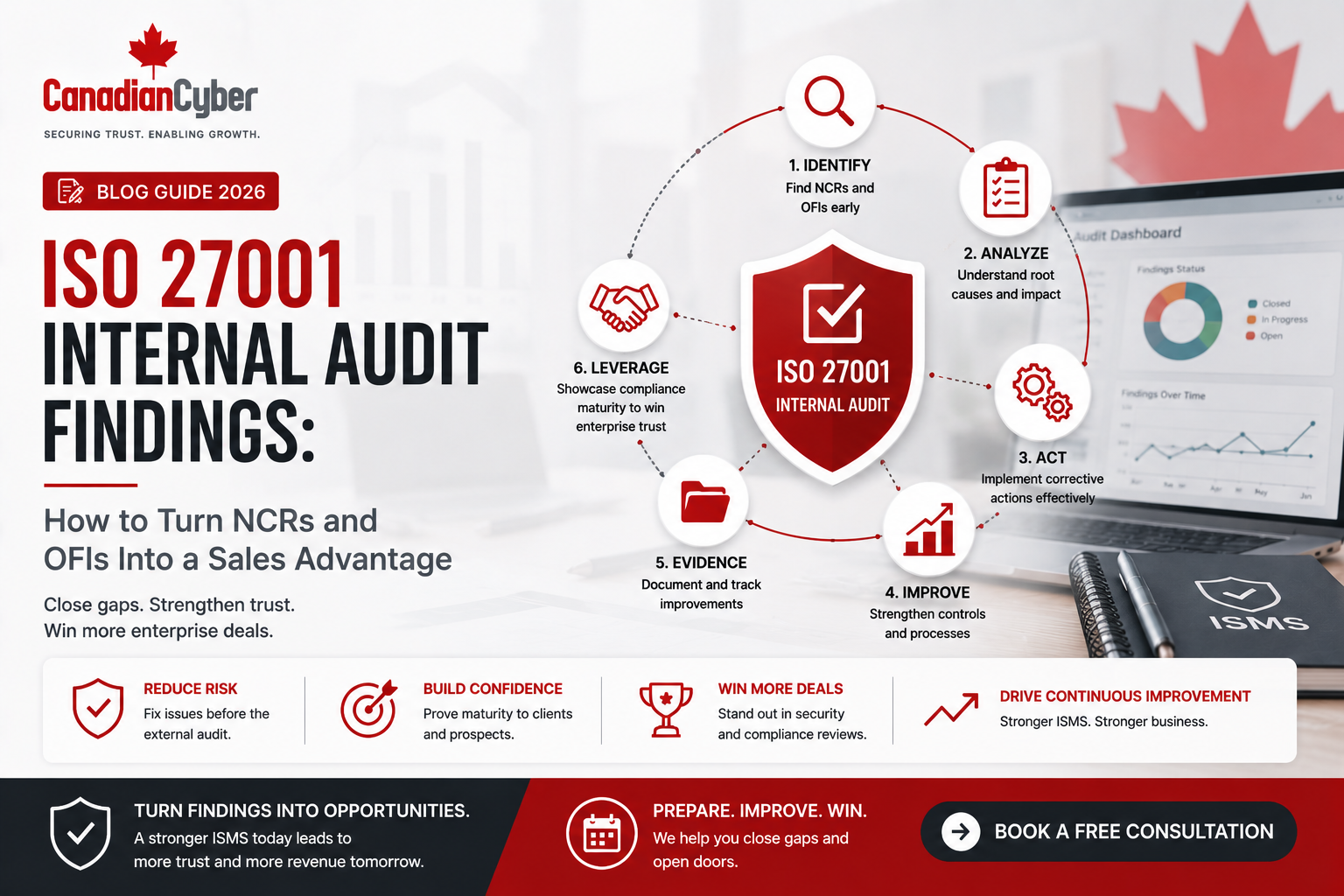
ISO 27001 Internal Audit Findings: How to Turn NCRs and OFIs Into a Sales Advantage
Internal audit findings do not have to weaken customer trust. When NCRs and OFIs are managed properly, they can prove that your organization identifies issues, fixes root causes, and improves security before customers or external auditors ask.
Canadian Cyber ISO 27001 Internal Audit Support
Turn Audit Findings Into Certification Readiness and Customer Trust
Canadian Cyber helps organizations conduct ISO 27001 internal audits, classify NCRs and OFIs, build corrective action trackers, prepare closure evidence, support management review, and create client-ready audit summaries inside a structured SharePoint ISMS.
Quick Answer
ISO 27001 internal audit findings can become a sales advantage when organizations manage NCRs and OFIs transparently, assign owners, document root causes, close corrective actions, and use the results to prove continuous improvement.
Enterprise buyers do not expect vendors to have zero security gaps. They expect vendors to identify, track, and fix issues before those issues create customer risk.
Practical takeaway: A strong internal audit process helps SaaS and growing companies answer security questionnaires faster, support ISO 27001 certification readiness, demonstrate governance maturity, and build trust during procurement.
Quick Snapshot
| Finding Type | What It Means | Sales Advantage |
|---|---|---|
| Major NCR | Significant failure or missing requirement. | Shows urgency and leadership attention when corrected. |
| Minor NCR | Limited gap or partial control weakness. | Shows continuous improvement and audit discipline. |
| OFI | Opportunity to improve a process or control. | Shows proactive maturity and roadmap thinking. |
| Corrective Action | Assigned fix for a finding. | Shows accountability and evidence-based remediation. |
| Closure Evidence | Proof the issue was fixed. | Shows buyers that improvements are real. |
Internal Audit Findings Are Not the Enemy
Many companies see ISO 27001 internal audit findings as bad news. A nonconformity appears. An opportunity for improvement is documented. A control owner feels pressure. Leadership worries about certification. Sales wonders whether the finding will hurt customer trust.
But internal audit findings are not the enemy. Mature organizations do not pretend everything is perfect. They identify issues, classify them, assign owners, fix root causes, track corrective actions, and prove improvement.
For SaaS companies, FinTechs, HealthTech firms, AI startups, MSPs, software companies, and professional services firms selling to enterprise buyers, internal audit findings can become more than certification evidence. They can become a sales advantage.
A well-managed internal audit program shows that your organization does not wait for customers or external auditors to find problems. You test yourself first.
Who This Guide Is For
- SaaS companies preparing for ISO 27001 certification.
- Companies planning an ISO 27001 internal audit.
- Startups selling to enterprise customers.
- FinTech and HealthTech companies preparing vendor due diligence.
- AI companies building security and governance evidence.
- CTOs, IT managers, and compliance leads responsible for controls.
- Sales teams answering security questionnaires.
- Organizations using SharePoint to manage ISMS evidence.
Why Internal Audit Findings Matter for Sales
Enterprise buyers ask vendors many security questions. They want to know whether you perform internal audits, track corrective actions, manage nonconformities, review risks, assign control owners, and improve your security program over time.
A weak vendor says, “We have no issues.” A mature vendor says, “We conduct internal audits, document findings, assign corrective actions, complete root cause analysis, and track closure evidence through our ISMS.”
Practical rule: Internal audit findings are not proof of weakness. Poorly managed findings are.
What Are ISO 27001 Internal Audit Findings?
ISO 27001 internal audit findings are issues, gaps, weaknesses, observations, or improvement opportunities identified during an internal audit of the Information Security Management System.
Findings may relate to:
Annex A controls
risk management
access control
vendor management
incident response
training records
cloud security
privacy controls
management review
The goal is not to embarrass the business. The goal is to test whether the ISMS is working and identify what must improve before external audit, customer review, or certification.
NCR vs OFI: What Is the Difference?
| Finding Type | Meaning | Example |
|---|---|---|
| Major NCR | Serious or systemic failure. | No risk assessment performed for the ISMS scope. |
| Minor NCR | Limited or isolated gap. | One access review was completed late. |
| OFI | Opportunity to improve. | Add better evidence naming rules for auditor readiness. |
NCRs require correction. OFIs create a roadmap for maturity.
Examples of ISO 27001 Internal Audit Findings
| Area | Common NCR Example | Common OFI Example |
|---|---|---|
| Risk Management | Risk register exists but treatment plans are incomplete. | Add review frequency and status date. |
| Access Control | Privileged access review evidence is missing. | Add clearer exception tracking. |
| Vendor Reviews | Critical vendors are not risk assessed. | Add risk rating definitions. |
| Incident Response | Incident response plan has not been tested. | Add ransomware-specific tabletop scenario. |
| Management Review | Minutes do not show decisions or actions. | Create dashboard for overdue corrective actions. |
| AI Governance | AI tools are used without approval or risk review. | Add AI tool inventory and approval workflow. |
Practical rule: The best findings are specific, evidence-based, and easy to translate into corrective actions.
How NCRs Can Become a Sales Advantage
A nonconformity may sound negative, but it can support sales when handled correctly. Enterprise buyers care about maturity. A mature company can explain that it identified a gap during internal audit, documented root cause, assigned an owner, completed corrective action, and verified closure evidence.
For example, a FinTech company preparing for bank vendor due diligence may discover that quarterly privileged access reviews were not consistently documented. Instead of hiding the issue, the company documents a minor NCR, assigns the IT manager as owner, creates a quarterly access review workflow, stores evidence in SharePoint, adds escalation, and verifies closure.
A closed NCR with strong evidence is more valuable than an undocumented control weakness.
How OFIs Can Become a Sales Advantage
OFIs are especially useful for sales because they show proactive improvement. An OFI says, “We meet the requirement, but we are improving the process.”
OFIs that can impress buyers include:
Need Help Turning NCRs and OFIs Into an Improvement Plan?
Canadian Cyber helps organizations conduct ISO 27001 internal audits that do more than identify gaps. We help turn NCRs, OFIs, corrective actions, and evidence into certification readiness, stronger governance, and better customer trust.
The Corrective Action Process: How to Manage Findings Properly
| Step | What to Do |
|---|---|
| 1. Record the Finding | Document the issue clearly. |
| 2. Classify the Finding | Major NCR, minor NCR, OFI, or observation. |
| 3. Identify Root Cause | Understand why it happened. |
| 4. Assign an Owner | Name the accountable person. |
| 5. Define Action Plan | Decide what must be fixed. |
| 6. Collect Evidence | Store proof of correction. |
| 7. Verify Closure | Confirm action was effective. |
| 8. Report to Management | Include status in management review. |
Practical rule: The corrective action tracker is one of the most important documents for proving audit maturity.
Corrective Action Tracker Fields
| Field | Purpose |
|---|---|
| Finding ID | Unique reference. |
| Finding Type | Major NCR, minor NCR, OFI, or observation. |
| ISO Clause or Control | Links finding to requirement. |
| Evidence Reviewed | Shows audit basis. |
| Root Cause | Explains why it happened. |
| Corrective Action | Defines the fix. |
| Owner and Target Date | Creates accountability. |
| Closure Evidence | Proves completion. |
| Client-Safe Summary | Optional external-friendly wording. |
What Buyers Want to See From Internal Audit Findings
Most buyers do not need to see every internal finding. Some records may be sensitive. What they usually want is assurance that internal audit is performed and findings are managed.
Client-safe evidence may include:
Turn internal audit results into client-safe summaries instead of sharing raw internal records.
How to Talk About NCRs in Security Questionnaires
Security questionnaires may ask whether your organization has audit findings, tracks corrective actions, manages nonconformities, conducts internal audits, and ensures continuous improvement.
Strong Answer Example
Our organization conducts internal audits as part of our ISO 27001-aligned ISMS. Findings are documented, classified, assigned to owners, tracked through corrective actions, and reviewed for closure evidence. Internal audit results and corrective action status are included in management review to support continual improvement.
Practical rule: Buyers trust vendors who can explain the process, not vendors who pretend the process never finds issues.
How to Turn Internal Audit Findings Into Sales Assets
| Sales-Ready Asset | Purpose |
|---|---|
| Internal Audit Summary | Shows audit discipline. |
| Corrective Action Summary | Shows issue tracking and closure. |
| ISMS Improvement Roadmap | Shows continuous improvement. |
| Client-Ready Security Overview | Explains governance maturity. |
| ISO 27001 Readiness Statement | Supports certification discussions. |
| Management Review Summary | Shows leadership oversight. |
SharePoint ISMS: Managing NCRs and OFIs Properly
A SharePoint ISMS can help manage internal audit findings in a structured way. Instead of tracking findings in scattered spreadsheets, SharePoint can centralize audit plans, evidence, findings, root causes, corrective actions, closure evidence, management review records, dashboards, and client-safe summaries.
| Component | Purpose |
|---|---|
| Internal Audit Library | Stores audit plans, checklists, reports, and evidence. |
| Findings Register | Tracks NCRs, OFIs, observations, and audit notes. |
| Corrective Action Tracker | Tracks owners, actions, due dates, and status. |
| Evidence Library | Stores closure evidence. |
| Management Review Library | Stores leadership review records. |
| Dashboard | Shows open findings, overdue actions, closure rate, and risk impact. |
Practical Checklist: Turn Findings Into Sales Advantage
| Action Item | Done? |
|---|---|
| Classify each finding as major NCR, minor NCR, OFI, or observation. | |
| Link each finding to an ISO clause, Annex A control, or internal policy. | |
| Document root cause for NCRs. | |
| Assign an owner and target date. | |
| Create a corrective action plan. | |
| Store closure evidence in a controlled evidence library. | |
| Verify that corrective action was effective. | |
| Report finding status in management review. | |
| Convert sensitive findings into client-safe summaries. | |
| Use OFIs to build a continuous improvement roadmap. |
Common Mistakes to Avoid
- Treating findings as embarrassing. Findings are part of a healthy internal audit process. Hiding them prevents improvement.
- No root cause analysis. Fixing the symptom without understanding the cause often leads to repeated findings.
- Closing findings without evidence. A finding should not be closed without proof that the action was completed.
- Not reviewing findings with management. Leadership should understand major gaps, overdue actions, and improvement priorities.
- Sharing raw findings with customers. Internal findings may contain sensitive information. Create client-safe summaries instead.
- Ignoring OFIs. OFIs can help build a stronger security roadmap and show proactive maturity.
- Calling the external auditor too early. Internal audit should help find and fix gaps before certification audit.
How Canadian Cyber Helps
Canadian Cyber helps organizations turn ISO 27001 internal audits into certification readiness and customer trust. We do not only identify NCRs and OFIs. We help organizations understand findings, prioritize actions, track remediation, prepare closure evidence, and convert audit results into client-ready maturity signals.
Canadian Cyber can support:
SharePoint ISMS for Internal Audit Findings
Canadian Cyber’s ISMS SharePoint Solution can help organize internal audit plans, checklists, findings registers, NCR records, OFI records, corrective actions, root cause records, closure evidence, management review dashboards, client-ready audit summaries, and external auditor evidence views.
This helps your organization move from audit stress to audit confidence.
Frequently Asked Questions
What is an NCR in ISO 27001 internal audit?
An NCR, or nonconformity report, means a requirement was not met. It may relate to ISO 27001, an Annex A control, an internal policy, a procedure, or a customer requirement.
What is an OFI in ISO 27001 internal audit?
An OFI, or opportunity for improvement, means the process or control may meet the requirement but could be improved. OFIs help support continual improvement.
Are ISO 27001 internal audit findings bad?
No. Findings are normal and useful. They become a problem only when they are ignored, poorly documented, not assigned to owners, or closed without evidence.
Should we share internal audit findings with customers?
Usually, raw findings should not be shared unless required and carefully reviewed. It is better to provide a client-safe internal audit summary, corrective action process summary, or certification readiness statement.
How can internal audit findings help sales?
They show that your organization actively tests controls, identifies gaps, tracks corrective actions, and improves security. This can strengthen trust during enterprise security reviews.
Can Canadian Cyber perform ISO 27001 internal audits?
Yes. Canadian Cyber can perform ISO 27001 internal audits, identify NCRs and OFIs, prepare findings reports, support corrective action planning, and help organize closure evidence.
Takeaway
ISO 27001 internal audit findings should not be feared. NCRs and OFIs are part of a mature security program.
They show that the organization is testing itself, identifying weaknesses, improving controls, and preparing properly before external audit or customer review.
The sales advantage comes from how findings are managed: document them, classify them, assign owners, find root causes, close actions with evidence, review them with management, and convert them into client-safe maturity summaries.
Preparing for ISO 27001 Certification or Internal Audit?
Canadian Cyber can help. We provide ISO 27001 internal audits, NCR and OFI reporting, corrective action tracking, certification readiness support, SharePoint ISMS implementation, vCISO services, cybersecurity assessments, incident response tabletop exercises, and SOC 2 alignment.
Stay Connected With Canadian Cyber
Follow Canadian Cyber for practical guidance on ISO 27001 internal audits, NCRs, OFIs, corrective actions, certification readiness, SOC 2, ISO 42001, ISO 27017, ISO 27018, SharePoint ISMS, audit evidence, and vCISO support.