AI Governance
Education Sector
Internal Audit
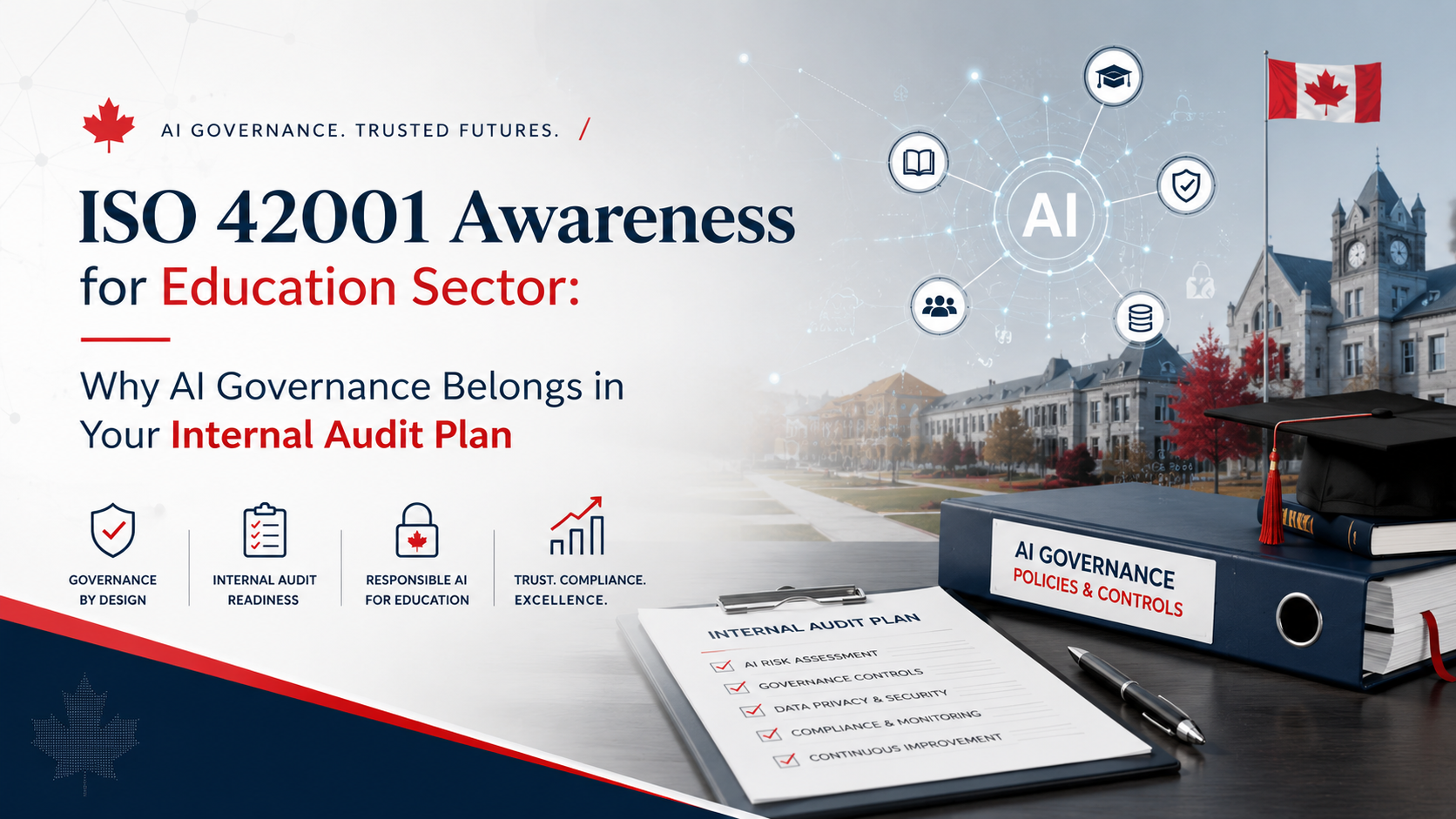
ISO 42001 Awareness for Education: Why AI Governance Belongs in Your Internal Audit Plan
ISO 42001 awareness for education helps schools, colleges, universities, and EdTech teams govern AI use before risk becomes hard to control.
Quick Answer
Why does AI governance belong in the internal audit plan?
AI governance belongs in the internal audit plan because education teams now use AI across teaching, student support, administration, research, and learning platforms.
Internal audit should check whether AI tools are known, approved, risk-assessed, vendor-reviewed, privacy-aware, and supported by human oversight.
Bottom line: ISO 42001 awareness helps education organizations move from informal AI use to controlled, responsible, and audit-ready AI governance.
Quick Snapshot
| AI Governance Area | Why It Matters in Education |
|---|---|
| AI Tool Inventory | You need to know which AI tools are used by staff, students, vendors, and platforms. |
| Student Data Protection | AI may involve academic, personal, support, or sensitive student information. |
| Approved Use Cases | Staff need clear rules for what AI can support. |
| AI Vendor Risk | AI vendors may process prompts, transcripts, files, or learning records. |
| Human Oversight | AI outputs should be reviewed before they affect students or decisions. |
| Management Review | Leadership should see AI risks, incidents, exceptions, and actions. |
Canadian Cyber AI Governance Support
Add AI Governance to Your Internal Audit Plan
Canadian Cyber helps education organizations build practical AI governance evidence.
We review AI tool inventories, student data rules, vendor risk, LMS AI features, Shadow AI, incident response, staff training, and SharePoint ISMS trackers.
Why ISO 42001 Awareness for Education Matters
AI is already changing education.
Teachers use AI to prepare material. Students use it for research. Administrators use it to summarize records.
Learning platforms also use AI to personalize content and improve service delivery.
These uses can help. However, they also create risk.
ISO 42001 awareness is not only about certification. It is about building responsible AI governance before risk becomes difficult to control.
Who This Guide Is For
- Schools, colleges, universities, and private education providers.
- Online learning platforms, EdTech companies, and training organizations.
- Tutoring companies and student support service providers.
- IT managers, privacy officers, security managers, and academic leaders.
- Internal auditors, compliance teams, and vCISO teams.
- Canadian education organizations preparing for ISO 27001, SOC 2, or ISO 42001 readiness.
Why AI Governance Belongs in Internal Audit
Internal audit checks whether controls are working.
That makes it a practical place to review AI governance.
A policy may exist. Yet staff may still use unapproved AI tools or enter student data into risky platforms.
| Common AI Governance Question | What Internal Audit Should Prove |
|---|---|
| Are AI tools approved? | There is an approved AI tool register. |
| Is student data protected? | Clear student data rules exist and staff are trained. |
| Are vendors reviewed? | AI vendors and LMS AI features are risk-assessed. |
| Are outputs checked? | Human review is defined for high-risk AI outputs. |
| Does leadership see AI risk? | AI risks, incidents, and actions are reported to management. |
Education AI Risks Internal Audit Should Not Ignore
Education AI risk is not only technical.
It can affect students, staff, parents, clients, reputation, and learning quality.
Key AI Risks in Education
Start With the Internal Audit Scope
Before auditing AI governance, define what is in scope.
The audit should include approved AI and possible Shadow AI.
Scope Questions
- Which departments use AI?
- Which tools support teaching or training?
- Which tools support student services?
- Which tools are inside learning platforms?
- Which vendors process student or client data?
- Which use cases affect students directly?
Evidence to Review
- AI tool inventory.
- SaaS inventory.
- Learning platform inventory.
- AI use case register.
- Vendor register.
- AI governance policy.
Audit Area 1: AI Tool Inventory
The first audit test is simple.
Does the education organization know which AI tools are used?
| Internal Audit Question | Evidence |
|---|---|
| Is there an AI tool inventory? | AI tool inventory and approved AI register. |
| Does it include free and paid tools? | SaaS inventory and procurement records. |
| Does it include LMS AI features? | LMS AI feature list. |
| Is each tool assigned an owner? | Tool owner field in the register. |
Practical rule: you cannot govern AI tools that you have not inventoried.
Audit Area 2: Approved AI Use Cases
AI should be approved by use case, not only by tool name.
For example, lesson planning is different from AI-supported assessment.
Use Cases to Review
Need ISO 42001 Awareness for Education AI Use?
Canadian Cyber can help add AI governance to your internal audit plan.
For senior advisory support, view Waqar Mehboob’s profile.
Audit Area 3: Student Data Protection
Student data protection should be a high-priority audit area.
Staff need practical rules for what can and cannot be entered into AI tools.
Audit Questions
- Can student data be entered into AI tools?
- Are grades and records restricted?
- Are support notes protected?
- Are transcripts and recordings controlled?
- Are accidental disclosures reportable?
Evidence to Review
- Student data handling policy.
- AI acceptable use policy.
- Data classification policy.
- Privacy review records.
- Training records and acknowledgments.
Student data restrictions should be specific, practical, and easy for staff to follow.
Audit Area 4: AI Vendor and Platform Review
AI tools and AI-enabled learning platforms are vendors.
They should be reviewed before they process student, staff, client, or institutional data.
| Vendor Review Item | Evidence |
|---|---|
| AI vendor register entry. | Vendor register and AI vendor assessment. |
| Privacy and data terms. | DPA, privacy terms, and terms of use review. |
| Subprocessors. | Subprocessor list and risk notes. |
| LMS AI features. | LMS feature review and approval record. |
Audit Area 5: Human Oversight and Output Review
AI output should not be accepted blindly.
This is especially important when AI can affect students or official decisions.
Human Review Should Cover
Audit Area 6: Academic Integrity and Responsible Use
Education organizations need clear AI rules for students and staff.
Internal audit should confirm that expectations are documented and communicated.
| Audit Question | Evidence |
|---|---|
| Are student AI rules clear? | Student AI policy and communication records. |
| Are teacher rules consistent? | Teacher guidance and assessment policy. |
| Are AI detection tools reviewed? | AI detection tool review. |
| Are complaints handled consistently? | Complaint handling procedure. |
Audit Area 7: Shadow AI
Shadow AI means AI tools are used without approval or visibility.
In education, this can happen quickly across many departments.
Shadow AI Evidence to Review
Audit Area 8: AI Incident Response
AI-related incidents should be reportable.
Staff should know what to do when AI use creates a privacy, security, or student trust issue.
Possible AI Incidents
Audit Area 9: Training and Awareness
AI governance depends on people understanding the rules.
Training should be role-based and practical.
| Training Area | Evidence |
|---|---|
| Staff AI acceptable use. | Training records and acknowledgments. |
| Teacher guidance. | Teacher AI guidance and communications. |
| Student data restrictions. | Privacy and data handling training. |
| Contractors. | Contractor training records. |
Audit Area 10: AI Risk Register and Management Review
AI governance should connect to the risk register.
It should also be visible to leadership.
Evidence to Review
What to Add to the Internal Audit Plan
Education organizations do not need to rebuild the entire audit program overnight.
Instead, add AI questions to existing audit areas.
Add AI Questions To
Sample AI Governance Internal Audit Calendar
| Month | Audit Focus | AI Governance Activity |
|---|---|---|
| January | Scope and Risk | Identify AI tools and update AI risks. |
| February | Student Data | Review student data restrictions. |
| March | Access Control | Review AI users and admin roles. |
| April | Vendor Risk | Review AI vendors and LMS AI features. |
| May | Training | Check staff AI training. |
| June | Academic Integrity | Review student-facing AI guidance. |
| September | Shadow AI | Conduct department AI use review. |
| November | Management Review | Report AI risks, incidents, and decisions. |
AI Governance Evidence Checklist
| Checklist Item | Ready? |
|---|---|
| AI tool inventory is current. | |
| AI tools are approved, restricted, under review, or prohibited. | |
| AI use cases are documented. | |
| Student data restrictions are defined. | |
| AI vendors are reviewed. | |
| LMS AI features are reviewed. | |
| AI outputs are reviewed by humans where needed. | |
| Academic integrity guidance includes AI. | |
| Shadow AI is assessed. | |
| AI incidents can be reported. | |
| AI risks are included in the risk register. | |
| Management review includes AI governance. |
Common Internal Audit Findings
The organization uses AI, but audit does not test AI controls.
Staff use AI tools, but there is no official record.
Staff do not know what they can enter into AI tools.
AI tools or platform features are used without vendor risk review.
Learning content, summaries, or support responses are used without validation.
Unapproved AI tools are used outside review.
How SharePoint Can Help Manage AI Governance Evidence
A SharePoint ISMS workspace can help education organizations organize AI governance evidence.
It keeps tools, owners, risks, evidence, and due dates visible in one controlled location.
SharePoint Can Track
How Canadian Cyber Helps
Canadian Cyber helps education organizations add AI governance to internal audit planning.
We help teams move from informal AI use to structured, evidence-based AI governance aligned with ISO 27001 internal audit and ISO 42001 readiness.
Frequently Asked Questions
What is ISO 42001 awareness?
ISO 42001 awareness means understanding how AI management system principles can help an organization govern AI use responsibly.
Why should education organizations include AI governance in internal audit?
Education organizations should include AI governance because AI tools may affect student data, learning content, support services, academic integrity, vendor risk, and trust.
Does every education organization need ISO 42001 certification?
Not every organization needs certification immediately. However, ISO 42001 awareness can help improve AI governance and accountability.
What should internal audit check first?
Internal audit should first check the AI tool inventory, approved use cases, student data restrictions, AI vendor reviews, training records, and AI risks.
Can SharePoint support AI governance evidence?
Yes. SharePoint can track AI tools, use cases, vendor reviews, student data rules, training, incidents, risks, actions, and dashboards.
Can Canadian Cyber help with ISO 42001 awareness?
Yes. Canadian Cyber supports ISO 42001 awareness, AI governance internal audit planning, SharePoint evidence workspaces, ISO 27001 internal audits, and vCISO advisory services.
Takeaway
AI belongs in the internal audit plan for education organizations.
Not because AI should be feared.
Because AI should be governed.
Education organizations need to know which AI tools are used, what student data is protected, which vendors are involved, and which outputs need review.
ISO 42001 awareness helps turn AI from a technology trend into a structured governance topic that internal audit can test and improve.
Ready to Add AI Governance to Your Internal Audit Plan?
Canadian Cyber can help your education organization improve ISO 42001 awareness and prepare practical AI governance evidence.
We provide ISO 42001 awareness support, AI governance internal audit planning, ISO 27001 internal audits, student data reviews, AI vendor risk assessments, Shadow AI assessments, SharePoint AI governance workspaces, vCISO services, SOC 2 readiness alignment, ISO 27017, ISO 27018, and cybersecurity assessments.
Stay Connected With Canadian Cyber
Follow Canadian Cyber for practical guidance on ISO 42001 awareness, AI governance, ISO 27001 internal audits, education sector cybersecurity, student data protection, SharePoint ISMS, SOC 2, vCISO services, and certification readiness.