Get in touch
info@canadiancyber.ca


Rafia Rizwan

April 14, 2026
A practical guide to multi-region compliance for startups selling across Canada, the US, and the EU without building a full compliance team.
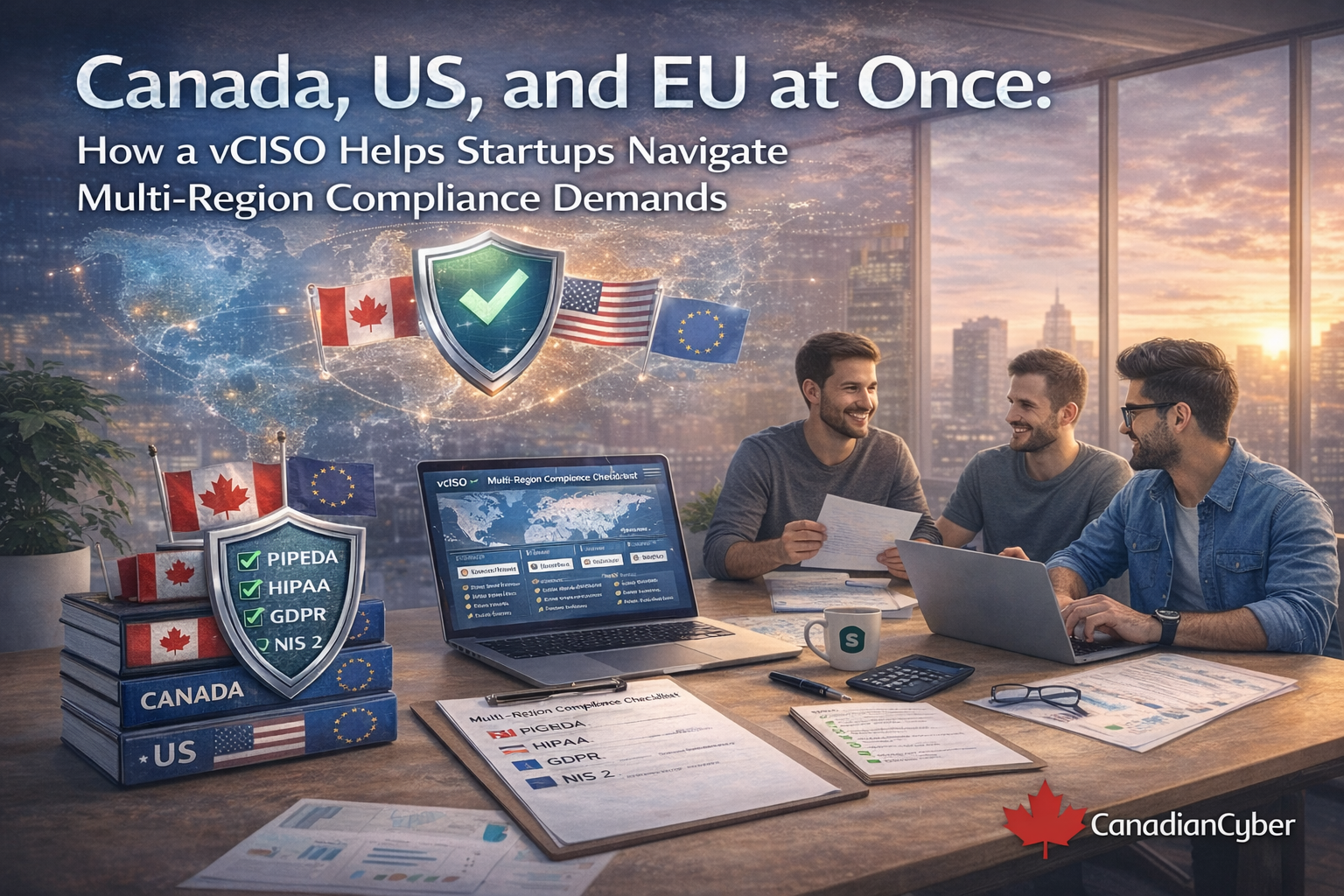
Most startups do not fail because they are unsafe. They fail because they cannot answer consistently, prove controls quickly, and keep evidence organized across regions. That is where a vCISO helps most: not as extra advice, but as an operating system that turns multi-region compliance into a manageable routine.
When you sell across Canada, the US, and the EU, the same concerns show up in different language. Security teams, privacy reviewers, procurement, and legal are often asking the same core questions through different regional lenses.
Canada, US, and EU stakeholders phrase those questions differently, but the proof they want is usually the same: governance plus operating evidence.
The vCISO job is to create one control system that can satisfy Canada, US, and EU expectations without tripling the work. The best way to think about it is simple: one trust engine that produces consistent answers, repeatable evidence, defensible processes, and faster audit readiness.
Before frameworks, a vCISO stabilizes reality. That means building the source documents that every later answer depends on.
That becomes the foundation for GDPR, PIPEDA, SOC 2, procurement, and contract questions. Why it matters is simple: accountability starts with clarity.
Instead of answering from scratch every time, a vCISO builds a standard pack sales can send early. This reduces escalation and makes responses consistent before legal and privacy teams get pulled in.
| Trust Pack component | Why it matters |
|---|---|
| Security overview | Explains your control model without turning into tool marketing. |
| Privacy and data residency statement | Answers storage, processing, access, and backup questions early. |
| Subprocessor summary | Shows vendor awareness, governance, and update discipline. |
| Incident response overview | Builds trust around detection, escalation, and notification readiness. |
| Backup and restore summary | Answers resilience and recoverability concerns quickly. |
| Access control model | Shows how admins, reviewers, and vendors are controlled. |
| Compliance posture and roadmap | Explains SOC 2, ISO, and privacy readiness without overpromising. |
The result is straightforward: fewer escalations, faster approvals, and far more consistent messaging from sales through security.
Startups often feel pressure to chase everything at once: SOC 2, ISO 27001, GDPR documentation, NIST references, and every client-specific add-on. A vCISO keeps this practical and sequences the work so you do not pay twice.
You do not need to certify everything at once. You need controls that operate, generate evidence, and satisfy the questions buyers actually ask.
Multi-region pressure is often privacy-driven. The fastest way to make privacy real is to operationalize it through controls people can review, test, and evidence.
This is what makes GDPR and PIPEDA questions easier. Instead of abstract policy answers, you can show a working system.
EU and enterprise US buyers care deeply about supply chain risk. A strong vCISO-led vendor model often reduces deal friction faster than expected because it answers a major source of due diligence pain.
Vendor governance is one of the fastest ways to reduce audit friction across all three regions because buyers interpret vendor weakness as maturity weakness.
Canada, US, and EU contracts often use different wording and different expectations around notification. A vCISO aligns the incident program so the business can respond safely without inventing process under pressure.
That is what lets teams answer hard buyer questions confidently: how fast do you notify, who decides materiality, and what proof do you keep.
Multi-region selling increases questionnaires and audit requests. Evidence must be easy to retrieve. If your ISMS runs in SharePoint, a vCISO can structure it so the program stays always-ready without forcing a heavy GRC platform too early.
This is what gives you an always-ready posture instead of a last-minute scramble every time a buyer asks for proof.
| Phase | What gets done |
|---|---|
| Days 1 to 30: Stabilize | Scope and data map, privileged access governance with MFA and admin reviews, vendor register and subprocessor list started, trust pack draft, and incident escalation basics. |
| Days 31 to 60: Prove | Evidence pack structure, first access review pack, first vendor review decisions, retention schedule plus deletion workflow, and a tabletop exercise scheduled. |
| Days 61 to 90: Repeat | Management review cadence, corrective action closure discipline, customer-facing auditor view, and a sequenced SOC 2 or ISO roadmap tied to deal reality. |
By day 90, the goal is not to be certified everywhere. The goal is to be credible everywhere and able to prove it quickly.
Not always at the same time. Many startups use SOC 2 to satisfy US enterprise buyers first, build an ISO-aligned ISMS for global governance, and pursue ISO certification later when it becomes a stronger sales or insurance lever. A vCISO helps sequence this so the work is not duplicated.
Sometimes, yes. But many deals are really about access controls, subprocessors, contractual safeguards, and transparency. A vCISO helps identify when EU-only hosting is a hard requirement and when it is a negotiable preference.
Multi-region selling gets painful when every geography feels like a separate compliance project. It becomes manageable when you build one trust engine that answers the core buyer questions consistently and backs them with operating evidence.
That is what a good vCISO really does: create one program that works across Canada, the US, and the EU without forcing the startup to act like it already has a full compliance department.