Why Leadership Teams Get This Wrong And Why It Matters
The confusion between these three services is not a failure of intelligence. It is a failure of how the security industry communicates. Vendors use the terms interchangeably. Sales proposals describe a “comprehensive security assessment” that turns out to be an automated scan. Pen test reports land on desks with no executive summary.
Getting this wrong has real consequences. Here are the four most common:
Compliance Gaps
ISO 27001 and SOC 2 require specific types of evidence. Submitting a vulnerability scan when an auditor expects a pen test finding log is a non-conformity. In SOC 2, it can delay or derail your Type II report entirely.
False Security
A scan that returns “no critical findings” does not mean you are secure. It means no known CVEs were detected. An attacker using a novel technique, a misconfiguration, or a logic flaw would not appear in that report at all.
Budget Misallocation
Organizations that pay for pen tests when a scan would meet their maturity needs are overspending. Organizations that pay for scans when their risk profile demands a pen test are underprotected. Both errors are expensive.
Governance Failure
Boards that cannot speak accurately about their testing programme cannot challenge their security team, satisfy institutional investors, or respond credibly to regulators after an incident.
Understanding the difference is not a technical exercise. It is a governance one.
1The Vulnerability Scan
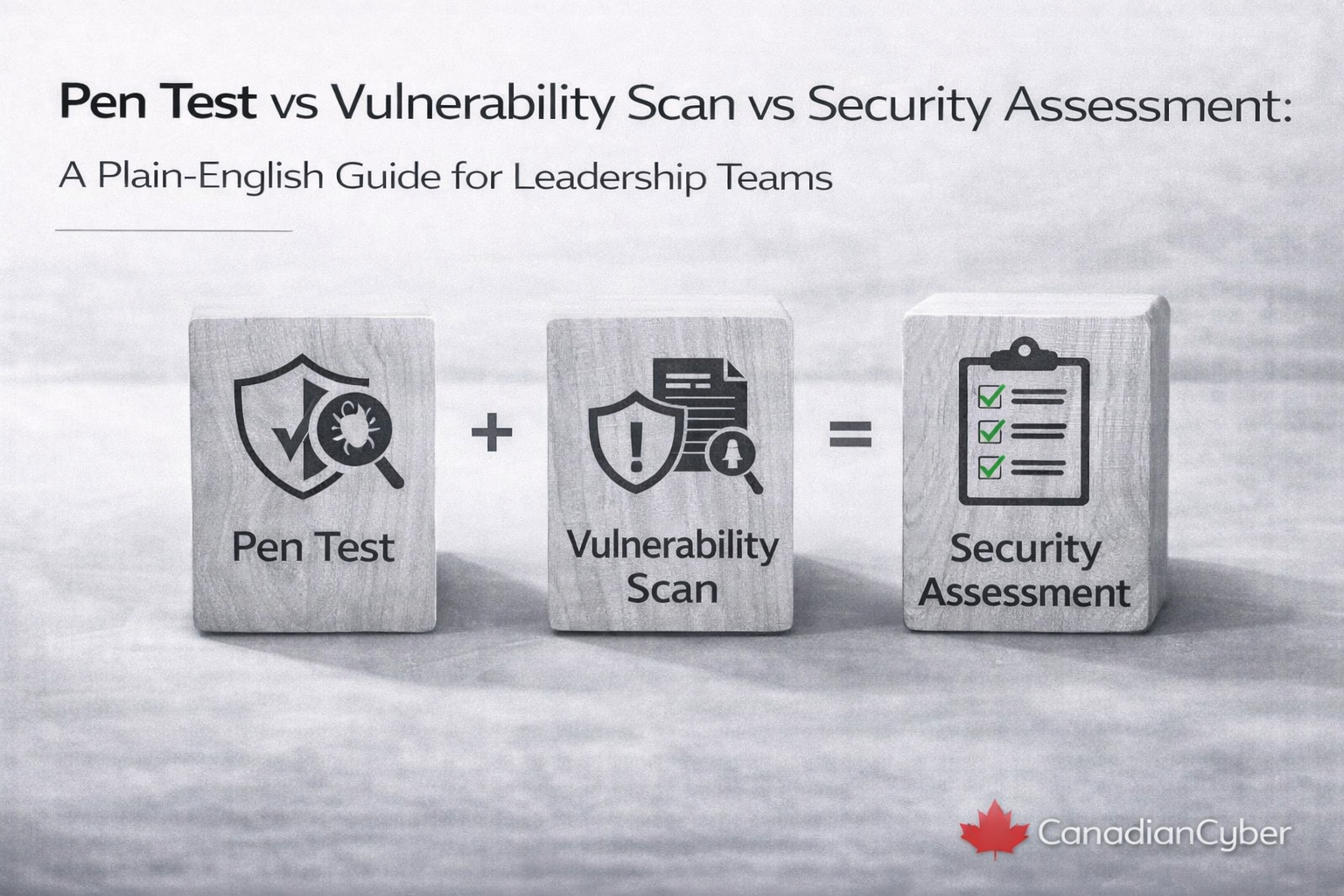
A vulnerability scan is an automated process. Software checks your IT assets servers, endpoints, network devices, cloud infrastructure, web applications against a database of known vulnerabilities. It looks for misconfigurations, outdated software, missing patches, and common weaknesses that match documented CVEs.
What It Does
Identifies known vulnerabilities. Flags unpatched systems, outdated software versions, and common misconfigurations. Lists findings by severity using CVSS scores.
What It Does Not Do
It does not attempt to exploit anything. It cannot tell you whether a weakness is actually exploitable in your environment, or what an attacker could access if they used it.
Who Runs It
Typically automated — by an internal IT or security team using tools like Qualys, Tenable Nessus, or Rapid7 InsightVM. External vendors can run credentialed or uncredentialed scans.
Timeline & Cost
Hours to a day. Annual cost of $1,000–$4,500 for continuous or recurring scan programmes. One-time scans can run lower.
When You Need It
→Ongoing security hygiene and patch management visibility
→Pre-assessment baseline before a penetration test
→Continuous compliance monitoring (PCI DSS requires regular external scans)
→Post-change validation after infrastructure updates
What It Produces
A prioritized list of detected vulnerabilities with CVSS severity scores, affected assets, and remediation recommendations. Not a proof of exploitability.
Pro Tip for Leadership
Vulnerability scans produce a lot of output. Without remediation prioritization tied to your actual risk appetite, teams can spend months patching low-impact findings while high-risk exposures sit unaddressed. Build a triage process before you run your first scan.
2The Penetration Test
A penetration test is a structured, human-led engagement. Certified security professionals actively attempt to exploit vulnerabilities in your systems to determine what an attacker could actually achieve. Unlike a scan, it is not automated. A skilled tester uses technical expertise, creativity, and attacker thinking chaining weaknesses together, bypassing controls, and escalating access to simulate a real breach.
What It Does
Actively exploits vulnerabilities within a defined scope. Chains weaknesses together. Demonstrates what an attacker could access, modify, or extract. Provides proof-of-concept evidence of real impact.
What It Does Not Do
It does not assess your overall security posture, governance processes, staff awareness, or policy maturity. It is focused on technical exploitation within a defined scope not a certification of security.
Who Runs It
Licensed, certified professionals — typically OSCP, CEH, or GPEN certified from a specialized security firm or an in-house red team. In-house red teams are rare outside large enterprises.
Timeline & Cost
One to three weeks for a scoped engagement. $5,000–$70,000+ depending on scope, methodology, and environment complexity. Cloud and social engineering components add cost.
Types of Penetration Test
External Network
Attacks your perimeter from the outside exactly as an attacker on the internet would.
Internal Network
Simulates a compromised insider or a threat actor who has already breached the perimeter.
Web Application
Targets a specific web or mobile application for logic flaws, injection vulnerabilities, and authentication bypasses.
Social Engineering
Tests your staff response to phishing, vishing, or physical access attempts.
Red Team Exercise
An advanced, full-scope simulation of a sophisticated attacker across multiple attack vectors simultaneously.
When You Need It
→ISO 27001 certification (required as evidence of control effectiveness)
→SOC 2 Type II audits (many auditors require pen test evidence)
→PCI DSS compliance (required annually and after significant changes)
→Before launching a new application or service to production
→When your board or insurer requires it
What It Produces
A detailed report with confirmed exploitable vulnerabilities, proof-of-concept evidence, a risk-rated finding list with business impact context, and specific remediation guidance. A good report includes an executive summary that non-technical leaders can read and act on.
Pro Tip for Leadership
Always ask for an executive summary written in business language not technical jargon. If your vendor cannot explain in plain English what they found and why it matters, ask for a rewrite. Leadership teams need to act on this information, not file it.
3The Security Assessment
A security assessment also called a cybersecurity assessment, security posture review, or gap assessment is a comprehensive evaluation of your organization’s security programme against a defined framework or standard. Rather than testing specific systems for exploitability, it examines whether your policies, controls, processes, staff awareness, governance structures, and technical safeguards are designed and operating effectively.
Common frameworks used as the benchmark include:
ISO 27001:2022
The international standard for information security management systems.
CIS Controls v8
The Center for Internet Security’s prioritized set of security actions.
NIST CSF
Widely used in North America, particularly in regulated sectors.
SOC 2 Trust Services
For SaaS and service providers handling customer data.
PIPEDA / Provincial Privacy
For Canadian organizations with privacy obligations.
What It Does Not Do
It does not involve active exploitation. It does not confirm whether a vulnerability is exploitable in practice. It is a programme-level review, not a technical attack simulation.
Who Runs It
Certified security consultants, Virtual CISOs (vCISOs), or advisory firms with framework expertise. Look for ISO 27001 Lead Auditors, CISA-certified assessors, or equivalent credentials.
Timeline & Cost
One to three weeks for an initial gap assessment. $5,000–$30,000+ depending on scope, framework, and whether a remediation roadmap is included.
When You Need It
→Before pursuing ISO 27001, SOC 2, or CIS Controls certification
→When a board, insurer, or enterprise customer demands evidence of your security posture
→After a significant organizational change — merger, acquisition, cloud migration
→When a new regulation applies and you need to understand your compliance gaps
What It Produces
A gap analysis against the chosen framework, a risk-rated maturity assessment, a prioritized remediation roadmap, and an executive summary. Suitable for board or regulator reporting.
Pro Tip for Leadership
A security assessment is only as useful as the remediation plan that follows it. Commissioning a gap assessment and filing the report without implementing recommendations is money spent without risk reduction. Build the remediation roadmap into your security budget before the assessment begins.
Side-by-Side Comparison: Which One Does What
Use this table to compare the three services across the dimensions that matter most to leadership teams.
| Dimension |
Vulnerability Scan |
Penetration Test |
Security Assessment |
| Primary question answered |
What weaknesses exist on our assets? |
Can an attacker exploit our weaknesses to cause damage? |
Is our overall security programme effective and compliant? |
| Method |
Automated scanning |
Manual, human-led exploitation |
Interview, review, framework mapping |
| Exploits vulnerabilities? |
No |
Yes |
No |
| Scope |
Assets / infrastructure |
Defined target (app, network, perimeter) |
Organization-wide programme |
| Produces compliance evidence? |
Limited |
Yes — ISO 27001, SOC 2, PCI DSS |
Yes — gap analysis, readiness reports |
| Typical cost |
$1K–$5K/year |
$5K–$70K+ per engagement |
$5K–$30K+ |
| Typical duration |
Hours |
1–3 weeks |
1–3 weeks |
| Frequency |
Continuous / monthly |
Annually or after major changes |
Annually or at programme milestones |
| Best for |
Patch management, hygiene |
Control validation, compliance proof |
Certification readiness, governance |
Not Sure Which Service You Need?
Get a straight answer — not a sales pitch
Canadian Cyber works with organizations across Canada to match their security testing programme to their actual risk profile, compliance requirements, and budget. We deliver the services that move the needle and tell you clearly which ones you do not need yet.
The Right Test Is the One That Answers the Right Question
Understanding the difference between a penetration test, a vulnerability scan, and a security assessment does not require a technical background. It requires asking one simple question: what specific risk, compliance gap, or unknown are we trying to address?
Once you can answer that, the right service becomes clear. And when your leadership team can speak accurately about what your organization has tested, what it has validated, and what it has not yet addressed you are in a position to govern cyber risk. You are no longer simply governed by it.
Not sure which type of assessment your organization needs right now? Canadian Cyber works with organizations across Canada to match their security testing programme to their actual risk profile, compliance requirements, and budget then delivers the assessments that move the needle. Talk to the Canadian Cyber team about a no-pressure scoping conversation. We will tell you exactly what you need and just as importantly, what you do not.
Ready to Choose the Right Service?
Talk to the Canadian Cyber Team
We work with leadership teams across Canada to select, scope, and deliver the right security services for their actual situation. No upselling. No jargon. Just the right answer for your organization.