

ISO 27001
Remote Internal Audit
Canada
Certification Readiness
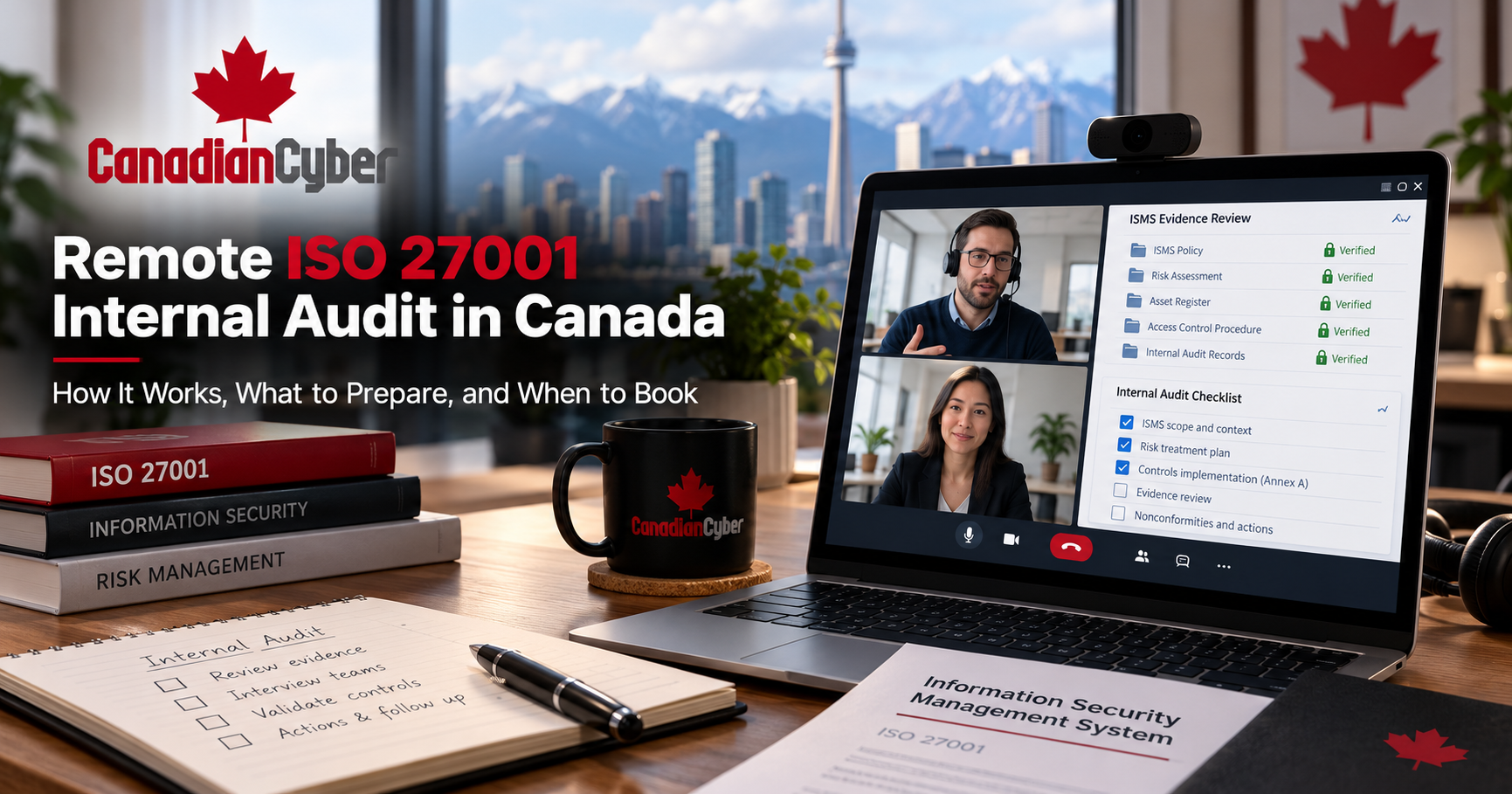
Remote ISO 27001 Internal Audit in Canada: How It Works and What to Prepare
Need a remote ISO 27001 internal audit? Learn how virtual interviews, screen sharing, evidence sampling, reporting, and corrective-action follow-up can work without unnecessary disruption.
Can an ISO 27001 Internal Audit Really Be Done Remotely?
Your company may already operate remotely.
Your systems may be hosted in the cloud.
Your evidence may live in Microsoft 365, SharePoint, Jira, GitHub, Azure, AWS, or other SaaS platforms.
So does an auditor always need to sit inside your office?
In many cases, no.
A remote ISO 27001 internal audit can use video interviews, screen sharing, document review, configuration walkthroughs, and evidence sampling.
However, remote does not mean superficial.
The auditor still needs to challenge processes, test evidence, interview control owners, and evaluate whether the ISMS works.
The real question is not “Can the audit happen online?” It is “Can the audit objectives be achieved remotely with reliable evidence?”
Quick Answer
Can a Remote ISO 27001 Internal Audit Be Completed Online?
Yes, many internal audits can be completed remotely when the scope, evidence, technology, and access arrangements support it.
Remote audit methods may include:
If reliable evidence can be obtained remotely, remote delivery can be practical for Canadian organizations.
Why Remote Internal Audits Make Sense for Modern Organizations
Many organizations no longer operate from one physical office.
A Canadian SaaS company may have:
- Employees across several provinces.
- Microsoft 365.
- Azure or AWS.
- GitHub.
- Remote developers.
- Cloud-hosted production systems.
- SaaS suppliers.
- Digital access records.
- Online security logs.
In this type of environment, physical presence does not automatically provide better audit evidence.
Most evidence may already be digital.
Microsoft Entra ID
SharePoint
Jira or ticketing system
GitHub
Security platform
Learning platform
How Does a Remote ISO 27001 Internal Audit Work?
A remote audit should still follow a structured process.
The delivery method changes. The audit objective does not.
Step 1: Confirm the Audit Scope
Before interviews begin, the auditor needs to understand your ISMS.
Provide:
- ISMS scope.
- Employee count.
- Locations.
- Departments in scope.
- Cloud platforms.
- Important business processes.
- Certification timeline.
- Whether this is your first internal audit.
- Whether certification, surveillance, or recertification is approaching.
This information helps determine whether the audit can be fully remote.
Step 2: Agree on the Remote Audit Method
Agree on tools, access, and confidentiality before the audit starts.
Options may include:
Microsoft Teams
Zoom
SharePoint
Secure File Sharing
Screen Sharing
Secure Portal
Step 3: Complete the Document Review
The auditor may review key ISMS documents before or during interviews.
These can include:
- ISMS scope.
- Information security policy.
- Risk assessment.
- Risk treatment plan.
- Statement of Applicability.
- Internal audit program.
- Security objectives.
- Asset inventory.
- Supplier register.
- Incident procedures.
- Access-control procedures.
- Business continuity documents.
The purpose is not only to confirm that documents exist. The auditor uses them to understand what the organization says it does before testing what actually happens.
Step 4: Conduct Remote Interviews
Remote interviews are a major part of the audit.
The auditor may interview:
- ISMS manager.
- Security team.
- IT administrators.
- HR.
- Development.
- Operations.
- Management.
- Supplier-management owners.
- Control owners.
Example
The access-control procedure says that access reviews happen quarterly.
The auditor asks:
The control owner can then demonstrate:
- User lists.
- Review records.
- Approvals.
- Access removals.
- Completion evidence.
Step 5: Use Screen Sharing for Sensitive Evidence
Screen sharing can reduce unnecessary transfer of sensitive information.
The auditor may need to review:
- Security configurations.
- Employee records.
- Customer information.
- Vulnerability findings.
- Access lists.
- Security logs.
- Cloud settings.
Example
The auditor requests a sample of five terminated employees.
HR identifies the sample.
IT then demonstrates whether each account was removed on time.
What Evidence Can Be Reviewed Remotely?
| Audit Area | Example Remote Evidence |
|---|---|
| Risk Management | Risk register and treatment records |
| Access Control | Entra ID, access reviews and user samples |
| Privileged Access | Administrative roles and approvals |
| HR Security | Joiner and leaver records |
| Awareness | Training completion records |
| Assets | Asset inventory and endpoint management |
| Suppliers | Supplier reviews and contracts |
| Vulnerabilities | Scan results and remediation tickets |
| Incidents | Incident records and investigations |
| Backups | Backup reports and restoration tests |
| Secure Development | GitHub, pull requests and CI/CD evidence |
| Logging | SIEM dashboards and audit logs |
| Changes | Change tickets and approvals |
| Management Review | Minutes, decisions and action records |
How Should Confidential Information Be Protected?
A remote audit should not require unnecessary transfer of confidential data.
Before the audit, agree on:
- Approved communication platforms.
- Evidence-transfer methods.
- Access restrictions.
- Retention expectations.
- Whether downloads are permitted.
- Whether screenshots are permitted.
- Whether sessions may be recorded.
- How sensitive information will be handled.
Can Audit Evidence Stay Inside Your Systems?
In many cases, yes.
The auditor still needs enough evidence to support the audit conclusion and document what was tested.
Need an Independent Internal Audit Without the Travel?
Canadian Cyber can perform ISO 27001 internal audit activities through remote interviews, screen sharing, evidence sampling, control walkthroughs, and structured reporting.
We can also help determine whether targeted onsite verification is necessary for your scope.
Step 6: Test Real Samples
Remote audits should still use evidence sampling.
Select users and compare access with their business roles.
Sample terminated employees and verify timely access removal.
Sample critical suppliers and review assessments and monitoring.
Trace selected findings from detection to remediation.
Sample production changes and verify approvals and testing.
Review response, root cause, corrective action, and lessons learned.
Remote delivery should not reduce the depth of audit testing.
Step 7: Conduct the Closing Meeting
At the end of the audit, the auditor should explain the results clearly.
This may include:
- Nonconformities.
- Observations.
- Opportunities for improvement.
- Positive practices.
- Required follow-up.
A virtual closing meeting also allows management and control owners from different locations to attend without travel.
What Should the Remote Internal Audit Report Include?
A useful report should show:
- Audit objective.
- Audit scope.
- Audit criteria.
- Audit dates.
- Auditor.
- People interviewed.
- Areas tested.
- Evidence sampled.
- Findings.
- Nonconformities.
- Observations.
- Overall conclusion.
What Happens After the Remote Internal Audit?
The audit should not end when the report is issued.
For significant findings:
Assign Owner
↓
Determine Root Cause
↓
Implement Corrective Action
↓
Retest Important Fixes
↓
Retain Closure Evidence
Corrective-action follow-up can often be completed remotely as well.
When Is Onsite Verification Still Useful?
Remote auditing is not the best approach for every control.
Onsite work may still be useful for:
- Physical access controls.
- Server rooms.
- Warehouses.
- Secure areas.
- Media destruction.
- Physical asset protection.
- Environmental controls.
- Manufacturing environments.
- Locations where digital evidence is insufficient.
Remote Does Not Mean Less Independent
Location does not determine auditor independence.
The key issue is whether the auditor can remain objective and impartial.
An external auditor in another city or province can still independently test your ISMS using secure remote techniques.
This can be particularly useful when your own security team designed the ISMS and cannot reasonably audit all of its own work.
Who Is a Good Fit for a Remote ISO 27001 Internal Audit?
SaaS Companies
Most evidence is already digital and cloud-based.
MSPs
Service records, access evidence, and support processes are usually online.
Remote-First Companies
Employees may already be distributed across several regions.
SMEs
Remote delivery may reduce unnecessary travel and disruption.
Microsoft 365 Businesses
Identity, devices, SharePoint, logs, and controls can often be demonstrated live.
When Should You Book the Remote Internal Audit?
Do not wait until a few days before Stage 1, Stage 2, surveillance, or recertification.
Remote Internal Audit
↓
Findings
↓
Corrective Actions
↓
Retesting
↓
Management Review
↓
External Assessment
The audit should create time for improvement, not only produce a report.
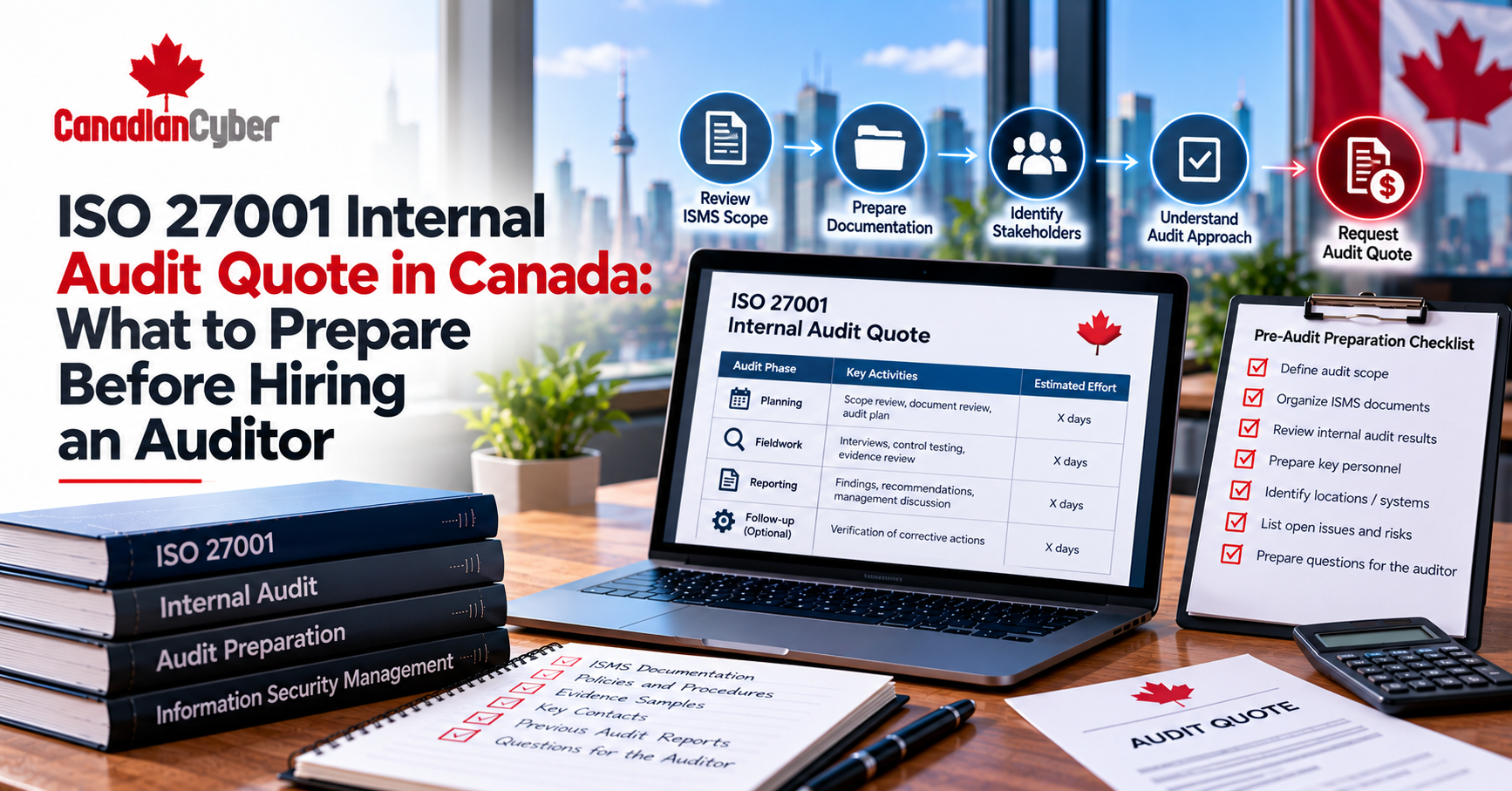
What Should You Prepare Before Requesting a Quote?
Prepare:
- ISMS scope.
- Number of employees in scope.
- Locations.
- Remote, hybrid, or onsite working model.
- Certification status.
- Stage 1, Stage 2, surveillance, or recertification date.
- Main technology platforms.
- Important suppliers.
- Current evidence readiness.
- Whether this is your first internal audit.
- Whether physical locations are within scope.
- Expected audit deliverables.
- Whether corrective-action follow-up is required.
Remote ISO 27001 Internal Audit Preparation Checklist
☐ ISMS scope is current.
☐ Audit dates are agreed.
☐ Interviewees are available.
☐ Secure meeting platform is confirmed.
☐ Evidence-sharing method is agreed.
☐ Screen sharing is available.
☐ Confidentiality requirements are understood.
☐ Risk assessment is current.
☐ Statement of Applicability is available.
☐ Policies and procedures are organized.
☐ Access-control evidence is ready.
☐ Supplier evidence is ready.
☐ Incident and vulnerability records are available.
☐ Backup and recovery evidence is available.
☐ Previous findings are prepared.
☐ Corrective-action register is current.
☐ Management understands the audit schedule.
How to Request a Remote ISO 27001 Internal Audit Quote
Avoid sending only:
Give the auditor enough information to scope the engagement.
We are a Canadian SaaS company with 45 employees in scope. Our team is fully remote across Canada.
Our environment includes Microsoft 365, Entra ID, Azure, GitHub, and several SaaS platforms.
We are preparing for our first ISO 27001 certification, with Stage 1 planned for February 2027.
Our ISMS scope, risk assessment, Statement of Applicability, policies, and most operating evidence are complete.
We are looking for an independent remote ISO 27001:2022 internal audit using video interviews, screen sharing, and evidence sampling. Please provide a quotation and confirm whether any onsite verification would be required.
Ready to Request a Remote Internal Audit Quote?
Send Canadian Cyber your ISMS scope, employee count, locations, certification timeline, technology environment, and audit expectations. We can help determine whether the engagement can be completed fully remotely or needs targeted onsite verification.
Frequently Asked Questions
Can an ISO 27001 internal audit be 100% remote?
Potentially. It depends on the scope, evidence, physical controls, technology, audit objectives, and risk.
Does ISO 27001 Clause 9.2 require an onsite audit?
Clause 9.2 focuses on an effective internal audit program, audit criteria, scope, methods, objectivity, reporting, and results. It does not prescribe one universal physical delivery method.
How are remote audit interviews conducted?
Usually through secure video meetings. Control owners can explain processes, answer questions, share screens, and demonstrate evidence live.
Can we show evidence without sending it to the auditor?
Often, yes. Sensitive information can sometimes be reviewed through screen sharing, controlled access, or redacted evidence.
Can an auditor review Microsoft 365 remotely?
Yes. Entra ID access, SharePoint records, audit logs, security settings, device-management records, and access reviews can often be demonstrated through controlled screen sharing.
Is remote auditing suitable for SaaS companies?
Often, yes. SaaS companies usually rely on cloud platforms, remote teams, digital evidence, and online workflows.
When might an onsite visit still be useful?
Onsite work may be useful when physical observation is important, reliable remote evidence is unavailable, or audit risk makes remote techniques insufficient.
What should the final remote internal audit report contain?
It should document the audit scope, criteria, areas tested, evidence sampled, findings, nonconformities, observations, and overall conclusions.
Can Canadian Cyber perform a remote ISO 27001 internal audit?
Yes. Canadian Cyber supports Canadian organizations with ISO 27001 internal audit services for cloud-based, remote, SaaS, MSP, and SME environments.
The Takeaway
A remote ISO 27001 internal audit should not mean:
A strong remote audit should still:
The main difference is how the evidence is accessed.
For many Canadian SaaS companies, MSPs, SMEs, and remote-first businesses, that can make remote audit delivery efficient without reducing audit depth.
Need an Independent ISO 27001 Internal Audit Without Disrupting Your Operations?
Canadian Cyber helps Canadian organizations complete independent ISO 27001 internal audits using practical evidence reviews, remote interviews, screen sharing, control sampling, reporting, and corrective-action follow-up.
Whether you are preparing for initial certification, surveillance, or recertification, we can help determine whether your audit can be completed remotely or whether targeted onsite verification is appropriate.
Stay Connected With Canadian Cyber
Follow Canadian Cyber for practical guidance on ISO 27001 internal audits, certification readiness, surveillance, recertification, risk management, and ISMS improvement.