Get in touch
info@canadiancyber.ca


Rafia Rizwan

April 20, 2026
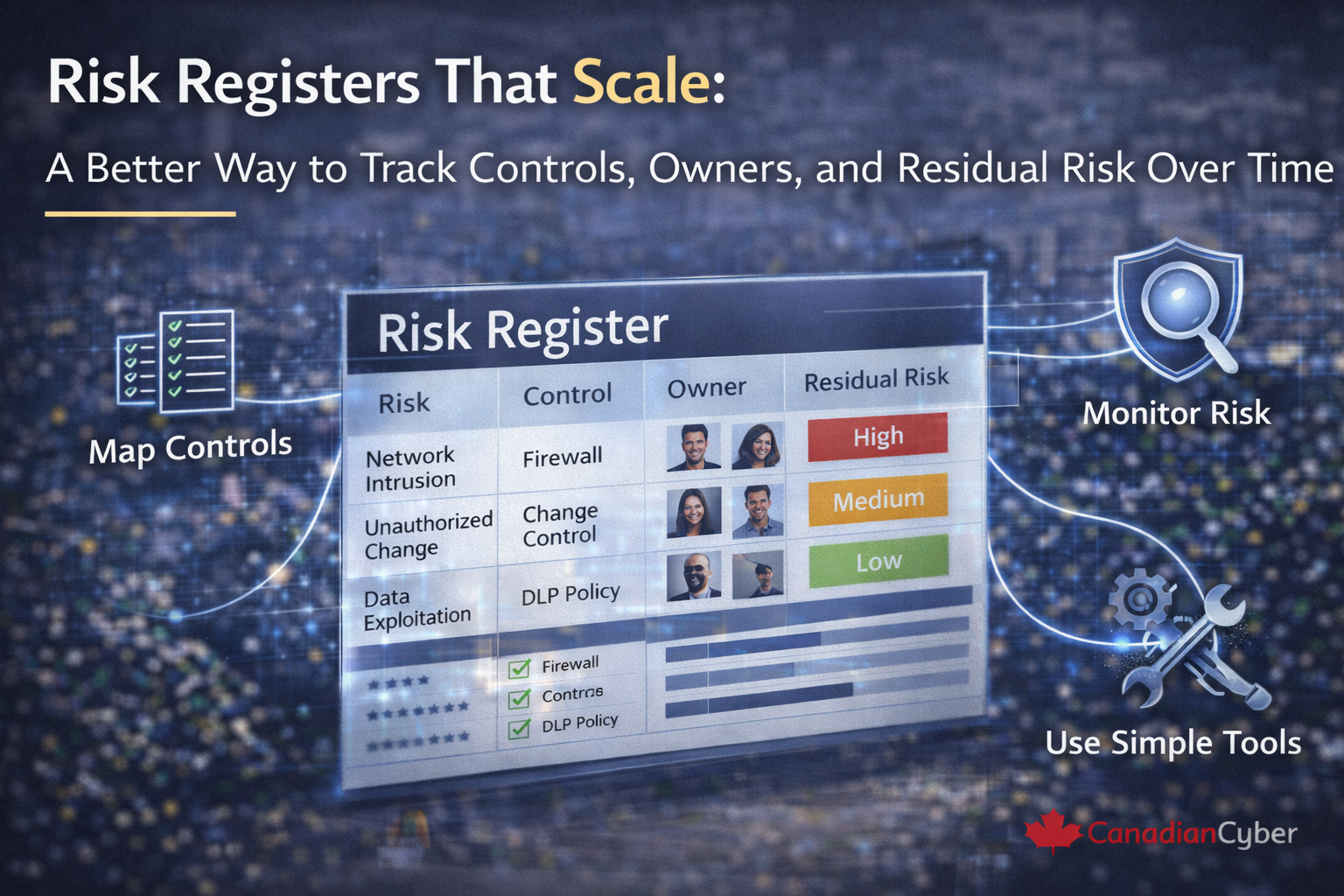
A practical guide to building a risk register that scales with your organization, improving control tracking, ownership, and residual risk visibility.
At first, that usually works. A spreadsheet is created. A few risks are listed. Scores are added. Owners are assigned. Review dates go into a column. For a while, the register feels useful.
Then the organization grows. New systems appear. More vendors are added. Audit findings start feeding into the process. Security questionnaires become more demanding. Residual risk discussions become more important. And suddenly the risk register becomes harder to trust.
Not because the idea was wrong. But because the register was never designed to scale.
A scalable risk register should not just list risks. It should help the organization track control status, ownership, treatment progress, and residual risk over time in a way leadership can actually use.
A small risk register usually fails for predictable reasons. Early on, the organization may have only a handful of systems, a few key risks, informal ownership, limited third-party complexity, and fewer audit or compliance pressures.
As the business matures, the register starts carrying more weight. It is now expected to support ISO 27001 risk treatment, SOC 2 readiness, management review, audit findings, vendor risk, corrective action tracking, executive reporting, and board-level visibility.
A good risk register should help answer practical questions, not just store rows of information.
If the register cannot answer these questions without a lot of extra explanation, it probably is not scaling well.
Imagine a growing software company that started with a simple risk register during early compliance work. It listed phishing risk, cloud misconfiguration, insider access risk, vendor outage risk, and data leakage risk. That felt fine at first.
Two years later, the company has multiple cloud environments, more vendors, a larger support team, new customer commitments, internal audits, corrective actions, privacy obligations, and more formal leadership reporting.
This is where a scalable design becomes necessary.
A scalable risk register does not need to be complicated. But it does need to be structured. The most useful registers usually scale well because they do five things well: define risks clearly, separate risk from controls and treatment, assign real ownership, track residual risk deliberately, and support review over time instead of one-time entry.
One of the biggest reasons registers become messy is that risks are written inconsistently. Entries like “access control,” “cloud,” “vendor issue,” or “data privacy” are not really risk statements. They are just topics.
A stronger risk statement identifies the threat, the asset or area affected, and the impact if it happens.
| Weak Entry | Better Risk Statement |
|---|---|
| access control | Unauthorized privileged access to production systems could lead to customer data exposure or service disruption. |
| vendor issue | Inadequate vendor security review could result in third-party access to sensitive data without sufficient oversight. |
| backup | Weak backup validation could delay recovery after ransomware or operational failure. |
Clearer risk statements reduce duplication and make treatment planning much easier.
This is one of the most important design improvements. Many registers collapse everything into one row of loose notes. That becomes hard to manage quickly.
A better register separates three things clearly: the risk itself, the existing controls already in place, and the treatment actions still needed to reduce the risk further.
| Element | Example |
|---|---|
| Risk | Unauthorized admin access to production could expose customer data. |
| Existing Controls | MFA, SSO, admin role restrictions, access logging |
| Treatment Actions | Quarterly privileged access review, remove legacy accounts, implement break-glass logging review |
This avoids a very common mistake: marking a risk as done just because some controls already exist.
Scalable risk registers need real accountability. One of the biggest reasons treatment stalls is weak ownership. Labels like IT, security, DevOps, or management may describe who is involved, but they do not create true accountability.
| Field | Better Example |
|---|---|
| Risk Owner | Head of Engineering |
| Treatment Owner | Platform Manager |
| Reviewer | Security Lead |
Without named ownership, a growing register becomes a shared problem that nobody truly owns.
A useful register should help the organization distinguish between inherent risk and residual risk.
Inherent risk is the level of risk before considering current controls. Residual risk is the level of risk after considering the controls already in place.
| Risk Area | Inherent Risk | Existing Controls | Residual Risk |
|---|---|---|---|
| Production admin misuse | High | MFA, SSO, limited admin roles, logging | Medium |
| Vendor outage affecting critical service | High | SLA, secondary provider planning, monitoring | Medium |
| Phishing leading to account compromise | High | MFA, awareness training, email protection | Low to Medium |
Residual risk should not be scored once and forgotten. It should change when controls improve, controls fail, the environment changes, a new vendor is added, or incidents reveal weaknesses.
A risk register does not scale if it is only updated during annual compliance activity. That turns it into a snapshot, not a management tool.
A stronger approach is to make risk review part of a recurring rhythm through quarterly reviews, post-incident reviews, audit follow-up, vendor change review, and management review cycles.
A risk register does not need dozens of columns to work well. But it does need the right fields.
| Field | Why It Matters |
|---|---|
| Risk ID | Supports tracking and reporting |
| Risk Title | Makes the entry easy to identify |
| Risk Description | Explains the threat and impact clearly |
| Category | Helps group risks by type |
| Asset / Area Affected | Shows what is at risk |
| Inherent Likelihood / Impact | Supports baseline scoring |
| Existing Controls | Documents current mitigation |
| Residual Likelihood / Impact / Rating | Shows current exposure after controls |
| Risk Owner | Establishes accountability |
| Treatment Plan / Status | Tracks next actions and progress |
| Target Date / Review Date | Creates deadline and review discipline |
| Risk Decision | Shows whether the risk is mitigated, accepted, transferred, or avoided |
| Notes / Change History | Shows what changed over time |
A common weakness in risk registers is that controls are mentioned too loosely. Entries like MFA, training, firewall, vendor review, or logging do not always tell you enough.
A better model ties each risk to real control status.
| Risk | Existing Control | Control Status |
|---|---|---|
| Excessive admin access | Quarterly privileged access review | Partially implemented |
| Vendor breach | Vendor due diligence questionnaire | Implemented |
| Incident detection delay | SIEM alerting on privileged events | Implemented |
| Backup recovery failure | Restore testing program | In progress |
This makes the register more useful for both risk discussion and remediation planning.
Residual risk becomes weak when teams use it as a ceremonial score instead of a real judgment. A better approach is to ask practical questions.
Residual risk should reflect control reality, not just control existence.
This is where many registers become much more valuable. Instead of showing only the current score, a scalable register should track movement such as new, increased, decreased, unchanged, closed, or accepted.
| Risk | Last Quarter | This Quarter | Trend |
|---|---|---|---|
| Privileged access misuse | High residual | Medium residual | Decreased |
| Vendor security review weakness | Medium residual | High residual | Increased |
| Backup restore failure | High residual | Medium residual | Decreased |
| Logging gap in new platform | Not listed | High residual | New |
This turns the register into a living risk picture instead of a static list.
Leadership usually does not want to read every row. They want to understand what the top risks are, which risks are overdue, where ownership is weak, where residual risk remains high, whether the control environment is improving, and which risks need decisions or resources.
That is why scalable registers work best when they can roll up into simple views such as high residual risks open, risks overdue for review, overdue treatment actions, risks accepted by management, risks repeatedly extended, and risks increasing over time.
Even well-designed risk registers start struggling when organizations make the same repeat mistakes: too many duplicate risks, vague treatment plans, owners not kept current, residual risk never revisited, controls listed without status, review dates ignored, and no history of change.
These are exactly the issues that make the register bigger but less useful over time.
| Level | What It Looks Like |
|---|---|
| Basic | List of risks, loose owners, limited treatment detail |
| Developing | Risks scored, owners named, some treatment plans tracked |
| Structured | Risks, controls, and treatment separated clearly |
| Managed | Residual risk reviewed regularly, deadlines tracked, leadership reporting in place |
| Scalable | Trend over time, strong ownership, linked controls, useful management views, clear residual risk discipline |
The goal is not perfection. The goal is to move from “we have a register” to “we can manage risk through it.”
A risk register that scales is not the one with the most rows. It is the one that helps the organization understand, over time, what the important risks are, what controls already exist, what still needs treatment, who is accountable, what residual risk remains, and whether the program is actually improving.
That means a better risk register should define risks clearly, separate controls from treatment, assign real owners, track residual risk deliberately, and support ongoing review instead of annual updates only.
Because in the end, the value of a risk register is not that it stores risks. It is that it helps the organization manage them.