Get in touch
info@canadiancyber.ca


Rafia Rizwan

April 23, 2026
A practical guide to SOC 2 HealthTech scoping, showing how to protect PHI-adjacent data without over-scoping the audit.
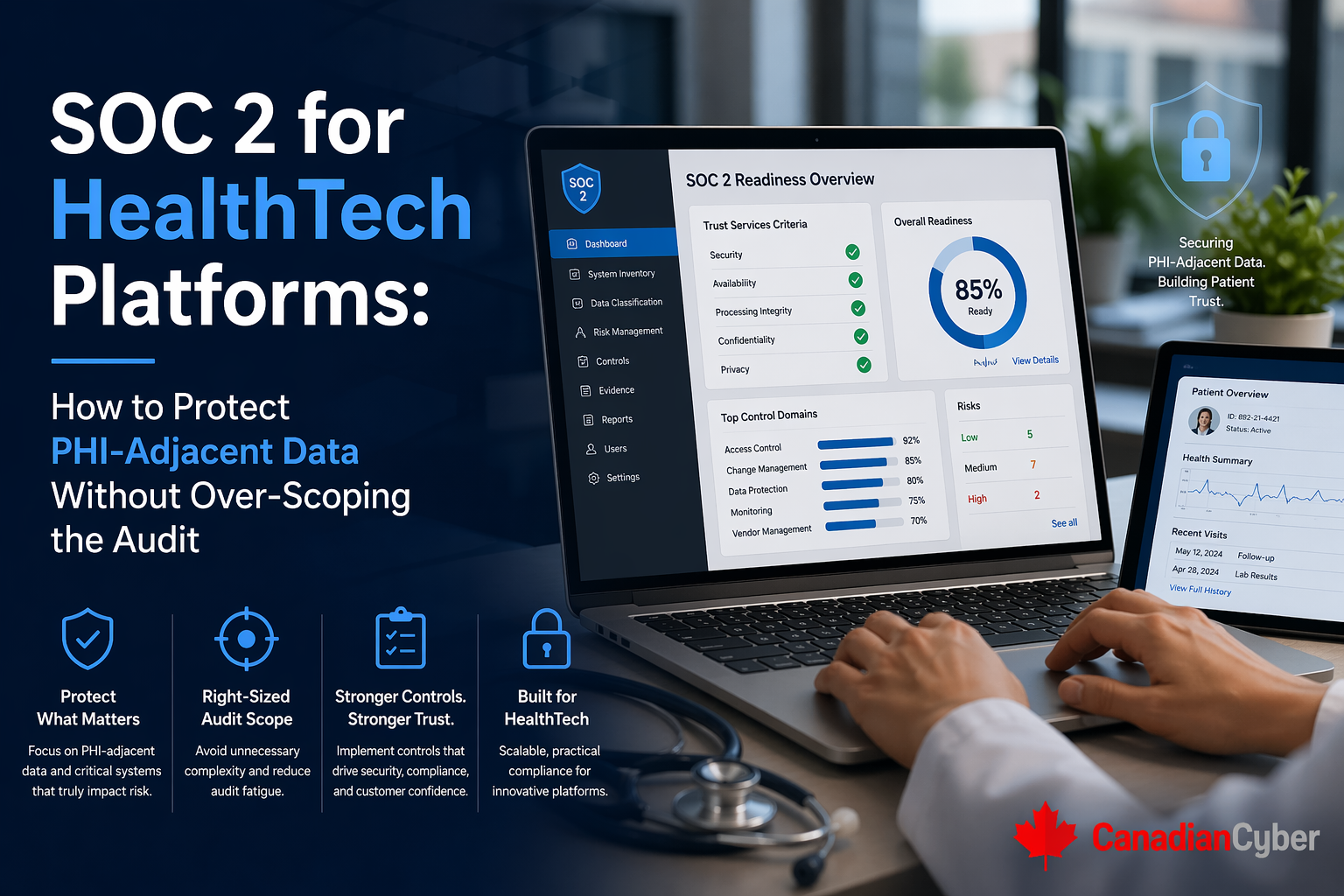
HealthTech companies do not need to store full clinical records to face serious security pressure.
A platform may never act as an EHR. It may never diagnose a patient. It may never market itself as a full HIPAA processor. But it can still handle data that feels sensitive, behaves like regulated data, or sits close enough to protected health information that customers treat it with the same level of concern.
That is the real challenge with PHI-adjacent data.
Many HealthTech teams know they need strong controls. They know buyers are asking harder questions. They know the platform touches sensitive workflows. But they also know there is real risk in over-scoping the audit and turning a focused trust exercise into a bigger, slower, and more expensive compliance burden.
The smartest SOC 2 approach for many HealthTech platforms is to protect PHI-adjacent data with discipline and clarity without automatically dragging every system, workflow, or edge case into scope.
HealthTech buyers are rarely casual about security. If your platform supports virtual care workflows, scheduling and intake, patient engagement, device monitoring, clinic operations, billing-related processes, care team collaboration, or workflow automation around patient services, customers will ask hard questions.
That means the real issue is not only whether your platform contains formal PHI in the strictest sense. The issue is whether your control environment matches the sensitivity and trust expectations around the data you actually handle.
A lot of HealthTech companies make one of two mistakes.
The second mistake is especially common. Teams assume health-related always means everything must be in scope, buyers want the broadest scope possible, adding more systems automatically makes the report more credible, and the safest answer is to include everything remotely connected.
That is why smarter scoping is not about being permissive. It is about being precise.
PHI-adjacent data is not a formal audit category. It is a practical way to describe information that may not always be full regulated medical record content, but still carries health-context sensitivity or trust impact.
This kind of data matters because even when it is not the core clinical record, customers still expect strong handling, restricted access, and disciplined operational controls.
So the real scoping question becomes: Which systems, people, and processes materially affect the security, confidentiality, and controlled handling of this data?
Picture this. A HealthTech startup provides a platform for specialty clinics. The product handles patient scheduling, intake workflows, reminders, clinic staff dashboards, messaging between staff and patients, support case handling, usage analytics, and cloud-hosted document uploads for onboarding.
The company does not market itself as a clinical records platform. It is not trying to replace the EHR. But its system still touches sensitive patient-adjacent workflows every day.
As enterprise deals start growing, customers begin asking for SOC 2. Leadership reacts cautiously and says, “We handle health-related data. We probably need to scope everything.”
Once the team starts listing everything, the scope balloons to include all production systems, all analytics environments, all support tooling, all experimental data workspaces, every internal reporting workflow, old staging environments, loosely connected operational tools, and every integration whether material or not.
For HealthTech platforms, SOC 2 scoping should focus on the systems and processes that materially affect the trust story.
This approach helps the company do two things at once: protect sensitive data responsibly and avoid dragging low-value or disconnected systems into audit scope unnecessarily.
A practical HealthTech SOC 2 scope often includes the systems and workflows that most directly affect PHI-adjacent data handling. These usually fall into six areas:
If the platform collects, displays, transmits, or modifies patient-adjacent information, the production environment should be in scope. That usually includes user-facing applications, backend APIs, production services, identity and session controls, tenant access enforcement, application-layer authorization, and sensitive exports or admin workflows.
This is where many HealthTech companies either under-scope or over-scope. Sensitive data may appear in more places than the main production database.
| Data store | Why it matters |
|---|---|
| Production relational database | Core patient-adjacent workflows and account context |
| Document or file storage | Intake uploads, support attachments, onboarding files |
| Messaging store | Communication content and workflow context |
| Backup systems | Recovery copies of sensitive data |
| Search or indexing layers | May expose the same sensitive content in another form |
| Analytics store | May contain identifiers or sensitive behavioral context |
Many companies assume support does not matter if it does not handle full clinical records. But support teams may still see patient names, appointment history, screenshots, support notes, account messages, or metadata that reveals sensitive workflow activity. That means support access is often part of the confidentiality story.
The product itself may be controlled well, but logs, traces, and incident workflows may still capture identifiers, request payloads, screenshots, workflow metadata, support context, or debugging exports. This is why monitoring and response environments that materially support in-scope systems often need attention too.
Most HealthTech platforms depend on vendors for hosting, messaging, file storage, support, analytics, identity, scheduling integrations, e-signature, device connectivity, and communication APIs. The scope does not need to treat every vendor equally, but it should cover governance over those that materially affect confidentiality, availability, administrative access, or sensitive workflow handling.
Some HealthTech platforms scope systems correctly but forget that the audit also has to prove the controls around those systems are operated with discipline. That is why practical scopes often include onboarding and offboarding for in-scope access, privileged access review, change management, incident response, security monitoring, vendor review, and secure deployment for in-scope services.
This is where over-scoping gets reduced. Many HealthTech companies can exclude certain areas if they are genuinely isolated, non-material, or incapable of affecting the in-scope trust boundary.
The key is honesty. These should only stay out of scope if they truly do not materially affect the confidentiality, integrity, availability, or controlled handling of in-scope data and services.
The best approach is to strengthen controls where sensitivity is real, not where labels are loudest. These priorities usually matter most.
Use least privilege, strong administrative controls, access review, support access restrictions, separation of customer and admin views, and clean offboarding. This often reduces risk faster than widening the audit boundary.
Know where patient-adjacent data enters, where it is stored, where it is copied, where it is logged, where it is exported, and where vendors can access it. A narrower but well-understood scope is stronger than a broad scope nobody can explain clearly.
Many HealthTech risks live in screenshots, ticket attachments, debug logs, manual exports, and internal comments. These should be governed intentionally because they often reveal sensitive context outside the main application layer.
Not every vendor needs the same level of audit attention, but every material vendor should be classified, owned, and reviewed appropriately.
Your scope description should clearly explain what services are in scope, which systems support them, how sensitive data is handled, which supporting processes and vendors matter, and what is excluded and why.
A good scope is justified, not maximal.
At Canadian Cyber, we often see HealthTech platforms struggle not because they lack security intent, but because they assume the only safe SOC 2 answer is to scope as broadly as possible. That usually creates unnecessary burden without improving trust proportionally.
The strongest HealthTech scopes tend to do three things well: identify where PHI-adjacent sensitivity really exists, protect the systems and workflows that materially affect that data, and avoid dragging isolated, non-material environments into the audit just because they are nearby.
That balance matters. Buyers want confidence that sensitive data is handled responsibly. They do not usually need a bloated audit boundary. They need a credible one.
For HealthTech platforms, SOC 2 scoping gets complicated when the product handles data that is close to PHI in context, sensitivity, or customer expectation.
The answer is not to under-scope and hope buyers do not ask hard questions. It is also not to over-scope until the audit becomes harder than it needs to be.
The smarter path is to identify where PHI-adjacent data really lives, scope the systems, stores, workflows, and vendors that materially affect it, control support and admin access carefully, govern logs, exports, and attachments intentionally, and write a scope that is precise, defensible, and operationally realistic.
Because in the end, the goal is not to make the audit look bigger. It is to make the control story stronger.