

vCISO • Accounting Firms • Financial Data Security
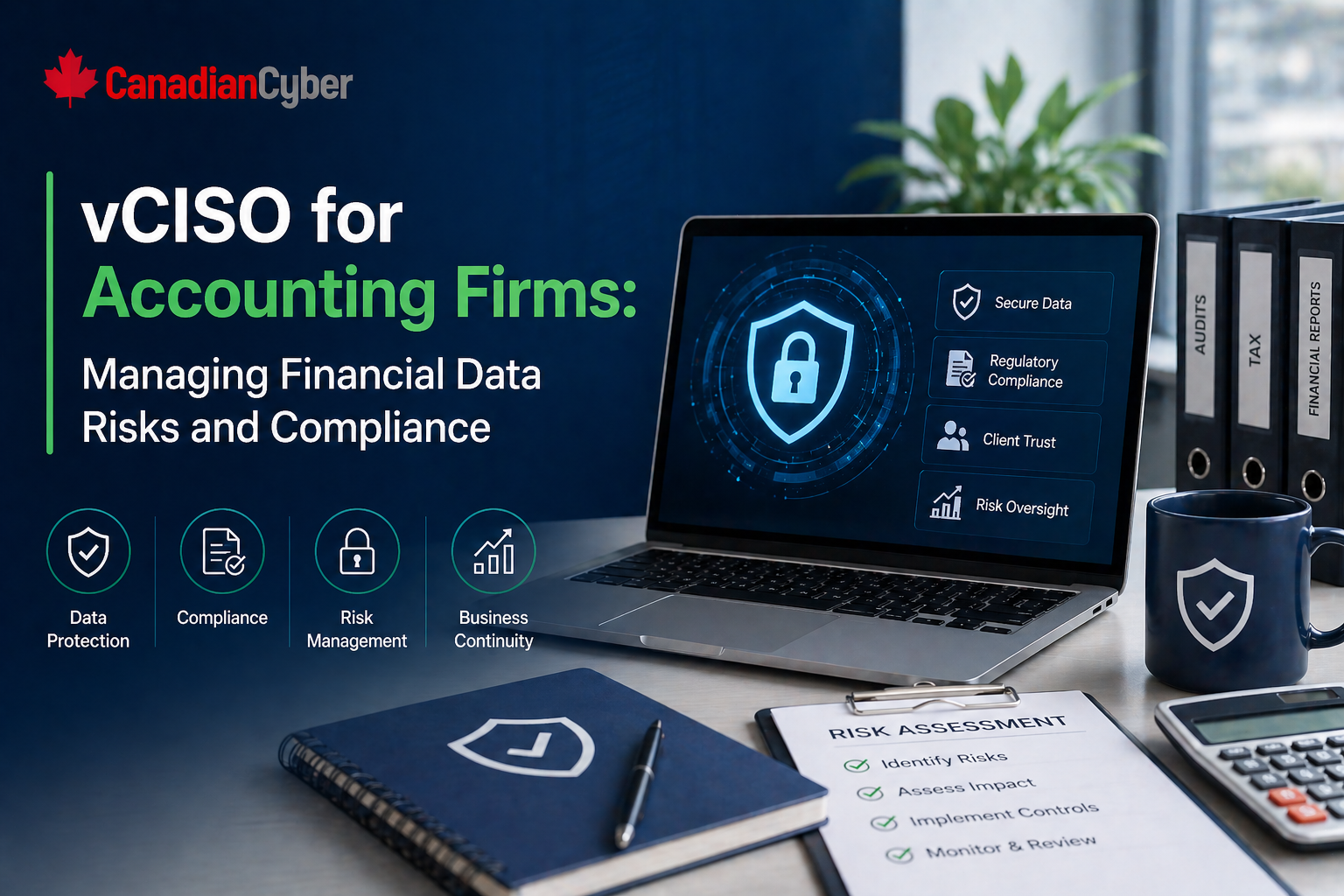
vCISO for Accounting Firms: Managing Financial Data Risks and Compliance
Accounting firms handle highly sensitive client financial data every day. A vCISO helps protect that trust with stronger access control, vendor governance, incident readiness, and compliance evidence.
Quick Snapshot
| Area | Why It Matters |
|---|---|
| Client Data | Tax records, payroll data, financial statements, banking details, and audit files need strict protection. |
| Access Control | Former staff, broad folder permissions, and seasonal access can create major exposure. |
| Vendor Risk | Tax software, payroll tools, portals, cloud storage, and managed IT providers all need review. |
| vCISO Value | Security leadership, compliance readiness, and client trust without hiring a full-time CISO. |
Introduction
Accounting firms are built on trust.
Clients share tax records, payroll data, financial statements, audit files, banking details, corporate documents, and sensitive business plans because they believe the firm will protect them.
But that trust is under more pressure than ever.
A vCISO helps accounting firms manage financial data risk, improve compliance readiness, and give clients more confidence without needing to hire a full-time security executive.
Accounting firms now face:
- more cloud platforms
- more client portals
- more remote work
- more vendor tools
- more phishing attempts
- more client security questions
- more compliance expectations
Why Accounting Firms Face Serious Cyber Risk
Accounting firms handle data attackers want.
That includes:
- tax returns
- payroll records
- employee SIN or SSN details
- bank account information
- corporate financial statements
- invoices and payment records
- audit working papers
- client contracts
- business acquisition details
This information can be used for fraud, identity theft, business email compromise, extortion, and financial manipulation. That makes accounting firms attractive targets, especially during tax season and year-end work when deadline pressure can lead to shortcuts.
The Compliance Pressure Is Growing
Clients increasingly expect accounting firms to prove that financial information is protected.
They may ask:
- Do you use MFA?
- How do you secure client portals?
- Who can access our files?
- Are staff trained on phishing?
- Do you review vendors?
- Do you have an incident response plan?
- Are backups tested?
- Can you prove access reviews happened?
For firms serving larger clients, these questions can become part of procurement, renewals, or audit committee reviews.
A Common Scenario
Picture this: a mid-sized accounting firm uses Microsoft 365, a cloud document management system, tax software, payroll platforms, client portals, e-signature tools, file-sharing systems, managed IT support, and remote laptops.
The firm has security tools in place, but the process is not fully coordinated.
Common gaps appear:
- some client folders are too broadly accessible
- vendor reviews are informal
- security policies are outdated
- incident response exists only as a rough plan
- access review evidence is scattered
Then a major client asks for a security review before renewing the contract. Now the firm needs to prove security maturity quickly. This is exactly where a vCISO helps.
1. Protecting Client Financial Data
The first priority is understanding where client financial data lives.
| Data Location | Why It Needs Review |
|---|---|
| Document management systems | May hold tax files, financial statements, and audit evidence |
| Often contains attachments, client requests, and sensitive conversations | |
| Client portals | Used for file exchange and client-facing workflows |
| Tax and payroll platforms | Contain high-value financial and employee data |
| Backups and archives | May retain sensitive records longer than expected |
Once the firm knows where sensitive data lives, it can apply stronger controls such as:
- role-based access
- MFA
- encryption
- secure file sharing
- restricted downloads
- retention rules
- logging and monitoring
Where Does Your Client Data Actually Live?
We help accounting firms map financial data across portals, email, tax systems, payroll tools, document platforms, backups, and vendors.
2. Strengthening Access Control
Access control is one of the biggest risk areas for accounting firms.
Common problems include:
- former staff retaining access
- broad partner or manager permissions
- shared accounts
- temporary access not removed
- client folders visible to too many users
- weak review of admin access
A vCISO helps create a cleaner process for onboarding, role changes, offboarding, privileged access review, client folder permissions, seasonal staff access, and contractor access.
3. Securing Client Portals and File Sharing
Accounting firms exchange large amounts of sensitive information. If staff rely too heavily on email attachments or unsecured links, risk increases.
Secure File-Sharing Rules
- use approved client portals
- avoid personal email for client files
- restrict public links
- apply expiry dates where possible
- control downloads for sensitive files
- monitor exceptions
4. Managing Vendor Risk
Accounting firms depend on vendors for tax software, payroll platforms, cloud storage, e-signature, IT support, cybersecurity tools, document management, and client portals.
| Vendor Type | Example | Review Priority |
|---|---|---|
| Critical | DMS, tax software, cloud identity provider | High |
| High Risk | payroll, client portal, managed IT | High |
| Moderate | e-signature, collaboration tools | Medium |
| Low | limited-data business tools | Basic tracking |
5. Preparing for Incidents
Accounting firms need a practical incident response plan, not a long document nobody uses.
A real plan should explain:
- who leads the response
- who contacts clients
- when legal or privacy support is needed
- how evidence is preserved
- how systems are isolated
- how decisions are logged
- how lessons learned are tracked
A vCISO can also run tabletop exercises for realistic scenarios, such as:
- phishing leading to mailbox compromise
- ransomware affecting client files
- accidental disclosure of tax documents
- vendor breach involving payroll data
- stolen laptop during busy season
6. Improving Compliance Readiness
Accounting firms may not always need formal certification immediately, but they still need compliance discipline.
A vCISO can help align the firm with:
- ISO 27001
- SOC 2
- privacy requirements
- cyber insurance controls
- client security questionnaires
- internal risk governance
The benefit is not just passing an audit. It is being ready when clients ask security questions.
What Accounting Firms Usually Get Wrong
- Treating cybersecurity as only an IT issue: IT can operate tools, but leadership must govern risk.
- Relying too much on email for sensitive files: Email attachments create unnecessary exposure.
- Not reviewing access regularly: Folder permissions and former user accounts can quietly create risk.
- Ignoring vendor evidence: Client portals, payroll tools, and tax software providers need review.
- Delaying incident response planning: Busy season is not the time to invent a response process.
- Assuming managed IT equals security leadership: Managed IT may operate tools. A vCISO helps govern risk.
Ready Before the Next Client Security Review?
We help accounting firms organize policies, access evidence, vendor reviews, incident response documents, and compliance proof before clients ask.
Canadian Cyber’s Take
At Canadian Cyber, we often see accounting firms with strong client service but uneven cybersecurity governance.
The firm may care deeply about confidentiality, but still lack a structured way to prove who has access, how vendors are reviewed, how incidents are handled, how client files are protected, and how compliance evidence is maintained.
A vCISO gives the firm a practical security leadership layer. It helps partners make better decisions, improves client confidence, and reduces last-minute security scrambling.
Takeaway
Accounting firms handle highly sensitive financial data every day. That creates real cybersecurity and compliance responsibility.
Clients are not only trusting accounting firms with numbers. They are trusting them with some of their most sensitive business and personal information.
A vCISO helps firms manage that responsibility by strengthening client data protection, access control, secure file sharing, vendor risk, incident response, compliance readiness, and leadership reporting.
How Canadian Cyber Can Help
We help accounting firms build practical cybersecurity programs that protect client data and support compliance confidence.
- vCISO services for accounting firms
- financial data risk assessments
- access control and client portal reviews
- vendor risk management
- incident response planning
- security policy and evidence development
- ISO 27001 and SOC 2 readiness support
- SharePoint-based compliance tracking
Stay Connected With Canadian Cyber
Follow Canadian Cyber for practical guidance on vCISO services, accounting firm cybersecurity, financial data protection, ISO 27001, SOC 2, and compliance readiness.