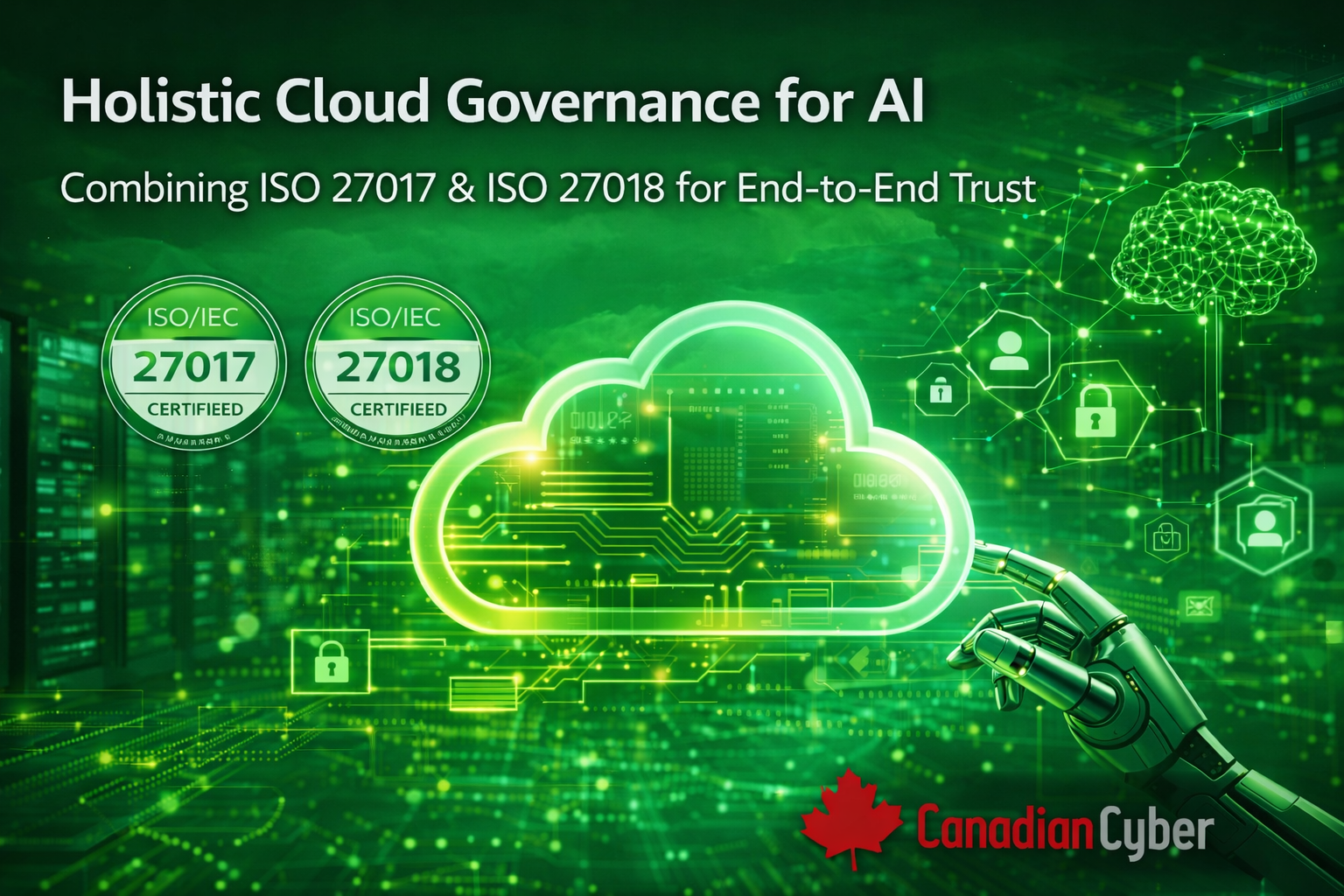
Holistic Cloud Governance for AI
Combining ISO 27017 & ISO 27018 for End-to-End Trust
AI in the cloud is powerful.
It’s also under a microscope.
Customers want assurance.
Regulators want accountability.
Partners want proof.
Many organizations try to respond by fixing security or privacy.
That approach no longer works.
In cloud-based AI, security and privacy must move together.
ISO 27017 and ISO 27018 tell one governance story from infrastructure to personal data.
Why AI forces a new governance mindset
AI systems don’t sit quietly in the background.
They behave like living services.
They:
- Continuously process data
- Interact with users and systems
- Generate new outputs
- Learn and evolve over time
That makes them both a security target and a privacy risk.
Treating these risks in silos creates blind spots.
ISO 27017 and ISO 27018: two halves of trust
These standards were designed to complement each other.
Together, they extend ISO 27001 for modern cloud environments.
| Standard | What it answers for cloud AI |
|---|---|
| ISO 27017 | Is cloud infrastructure secure? Are access controls enforced? Is shared responsibility clear? Are configurations monitored and maintained? |
| ISO 27018 | Is personal data protected? Is PII used only for approved purposes? Are privacy rights respected? Is data handling transparent and accountable? |
Security protects systems.
Privacy protects people.
AI needs both.
Strong security with unclear privacy still fails trust.
Strong privacy with weak cloud controls still fails trust.
Quick snapshot: end-to-end cloud governance
| Problem | AI cloud systems face security and privacy scrutiny |
| Risk | Siloed controls create gaps |
| Solution | ISO 27017 + ISO 27018 together |
| Outcome | Trust across customers, partners, and regulators |
A real-world scenario: FinTech AI SaaS
Imagine a cloud-based FinTech AI platform.
It:
- Processes customer financial data
- Uses ML models for fraud detection
- Runs on public cloud infrastructure
Without holistic governance, you usually get one of two outcomes.
Neither is good.
| What happens without end-to-end governance | Why it undermines trust |
|---|---|
| Cloud security is strong, but privacy controls are unclear | Buyers question how PII is used, stored, and protected across the AI lifecycle |
| Privacy policies exist, but cloud access is over-permissive | Policy claims can’t survive audit questions about access, logging, or misconfigurations |
With ISO 27017 + ISO 27018 aligned, the story becomes clear:
- Cloud access is tightly controlled
- Logs and monitoring are enforced
- AI data usage is clearly defined
- PII is encrypted and minimized
- Responsibilities are documented
Result: end-to-end trust that holds up in procurement, audits, and incident reviews.
Building AI services in the cloud?
Adopt holistic cloud governance. Combine security and privacy with confidence.
Why customers and regulators now expect both
Expectations are rising.
Large enterprises, banks, and public sector buyers increasingly ask for proof across both domains.
Common requests include:
- ISO 27001 certification
- Cloud-specific security controls
- Evidence of privacy governance
Vendor risk questionnaires now probe:
- Cloud configuration practices
- PII handling in AI systems
- Breach notification processes
- Data residency and deletion
ISO 27017 and ISO 27018 answer these questions in a structured, defensible way.
Governance is now a competitive advantage
Trust has become a differentiator.
Organizations aligned to both standards send a clear signal.
| Signal | What buyers hear |
|---|---|
| Cloud security is operational | “They can protect the platform in real life.” |
| Privacy governance is real | “They respect personal data and can prove it.” |
| Audit readiness is built in | “They won’t slow procurement with unclear answers.” |
Avoiding the “patchwork compliance” trap
Many organizations take a piecemeal approach.
A few cloud controls here. Some privacy policies there.
Tools without governance.
This leads to:
- Inconsistent controls
- Audit friction
- Confusing ownership
Unified frameworks reduce rework.
They also make ownership, evidence, and accountability easier to maintain.
Tired of juggling security and privacy separately?
Unify cloud governance with ISO standards and prepare for AI scrutiny the right way.
How Canadian Cyber delivers end-to-end cloud governance
Canadian Cyber helps organizations design integrated compliance programs.
Our approach is holistic because modern risk demands it.
- ISO 27017 cloud security implementation
- ISO 27018 privacy governance
- AI system scoping and risk assessments
- Audit readiness and certification support
The future of trust in cloud AI
AI regulation is evolving.
Expectations are tightening.
Organizations that align security and privacy early will move faster later.
ISO 27017 + ISO 27018 together create a future-proof foundation for cloud AI trust.
Final thought
In cloud-based AI, trust is not built in pieces.
It’s built end-to-end.
Combining ISO 27017 and ISO 27018 shows customers, regulators, and partners that your organization
understands what responsible cloud AI really means.
Build holistic cloud governance for AI
Work with Canadian Cyber on end-to-end compliance that stands up to audits, procurement, and AI scrutiny.
Stay connected with Canadian Cyber
Follow us for practical insights on cloud governance, AI security, and privacy frameworks: