ISO 27001 Internal Audit • Corrective Action Plans • Root Cause Analysis • NCRs • OFIs
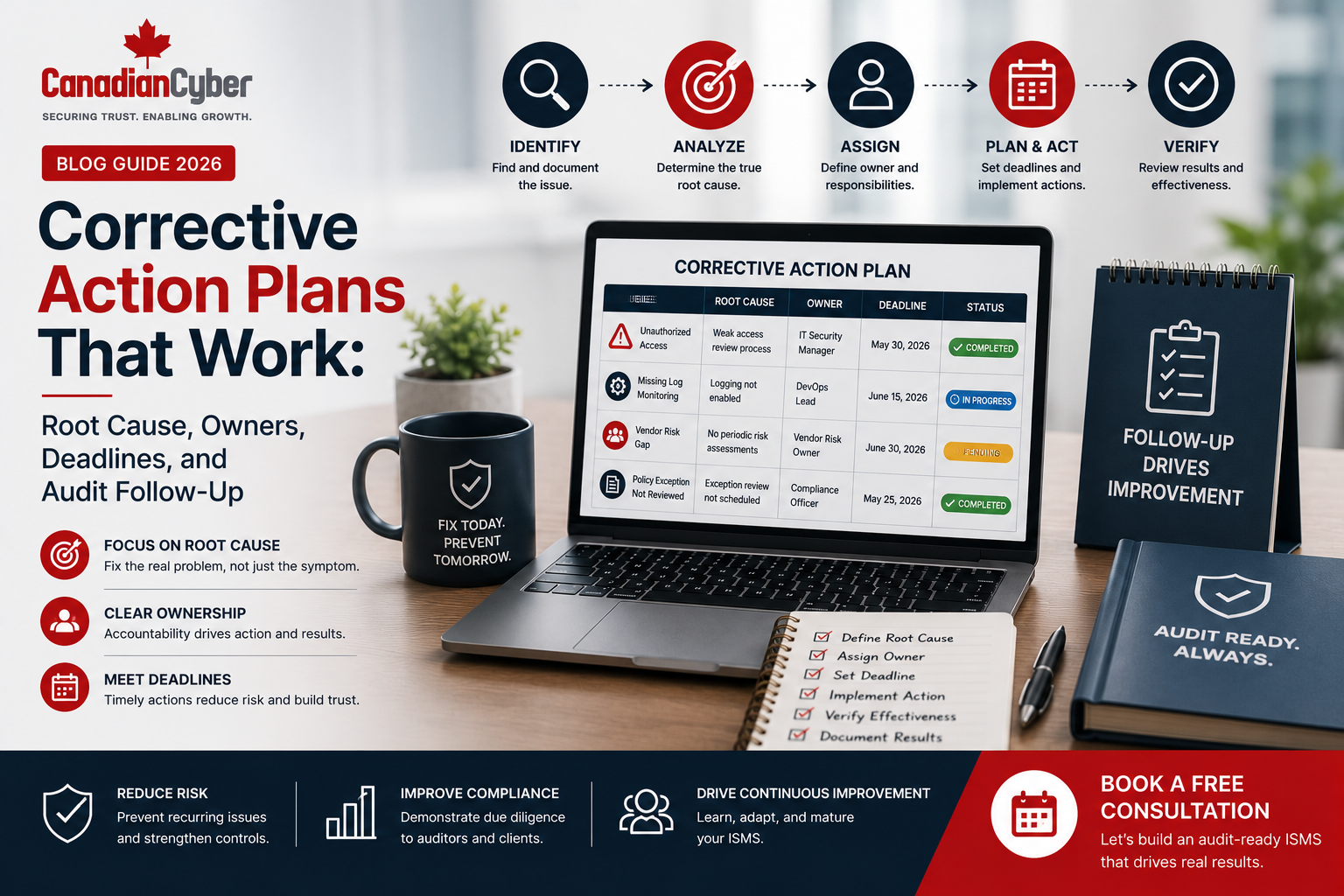
Corrective Action Plans That Work: Root Cause, Owners, Deadlines, and Audit Follow-Up
Finding an ISO 27001 gap is not the real problem. Leaving it unresolved is.
Canadian Cyber Corrective Action Support
Close ISO 27001 Findings the Right Way
Canadian Cyber helps organizations review ISO 27001 findings, classify NCRs and OFIs, identify root causes, assign owners, set deadlines, and verify closure evidence.
We help teams move from open audit findings to verified corrective action closure.
Quick Answer
An effective ISO 27001 corrective action plan should document the finding, root cause, correction, corrective action, owner, deadline, evidence, verification method, and follow-up status.
The plan should not only fix the immediate issue. It should also address why the issue happened and how it will be prevented from happening again.
Practical takeaway: Corrective action is not closed when the task is done. It is closed when the fix is verified.
Quick Snapshot
| Corrective Action Element | What It Should Prove |
|---|---|
| Finding | What went wrong. |
| Root Cause | Why it happened. |
| Correction | Immediate fix. |
| Corrective Action | Long-term fix to prevent recurrence. |
| Owner | Who is accountable. |
| Evidence | Proof the action was completed. |
| Verification | Confirmation that the fix works. |
Why Corrective Action Plans Matter in ISO 27001
ISO 27001 is based on continual improvement.
That means the organization is expected to find issues, understand them, correct them, and prevent recurrence.
A corrective action plan shows that the ISMS can learn and improve. It also proves that audit findings are managed seriously.
A finding is not a failure. A finding without corrective action is the real risk.
Who This Blog Is For
- ISO 27001 internal auditors.
- ISMS managers and compliance leads.
- Security managers, CTOs, and IT managers.
- vCISO teams and risk owners.
- Control owners managing NCRs and OFIs.
- Companies preparing for ISO 27001 certification.
- Teams using SharePoint or Microsoft 365 for ISMS evidence.
Correction vs Corrective Action
Many organizations confuse correction with corrective action.
They are related, but they are not the same.
| Term | Meaning | Example |
|---|---|---|
| Correction | Fixes the immediate issue. | Complete the missed access review. |
| Corrective Action | Fixes the cause so the issue does not return. | Create a recurring access review task with owner, reminder, and escalation. |
Practical rule: Correction fixes the symptom. Corrective action fixes the system.
Why Corrective Action Plans Fail
Corrective action plans often fail for simple reasons.
- The root cause is vague.
- The action only fixes the immediate issue.
- The owner is missing or unclear.
- The deadline is unrealistic.
- The evidence requirement is not defined.
- No one verifies closure.
- The same issue repeats later.
- Management does not review overdue actions.
If the same issue can happen again next quarter, the corrective action is not strong enough.
Weak vs Strong Corrective Action Example
| Weak Example | Strong Example |
|---|---|
|
Finding: Access review missing. Action: Complete access review. Owner: IT. Due date: Soon. |
Finding: Q2 privileged access review was late. Root cause: No reminder or backup owner existed. Action: Create quarterly evidence task, assign owner, add Teams reminder, and escalate if overdue. Verification: ISMS owner confirms the Q3 review is completed on time. |
The Corrective Action Lifecycle
A strong corrective action process follows a clear lifecycle.
- Identify the finding.
- Classify the finding.
- Analyze the root cause.
- Define the correction.
- Define the corrective action.
- Assign a named owner.
- Set a realistic deadline.
- Collect closure evidence.
- Verify the fix.
- Review for recurrence.
Practical rule: Corrective action is not closed when the task is done. It is closed when the fix is verified.
Root Cause Analysis: Ask the Right Questions
Root cause analysis should be honest and practical.
The goal is to understand why the issue happened.
Useful root cause questions include:
- Was the process unclear?
- Was the owner unaware of responsibility?
- Was there no reminder?
- Was evidence saved in the wrong place?
- Was the policy unrealistic?
- Was training missing?
- Was the system not configured properly?
“Human error” is usually not a complete root cause. Ask why the error was possible.
Common Root Cause Categories
| Root Cause Type | Example |
|---|---|
| Ownership Gap | No named owner for vendor reviews. |
| Process Gap | No documented access review process. |
| Evidence Gap | Review happened, but evidence was not saved. |
| Tooling Gap | No reminder or tracking workflow. |
| Training Gap | Owner did not understand the requirement. |
| Governance Gap | Management did not review overdue actions. |
Owners: Accountability Must Be Specific
A corrective action without a real owner usually gets delayed.
The owner should be a person, not a department.
| Weak Ownership | Strong Ownership |
|---|---|
| IT | IT Manager |
| Compliance | ISMS Manager |
| HR | HR Operations Lead |
| Management | Management Representative |
Practical rule: If everyone owns the corrective action, no one owns it.
Deadlines: Set Realistic Target Dates
Deadlines should be based on risk, complexity, and audit timelines.
Not every finding needs the same deadline.
Deadline factors include:
- Finding severity.
- Customer impact.
- Data sensitivity.
- Certification audit date.
- Technical complexity.
- Vendor dependency.
A deadline should be realistic enough to meet and urgent enough to reduce risk.
Evidence: What Proves Corrective Action Is Complete?
Corrective action closure requires evidence.
The right evidence depends on the finding.
| Finding | Closure Evidence |
|---|---|
| Missing access review | Completed access review and removal evidence. |
| Outdated policy | Approved updated policy and communication record. |
| Training incomplete | Completion report and overdue follow-up. |
| Vendor not reviewed | Vendor risk assessment and approval. |
| Backup not tested | Restore test report. |
| Incident process untested | Tabletop exercise report. |
Practical rule: Closure evidence should prove both the immediate fix and the improved process.
Audit Follow-Up: Closure Must Be Verified
A corrective action should not be closed only because the owner says it is done.
Closure should be verified by someone who can challenge the evidence.
Verification should confirm:
- The action was completed.
- The evidence is sufficient.
- The root cause was addressed.
- The fix matches the finding.
- The control now operates as expected.
- The recurrence risk is reduced.
Corrective action closure should be verified by someone objective.
Corrective Action Tracker Fields
A strong tracker should support accountability, evidence, and audit follow-up.
Recommended fields include:
- Finding ID and finding type.
- Finding description and related clause or control.
- Risk rating and root cause.
- Correction and corrective action.
- Owner and backup owner.
- Target date and status.
- Evidence required and evidence link.
- Verification owner and verification date.
- Closure decision and recurrence check date.
Example Corrective Action Plan Template
| Finding ID | IA-2026-07 |
| Finding Type | Minor Nonconformity |
| Finding | Q2 user access review was not completed for the support platform. |
| Root Cause | The support platform was not included in the quarterly access review schedule. |
| Correction | Complete access review and remove unnecessary users. |
| Corrective Action | Add support platform to quarterly review calendar and create recurring SharePoint evidence task. |
| Owner | Support Operations Manager |
| Verification | ISMS owner verifies the next quarterly review is completed on time. |
NCRs vs OFIs: Should Both Be Tracked?
Yes. Nonconformities must be addressed. Opportunities for improvement should also be tracked.
OFIs may not require the same urgency as NCRs. However, ignoring them can allow small weaknesses to become future findings.
Practical rule: NCRs require corrective action. OFIs deserve review, prioritization, and improvement planning.
How to Prioritize Corrective Actions
Not all corrective actions carry the same risk.
Prioritize based on:
- Severity.
- Data sensitivity.
- Customer impact.
- Control importance.
- Likelihood of recurrence.
- Certification timeline.
- System criticality.
Corrective actions that affect access, sensitive data, incidents, backups, and external audit readiness should receive higher priority.
Corrective Action Plans for Common ISO 27001 Findings
Access Review Missing
Root cause may be no assigned owner or recurring reminder.
A strong corrective action adds a recurring workflow, assigns an owner, and includes exception tracking.
Vendor Review Not Completed
Root cause may be an incomplete vendor register.
A strong corrective action updates the vendor register, classifies vendors by risk, and sets review dates.
Training Incomplete
Root cause may be that new hires were not automatically assigned training.
A strong corrective action adds training assignment to onboarding.
Management Review Too Vague
Root cause may be no prepared metrics or decision tracker.
A strong corrective action creates a management review dashboard and action tracker.
Backup Restore Not Tested
Root cause may be that restore testing was not scheduled.
A strong corrective action adds restore testing to the annual or quarterly schedule.
How Management Review Supports Corrective Action
Management review should include corrective action status.
Leadership should review:
- Open findings.
- Overdue corrective actions.
- High-risk corrective actions.
- Repeat findings.
- Resource blockers.
- Verification status.
Practical rule: Corrective actions should not disappear into a tracker. Leadership should review progress.
How Internal Audit Follow-Up Should Work
Internal audit follow-up confirms that corrective actions were completed and effective.
Follow-up should include:
- Review the corrective action tracker.
- Check overdue actions.
- Review closure evidence.
- Interview action owners where needed.
- Verify that the control now operates.
- Document the closure decision.
- Raise unresolved issues to management.
Follow-up should test whether the issue is fixed, not only whether a task was marked complete.
Common Corrective Action Mistakes to Avoid
- Root cause is too shallow. “Forgot to do it” is not enough.
- Owner is a department. Assign a named accountable person.
- Deadline is “ASAP.” Use a real date.
- Evidence is not defined. The owner should know what proof is required.
- Only the immediate issue is fixed. The plan should prevent recurrence.
- No verification is performed. Someone must confirm the action works.
- OFIs are ignored. They can become future findings.
How SharePoint Can Help Manage Corrective Actions
A structured SharePoint ISMS can make corrective action management easier.
It can help teams avoid scattered tracking across email, spreadsheets, chats, and personal folders.
Canadian Cyber’s ISMS SharePoint Solution can organize:
- Internal audit findings.
- NCR and OFI registers.
- Corrective action tracker.
- Root cause records.
- Owner assignments and due dates.
- Evidence links and verification status.
- Management review dashboard.
- Power Automate reminders and Teams notifications.
Practical rule: Corrective actions are easier to close when owners, deadlines, reminders, and evidence links are managed in one place.
How Canadian Cyber Helps
Canadian Cyber helps organizations manage ISO 27001 internal audit findings from identification to verified closure.
Our team supports corrective action planning, NCR and OFI classification, root cause review, evidence verification, follow-up testing, and certification readiness.
- ISO 27001 internal audits.
- Corrective action plan review.
- Root cause analysis support.
- NCR and OFI classification.
- Finding register development.
- Closure evidence review.
- Corrective action verification.
- Management review preparation.
- Certification readiness reviews.
- SharePoint ISMS implementation.
Frequently Asked Questions
What is a corrective action plan in ISO 27001?
A corrective action plan documents how the organization will address a nonconformity or weakness. It includes the root cause, action, owner, deadline, evidence, and verification.
What is the difference between correction and corrective action?
Correction fixes the immediate problem. Corrective action addresses the root cause so the problem does not happen again.
Who should own corrective actions?
Each corrective action should have a named owner who is accountable for completion, evidence collection, status updates, and closure readiness.
What evidence is needed to close a corrective action?
Evidence depends on the finding. It may include updated policies, access reviews, training reports, vendor assessments, restore test results, approvals, logs, or workflow records.
Should OFIs be tracked?
Yes. OFIs should be reviewed and prioritized. They can help improve the ISMS and prevent future findings.
Can Canadian Cyber help verify corrective action closure?
Yes. Canadian Cyber can review corrective action plans, verify closure evidence, perform follow-up testing, and help prepare for certification or surveillance audits.
Takeaway
Corrective action plans are where ISO 27001 improvement becomes real.
A finding alone does not improve security. Improvement happens when the organization understands the root cause and fixes the system.
A strong corrective action plan includes a clear finding, root cause, correction, corrective action, named owner, real deadline, closure evidence, verification method, and follow-up status.
For ISO 27001, corrective action is not paperwork. It is proof that the ISMS can learn, improve, and stay audit-ready.
Need Help Closing ISO 27001 Findings?
Canadian Cyber can help you close NCRs, OFIs, and overdue corrective actions properly.
We support ISO 27001 internal audits, corrective action planning, root cause review, closure evidence verification, management review preparation, certification readiness, vCISO services, cybersecurity assessments, SOC 2 readiness, ISO 42001 AI governance, and SharePoint ISMS implementation.
Stay Connected With Canadian Cyber
Follow Canadian Cyber for practical guidance on ISO 27001 internal audits, corrective action plans, NCRs, OFIs, root cause analysis, audit follow-up, SOC 2, ISO 42001, ISO 27017, ISO 27018, SharePoint ISMS, cybersecurity assessments, and vCISO support.