ISO 27001 Internal Audit • Evidence Sampling • Audit Readiness • ISMS Evidence
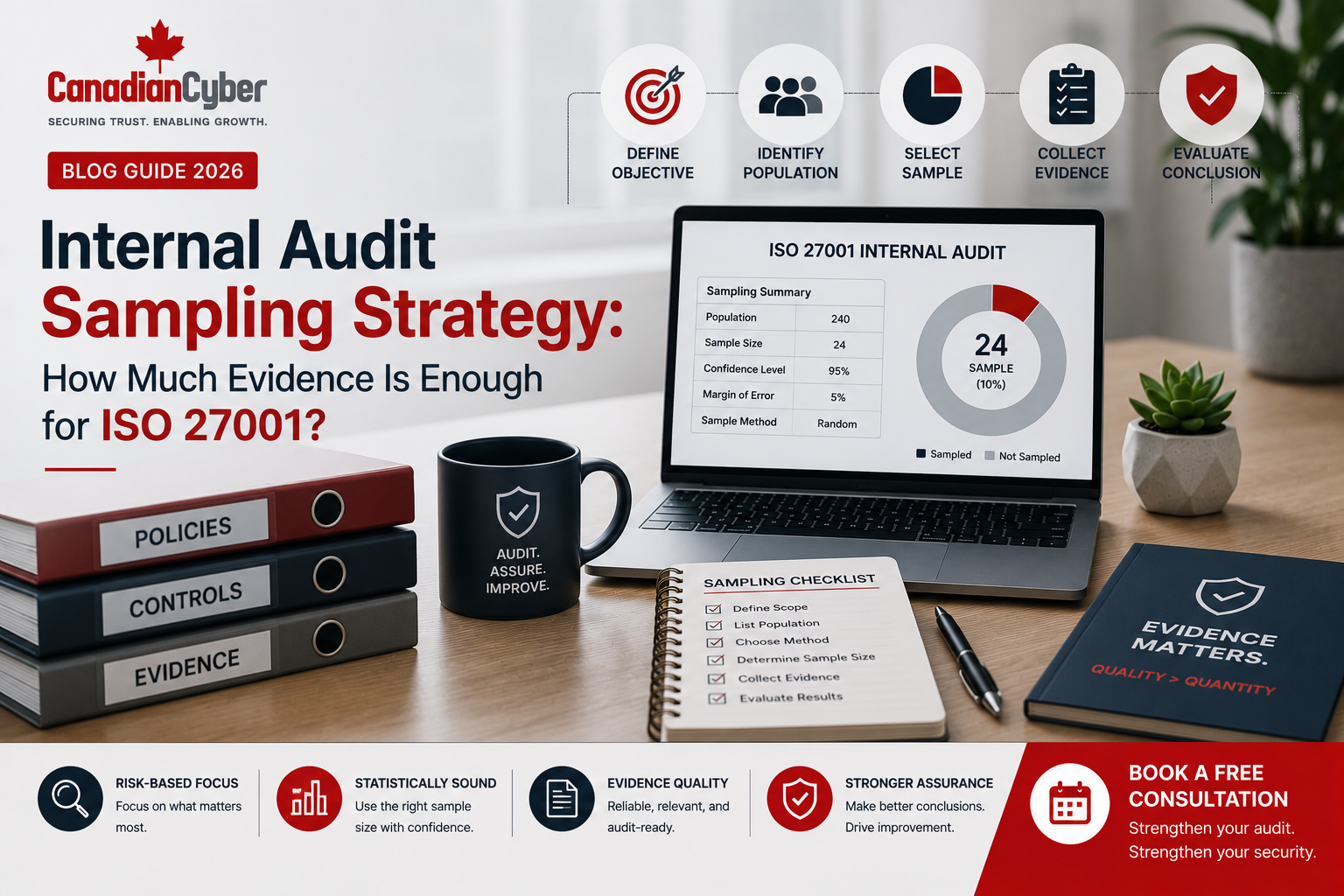
Internal Audit Sampling Strategy: How Much Evidence Is Enough for ISO 27001?
ISO 27001 internal auditors do not need to review every record. They need enough relevant evidence to support a clear and reasonable audit conclusion.
Canadian Cyber ISO 27001 Internal Audit Support
Build an Internal Audit That Tests Real Control Operation
Canadian Cyber provides ISO 27001 internal audits that test evidence quality, control operation, sampling coverage, NCRs, OFIs, and certification readiness.
We help organizations avoid weak audits that only check whether documents exist.
Quick Answer
There is no single sample size for every ISO 27001 internal audit control.
The right amount of evidence depends on control frequency, risk, population size, maturity, prior findings, and evidence quality.
Practical takeaway: Test enough evidence to confirm whether the control is operating as intended. Then document the sample, method, evidence reviewed, exceptions, and conclusion.
Quick Snapshot
| Sampling Area | What the Auditor Should Consider |
|---|---|
| Control Frequency | Daily, weekly, monthly, quarterly, annual, or event-based. |
| Control Risk | Higher-risk controls usually need deeper testing. |
| Control Type | Manual controls may need more samples than automated controls. |
| Population Size | More records may require a larger sample. |
| Prior Findings | Repeat issues may require more detailed testing. |
| Evidence Quality | Weak evidence may require more samples. |
Why Sampling Matters in ISO 27001 Internal Audits
ISO 27001 internal audit is meant to test whether the ISMS is implemented and working.
That does not mean the auditor must review every record. Instead, the auditor should review a reasonable sample.
Sampling helps the auditor test control operation, find exceptions, reduce audit burden, and support audit conclusions.
Sampling should be risk-based, documented, and linked to the audit objective.
Who This Blog Is For
- ISO 27001 internal auditors.
- Compliance managers and ISMS owners.
- CTOs, IT managers, and security leaders.
- vCISO teams and risk managers.
- Companies preparing for ISO 27001 certification.
- Organizations preparing for surveillance audits.
- Teams using SharePoint or Microsoft 365 for ISMS evidence.
What Is Evidence Sampling?
Evidence sampling means selecting a portion of available records for audit testing.
For example, the company may have 120 access requests. The auditor may select 10 and check whether each request was approved and closed correctly.
Or the company may have 12 monthly backup reports. The auditor may select three months and check whether backups ran successfully.
Practical rule: The sample should be large enough to support a conclusion, but focused enough to remain practical.
How Much Evidence Is Enough?
The honest answer is simple. It depends.
ISO 27001 does not give one fixed sample size for every control.
The auditor should consider:
- How often the control operates.
- How risky the control is.
- How many records exist.
- Whether the control is manual or automated.
- Whether the control failed before.
- Whether the evidence is complete.
- Whether the system is critical.
The right sample size is based on risk and control frequency, not guesswork.
Sampling by Control Frequency
Annual Controls
Annual controls happen once per year. Examples include annual risk assessment, management review, internal audit, policy review, and training.
For annual controls, one complete record may be enough if the evidence is clear and current.
Quarterly Controls
Quarterly controls happen four times per year. Examples include access reviews, risk reviews, and vendor status reviews.
For lower-risk controls, one quarter may be enough. For higher-risk controls, test more quarters.
Monthly Controls
Monthly controls happen 12 times per year. Examples include backup reviews, vulnerability scans, endpoint reviews, and metrics reviews.
A good approach is to select one early month, one middle month, and one recent month.
Daily or Weekly Controls
Daily and weekly controls may create too many records to review one by one.
For frequent controls, combine sample testing with dashboards, summary reports, and exception review.
Event-Based Controls
Event-based controls happen when something occurs. Examples include onboarding, terminations, access requests, production changes, and vendor onboarding.
For event-based controls, select a sample from the population. Include higher-risk cases where relevant.
Practical Sample Size Guide
| Control Frequency | Example Control | Practical Sampling Approach |
|---|---|---|
| Annual | Management review | Review the annual record. |
| Quarterly | Access review | Test one to four quarters based on risk. |
| Monthly | Backup review | Test several months across the period. |
| Weekly | Vulnerability scan | Test selected weeks and exception handling. |
| Daily | Automated backup | Review summary reports and selected exceptions. |
| Event-Based | Termination | Sample selected terminations. Test deeper if high-risk. |
| Rare Events | Security incidents | Review all incidents if the number is small. |
Practical rule: Use the table as a guide, not a fixed rule. Audit judgment still matters.
When to Test More Evidence
Some controls deserve deeper testing. This is especially true when risk is high.
Test more evidence when:
- The control protects sensitive data.
- The control relates to privileged access.
- The system is business-critical.
- The control failed before.
- Evidence is inconsistent.
- Manual judgment is involved.
- There were incidents, complaints, or repeat issues.
High-risk controls should receive stronger sampling than routine low-risk controls.
When One Sample Is Not Enough
One sample may not be enough when the auditor needs to test consistency over time.
For example, one good access review does not prove that all quarterly reviews were completed properly.
One sample may be too weak when:
- The control happens many times.
- The control is manual.
- The control is high-risk.
- There were prior findings.
- Evidence quality is weak.
- The sample has exceptions.
Practical rule: One perfect screenshot does not prove a control operated consistently.
What If the Sample Finds an Exception?
If the auditor finds an exception, it should not be ignored.
Common exceptions include:
- Missing approval.
- Late review.
- Incomplete record.
- Access not removed.
- Vendor not reviewed.
- Corrective action not verified.
The auditor should document the exception. Then they should assess whether it is isolated or systemic.
If a sample fails, the auditor may need to test more evidence.
Need a Stronger ISO 27001 Internal Audit?
Canadian Cyber performs ISO 27001 internal audits that test whether controls are actually operating.
Sampling Strategy by Evidence Area
1. Access Control Evidence
Access control is usually high-risk. Samples should include standard users and privileged users.
Check approvals, business need, role assignment, MFA status, timely removal, and review sign-off.
2. HR and People Controls
HR controls affect onboarding, training, role changes, and offboarding.
Offboarding samples often need extra attention because late access removal creates serious risk.
3. Vendor Risk Evidence
Vendor controls can be annual, event-based, or risk-based.
For vendor sampling, include critical vendors even when they are not randomly selected.
4. Backup and Recovery Evidence
Backup evidence should prove that recovery is possible.
Samples should include both successful backup runs and exceptions.
5. Incident Response Evidence
If incidents are rare, review all incidents in the audit period.
Check classification, timeline, escalation, containment, lessons learned, and closure evidence.
6. Change Management Evidence
Change samples should include different types of changes.
Do not sample only easy changes. Include higher-risk changes where relevant.
7. Training Evidence
Training evidence should prove assignment, completion, and follow-up.
Include new hires and overdue cases, not only completed users.
8. Corrective Action Evidence
Corrective actions show continual improvement.
A corrective action is not closed until evidence proves the issue was addressed.
How to Document Sampling in the Audit Report
Sampling should be visible in the internal audit report.
Include these details:
- Control tested.
- Population reviewed.
- Sample size.
- Sample selection method.
- Evidence reviewed.
- Date range.
- Exceptions found.
- Auditor conclusion.
Example Sampling Note
Control: Quarterly access review.
Population: Four quarterly access reviews in 2026.
Sample: Q1 and Q3 access reviews.
Method: Risk-based selection.
Conclusion: One exception noted. Minor nonconformity raised.
Random Sampling vs Judgmental Sampling
Internal auditors may use different sampling methods.
Random sampling selects records randomly. This can reduce bias.
Judgmental sampling selects records based on risk, importance, timing, or known concerns.
Both can be useful. The auditor should document the method used.
Practical rule: Judgmental sampling is acceptable when the auditor explains why the sample was selected.
What External Auditors May Expect
External auditors may review the internal audit process.
They may ask:
- Was the internal audit planned?
- Was the sampling approach reasonable?
- Were high-risk areas tested?
- Were findings documented?
- Were corrective actions assigned?
- Were results reported to management?
A strong internal audit helps the external auditor trust that the ISMS was tested seriously.
Common Sampling Mistakes
- Testing only the best evidence. Auditors should not only review evidence selected by the control owner.
- Sampling too little. One screenshot may not prove recurring control operation.
- Ignoring high-risk controls. Privileged access, offboarding, vendor risk, backups, and incidents need careful testing.
- Not documenting the sample. Weak documentation makes the conclusion harder to defend.
- Not expanding after exceptions. One exception may indicate a wider issue.
- Reviewing documents but not records. Policies explain what should happen. Records prove what happened.
- No link to risk. Sampling should be stronger where risk is higher.
How SharePoint Can Help With Evidence Sampling
A structured SharePoint ISMS can make sampling easier.
Instead of searching through email, chats, folders, screenshots, and spreadsheets, evidence can be organized by control, owner, period, status, and due date.
Canadian Cyber’s ISMS SharePoint Solution can manage:
- Evidence libraries and control registers.
- Risk registers and access review records.
- Vendor review evidence.
- Training records and backup evidence.
- Incident records and corrective actions.
- Internal audit workpapers.
- Sampling notes, NCRs, and OFIs.
- Management review dashboards.
Practical rule: Sampling becomes easier when evidence is stored consistently throughout the year.
Canadian Cyber’s Approach to Internal Audit Sampling
Canadian Cyber performs ISO 27001 internal audits with a practical, risk-based sampling approach.
We do not only ask whether documents exist. We test whether controls are operating.
Our approach considers:
- Control frequency and control risk.
- System criticality and business impact.
- Evidence quality and prior findings.
- Sensitive data exposure.
- Manual control dependency.
- Audit period coverage and certification readiness.
How Canadian Cyber Helps
Canadian Cyber helps organizations prepare for ISO 27001 certification and surveillance audits.
We provide practical internal audit services and evidence readiness support.
- ISO 27001 internal audits.
- ISO 27001 implementation.
- Internal audit sampling strategy.
- Evidence readiness reviews.
- Access control testing.
- Vendor risk testing.
- Backup and recovery evidence review.
- Corrective action verification.
- NCR and OFI classification.
- SharePoint ISMS implementation.
Frequently Asked Questions
How much evidence is enough for ISO 27001 internal audit?
There is no fixed amount. Evidence should be enough to support the auditor’s conclusion. Sample size depends on frequency, risk, population size, evidence quality, and prior findings.
Does ISO 27001 require auditors to check every record?
No. Internal auditors can use sampling where appropriate. The sampling approach should be reasonable, risk-based, and documented.
How many access reviews should be sampled?
It depends on frequency and risk. For quarterly access reviews, the auditor may test one or more quarters. Privileged access may need deeper testing.
Should internal auditors use random sampling?
Random sampling can be useful. Judgmental risk-based sampling is also common. The auditor should document the method used.
What happens if a sample fails?
The auditor should document the exception, assess impact, consider expanding the sample, and raise a finding if needed.
Can Canadian Cyber help with ISO 27001 sampling?
Yes. Canadian Cyber performs ISO 27001 internal audits, evidence readiness reviews, sampling strategy design, corrective action verification, and SharePoint ISMS implementation.
Takeaway
ISO 27001 internal audit sampling is not about collecting random screenshots.
It is about testing enough evidence to decide whether controls are working.
A strong sampling strategy considers frequency, risk, population size, evidence quality, prior findings, system criticality, and audit period coverage.
Enough evidence means enough to support a reliable audit opinion. Not too little. Not endless. Just enough to prove the ISMS is working.
Not Sure Whether Your ISO 27001 Evidence Is Strong Enough?
Canadian Cyber can help you plan a practical internal audit and test the right evidence.
We support ISO 27001 internal audits, sampling strategy design, evidence readiness reviews, NCR and OFI classification, corrective action verification, vCISO services, cybersecurity assessments, and SharePoint ISMS implementation.
Stay Connected With Canadian Cyber
Follow Canadian Cyber for practical guidance on ISO 27001 internal audits, audit sampling, evidence readiness, certification preparation, SOC 2, ISO 42001, ISO 27017, ISO 27018, SharePoint ISMS, cybersecurity assessments, and vCISO support.