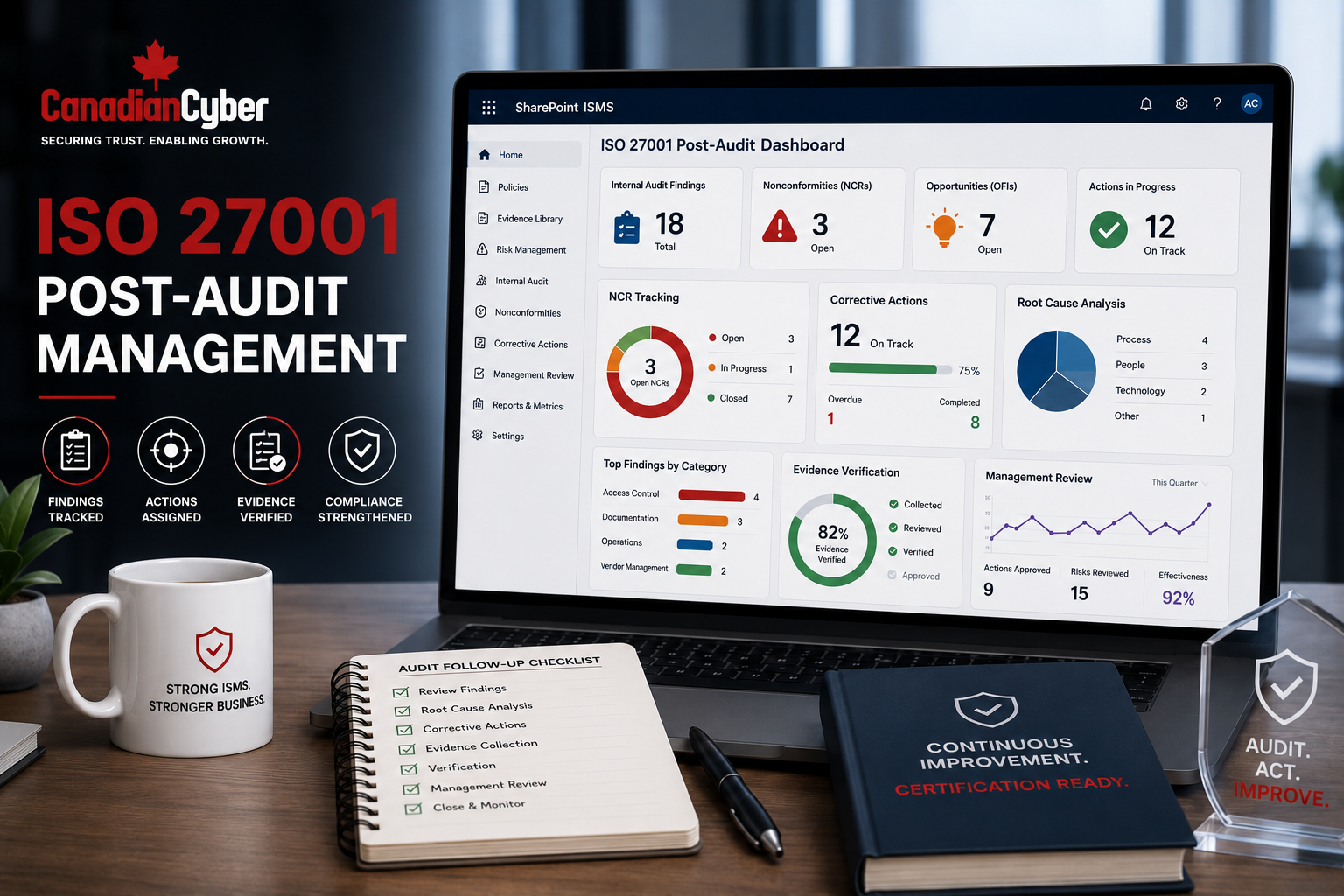
ISO 27001 Internal Audit • Audit Findings • Corrective Actions • NCRs • OFIs
What Happens After an ISO 27001 Internal Audit? A Practical Guide to Fixing Findings, Owners, and Deadlines
An ISO 27001 internal audit does not end when the report is submitted. That is when the most important work begins.
Canadian Cyber Post-Audit Support
Turn ISO 27001 Findings Into Clear Corrective Actions
Canadian Cyber helps organizations review ISO 27001 internal audit findings, classify NCRs and OFIs, assign owners, set deadlines, verify evidence, and prepare for certification or surveillance audits.
Findings are useful. Unmanaged findings are the real risk.
Quick Answer
After an ISO 27001 internal audit, the organization should review the report and confirm each finding.
Next, it should classify findings, assign owners, identify root causes, define corrective actions, set deadlines, collect closure evidence, verify completion, and report progress to management.
Practical takeaway: The goal is not only to close findings quickly. The goal is to fix why the finding happened.
Quick Snapshot
| Post-Audit Step | What It Means |
|---|---|
| Review the Report | Understand each finding and its business impact. |
| Classify Findings | Separate major NCRs, minor NCRs, OFIs, and observations. |
| Assign Owners | Give each action to a specific accountable person. |
| Identify Root Cause | Understand why the issue happened. |
| Verify Closure | Confirm the fix works and evidence is sufficient. |
| Report to Management | Keep leadership informed about high-risk and overdue actions. |
Why the Post-Audit Phase Matters
The internal audit is designed to test whether the Information Security Management System is working.
The report may identify missing evidence, overdue reviews, weak access controls, unclear ownership, or process gaps.
Some organizations panic when they see findings. However, findings are not the enemy.
Findings help the organization improve before certification audits, surveillance audits, customer reviews, cyber insurance renewals, or leadership meetings.
The internal audit report is not the finish line. It is the action plan for improvement.
Who This Guide Is For
- ISMS managers and ISO 27001 internal auditors.
- Compliance leads and security managers.
- Risk owners, control owners, and IT managers.
- CTOs and operations leaders.
- vCISO teams supporting ISO 27001 programs.
- Companies preparing for ISO 27001 certification.
- Organizations preparing for surveillance audits.
- Teams using SharePoint or Microsoft 365 for audit follow-up.
Step 1: Review the Internal Audit Report Carefully
The first step after the audit is to review the report in detail.
Do not simply forward the report to control owners and ask them to “fix it.”
The ISMS owner or compliance lead should understand each finding before action begins.
Review each finding for:
- the clause or control it relates to.
- the evidence gap.
- the requirement that was not met.
- the risk to the organization.
- the owner who should respond.
- whether management needs visibility.
Practical rule: Do not rush into fixing findings before understanding what the auditor actually found.
Step 2: Classify the Findings
Findings are not all equal.
Different types of findings need different responses.
| Finding Type | Meaning | Typical Response |
|---|---|---|
| Major Nonconformity | A serious failure or missing required process. | Immediate corrective action and management attention. |
| Minor Nonconformity | A limited failure or incomplete implementation. | Corrective action with evidence. |
| Opportunity for Improvement | A control exists but could be stronger. | Improvement planning. |
| Evidence Gap | A control may exist, but proof is weak or missing. | Collect or improve evidence. |
| Process Gap | A process is unclear, inconsistent, or not followed. | Update process and train owners. |
Classification helps the organization prioritize effort and avoid treating every issue the same way.
Step 3: Create a Corrective Action Tracker
Every finding should be tracked.
Do not manage findings through email threads alone.
A tracker gives visibility, ownership, and accountability.
Recommended tracker fields include:
- finding ID and finding type.
- audit source and clause or control reference.
- finding description and risk impact.
- root cause and correction.
- corrective action and owner.
- target date and status.
- evidence required and evidence link.
- verification owner, verification date, and closure decision.
Practical rule: If findings are not tracked, they are likely to become overdue.
Step 4: Assign Specific Owners
Every finding needs an owner.
The owner should be a named person, not a department.
| Weak Ownership | Strong Ownership |
|---|---|
| IT | IT Manager |
| HR | HR Operations Lead |
| Compliance | ISMS Manager |
| Management | Management Representative |
The owner coordinates the fix, gathers evidence, updates status, and raises blockers.
A corrective action without a named owner is usually a delayed corrective action.
Step 5: Identify the Root Cause
Root cause analysis is one of the most important post-audit activities.
The organization should not only ask what needs to be fixed.
It should also ask why the issue happened.
| Finding | Weak Root Cause | Stronger Root Cause |
|---|---|---|
| Access review missed | Someone forgot. | No recurring reminder, no backup owner, and no escalation process. |
| Vendor review incomplete | Vendor owner delayed it. | Vendor register did not classify critical vendors or assign review dates. |
| Policy not reviewed | Review was missed. | Policy library had no owner metadata or annual review workflow. |
| Training incomplete | Employees did not finish. | New hire training was not linked to onboarding workflow. |
Practical rule: “Human error” is usually not enough. Ask what process allowed the error to happen.
Step 6: Separate Correction From Corrective Action
A correction and a corrective action are different.
Both matter after an ISO 27001 internal audit.
| Term | Meaning | Example |
|---|---|---|
| Correction | Fixes the immediate problem. | Complete the missed vendor review. |
| Corrective Action | Fixes the cause so the issue does not repeat. | Update the vendor register with risk rating, owner, next review date, and reminders. |
Correction fixes today’s problem. Corrective action prevents tomorrow’s repeat finding.
Need Help Closing ISO 27001 Findings?
Canadian Cyber helps organizations turn audit findings into clear, evidence-backed corrective action plans.
Step 7: Set Realistic Deadlines
Deadlines should be based on risk, severity, effort, and audit timeline.
Not every finding needs the same deadline.
Deadline factors include:
- finding severity.
- external audit date.
- customer commitment.
- risk level.
- resource availability.
- technical complexity.
- vendor dependency.
| Finding Type | Deadline Approach |
|---|---|
| Major NCR | Urgent management attention and short target timeline. |
| Minor NCR | Defined corrective action deadline before certification where possible. |
| Evidence Gap | Short deadline if evidence already exists. |
| Policy Gap | Allow time for review, approval, and communication. |
| OFI | Prioritized improvement timeline. |
Step 8: Define Closure Evidence
Every corrective action should state what evidence is required for closure.
Without evidence requirements, owners may mark actions complete without proof.
| Finding | Closure Evidence |
|---|---|
| Missing access review | Completed review, sign-off, and removed access evidence. |
| Vendor not reviewed | Vendor assessment, approval, and updated vendor register. |
| Policy outdated | Approved policy, version history, and communication record. |
| Training incomplete | Completion report and overdue follow-up record. |
| Backup restore not tested | Restore test report and issue resolution. |
| Management review incomplete | Updated minutes, input pack, and decision log. |
Practical rule: If the evidence does not prove completion, the finding should not be closed.
Step 9: Verify the Fix
Verification is different from completion.
Completion means the owner says the action is done.
Verification means someone checks whether the action is effective.
Verification should confirm:
- the action was completed.
- evidence is sufficient.
- root cause was addressed.
- the control now works as expected.
- exceptions were resolved.
- recurrence risk is reduced.
A corrective action should not be closed only because the owner says it is done.
Step 10: Update the Risk Register Where Needed
Some findings indicate changes in risk.
For example, access failures, vendor review gaps, backup issues, and incident response weaknesses may affect the risk register.
Ask these questions:
- Does this finding create a new risk?
- Does it change the likelihood or impact of an existing risk?
- Does treatment need to change?
- Does management need to accept residual risk?
- Does the Statement of Applicability need an update?
- Does control status need revision?
Practical rule: Internal audit findings should feed the risk management process.
Step 11: Report Progress to Management
Leadership should know whether findings are being closed.
High-risk and overdue actions should not remain hidden in a tracker.
Management should review:
- open findings and overdue actions.
- high-risk NCRs and repeat findings.
- root causes and resource blockers.
- closure evidence status.
- verification status.
- risk treatment updates and improvement trends.
Corrective actions should not live only in a tracker. Leadership should review them.
Step 12: Prepare for External Audit or Surveillance Audit
If the internal audit supports certification readiness, findings should be fixed before the external audit where possible.
External auditors may ask what happened after internal audit.
Prepare this follow-up trail:
- updated corrective action tracker.
- closure evidence and verification records.
- management review discussion.
- risk register updates.
- SoA updates where needed.
- policy updates and access review evidence.
- control owner preparation notes.
Step 13: Learn From Repeat Findings
Repeat findings are important.
They show that a process may not be working.
Repeat findings may include:
- access reviews are late every quarter.
- vendor reviews keep missing deadlines.
- training is incomplete for new hires.
- policy reviews are not performed annually.
- backup restore testing is delayed.
- corrective actions are closed without evidence.
To respond, you should:
- analyze trends.
- review root causes.
- assign stronger ownership.
- automate reminders.
- escalate overdue actions.
- update process documentation.
Practical rule: A repeated finding is a signal that the process needs redesign, not another reminder.
Post-Audit Action Plan Template
| Finding ID | IA-2026-03 |
| Finding Type | Minor Nonconformity |
| Clause or Control | Access Control |
| Finding | Quarterly privileged access review was not completed for the cloud admin group. |
| Risk | Excessive or inappropriate privileged access may remain active. |
| Root Cause | Cloud admin group was not included in the access review schedule. |
| Correction | Complete the missed review and remove unnecessary access. |
| Corrective Action | Add cloud admin group to quarterly access review calendar with owner, backup owner, and automated reminder. |
| Owner | IT Manager |
| Evidence Required | Completed review, removed access record, updated schedule, and reminder workflow screenshot. |
| Verification | ISMS Manager verifies the next quarterly review is completed on time. |
ISO 27001 Post-Audit Follow-Up Checklist
| Post-Audit Question | Ready? |
|---|---|
| Has the audit report been reviewed? | |
| Are findings clearly classified? | |
| Has each finding been assigned a named owner? | |
| Has root cause been documented? | |
| Is the immediate correction defined? | |
| Is the corrective action defined? | |
| Is the deadline realistic and documented? | |
| Is closure evidence clearly defined? | |
| Has verification been assigned? | |
| Are overdue actions escalated? | |
| Are high-risk findings reported to management? | |
| Is the organization ready to show follow-up to the external auditor? |
Common Post-Audit Mistakes
- Treating the report as the final deliverable. The report is only useful if action follows.
- Assigning findings to departments. Specific owners are needed.
- Fixing the symptom only. Corrective action should address root cause.
- Using “ASAP” as a deadline. Every action needs a real date.
- Closing without evidence. Closure should be supported by proof.
- No verification. Someone should confirm the fix works.
- Ignoring OFIs. Opportunities for improvement may prevent future nonconformities.
- Not reporting to management. Leadership should see high-risk and overdue actions.
How SharePoint Can Help After Internal Audit
A structured SharePoint ISMS can make post-audit follow-up easier.
It keeps findings, owners, deadlines, evidence, and verification in one controlled workspace.
Canadian Cyber’s ISMS SharePoint Solution can manage:
- internal audit report library.
- finding register, NCR tracker, and OFI tracker.
- corrective action tracker.
- root cause records.
- owner assignments and deadlines.
- evidence links and verification status.
- risk register and SoA updates.
- management review dashboard.
- Power Automate reminders and Teams notifications.
Audit follow-up becomes easier when findings, owners, deadlines, evidence, and verification live in one workspace.
How Canadian Cyber Helps
Canadian Cyber helps organizations close ISO 27001 internal audit findings properly.
We help turn audit results into clear action plans with accountability, evidence, and verification.
Canadian Cyber can support:
- ISO 27001 internal audits.
- post-audit findings review.
- NCR and OFI classification.
- root cause analysis support.
- corrective action planning.
- owner and deadline planning.
- closure evidence review.
- corrective action verification.
- management review preparation.
- SharePoint ISMS implementation.
Frequently Asked Questions
What happens after an ISO 27001 internal audit?
After an ISO 27001 internal audit, the organization should review the report, classify findings, assign owners, identify root causes, define corrective actions, set deadlines, collect evidence, verify closure, update risks where needed, and report progress to management.
Do all internal audit findings need corrective action?
Nonconformities require corrective action. OFIs should be reviewed and prioritized. Observations may be monitored or addressed depending on risk.
Who should own internal audit findings?
Each finding should have a named owner who is accountable for completing the action, collecting evidence, updating status, and preparing for verification.
What is closure evidence?
Closure evidence is proof that the corrective action was completed. It may include updated records, approvals, screenshots, reports, training completion, access review evidence, vendor reviews, or test results.
Should internal audit findings be included in management review?
Yes. Management should review internal audit results, open findings, overdue actions, high-risk issues, corrective action progress, and resource needs.
Can Canadian Cyber help close ISO 27001 findings?
Yes. Canadian Cyber helps organizations review findings, classify NCRs and OFIs, define corrective actions, verify closure evidence, prepare management review updates, and get ready for certification or surveillance audits.
Takeaway
An ISO 27001 internal audit is only valuable if the organization acts on the results.
After the audit, the organization should not simply file the report away.
It should review findings, classify issues, assign owners, identify root causes, define corrective actions, set deadlines, collect evidence, verify closure, update risks, and report progress to management.
Findings are not the problem. Unmanaged findings are.
Need Help After an ISO 27001 Internal Audit?
Canadian Cyber can help you turn findings into practical improvement.
We support post-audit findings review, NCR and OFI classification, root cause analysis, corrective action planning, closure evidence verification, management review preparation, certification readiness, vCISO services, cybersecurity assessments, SOC 2 readiness, ISO 27017, ISO 27018, ISO 42001 AI governance, and SharePoint ISMS implementation.
Stay Connected With Canadian Cyber
Follow Canadian Cyber for practical guidance on ISO 27001 internal audits, audit findings, corrective actions, NCRs, OFIs, certification readiness, SOC 2, ISO 42001, ISO 27017, ISO 27018, SharePoint ISMS, cybersecurity assessments, and vCISO support.