ISO 27001 Internal Audit • Evidence Management • Audit Readiness • ISMS Proof
From Audit Panic to Evidence Confidence: How to Organize ISO 27001 Internal Audit Proof Before Review Week
Audit panic often starts when evidence is scattered. ISO 27001 internal audit proof should be organized before the auditor asks for it.
Canadian Cyber ISO 27001 Evidence Readiness Support
Organize ISO 27001 Evidence Before Review Week
Canadian Cyber helps organizations move from audit panic to evidence confidence.
We help map evidence to ISO 27001 clauses and Annex A controls. We also help build SharePoint evidence workspaces, assign owners, review evidence quality, and prepare audit-ready proof packs.
The goal is simple. Make evidence easy to find, easy to explain, and strong enough to support audit conclusions.
Quick Answer
To organize ISO 27001 internal audit proof, create one central evidence workspace.
Then map each evidence item to the correct clause or Annex A control. Assign an owner, add review dates, define evidence frequency, and track missing proof before audit week.
Practical takeaway: Evidence should be collected when controls operate, not when the auditor asks.
Quick Snapshot
| Evidence Area | What to Organize Before Review Week |
|---|---|
| Scope Evidence | ISMS scope, interested parties, systems, processes, and exclusions. |
| Risk Evidence | Risk register, methodology, treatment plan, and accepted risks. |
| SoA Evidence | Statement of Applicability, justifications, and control status. |
| Policy Evidence | Approved policies, review dates, versions, and acknowledgments. |
| Access Evidence | MFA, access reviews, admin access, and offboarding records. |
| Corrective Actions | NCRs, OFIs, owners, deadlines, evidence links, and closure proof. |
Why Audit Panic Happens
Audit panic rarely happens because teams do not care.
It happens because the evidence process is weak.
Many organizations have controls. But they do not have a controlled way to prove them.
When evidence is scattered, the audit becomes stressful. Control owners search old folders. IT checks spreadsheets. HR looks for training records. Vendor proof stays buried in email.
Audit panic is usually an evidence management problem, not only a control problem.
Who This Guide Is For
- ISO 27001 implementation teams.
- ISMS managers and internal auditors.
- Compliance leads and security managers.
- IT managers, risk owners, and control owners.
- vCISO teams preparing organizations for audits.
- Companies preparing for ISO 27001 certification.
- Organizations preparing for surveillance audits.
- Teams using Microsoft 365 or SharePoint for ISO evidence.
What Evidence Confidence Looks Like
Evidence confidence means the organization can answer audit questions without scrambling.
A confident team knows where evidence is stored. It also knows who owns it and which control it supports.
A confident evidence system shows:
- where the evidence is stored.
- which clause or control it supports.
- who owns the evidence.
- when it was last reviewed.
- whether it is approved.
- what exceptions exist.
- which corrective actions remain open.
Practical rule: Confidence comes from knowing evidence status before the auditor asks.
Step 1: Create One Central Evidence Workspace
The first step is to stop storing audit proof everywhere.
Evidence should not sit in personal folders, email attachments, old downloads, random Teams chats, or uncontrolled spreadsheets.
Your evidence workspace should include:
- scope and context evidence.
- risk management records.
- Statement of Applicability evidence.
- policies and procedures.
- access control records.
- vendor and supplier reviews.
- incident and backup evidence.
- management review records.
- corrective actions and audit requests.
If evidence cannot be found quickly, it is not audit-ready.
Step 2: Map Evidence to Clauses and Controls
Evidence should not be stored as random files.
Each evidence item should connect to a requirement.
This helps the auditor understand what the evidence proves.
| Evidence Item | Supports |
|---|---|
| ISMS Scope Statement | Clause 4.3 |
| Risk Register | Clause 6.1 and Clause 8.2 |
| Risk Treatment Plan | Clause 6.1 and Clause 8.3 |
| Statement of Applicability | Clause 6.1.3 |
| Management Review Minutes | Clause 9.3 |
| Internal Audit Report | Clause 9.2 |
| Corrective Action Tracker | Clause 10.1 |
| Training Records | Clause 7.2 and Clause 7.3 |
Practical rule: Evidence should answer, “Which requirement does this prove?”
Step 3: Assign Evidence Owners
Every recurring evidence item should have an owner.
Without owners, evidence becomes everyone’s responsibility. Then it becomes no one’s priority.
| Evidence Type | Possible Owner |
|---|---|
| Risk Register | ISMS Manager |
| Access Reviews | IT Manager |
| Privileged Access Review | Cloud Security Lead |
| Training Records | HR or Compliance Lead |
| Vendor Reviews | Procurement or Vendor Owner |
| Backup Evidence | IT Operations Lead |
| Corrective Actions | Finding Owner |
Evidence owners should:
- collect evidence on time.
- confirm accuracy.
- update status.
- resolve exceptions.
- link supporting proof.
- respond to auditor questions.
Step 4: Use Evidence Naming Rules
File names matter.
A folder full of files named “screenshot,” “final,” and “final updated” creates confusion.
A clear naming standard makes evidence easier to review.
Example Naming Format
ControlArea_EvidenceType_Period_Owner_Status
AccessReview_UserAccess_Q2-2026_ITManager_Approved
Training_SecurityAwareness_2026_HR_Completed
ManagementReview_Minutes_Q2-2026_ISMS_Approved
A good evidence name should tell the auditor what it is before they open it.
Step 5: Separate Draft Evidence From Approved Evidence
Version confusion creates audit risk.
The auditor should never have to guess which policy or record is current.
Create separate areas for:
- draft documents.
- approved documents.
- published documents.
- archived documents.
- external-facing documents.
Maintain this evidence:
- approval record.
- version history.
- review date.
- policy owner.
- published PDF.
- communication record.
Is Your ISO 27001 Evidence Scattered?
Canadian Cyber helps organize evidence before internal audit review week. We map proof to clauses, assign owners, review quality, and prepare audit-ready evidence packs.
Step 6: Build a Recurring Evidence Calendar
Many ISO 27001 controls operate on a schedule.
If evidence is collected only before audit week, the organization will struggle.
Recurring evidence may include:
- monthly backup reviews.
- monthly vulnerability reviews.
- quarterly access reviews.
- quarterly risk reviews.
- annual policy reviews.
- annual security training.
- annual vendor reviews.
- restore tests and tabletop exercises.
Your evidence calendar should show:
- evidence item.
- control area.
- frequency and due date.
- owner and reviewer.
- status and evidence link.
- escalation owner and notes.
Practical rule: Evidence should be collected when the control operates, not when the auditor asks.
Step 7: Prepare Evidence by Audit Question
Internal auditors do not only ask for documents.
They ask questions. Your evidence should be ready to answer those questions.
Common audit questions include:
- How is ISMS scope defined?
- How are risks identified and treated?
- Why are Annex A controls included or excluded?
- How are access rights reviewed?
- How are vendors assessed?
- How is security training tracked?
- How are corrective actions closed?
- How do you know controls are working?
For each question, prepare:
- main evidence.
- supporting evidence.
- owner and last review date.
- exceptions and corrective actions.
- auditor explanation notes.
Step 8: Create an Evidence Status Dashboard
A dashboard gives leadership and control owners visibility before review week.
It shows what is complete, what is missing, and what needs attention.
Your dashboard should show:
- evidence complete.
- evidence missing.
- evidence overdue.
- evidence awaiting approval.
- evidence with exceptions.
- open corrective actions.
- high-risk control gaps.
A dashboard should show audit readiness before the auditor shows the gaps.
Step 9: Review Evidence Quality Before the Audit
Not all evidence is good evidence.
A screenshot may exist, but it may not prove enough.
Use this evidence quality checklist:
- Is the evidence dated?
- Is the owner clear?
- Is the control period clear?
- Is the system visible?
- Is approval shown?
- Are exceptions documented?
- Are follow-ups tracked?
- Is it linked to the right control?
| Weak Evidence | Strong Evidence |
|---|---|
| A user list screenshot with no date, no reviewer, and no conclusion. | A quarterly access review export with date, reviewer sign-off, system name, exceptions, removed access record, and closure note. |
Practical rule: Evidence should prove what happened, when it happened, who reviewed it, and what happened next.
Step 10: Prepare Control Owners for Interviews
Internal audits often include interviews.
Control owners should be ready to explain their process and show evidence.
Control owners should know:
- which control they own.
- why the control matters.
- how often the control operates.
- where evidence is stored.
- what exceptions occurred.
- how exceptions were resolved.
- what improvements are planned.
Audit readiness includes people, not just files.
Step 11: Track Missing Evidence Before Review Week
Missing evidence should not be discovered during the audit.
Create a missing evidence tracker before review week.
Your tracker should include:
- evidence item.
- control area.
- owner.
- reason missing.
- risk level.
- target date.
- status.
- final evidence link.
Common missing evidence includes:
- access review sign-off.
- vendor review approval.
- restore test evidence.
- policy acknowledgment records.
- risk acceptance approval.
- corrective action verification.
Step 12: Prepare a Clean Evidence Pack
Before the audit begins, create a clean evidence pack.
It should include only approved, relevant, and current evidence.
Your evidence pack may include:
- ISMS scope.
- context and interested parties.
- risk register and risk treatment plan.
- Statement of Applicability.
- policy library.
- access reviews and vendor reviews.
- training, incident, and backup records.
- management review minutes.
- corrective actions and evidence index.
Practical rule: A clean evidence pack saves time and reduces auditor frustration.
Step 13: Keep an Audit Request Tracker
During audit week, requests will come in.
Track every request so nothing gets lost.
Your audit request tracker should include:
- request ID.
- auditor request.
- control area.
- owner and due date.
- status and evidence link.
- response notes.
- follow-up and closure status.
Audit requests should be managed like tasks, not scattered messages.
Step 14: Organize Corrective Action Evidence
Internal audit findings should not remain as comments in the report.
They should become tracked corrective actions.
Corrective action evidence should include:
- finding description and type.
- root cause.
- correction and corrective action.
- owner and deadline.
- evidence required and evidence link.
- verification owner.
- closure date and recurrence check.
Practical rule: Corrective action proof should show that the issue was fixed and the root cause was addressed.
ISO 27001 Evidence Confidence Checklist
| Readiness Question | Ready? |
|---|---|
| Is there one central evidence workspace? | |
| Is evidence mapped to clauses and controls? | |
| Does every recurring evidence item have an owner? | |
| Are file naming rules used consistently? | |
| Are draft and approved documents separated? | |
| Is there a recurring evidence calendar? | |
| Are access reviews complete and signed off? | |
| Are vendor reviews current? | |
| Is training evidence complete? | |
| Are corrective actions tracked to closure? | |
| Is there a clean evidence pack for the auditor? |
Common Evidence Organization Mistakes
- Waiting until audit week. Evidence should be collected throughout the year.
- Using personal folders. Evidence should be stored in a controlled workspace.
- No control mapping. The team cannot explain which requirement the evidence supports.
- Screenshots without dates. Undated screenshots are weak evidence.
- No owner. Evidence with no owner becomes delayed.
- Policies without approval records. A policy file alone may not prove approval.
- Management review without decisions. Minutes should show inputs, decisions, owners, and actions.
- Corrective actions without verification. Closure should be verified with evidence.
How SharePoint Can Turn Evidence Chaos Into Evidence Confidence
SharePoint is a practical platform for ISO 27001 internal audit evidence.
This is especially useful for organizations already using Microsoft 365.
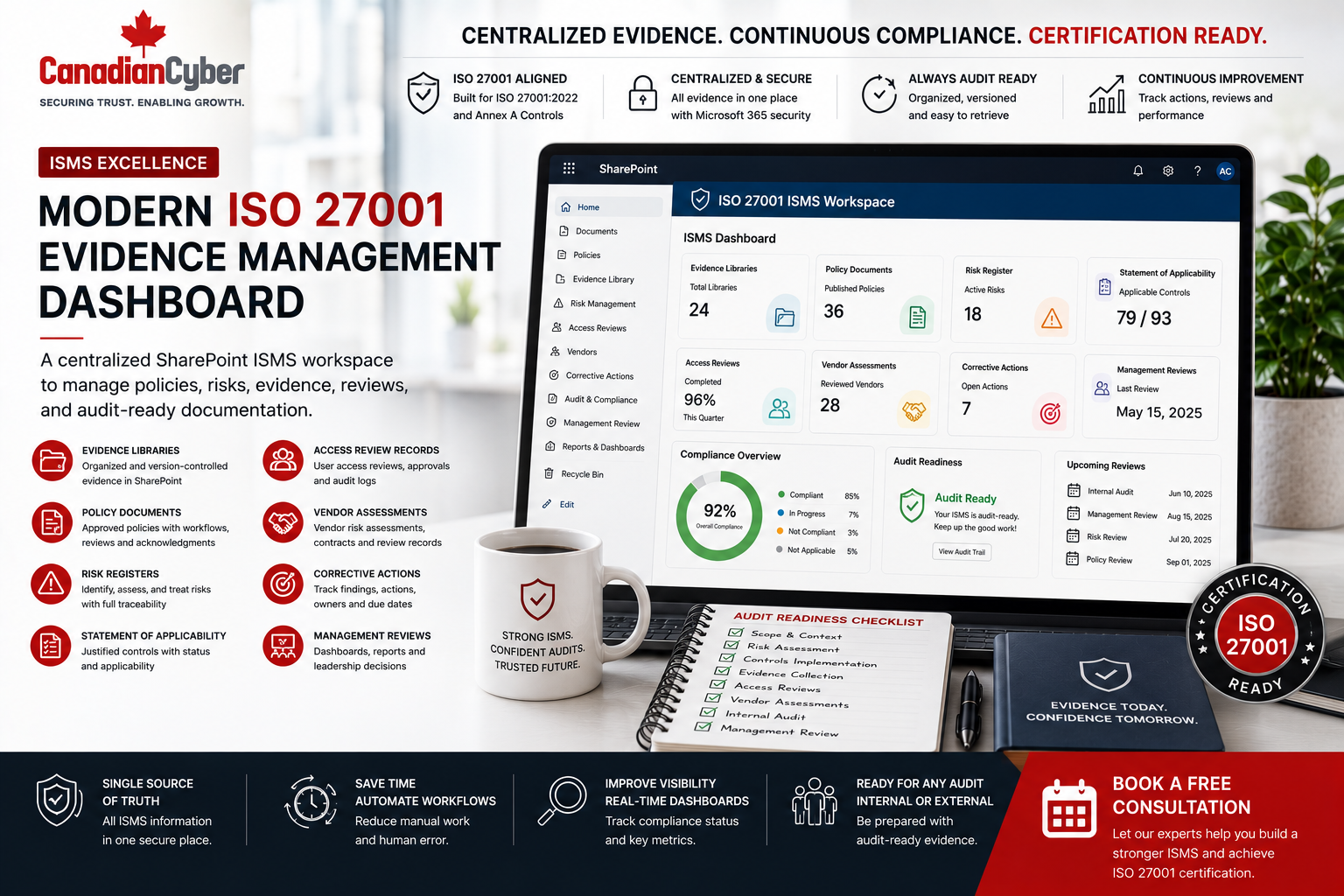
Canadian Cyber’s ISMS SharePoint Solution can structure:
- policy and procedure libraries.
- risk register and SoA tracker.
- control register and evidence library.
- access review tracker.
- vendor register and training evidence.
- incident register and backup evidence.
- management review dashboard.
- internal audit workspace.
- audit request tracker.
- corrective action tracker and client-ready evidence room.
SharePoint becomes powerful when it is designed as an ISMS evidence system, not just a document folder.
How Canadian Cyber Helps
Canadian Cyber helps organizations move from audit panic to evidence confidence.
We support ISO 27001 internal audit readiness, evidence organization, SharePoint ISMS setup, audit preparation, internal audit execution, management review readiness, corrective action tracking, and certification preparation.
Canadian Cyber can support:
- ISO 27001 internal audit readiness reviews.
- ISO 27001 internal audits.
- SharePoint ISMS implementation.
- control-to-evidence mapping.
- evidence quality review.
- risk register and SoA review.
- policy library setup.
- access and vendor evidence checks.
- management review preparation.
- corrective action verification.
Canadian Cyber’s ISMS SharePoint Solution
Canadian Cyber’s ISMS SharePoint Solution helps organizations manage ISO 27001 evidence inside Microsoft 365.
It can include:
- central evidence library.
- control register and risk register.
- SoA tracker and policy library.
- audit request tracker and internal audit workspace.
- corrective action tracker.
- evidence calendar and owner dashboard.
- management review dashboard.
- client-ready evidence room and auditor-ready views.
Frequently Asked Questions
What is ISO 27001 internal audit evidence?
ISO 27001 internal audit evidence is proof that the ISMS is implemented and operating. It can include policies, risk registers, access reviews, vendor reviews, training records, incident records, backup tests, management review minutes, and corrective action records.
When should ISO 27001 evidence be collected?
Evidence should be collected throughout the year as controls operate. Waiting until audit week often creates missing records, weak proof, and unnecessary stress.
How should ISO 27001 evidence be organized?
Evidence should be stored in a central workspace. It should be mapped to clauses and controls, assigned to owners, named consistently, reviewed for quality, and tracked by status and due date.
Can SharePoint be used for ISO 27001 evidence?
Yes. SharePoint can manage ISO 27001 policies, risks, SoA, evidence, access reviews, vendor records, internal audit workpapers, corrective actions, and management review dashboards.
What makes audit evidence weak?
Weak evidence may be outdated, undated, incomplete, unapproved, unmapped, stored in personal folders, missing owner sign-off, or unable to show what happened and what was reviewed.
Can Canadian Cyber help organize ISO 27001 evidence?
Yes. Canadian Cyber helps organizations organize ISO 27001 evidence, build SharePoint ISMS workspaces, perform internal audit readiness reviews, execute internal audits, and verify corrective action closure.
Takeaway
ISO 27001 internal audit should not begin with panic.
It should begin with confidence.
That confidence comes from organized evidence.
Before review week, organizations should know where evidence is stored, which control it supports, who owns it, what gaps remain, and which corrective actions are open.
The strongest organizations do not scramble for evidence. They manage it continuously.
Preparing for ISO 27001 Internal Audit?
If your evidence is scattered across folders, emails, chats, and spreadsheets, Canadian Cyber can help.
We provide ISO 27001 internal audit readiness reviews, evidence organization, SharePoint ISMS implementation, control-to-evidence mapping, internal audit services, management review preparation, corrective action verification, vCISO services, cybersecurity assessments, SOC 2 readiness, ISO 27017, ISO 27018, and ISO 42001 AI governance support. You can also learn more through Waqar Mehboob’s profile.
Stay Connected With Canadian Cyber
Follow Canadian Cyber for practical guidance on ISO 27001 internal audits, evidence readiness, SharePoint ISMS, audit proof, corrective actions, SOC 2, ISO 42001, ISO 27017, ISO 27018, cybersecurity assessments, and vCISO support.