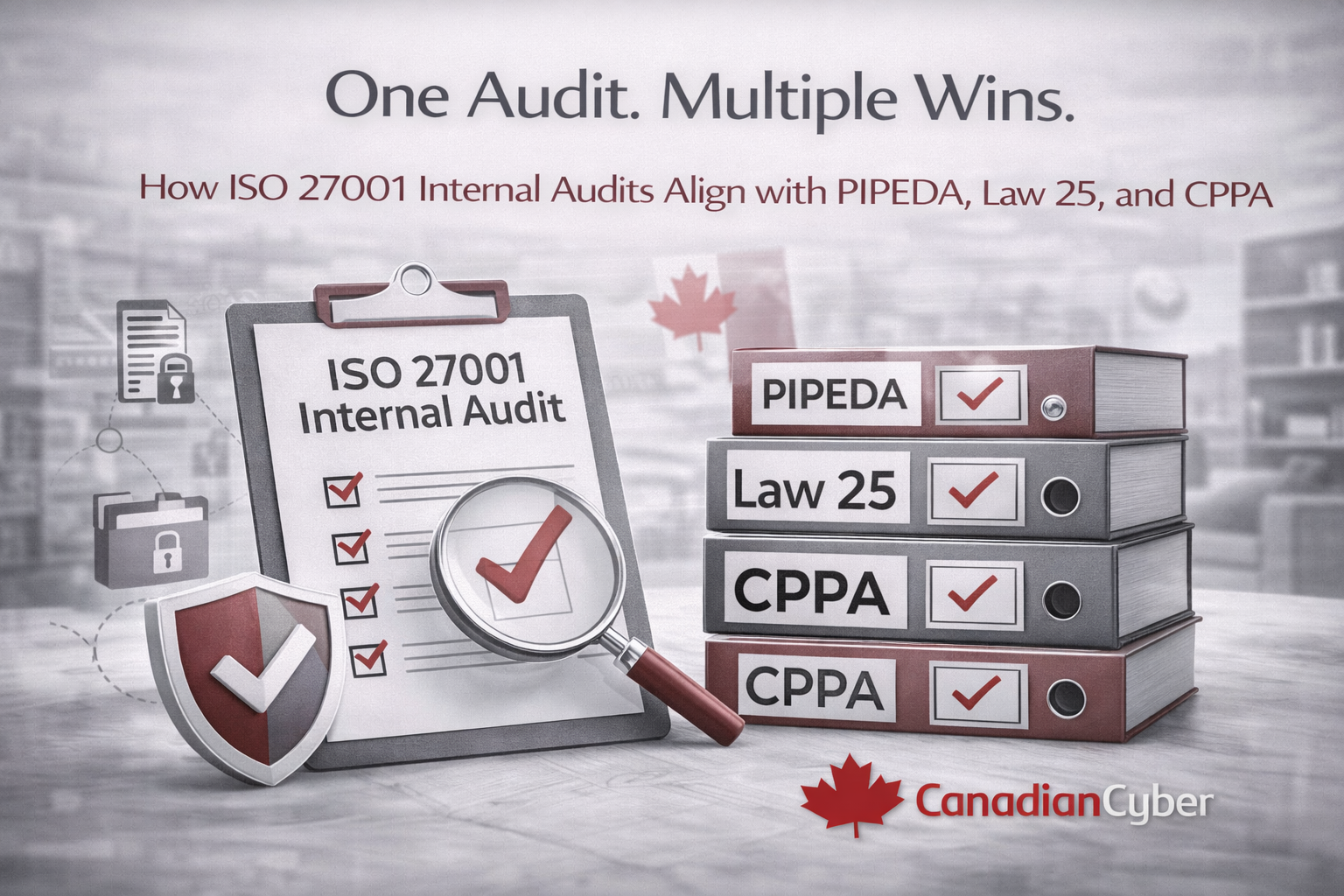
One Audit. Multiple Wins.
How ISO 27001 Internal Audits Align with PIPEDA, Law 25, and the CPPA
Canadian privacy expectations are rising. Smart teams now use ISO 27001 internal audits to prove both security maturity and privacy accountability without running three separate programs.
Read time: 6–8 minutes
Keywords: ISO 27001 internal audit, PIPEDA, Law 25, CPPA, audit readiness, privacy compliance Canada
If your internal audit checks the right evidence (consent, retention, access logging, breach readiness), you can get ISO 27001 assurance and privacy-law defensibility in one cycle.
The 2026 shift: security controls are not enough
In Canada, organizations are no longer judged only on whether controls exist.
They are judged on whether those controls prove privacy accountability.
That’s why leaders are asking a smarter question:
Can our ISO 27001 internal audit also reduce privacy law exposure?
Short answer: Yes! if you audit evidence the way regulators and customers expect.
The new compliance reality in Canada
Most Canadian organizations have overlapping obligations:
- ISO 27001 for information security management
- PIPEDA for federal privacy accountability and safeguards
- Québec’s Law 25 for stricter governance and enforcement
- CPPA (proposed) signaling tougher federal expectations (via Bill C-27)
Treating these as separate tracks creates duplication, confusion, and cost.
The better approach is to map privacy requirements into your ISO 27001 audit plan.
Quick snapshot: traditional vs integrated internal audit
Why ISO 27001 is a strong privacy backbone
ISO 27001 is not “just security.”
It forces the disciplines privacy laws rely on:
- Risk-based protection of information
- Defined ownership and accountability
- Documented processes and evidence
- Continuous improvement (not annual scrambling)
The win is simple: audit the controls in a way that also answers privacy questions.
What an integrated internal audit looks like
A modern internal audit checks more than “do we have a policy.”
It checks evidence and outcomes.
The goal: one audit cycle that produces security assurance and privacy-law alignment evidence.
The method: build “privacy checks” into your ISO 27001 audit tests.
Practical mapping: audit tests that support privacy alignment
Why this matters more now
Québec’s Law 25 includes significant penalties for non-compliance, including administrative monetary penalties that can reach up to C$25M or 4% of worldwide turnover (depending on the situation). This raises the stakes.
At the federal level, the CPPA has been proposed through Bill C-27 (Digital Charter Implementation Act, 2022), signalling tougher national expectations even before full enactment.
Bottom line:
Regulators and enterprise customers expect proof.
“We’re ISO-aligned” is stronger when your audit tests privacy outcomes too.
The strategic advantage of doing both together
- Less duplicated work across teams
- Fewer conflicting controls and documents
- A single, consistent compliance story for customers
- Stronger defensibility if regulators ask questions
- More confidence for leadership and boards
Running ISO 27001 audits without privacy alignment?
Upgrade your internal audit tests to cover the evidence privacy laws and enterprise buyers care about.
Where Canadian Cyber stands apart
Many firms can audit ISO 27001.
Fewer can integrate Canadian privacy expectations into an audit plan in a practical way.
- ISO 27001 internal audit expertise
- Privacy-aware audit testing (evidence, ownership, accountability)
- Regulator-ready documentation mindset
- Actionable remediation support (not just findings)
Supported by structure, not spreadsheets
Internal audits are easier when evidence is already organized.
That’s why many teams use a SharePoint-based ISMS structure to:
- Store audit evidence centrally
- Track corrective actions with owners and due dates
- Maintain privacy-related documentation alongside controls
- Stay audit-ready throughout the year
The executive case for an integrated audit
- One audit with a clear plan
- Multiple outcomes (security + privacy alignment)
- Lower exposure and fewer surprises
- Better use of budget and internal time
Final thought
Regulators are not asking for more paperwork.
They want proof of accountability.
A well-designed ISO 27001 internal audit mapped to privacy expectations helps you show that proof clearly.
Next step: One audit. Stronger security. Real privacy alignment.
Stay Connected With Canadian Cyber
Follow us for insights on ISO 27001, Canadian privacy alignment, and audit readiness: