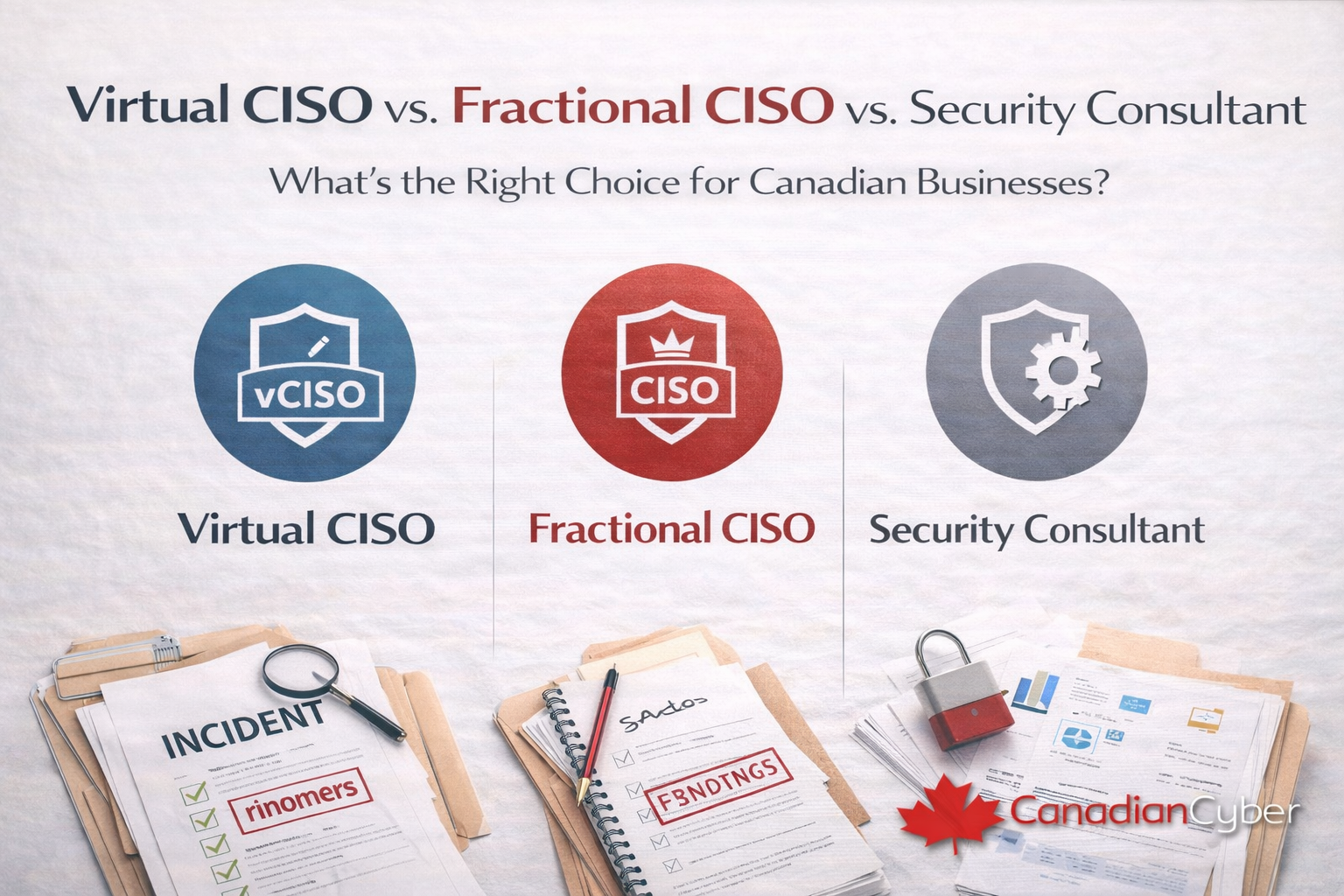
Virtual CISO vs. Fractional CISO vs. Security Consultant
What’s the Right Choice for Canadian Businesses?
At some point, every growing organization hits the same wall. Security questions start coming from everywhere customers, auditors, regulators, boards, and investors. Suddenly, “we’ll handle it internally” isn’t enough.
That’s when most Canadian businesses start Googling: vCISO vs fractional CISO vs security consultant.
They sound similar but they are not the same. Choosing the wrong model can cost you audits, timelines, and deals.
Let’s break it down clearly, honestly, and without fluff.
Why This Decision Matters More Than Ever
In Canada, expectations are rising fast: ISO 27001, SOC 2, vendor risk reviews, and privacy requirements like Law 25, PIPEDA, and the upcoming CPPA. Enterprise clients want proof not promises.
Security leadership is no longer optional, but a full-time CISO still isn’t realistic for many organizations.
Option 1: Security ConsultantBest for: Short, tactical problems
What they do
- Perform assessments
- Deliver reports and recommendations
- Fix a specific issue, then leave
Strengths: fast expertise, great for one-off projects, no long-term commitment.
Limitations: no ongoing ownership, limited accountability, and the knowledge often walks out the door.
Consultants can tell you what’s wrong they don’t stay to make sure it’s fixed.
Option 2: Fractional CISOBest for: Executive presence, limited engagement
What they do
- Act as a part-time CISO
- Join leadership meetings and steer strategy
- Provide credibility and executive guidance
Strengths: board-friendly communication, senior credibility, strong strategic lens.
Limitations: limited availability, often advisory-only, execution stays on internal teams.
Fractional CISOs can feel disconnected from day-to-day operations when fundamentals are still being built.
Option 3: Virtual CISO (vCISO)Best for: Growing organizations that need results (strategy + execution)
A vCISO isn’t just “part-time.” It’s a delivery model designed for ongoing momentum:
roadmap ownership, operational follow-through, and measurable progress.
What a vCISO actually does
- Owns your security roadmap and priorities
- Leads ISO 27001 / SOC 2 readiness and evidence discipline
- Runs governance, risk, and control ownership
- Coaches internal teams and prepares you for audits and customer reviews
- Stays accountable month after month
Strengths: continuous leadership, strategic + operational, cost-effective, scales with growth, built for compliance-driven environments.
A vCISO doesn’t just advise they embed.
Side-by-Side Comparison (Quick Clarity)
| Capability | Consultant | Fractional CISO | vCISO |
|---|---|---|---|
| Ongoing accountability | ❌ | ⚠️ Limited | ✅ |
| Audit & compliance ownership | ❌ | ⚠️ | ✅ |
| Strategic + execution | ❌ | ❌ / ⚠️ | ✅ |
| Cost-effective for SMBs | ⚠️ Depends | ❌ Often high | ✅ |
| Scales with growth | ❌ | ⚠️ | ✅ |
The Hidden Risk Most Companies Miss
Many organizations mix these roles incorrectly:
consultant writes policies, fractional CISO reviews once a quarter, and no one owns follow-through.
The result is predictable:
- Gaps between strategy and reality
- Failed audits or corrective actions
- Confused teams and stalled remediation
- Leadership frustration (“why isn’t this moving?”)
Security fails in the gaps between roles.
Not sure which model fits your organization? Get clarity before you commit budget or time.
Why Canadian Cyber’s vCISO Model Works
Canadian Cyber’s vCISO offering is built specifically for Canadian regulations and compliance-driven environments (ISO 27001, SOC 2, vendor risk reviews). We combine executive-level leadership with hands-on execution and use our ISMS SharePoint Platform to keep structure and evidence tight.
You get direction, delivery, and accountability without hiring a full-time CISO.
A Simple Rule to Decide
- Need a report? → Consultant
- Need board presence only? → Fractional CISO
- Need real security progress? → vCISO
Final Takeaway
Security leadership isn’t about titles it’s about ownership. If no one owns your security program end-to-end, the business owns the risk.
Stay Connected With Canadian Cyber
Follow us for real-world vCISO insights, compliance guidance, and cybersecurity leadership content: