email-svg
Get in touch
info@canadiancyber.ca

SOC 2 Control Gaps in Modern Startups

Most SOC 2 audit failures in startups come from tool defaults. This guide explains the most common SOC 2 control gaps in GitHub, Slack, and cloud environments and the evidence auditors expect.
Main Hero Image
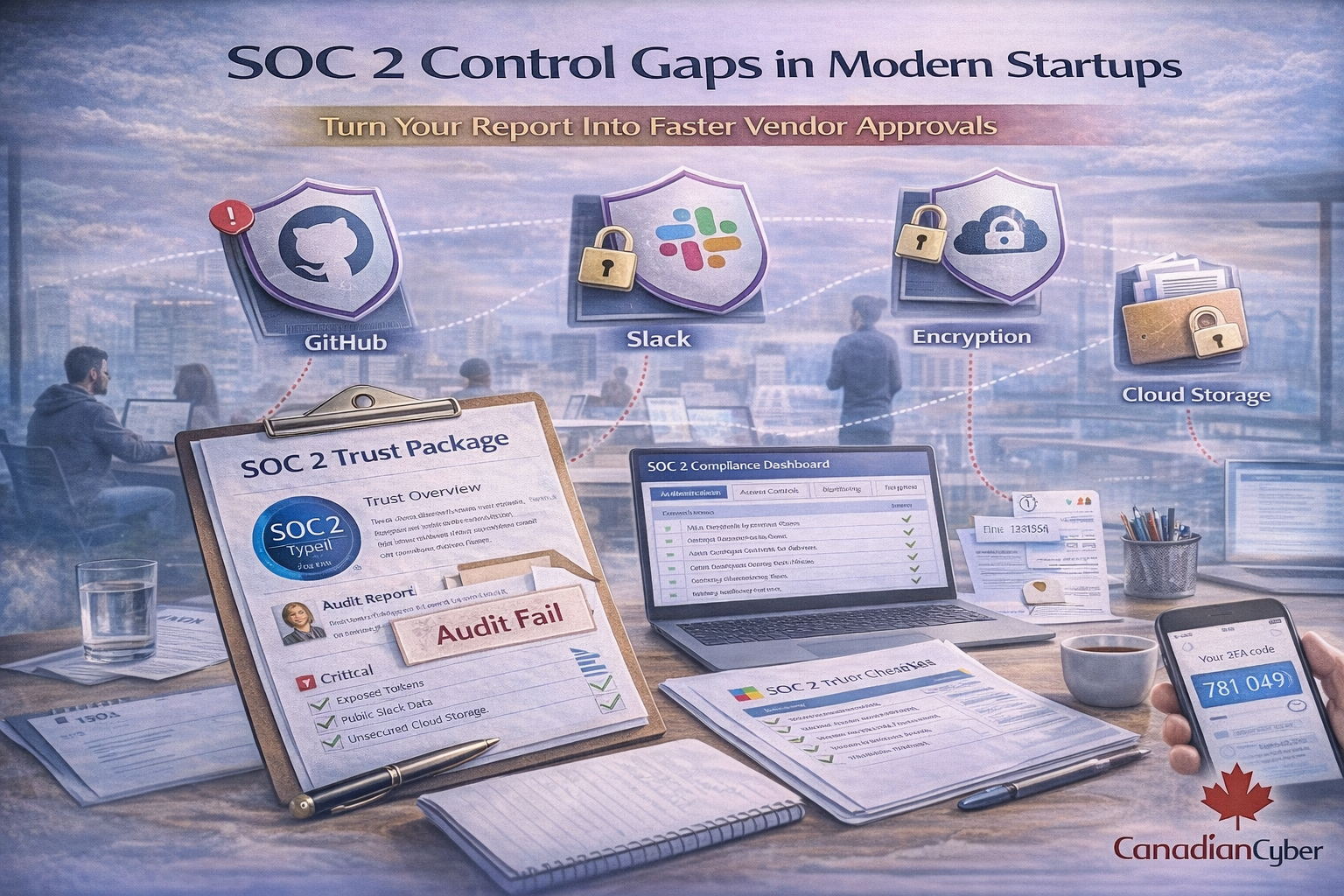
GitHub • Slack • AWS/Azure/GCP • Audit-Ready Evidence

SOC 2 Control Gaps in Modern Startups

GitHub, Slack, and Cloud Defaults That Break Audits

Most SOC 2 failures in startups don’t happen because teams don’t care about security.
They happen because modern tools ship with permissive defaults and nobody tightens them until an auditor asks.
This is a realistic, audit-focused breakdown of the control gaps we see most in GitHub, Slack, and cloud environments (AWS/Azure/GCP), plus exactly what evidence auditors expect.

Why audits break
Defaults create privilege sprawl and evidence gaps.
What auditors test
Designed controls + proof they operate over time.
Fastest win
Tighten admin paths and build review records you can reproduce.

The real pattern we see in SOC 2 readiness

A startup hits a growth milestone. Enterprise deals start appearing. Then procurement asks:

  • Do you have SOC 2?
  • Can you share your security controls?
  • How do you restrict access and changes?

The team is capable and moving fast. But the environment often looks like this:

  • GitHub was set up fast. Everyone is an admin.
  • Slack is the nervous system. Guests exist. Retention is unclear.
  • Cloud accounts were created with defaults.
  • Logging exists… somewhere.
  • Access reviews are a spreadsheet right before the audit.

That is enough to break a SOC 2 audit. Not because you are unsafe, but because you cannot prove consistent control.

Why tool defaults are a SOC 2 problem

SOC 2 auditors test whether controls are designed (documented and appropriate) and operating (working consistently over time).

Audit risk 1: Privilege sprawl
Too many people can change production settings, code, or access.
Audit risk 2: Evidence gaps
You can’t show who did what, when, and why.
SOC 2 audits do not fail on vibes. They fail on missing evidence and uncontrolled admin paths.

1) GitHub gaps that break SOC 2

Gap A: Everyone is an org owner (or repo admin)
What happens in startups
  • Early hires get org owner access.
  • Contractors get elevated roles “temporarily.”
  • Nobody revisits it.
Why auditors care
SOC 2 expects controlled access to systems that affect production and code integrity.
What auditors ask
  • Who can merge to main?
  • Who can bypass reviews?
  • Who can change branch protection?
  • Who can add secrets or deploy keys?
Fix (practical)
  • Reduce org owners to a small set (2–4).
  • Use role-based access (maintainers per repo, least privilege for contributors).
  • Document the access model.
Evidence auditors expect:
org owners/admin export, branch protection settings, PR requirements, quarterly owner/admin access review record.

Gap B: Weak branch protections and no enforced reviews
What happens
Direct pushes to main are allowed. CI checks are optional. Shipping wins.
Why auditors care
This breaks change management evidence. Anyone can change production code without review.
Fix
  • Require PRs to merge to main.
  • Require 1–2 reviewers.
  • Require status checks (CI).
  • Restrict force pushes.
  • Use signed commits if feasible.
Evidence auditors expect:
branch protection rules + sample PRs showing approvals, CI passing, linked ticket/issue, and release/change record ties.

Gap C: Secrets in repos (or unmanaged secrets)
What happens
Keys get committed by mistake. Secrets live in broad Actions variables. No scanning baseline.
Why auditors care
This creates confidentiality risk and weak control evidence.
Fix
  • Enable secret scanning (where available).
  • Use a secrets manager (AWS Secrets Manager, Azure Key Vault, etc.).
  • Define a secret handling standard and rotate exposed keys.
Evidence auditors expect:
scanning enabled settings, a rotation ticket/incident record, access controls for secret stores.

2) Slack gaps that break SOC 2

Gap A: Guests and shared channels without control
What happens
Vendors, freelancers, and clients get invited. Nobody knows who is still in the workspace.
Why auditors care
Slack often contains customer data, credentials, incident details, and internal decisions.
Fix
  • Restrict who can invite guests.
  • Review guest accounts monthly or quarterly.
  • Use Slack Connect with governance rules.
  • Set a policy: what data can be shared in Slack.
Evidence auditors expect:
guest invite restriction settings, guest export + review record, sensitive data policy, sample offboarding/removal record.

Gap B: No retention policy (or infinite retention)
What happens
Slack becomes a system of record. Messages are kept forever, or retention is too short for investigations.
Why auditors care
SOC 2 expects retention aligned to legal needs, investigations, and privacy requirements.
Fix
  • Define retention by risk (enough for investigations).
  • Avoid infinite retention without a reason.
  • Document what belongs in tickets/docs—not Slack.
Evidence auditors expect:
retention settings screenshot, retention policy, incident process showing evidence captured into ticketing.

Gap C: No evidence of admin control or monitoring
What happens
Admins are broad. No periodic review. Audit logs are not used or not retained.
Fix
  • Reduce Slack admins.
  • Record admin reviews quarterly.
  • Enable audit logs (where available on your plan) and retain evidence.
Evidence auditors expect:
admin export, quarterly admin review record, audit log availability + sample export (if possible).

3) Cloud defaults that break SOC 2 (AWS/Azure/GCP)

Gap A: Root/admin accounts not locked down
What happens
Root exists without MFA. Too many admins. No break-glass process.
Fix
  • MFA on root and all admins.
  • Limit admin roles and use role-based access.
  • Use a break-glass account with monitoring.
Evidence auditors expect:
MFA proof, admin role export, quarterly privileged access review, break-glass procedure.

Gap B: Logging is off or not monitored
CloudTrail / Azure Activity Logs / GCP Audit Logs
What happens
  • Logs are not enabled in all regions/projects.
  • Logs exist, but nobody reviews them.
  • No alerts on key events (new admin, key deletion).
Fix
  • Enable audit logging platform-wide.
  • Centralize logs (SIEM or log storage).
  • Define review cadence and alert triggers.
Evidence auditors expect:
logging config export, log review checklist + completed example, sample alert ticket and response record.

Gap C: No baseline configuration (public access, networks, encryption)
What happens
  • Public storage exists.
  • Security groups allow wide inbound access.
  • Default networks are used without standards.
Fix
  • Block public storage by default.
  • Restrict inbound rules.
  • Require encryption at rest where applicable.
  • Run periodic posture checks.
Evidence auditors expect:
baseline standard, config rules (where available), periodic review report/tickets.

Gap D: Production is not separated
What happens
Dev and prod share an account/project. Engineers test in production because it’s fast.
Fix
  • Separate environments (accounts/projects/subscriptions).
  • Limit production access and require stronger change controls.
Evidence auditors expect:
architecture diagram showing separation, prod access rules, sample change approvals and deployment evidence.

The SOC 2 evidence problem: “We do it” isn’t enough

Startups often do the right thing informally. The audit problem is that it isn’t recorded.

Auditors need
  • consistent control operation
  • over a time period
  • with traceable evidence
That means you need
  • access reviews (dated, signed)
  • change records (tickets + PRs)
  • incident records (even small incidents)
  • vendor reviews (cloud providers and key tooling)

Fix defaults and build an evidence pack (fastest path)
If you’re a startup using GitHub + Slack + cloud and trying to pass SOC 2, focus on control-tightening and evidence repeatability.
Canadian Cyber vCISO support can deliver:
  • a SOC 2 gap assessment focused on modern toolchains
  • a prioritized remediation plan (30/60/90 days)
  • evidence templates for access reviews, log reviews, change approvals
  • a SharePoint audit evidence structure your team can maintain

A quick SOC 2 readiness checklist (copy/paste)

Pre-audit checklist
GitHub
  • Org owners limited and reviewed quarterly
  • Branch protections enforced for critical repos
  • PR reviews and CI checks required
  • Secrets managed and scanning enabled
Slack
  • Guest invites restricted
  • Guests reviewed quarterly
  • Retention policy defined and implemented
  • Admin roles reviewed quarterly
Cloud
  • MFA enforced for root/admins
  • Admin roles limited and reviewed
  • Audit logging enabled across all regions/projects
  • Baseline configs enforced (no public storage by default)
  • Prod access restricted and separated

Get the “Startup SOC 2 Toolchain Evidence Pack”
Want an auditor-ready structure for GitHub, Slack, and cloud? Use this pack to build repeatable evidence fast.
Includes:
  • GitHub access review + branch protection evidence checklist
  • Slack guest/admin review checklist + retention evidence
  • Cloud logging + admin access evidence checklist
  • Sample tickets and review records (ready to copy)
  • Evidence folder structure for SharePoint

Follow Canadian Cyber
Practical cybersecurity + compliance guidance for Canadian teams:

© 2026 Canadian Cyber. All rights reserved.


Related Post