Get in touch
info@canadiancyber.ca


Rafia Rizwan

April 17, 2026
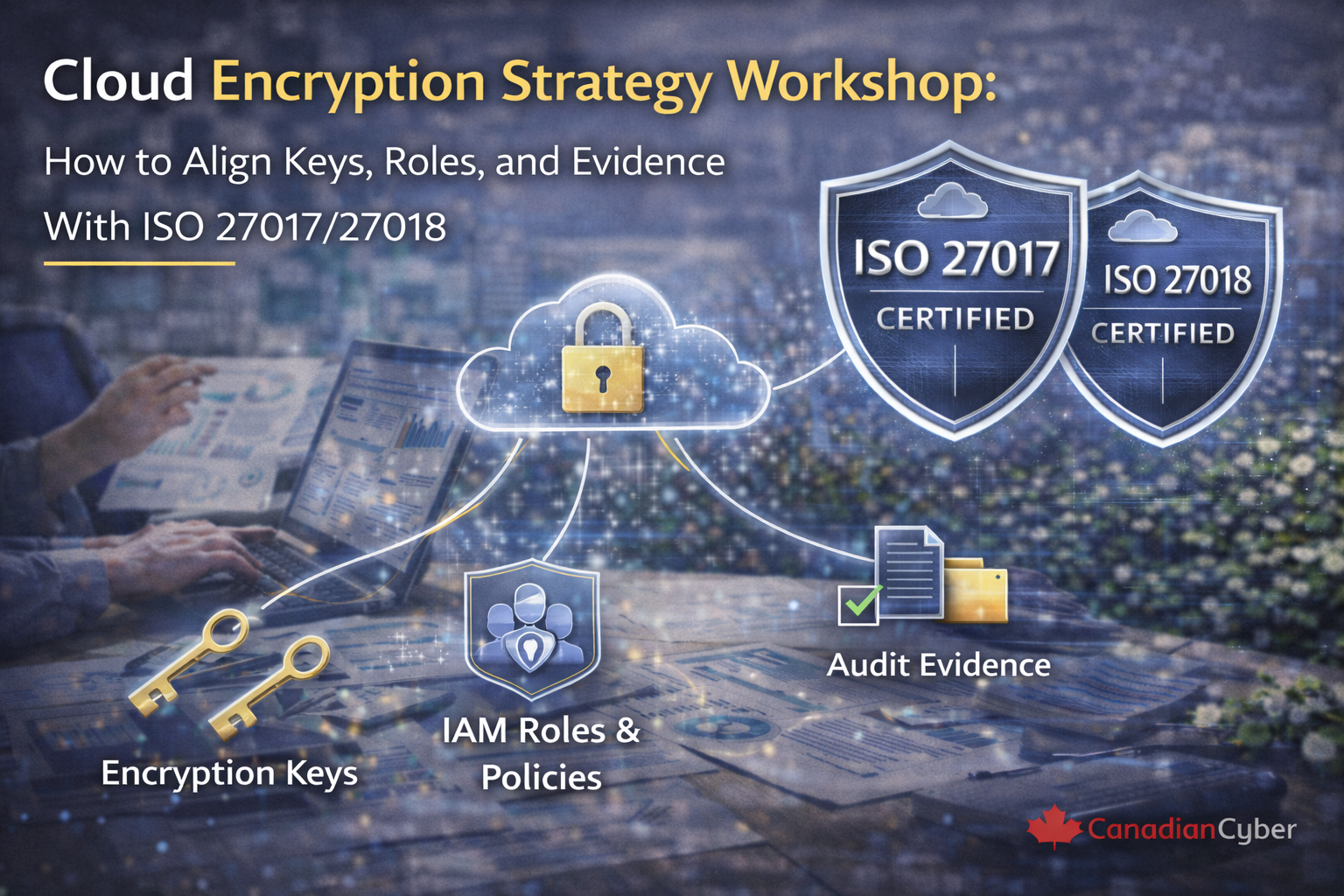
A practical guide to cloud encryption strategy, helping teams align key management, access roles, and evidence for ISO 27017 and ISO 27018.
Questions like: Which data is encrypted? Who manages the keys? Are cloud provider defaults enough? Who can decrypt sensitive records? What evidence proves encryption is really working? How does all of this support privacy obligations for personal data?
This is where many teams discover they do not have an encryption strategy. They have a collection of settings. In cloud environments, that is not the same thing.
A cloud encryption strategy workshop helps security, platform, compliance, privacy, and engineering teams align three areas that often drift apart: keys, roles, and evidence.
Encryption sounds simple in theory. Turn it on. Store keys safely. Restrict access. But cloud environments rarely stay simple for long.
Data may exist across managed databases, object storage, backups, snapshots, logs, analytics environments, SaaS integrations, data lakes, support exports, AI pipelines, and messaging systems. Each of those may use a different encryption model.
That is when governance questions begin. Which data needs which level of protection? When is provider-managed encryption enough? When should customer-managed keys be used? Who can create, rotate, disable, or delete keys? Are privacy-sensitive datasets treated differently? How do we prove this during an audit or customer review?
These two standards are useful because they frame encryption in the context that actually matters: cloud governance.
| Standard | What it sharpens |
|---|---|
| ISO 27017 | Secure use of cloud services, role clarity, admin control, access management, and evidence of controlled cloud operations |
| ISO 27018 | Protection of PII in public cloud environments, disclosure risk, retention and deletion logic, and stronger governance over personal data processing |
That means encryption is no longer just a technical checkbox. It becomes part of a bigger control story about who controls access, how cloud responsibilities are divided, how sensitive data is protected, and how the organization proves that protection is operating as intended.
Picture a growing SaaS company running most of its platform in the cloud. The team uses encrypted object storage, managed databases with encryption at rest, cloud KMS, secrets management tools, encrypted backups, and TLS for in-transit protection.
From an engineering view, that feels mature. Then an enterprise customer sends a security questionnaire.
Now the team has a problem. The settings exist, but the strategy is fragmented. One person understands database encryption. Another manages KMS. The privacy team knows which data is sensitive. Compliance has no easy evidence set. Engineering knows the app behavior, but not the control narrative.
A cloud encryption workshop should not be just a settings review. It should help the organization answer five practical questions.
That is the difference between a useful workshop and a generic architecture meeting.
The strongest encryption workshops focus on three control areas: keys, roles, and evidence.
The point is not to choose the most complicated key model possible. The point is to choose the right level of control for the right type of data.
| Data area | Encryption approach | Key model | Why it matters |
|---|---|---|---|
| Production database | Encryption at rest | Customer-managed key | Core tenant and transaction data |
| Object storage | Encryption at rest | Provider-managed or customer-managed depending on sensitivity | Uploaded files and exports |
| Backups | Encrypted backup storage | Provider-managed or customer-managed | Recovery copies are often overlooked |
| Logs | Encrypted storage | Usually provider-managed unless highly sensitive | Logs may contain metadata or sensitive traces |
| Analytics warehouse | Encryption at rest | Customer-managed for higher sensitivity cases | Consolidated data may raise privacy exposure |
The goal is not maximum complexity. The goal is intentionality.
This is where many encryption strategies become weak. Encryption may be enabled, but the role model around it is unclear. Under ISO 27017 and ISO 27018 thinking, that matters a lot because encryption is only as strong as the people and permissions around it.
| Role area | Practical responsibility |
|---|---|
| Cloud/KMS administrators | Manage key infrastructure and policy settings |
| Security or platform governance | Approve high-risk key changes and review access |
| Application or service roles | Use keys only for approved workloads |
| Database or storage admins | Manage service operation without broad key authority |
| Compliance or privacy stakeholders | Identify high-sensitivity data needing stronger control |
| Support teams | Access approved outputs only, not unrestricted raw decryption paths |
If the same small group can manage cloud roles, change KMS policy, approve access, and retrieve sensitive data, then the environment may be encrypted but not strongly governed.
A lot of teams can explain encryption verbally. Far fewer can produce clean evidence quickly. That becomes a problem during ISO audits, customer security reviews, internal assessments, privacy reviews, and incident investigations.
| Evidence type | What it helps prove |
|---|---|
| Cloud KMS configuration screenshots or exports | Keys exist and are configured intentionally |
| Storage or database encryption settings | Data at rest is encrypted |
| IAM or KMS access policies | Key permissions are restricted |
| Access review records | Key-related permissions are reviewed |
| Rotation logs or configuration | Lifecycle management is active |
| Backup encryption settings | Recovery copies are protected too |
| Architecture diagrams | Encryption coverage is understood structurally |
| Data classification and key mapping | Sensitive data is treated appropriately |
This is what turns encryption into a usable audit story.
A cloud encryption strategy workshop works best when it brings together security or compliance, cloud or platform engineering, application owners, privacy or data governance stakeholders, and IT or operations where relevant.
| Workshop step | Focus |
|---|---|
| 1. Identify critical cloud data types | Production data, backups, logs, analytics stores, exports, personal data, and sensitive internal data |
| 2. Map current encryption methods | At-rest encryption, in-transit protection, provider-managed vs customer-managed keys, app-layer encryption |
| 3. Review key management and roles | Who manages keys, who uses them, who approves changes, and where duties overlap too much |
| 4. Review privacy-sensitive data under ISO 27018 logic | Which datasets contain PII and whether stronger governance is needed |
| 5. Build evidence map | What evidence exists, what is missing, and who owns retaining it |
| 6. Capture action items | Tighten KMS roles, add review cadence, extend evidence to backups, improve export controls |
A strong workshop usually produces a small set of practical outputs that are useful long after the meeting ends.
Even well-intentioned encryption programs repeat the same mistakes. They make decisions system by system with no shared logic. They focus on databases and ignore logs, backups, or analytics copies. They assume provider-managed encryption answers every risk. They let KMS permissions stay too broad for too long. They collect evidence only when the audit or questionnaire arrives.
A workshop helps surface these issues before they turn into audit pain or customer trust problems.
Cloud encryption is not just a technical setting. It is a control environment shaped by data sensitivity, key design, access roles, privacy obligations, and evidence readiness.
A practical encryption strategy workshop helps organizations align those pieces in a way that supports both ISO 27017 and ISO 27018. For most teams, the most important areas to align are keys, roles, and evidence.
Because in the end, the strongest cloud encryption strategy is not the one with the most settings. It is the one your organization can explain, govern, and prove.