Get in touch
info@canadiancyber.ca


Rafia Rizwan

April 21, 2026
A practical guide on how a vCISO for restaurants and retail chains secures POS systems, loyalty data, and third-party delivery platforms.
That is exactly why many restaurant groups and retail chains struggle to keep cybersecurity under control. The environment is rarely simple.
A single business may be dealing with point-of-sale systems, payment workflows, loyalty platforms, eCommerce tools, store Wi-Fi, tablets and handhelds, inventory systems, shift scheduling apps, third-party delivery apps, cloud reporting dashboards, managed IT vendors, and multi-location access complexity.
That creates a very specific security challenge. The business is not just protecting one office network. It is protecting customer payment data, loyalty information, operational systems, and multiple third-party relationships across many locations.
This is where a vCISO can make a major difference. Not by replacing operations, and not by creating enterprise-style bureaucracy that slows stores down. A good vCISO gives the business structured security leadership around the systems that matter most: POS, loyalty data, and third-party delivery platforms.
A lot of security guidance is written with office environments in mind. Restaurants and retail chains are different. They usually operate with many endpoints in many locations, shared or semi-shared devices, front-line staff with fast onboarding and offboarding, multiple outside vendors, constant payment activity, customer data tied to loyalty or promotions, limited in-store IT support, and pressure to keep service running at all costs.
That makes the security risk very practical. The biggest problems are often not exotic attacks. They are things like outdated POS systems, over-shared admin access, weak store-level passwords, inconsistent patching across locations, loyalty systems collecting more data than expected, vendor integrations with broad permissions, third-party delivery tools creating blind spots, and store teams bypassing approved processes to keep operations moving.
Most restaurant groups and retail chains do not need, or cannot justify, a full-time in-house CISO. But they still need security leadership. That leadership often needs to cover cyber risk prioritization, vendor and platform review, payment and customer data protection, incident response planning, franchise or multi-location governance, access control cleanup, policy and procedure structure, customer and partner questionnaire support, security roadmap development, and executive reporting.
This is where a vCISO model fits naturally. A vCISO gives the business experienced security leadership, a practical roadmap, policy and governance support, vendor-risk oversight, faster responses to customer or partner concerns, and executive-level visibility without a full-time executive hire.
Picture a regional restaurant chain that has grown from 8 locations to 40. Over time, it has adopted a cloud POS platform, a loyalty and rewards app, third-party delivery integrations, QR ordering at some sites, a scheduling app, multiple payment terminals, a gift card provider, store Wi-Fi for staff and guests, central reporting dashboards, and a managed IT support vendor.
The business is growing, but so are the security questions. Leadership starts hearing concerns about who has admin access to the POS across all stores, whether loyalty data is stored securely, what happens if a third-party delivery platform is compromised, whether former managers still have access, and which vendor is responsible for what.
At this point, the problem is not a lack of tools. The problem is a lack of coordinated security leadership.
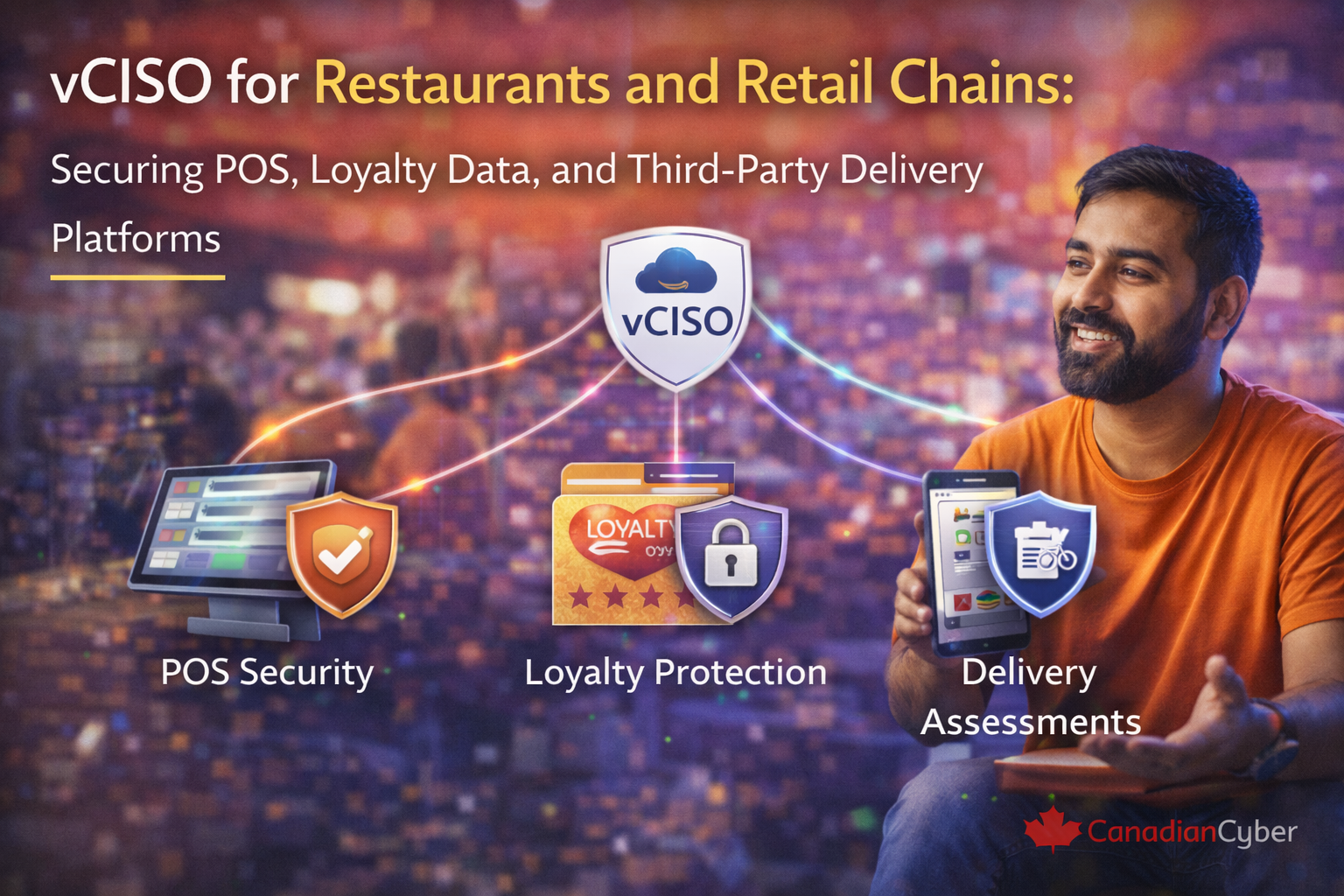
For restaurants and retail chains, many systems matter. But three areas usually create the highest combination of operational risk, customer trust risk, and business exposure: POS security, loyalty and customer data governance, and third-party delivery and vendor platform risk.
For many restaurants and retail chains, POS is the most business-critical technology in the environment. If it fails, stores slow down or stop. If it is compromised, payment trust is damaged fast. If access is weak, the blast radius can spread across many locations.
That is why POS security usually becomes the first major workstream for a vCISO.
These questions matter because POS environments often drift over time. A chain may start with a clean setup, but then stores improvise, vendors get added, managers change, support access grows, legacy permissions remain, and different locations handle issues differently.
| Common POS Weakness | Better Governance Direction |
|---|---|
| shared manager credentials | named user accounts only |
| too many elevated permissions | role-based store and central access |
| weak vendor support access | restricted and logged vendor access |
| weak network separation | segmented store networks |
| poor device visibility | location-by-location inventory visibility |
Many restaurant and retail businesses think about cybersecurity first through payments. But loyalty systems often carry just as much long-term trust risk. Loyalty and rewards programs often collect names, email addresses, phone numbers, birthdays, location history, order preferences, visit frequency, account balances or points, marketing preferences, and sometimes even household or demographic details.
That means the loyalty platform is often one of the largest customer-data environments in the business. Unlike one-time payment events, loyalty data stays with the business over time.
This matters because loyalty platforms are often deeply connected to POS, mobile apps, email marketing tools, analytics platforms, customer support systems, and third-party marketing vendors. One weak integration can widen the risk surface quickly.
For restaurants in particular, third-party delivery platforms create a major and often underestimated security challenge. These platforms help drive revenue and convenience, but they also introduce new questions about order flows, customer data sharing, operational continuity, brand reputation, account access, API integration, and support dependencies.
The business may not control the delivery platform directly, but customers will still associate problems with the restaurant brand.
These platforms are often treated as operational partnerships, but they are also third-party cyber dependencies. For many businesses, delivery is no longer a convenience layer. It is part of the core operating model.
The best restaurant and retail vCISO engagements do not start with big theory. They usually start with the highest-risk realities.
This is almost always one of the first wins. The vCISO helps the business review store manager access, district and regional admin rights, POS privileges, loyalty platform access, delivery platform access, support vendor accounts, shared accounts that should be eliminated, and offboarding gaps for former staff and contractors.
Most chains use many vendors, but not all vendors create equal risk. A vCISO helps classify vendors based on what they can access and how much business impact they carry.
| Vendor Type | Example | Typical Risk Focus |
|---|---|---|
| Critical operations vendor | POS provider, managed IT, loyalty platform | access, availability, customer data |
| High-risk customer data vendor | delivery platform, CRM, marketing platform | privacy, integration, disclosure |
| Moderate-risk business support vendor | HR, scheduling, finance tools | employee data, admin controls |
| Lower-risk vendor | limited-impact utilities | basic oversight and inventory |
A lot of businesses have generic incident plans that do not match how restaurants and retail locations actually operate. A vCISO helps build practical response plans for scenarios like POS outage, payment or terminal compromise, loyalty platform breach, third-party delivery outage, store manager credential misuse, ransomware, or vendor-side disruption.
Restaurants and retail chains do not need giant policy binders nobody will read. They need standards that support repeatable behavior across many locations. That may include account and password rules, MFA requirements, store device handling, approved support access methods, secure vendor onboarding expectations, data export restrictions, escalation rules for suspicious activity, and store opening or closing tech checks where relevant.
Leadership in these businesses often knows there is risk, but not how to prioritize it. A vCISO helps bring visibility through reporting such as top security risks by business impact, open critical access issues, vendor risks requiring attention, overdue corrective actions, incident trends, priority roadmap items by quarter, and security posture by platform category.
For these businesses, security should not be treated as purely an IT concern. Leadership should focus on the risks that most directly affect payment trust, customer loyalty, revenue continuity, brand reputation, franchise or multi-location consistency, vendor dependency, and regulatory or contractual exposure.
The better question is not “Are we perfectly secure?” It is “Are we managing the systems and relationships that create the most business risk in a disciplined way?” That is exactly the kind of question a vCISO helps answer.
At Canadian Cyber, we often see restaurant groups and retail chains working hard to keep operations smooth while cybersecurity remains fragmented across POS vendors, loyalty tools, delivery platforms, managed IT, and store-level practices. That fragmentation is the real problem.
The strongest programs usually improve when someone steps back and connects the dots across locations, access models, customer data systems, third-party vendors, response planning, and executive accountability. That is what a practical vCISO engagement does.
It brings structure to a fast-moving environment without forcing the business into unnecessary bureaucracy. That balance matters a lot, because controls that slow down front-line operations too much usually get bypassed.
Restaurants and retail chains face a very practical cybersecurity challenge. They need to protect POS systems, loyalty data, and third-party delivery and vendor platforms while still running fast, distributed operations across many locations.
That is why a vCISO can be such a strong fit. A good vCISO helps the business clean up access, prioritize vendor risk, strengthen POS governance, protect loyalty and customer data, plan for incidents realistically, and give leadership a clearer view of cyber risk.
Because in the end, security for restaurants and retail chains is not just about technology. It is about protecting revenue, customer trust, and operational continuity in the systems the business depends on every day.