Get in touch
info@canadiancyber.ca


Rafia Rizwan

April 21, 2026
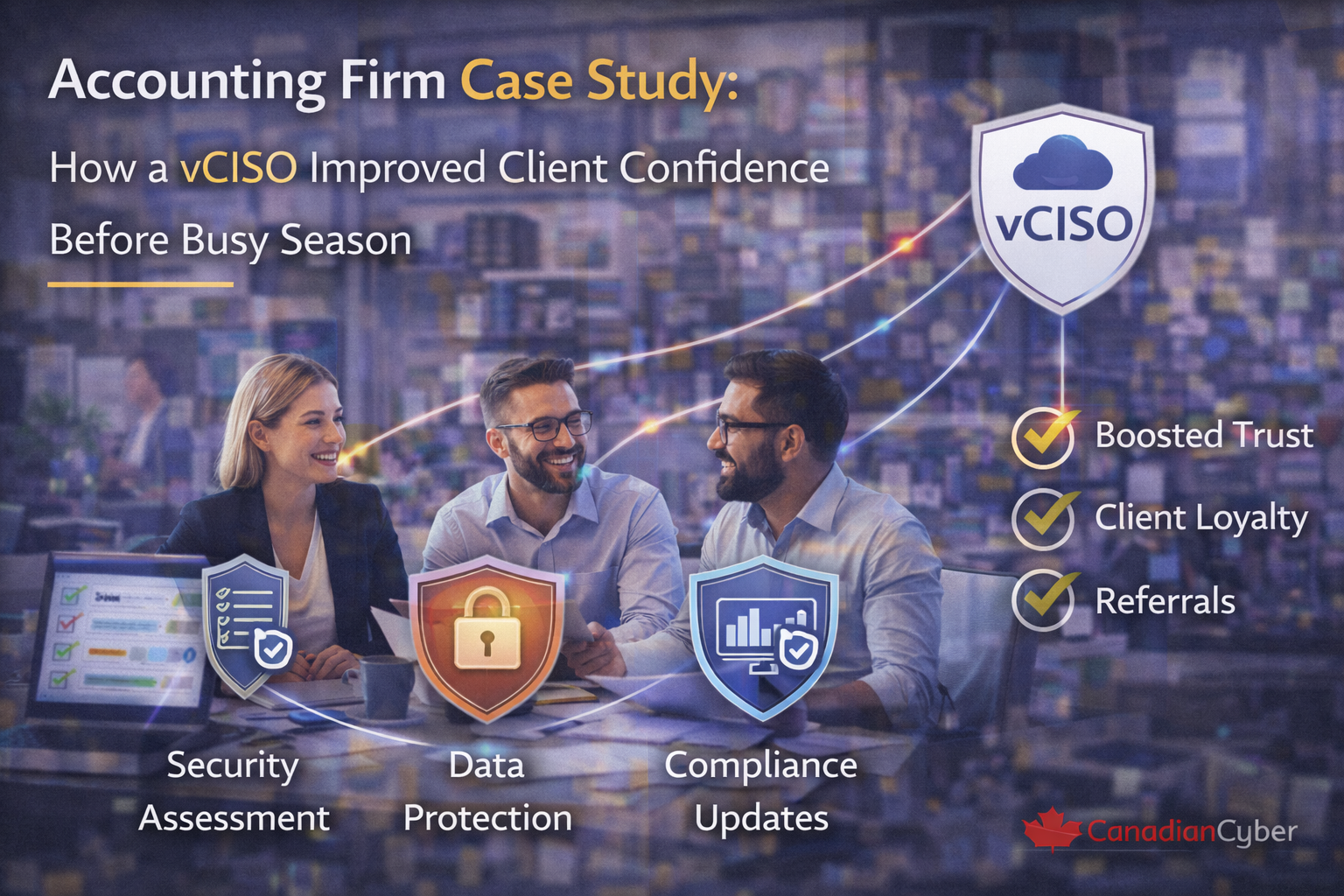
A practical case study showing how a vCISO for accounting firms improves client confidence by tightening access, workflows, and vendor risk before busy season.
This is when client confidence matters most. It is also when security weaknesses become easier to expose.
A lot of firms assume cybersecurity risk is mainly about preventing a major breach. But for accounting firms, the bigger business problem is often simpler: clients start asking whether their financial data, tax records, payroll files, and internal reports are really being handled securely during the busiest time of year.
That question becomes even more serious when the firm is dealing with seasonal workload spikes, more shared files, more temporary or short-term access, more vendor and portal usage, more partner and manager approvals, and more client deadlines with less tolerance for disruption.
This case study shows how a fictional accounting firm used a vCISO to improve client confidence before busy season by tightening practical controls around client data, access, and communication without slowing the business down.
Accounting firms do not operate under normal pressure year-round. Busy season changes everything.
The firm may suddenly have more client documents flowing in and out, more staff accessing shared folders and tax systems, extended hours and rushed approvals, more email traffic with sensitive attachments, greater reliance on portals and e-signature tools, temporary staff or contractors, more payroll, bookkeeping, and tax platform activity, and less patience for system outages or access delays.
This example is fictional, but it reflects real patterns many accounting firms experience. Let’s call the firm NorthRiver Accounting LLP.
NorthRiver is a mid-sized accounting firm serving small and mid-market clients across tax preparation, bookkeeping, payroll, assurance support, outsourced controllership, and advisory services.
The firm has grown steadily and now operates with a cloud document repository, tax software platforms, payroll systems, Microsoft 365, client file-sharing portals, e-signature tools, multiple office locations, hybrid staff, and seasonal contract support during peak periods.
The firm realized something important. It had not suffered a major public incident, but client confidence was becoming a real business issue.
NorthRiver already had some controls in place. It was not starting from zero. The firm used MFA for many systems, endpoint protection, client portal workflows, document permissions, managed IT support, backup and recovery services, and basic onboarding and offboarding checklists.
On the surface, things looked acceptable. But once the firm started reviewing its environment more carefully, several weaknesses stood out.
That last point mattered a lot. During busy season, uncertainty alone can damage trust.
NorthRiver did not need a full-time in-house CISO. What it needed was a clear security lead, a practical review of its current risk, a short-term plan before busy season, stronger answers for clients, better governance over access and vendors, and less guesswork for partners and operations leaders.
A vCISO was the right fit because the firm needed senior direction quickly, without building a large internal security function from scratch. The vCISO’s job was not to rebuild everything. It was to improve confidence in the areas that mattered most before peak operational pressure arrived.
The vCISO did not begin with a giant control library. Instead, the first move was to identify the client-confidence issues most likely to matter before busy season.
This kept the effort practical. Instead of trying to solve everything at once, the firm focused on the controls most visible to clients and most likely to create trouble under seasonal pressure.
The vCISO quickly identified access review as the biggest immediate priority. Busy season was about to increase document volume, portal usage, client data exposure, pressure for temporary access, and reliance on fast turnaround across teams. If the firm entered that period with weak access discipline, the risk would only increase.
| What the vCISO reviewed | What changed |
|---|---|
| client folder permissions | access tied more closely to role and active engagement |
| tax software access | stronger review of payroll and tax platform permissions |
| portal administration rights | clearer ownership for periodic access reviews |
| temporary and seasonal users | seasonal-user cleanup confirmed before onboarding new users |
| partner and manager access inheritance | documented cleanup of unnecessary permissions |
This gave the firm something valuable very quickly: a clearer answer to the question, “Who can see our information?”
The next issue was not only system access. It was workflow behavior. The vCISO found that although the firm had approved file-sharing and portal tools, usage patterns were uneven. Some teams worked cleanly through the portal. Others occasionally fell back to attachments, local copies, or rushed workarounds when deadlines got tight.
That is common in accounting environments, especially under seasonal pressure. But it creates risk in exactly the period when clients are paying the closest attention.
This was a practical improvement, not a huge technology overhaul. But it mattered because it made the firm’s secure working model more consistent right before pressure increased.
The firm also relied heavily on third parties, including tax software vendors, payroll platforms, document and portal tools, e-signature providers, managed IT support, and cloud productivity systems. Clients were not only trusting NorthRiver. They were trusting the ecosystem around NorthRiver.
The vCISO helped the firm stop treating vendor risk as a background issue.
There was no single, clean vendor-risk picture at the beginning. Different departments understood different vendors, but no one had pulled the important ones into one business-risk view.
The vCISO helped the firm identify critical and high-impact vendors, assign internal ownership, document which platforms affected client confidentiality and operational continuity, clarify escalation expectations for vendor incidents or outages, and improve the firm’s ability to answer client questions about third-party dependencies.
One of the most valuable changes was not purely technical. It was communication. Before the vCISO engagement, partners and firm leadership often knew the firm was “doing security things,” but they lacked a clear narrative.
When clients asked about access control, secure sharing, or vendor oversight, responses could feel too general. The vCISO helped create a more usable confidence story around restricted access to client information, secure client portal usage, stronger seasonal access review, oversight of critical third-party providers, clearer administrative ownership, and better readiness for incidents or disruptions.
NorthRiver did not become magically perfect overnight. That was never the goal. But before busy season began, the firm had made meaningful improvements in the areas that mattered most.
| What Improved Internally | What Improved Externally |
|---|---|
| client-data access was cleaner and more deliberate | client answers became clearer |
| seasonal access risk was reduced | responses became more consistent |
| secure sharing practices were more consistent | leadership responded with more confidence |
| critical vendor exposure was more visible | security explanations became more operationally grounded |
| leadership had clearer ownership and reporting | client confidence improved before peak season pressure hit |
Instead of vague assurances, the firm could explain that it had reviewed access before peak season, tightened handling of sensitive files, improved oversight of critical systems and vendors, and strengthened its security governance before volume increased.
At Canadian Cyber, we often see accounting firms working hard to protect client information but lacking a coordinated way to show that protection clearly before high-pressure periods begin.
The strongest improvements usually come from focusing on practical trust points first: who can access client data, how files are shared during high-volume work, which third parties affect confidentiality and continuity, and how leadership answers client concerns.
That is why the vCISO model works so well in firms like this. It gives the business experienced security leadership without unnecessary overhead, and it helps convert scattered controls into a clearer, more confident operating posture.
For accounting firms, busy season does not just increase workload. It increases the importance of client confidence.
This case study shows how a vCISO helped one firm improve that confidence by focusing on the areas clients care about most: cleaner access control, more consistent secure file handling, better visibility into third-party risk, and stronger, clearer communication from leadership.
Because in the end, client trust during busy season is not built by saying “we take security seriously.” It is built by being able to show that the firm reviewed the right risks, tightened the right controls, and prepared before the pressure hit.