Get in touch
info@canadiancyber.ca


Rafia Rizwan

April 24, 2026
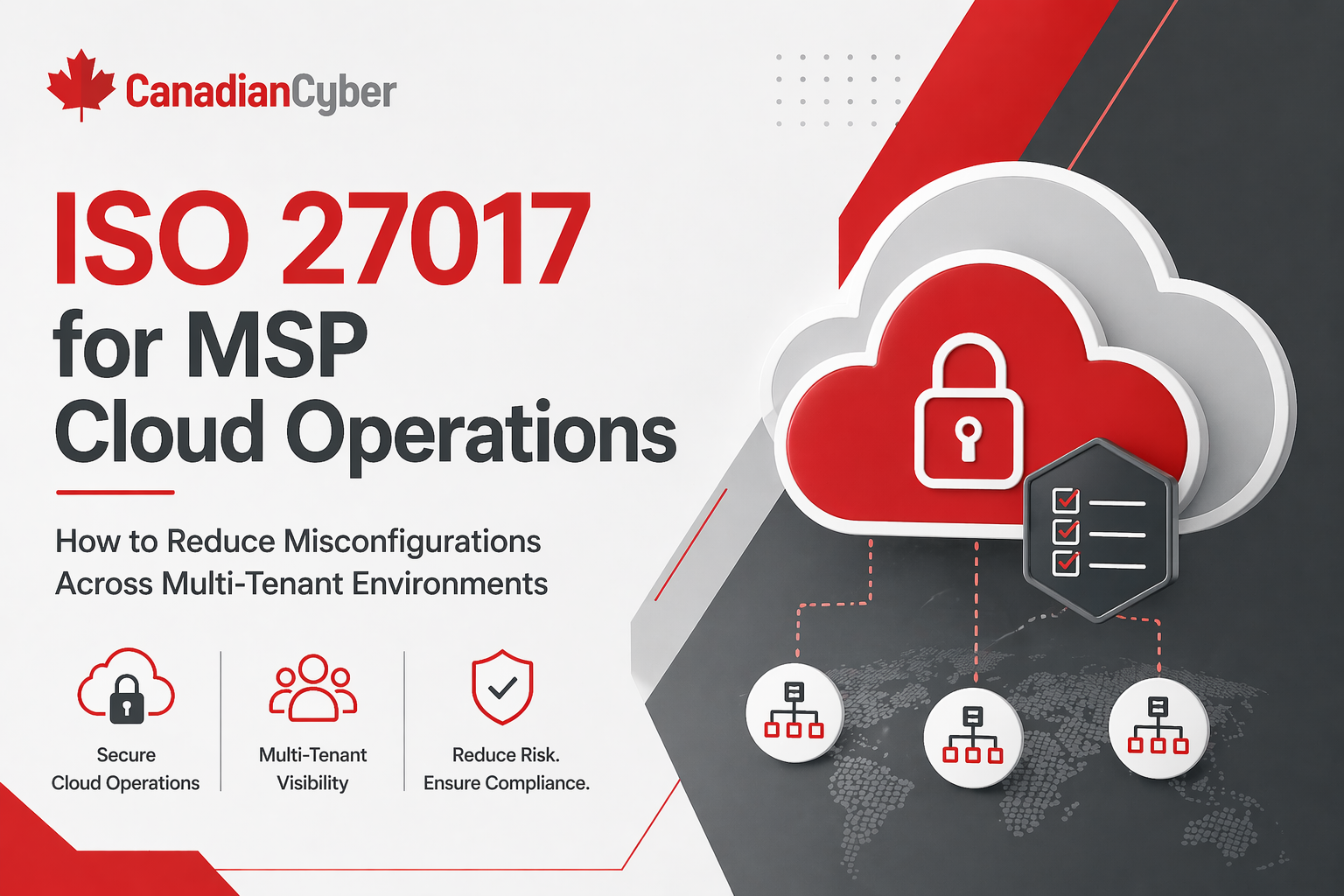
A practical guide to ISO 27017 MSP cloud operations, helping reduce misconfigurations across multi-tenant environments.
For managed service providers, cloud operations rarely fail because nobody cares about security.
They fail because complexity grows faster than control.
One tenant needs a firewall change. Another needs a new storage policy. A third needs backup updates. An engineer modifies an IAM role. A script gets reused across environments. A temporary exception stays in place too long. A shared baseline drifts quietly.
And suddenly the biggest risk is not a sophisticated attacker. It is a misconfiguration.
For MSPs running cloud operations across multiple customers, that risk is constant. Different clients, different environments, different urgency, different admins, different service tiers, and one operations team trying to keep all of it aligned.
This is exactly where ISO 27017 becomes useful. It helps MSPs apply cloud-specific security guidance in a way that fits real service environments, especially where shared responsibility, administrative access, and multi-tenant complexity create room for mistakes.
Misconfigurations are dangerous in any cloud environment. But MSPs face a different level of exposure because they often manage many customer tenants, many cloud platforms, shared operational tooling, recurring administrative changes, urgent customer requests, inherited environments with uneven maturity, and automation reused across clients.
These are not rare edge cases. They are exactly the kind of issues multi-tenant cloud teams deal with every day.
ISO 27017 is not just a misconfiguration checklist. It is cloud security guidance that helps organizations think more clearly about how cloud controls should be governed.
For MSPs, that matters because misconfiguration risk is rarely only technical. It is usually connected to unclear ownership, weak change control, poor segregation, inconsistent baselines, excessive admin rights, weak review processes, incomplete monitoring, and confusion about who is responsible for what.
That makes ISO 27017 a very practical lens for MSP environments.
Picture this. An MSP manages cloud operations for 60 clients across AWS, Azure, and Microsoft 365. The operations team handles identity and access administration, backup configuration, logging setup, firewall and network changes, endpoint and server deployments, monitoring, tenant hardening, support escalations, and onboarding of new customer environments.
The team is experienced and busy. They use scripts, templates, admin consoles, and internal runbooks. They know the cloud platforms well. They respond quickly.
But over time, several issues start appearing.
Now the MSP has a real problem. Not because the team is careless, but because cloud operations are scaling faster than control discipline. This is exactly where ISO 27017 helps.
A lot of MSPs respond to misconfiguration risk by looking only for more technical tools. Those tools can help. But many misconfigurations still come from something deeper: process drift.
This is why the real answer is not only better tooling. It is better operational structure.
For MSPs, the goal is not to make every tenant identical. That is usually unrealistic. Different customers have different requirements, different cloud maturity, different risk tolerance, different service tiers, and different workloads.
The real goal is simpler: make security-relevant cloud controls consistent enough that misconfiguration risk stays low, visibility stays high, and exceptions stay intentional.
For MSP cloud operations, the ISO 27017 areas that matter most for reducing misconfigurations usually fall into six practical categories:
Misconfiguration risk increases sharply when tenant boundaries are not clear enough. For MSPs, segregation is not just a security principle. It is an operational survival requirement.
This is one of the fastest ways to reduce the chance that one mistake reaches the wrong tenant.
One of the biggest misconfiguration drivers in MSP operations is broad admin access. It usually happens for understandable reasons such as urgent support demands, after-hours issues, customer pressure, and small teams covering many environments.
But the cost is high. The more people can change more things across more tenants, the more likely it becomes that something is changed in the wrong place, high-risk actions go unreviewed, accountability becomes blurry, and mistakes become harder to trace.
This is one of the most important control areas in the whole topic. Misconfigurations become common when there is no reliable baseline for what secure enough actually means across customer environments. Without a baseline, each tenant slowly becomes its own special case.
This baseline does not need to be identical for every customer. But it should define the default secure standard, what is mandatory, what is optional, and what requires documented customer acceptance if changed.
| Control area | Standard baseline | Allowed variations |
|---|---|---|
| MFA | Required for all admin roles | No variation without formal exception |
| Logging | Enabled for defined security events | Higher logging tiers for premium clients |
| Backup | Defined retention and success monitoring | Client-specific retention where approved |
| External access | Restricted by default | Expanded only with documented need |
| Admin accounts | Named accounts only | Break-glass accounts controlled separately |
Misconfigurations thrive in rushed cloud operations. MSPs are especially vulnerable because many changes feel urgent: customer issues, outage remediation, permission requests, onboarding deadlines, vendor troubleshooting, security incidents, and after-hours support escalations.
When these changes happen without enough structure, the chance of error rises quickly.
Even good baselines fail if nobody checks whether environments stay aligned over time. This is where many MSPs lose control. They configure an environment well on day one, but months later an admin role has expanded, a security setting changed, a log source was disabled, a backup policy drifted, or an exception was never rolled back.
If baseline controls exist but drift goes undetected, the MSP may believe the environment is secure while the real posture keeps degrading.
This is one of the most overlooked sources of misconfiguration. MSPs often make exceptions for good reasons: customer operational needs, legacy compatibility, urgent business requests, budget constraints, phased rollouts, and industry-specific requirements.
The problem is not that exceptions exist. The problem is when they become undocumented, indefinite, copied between customers, forgotten, or invisible in review cycles.
Customer-specific differences are normal. But they must stay intentional.
| Operational area | Misconfiguration risk | Better control direction |
|---|---|---|
| Tenant access | Wrong environment changed | Restrict cross-tenant admin scope |
| Privileged access | Broad change authority | Role-based, reviewed admin privileges |
| Baselines | Inconsistent secure state | Defined tenant security standards |
| Change control | Rushed or unreviewed changes | Risk-based change approval |
| Drift | Secure settings degrade over time | Posture checks and alerts |
| Exceptions | Temporary differences become permanent | Time-bound documented deviations |
This is where ISO 27017 becomes practical. It helps turn operational pain points into structured control areas.
Leadership in MSP environments should not ask only, “Do we have cloud expertise?” They should also ask harder operational questions.
These are the questions that matter when scale increases.
These are exactly the areas where ISO 27017 thinking improves operational maturity.
At Canadian Cyber, we often see MSPs with strong cloud skills still struggle with misconfiguration risk because operations scaled faster than governance. That is the real issue.
The technical capability exists. The team knows AWS, Azure, Microsoft 365, and other cloud platforms well. But the operating model around those environments is not always consistent enough to keep risk low across many tenants.
The strongest MSP cloud programs usually improve when they focus on tighter administrative boundaries, baseline clarity, stronger change discipline, visible drift monitoring, and much cleaner exception handling. That is what turns ISO 27017 from a theoretical cloud standard into something highly practical for MSP operations.
For MSPs, misconfigurations across multi-tenant cloud environments are not just technical mistakes. They are usually signs that operations need stronger structure.
ISO 27017 helps by giving MSPs a more practical way to think about tenant segregation, privileged access, secure baselines, cloud change control, posture drift, and exception discipline.
Because in the end, reducing misconfigurations is not about making every tenant identical. It is about making the security-relevant parts of cloud operations consistent, visible, and controlled enough that mistakes become less frequent, easier to detect, and easier to correct.