SOC 2 • Fintech SaaS • Control Prioritization • Audit Readiness • Customer Trust
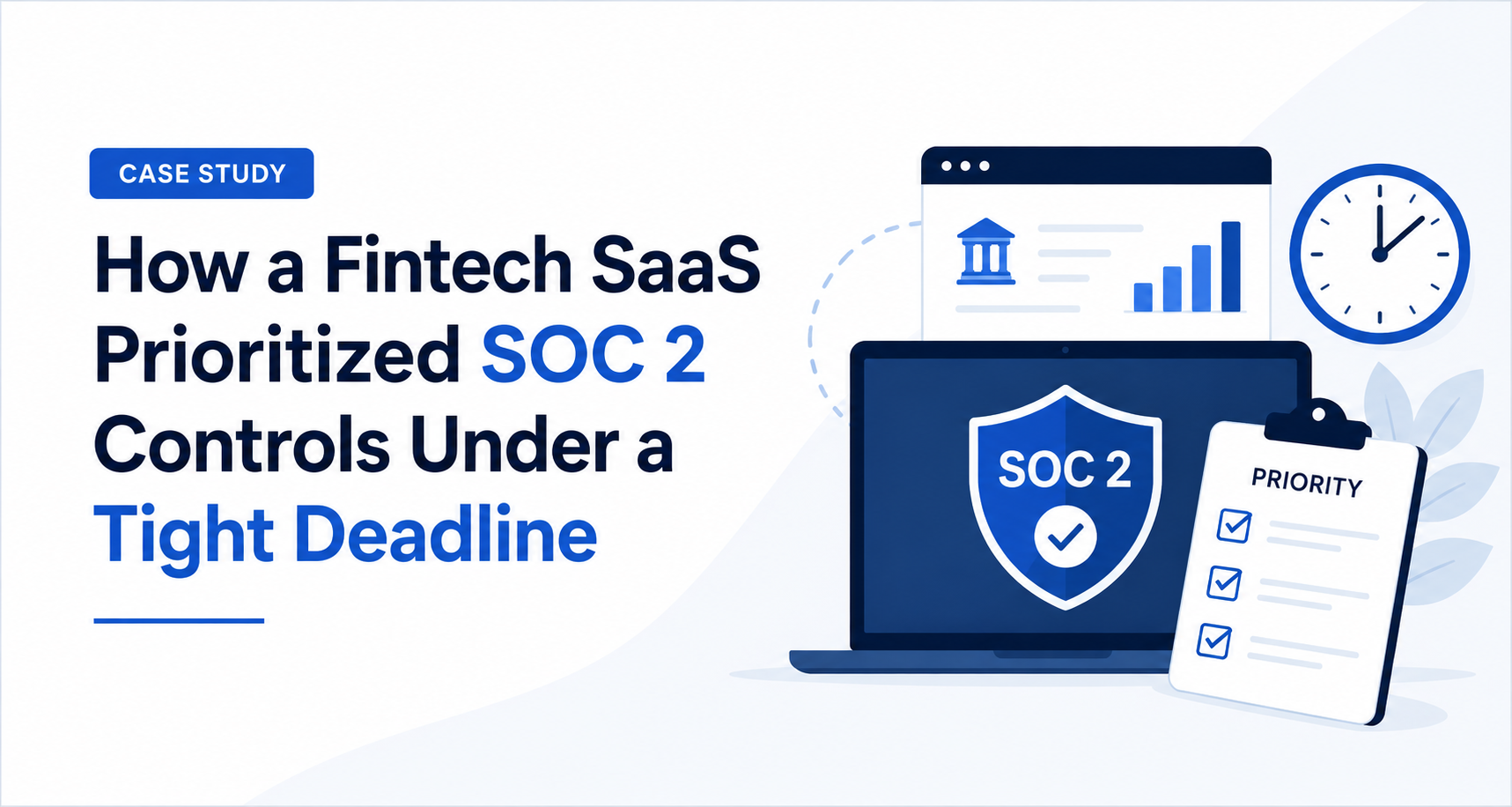
Case Study: How a Fintech SaaS Prioritized SOC 2 Controls Under a Tight Deadline
A fintech SaaS company does not have the luxury of treating SOC 2 like a slow paperwork project. When banks, payment partners, investors, and enterprise buyers ask for proof, the team needs to know which controls matter first.
Quick Snapshot
| Case Study Area | What Happened |
|---|---|
| Business Context | Fintech SaaS preparing for bank security reviews and SOC 2 readiness. |
| Deadline | 90 days to show serious control maturity. |
| Main Problem | Too many controls, scattered evidence, and unclear ownership. |
| Strategy | Prioritize high-risk and buyer-critical SOC 2 controls first. |
| Outcome | A focused evidence pack, reduced security gaps, and stronger buyer confidence. |
Introduction
The fintech team had a problem.
A major banking partner wanted security evidence before approving the next stage of the deal.
The company had some controls in place. MFA was enabled. Backups existed. GitHub pull requests were used. Policies had been drafted. But the team did not yet have clean, audit-ready evidence.
This fictional case study shows how a fintech SaaS company prioritized SOC 2 controls under pressure without trying to fix everything at once.
Facing a SOC 2 Deadline?
Canadian Cyber helps fintech SaaS teams prioritize SOC 2 controls, build evidence packs, prepare for bank security reviews, and create a practical readiness roadmap.
Meet the Fintech SaaS Company
Let’s call the company LedgerFlow.
LedgerFlow provided a SaaS platform for finance teams to manage approvals, reconciliation workflows, payment file references, and reporting dashboards.
The platform handled sensitive data, including:
- customer account records
- transaction metadata
- approval workflows
- financial reports
- user activity logs
- admin actions
The Starting Point
LedgerFlow was not starting from zero. But SOC 2 readiness is not only about having controls. It is about proving that controls operate.
| Area | Initial Gap |
|---|---|
| Access Control | Access reviews were informal. |
| Vendor Risk | Critical vendors were known but not formally reviewed. |
| Incident Response | Plan existed but had not been tested. |
| Backups | Backups were configured, but restore testing was missing. |
| Ownership | Control owners were unclear. |
Practical rule: Under a tight deadline, do not ask, “What does SOC 2 include?” Ask, “Which control gaps could block this deal or create real risk?”
Priority 1: Access Control
Access control came first because fintech access risk can become customer trust risk quickly.
| Action | Why It Mattered |
|---|---|
| Exported user access from key systems | Created visibility. |
| Reviewed privileged access | Reduced high-impact risk. |
| Created an exception register | Made gaps visible. |
| Reviewed offboarding samples | Proved access removal. |
Evidence created: MFA report, admin role export, privileged access review, removed user list, offboarding ticket samples, support access log sample, and access exception register.
Priority 2: Vendor Risk
Vendor risk came next because fintech SaaS companies depend heavily on third parties for cloud hosting, monitoring, logging, payment integrations, source code management, support tools, and security scanning.
| Vendor Register Field | Purpose |
|---|---|
| Vendor Name | Supplier identification. |
| Data Handled | Customer, employee, financial, or metadata. |
| Criticality | High, medium, or low. |
| Assurance Reviewed | SOC 2, ISO, questionnaire, or contract. |
| Next Review Date | Ongoing review. |
Evidence created: critical vendor register, risk ratings, SOC 2 report review notes, approval decisions, remediation tracker, sub-processor list, and contract links.
Need SOC 2 Evidence Organized Fast?
Canadian Cyber can help build access control evidence packs, vendor registers, remediation trackers, and SharePoint evidence workspaces for SOC 2 and bank reviews.
Priority 3: Incident Response
LedgerFlow had a draft incident response plan, but it had never been tested. For fintech buyers, that was a serious gap.
The team finalized the plan, defined severity levels, assigned roles, added customer notification steps, ran a tabletop, and recorded lessons learned.
Tabletop scenario:
A privileged support account is compromised. The attacker accesses customer support tickets containing financial workflow details and attempts to access production admin tools.
Evidence created: incident response plan, role matrix, tabletop agenda, participant list, scenario notes, lessons learned, and corrective action tracker.
Priority 4: Backup and Recovery
Backups existed, but restore testing was missing. The team confirmed backup coverage, checked encryption and retention, reviewed backup admin access, ran a restore test, and documented the result.
“We have backups” is weak. “We have tested recovery evidence” is much stronger.
Priority 5: Change Management
LedgerFlow already used pull requests, but evidence was scattered. The team defined a change process, mapped GitHub to Jira tickets, sampled production changes, verified approvals, saved deployment records, and added an emergency change process.
Evidence created: pull request samples, review approvals, linked Jira tickets, deployment records, emergency change procedure, scan results, and release notes.
Priority 6: Logging, Policies, and Risk Register
The last priority group focused on proving governance. Logs existed, but review evidence was weak. Policies existed, but several were still drafts. Risks were discussed verbally, but not tracked in one place.
| Area | What Changed |
|---|---|
| Logging | Created log source inventory, retention evidence, alert samples, and monthly review sign-off. |
| Policies | Assigned owners, approved core policies, added versions and review dates. |
| Risk Register | Added owners, ratings, treatment actions, evidence links, and leadership decision flags. |
The 90-Day SOC 2 Prioritization Plan
| Timeline | Main Focus | Output |
|---|---|---|
| Days 1–30 | Stabilize and prioritize. | Scope, priority controls, owners, risk register, evidence workspace. |
| Days 31–60 | Fix high-risk gaps. | Access review, vendor register, policies, restore test, IR plan. |
| Days 61–90 | Package and prove. | Tabletop, log review, corrective actions, buyer evidence pack, next roadmap. |
Buyer Evidence Pack
The buyer did not need perfection. They needed confidence.
| Evidence Area | Included |
|---|---|
| SOC 2 Roadmap | Scope, timeline, priority controls. |
| Access Control | MFA, admin review, access review, offboarding. |
| Vendor Risk | Vendor register and critical vendor reviews. |
| Incident Response | Approved plan and tabletop record. |
| Backup Recovery | Backup settings and restore test. |
The evidence pack showed that the team understood its risks, assigned owners, created evidence, tracked gaps, involved leadership, and was moving toward SOC 2 readiness.
Lessons for Fintech SaaS Teams
- Prioritize based on risk and buyer pressure. Do not treat every control equally under a tight deadline.
- Evidence beats intent. A planned control is not the same as an operating control.
- Access control usually comes first. Privileged access and customer data access are high-impact.
- Restore testing matters. Backups are not enough. Recovery must be proven.
- Vendor risk can block deals. Fintech customers care about your supply chain.
Common Mistakes to Avoid
- Trying to fix everything at once. This creates confusion.
- Writing policies without evidence. Policies must match operating controls.
- Ignoring bank security review questions. Buyer questions should influence prioritization.
- Assuming GitHub PRs are enough. You still need organized evidence and traceability.
- Waiting to run a tabletop. Incident response should be tested before the buyer asks.
Canadian Cyber’s Take
At Canadian Cyber, we often see fintech SaaS teams try to prepare for SOC 2 by chasing every possible control at once.
That usually fails.
The better approach is focused. Start with the controls that reduce real risk and answer buyer concerns.
For fintech SaaS, that usually means access control, vendor risk, incident response, backup recovery, change management, logging, policies, and risk management.
Under a tight deadline, the goal is not perfection. The goal is credible progress, clear evidence, and strong prioritization.
Takeaway
A tight SOC 2 deadline does not mean you should panic. It means you should prioritize.
Focus on the controls that matter most:
- access control
- vendor risk
- incident response
- backup and recovery
- change management
- logging and monitoring
- policy approval
- risk management
SOC 2 readiness is not about doing everything at once. It is about proving the right controls are operating and improving.
How Canadian Cyber Can Help
Canadian Cyber helps fintech SaaS companies prioritize SOC 2 controls under tight deadlines and prepare for bank security reviews.
- SOC 2 readiness assessments
- fintech SOC 2 control prioritization
- bank security review preparation
- access control evidence packs
- vendor risk reviews
- incident response tabletop exercises
- backup and restore evidence reviews
- SharePoint evidence workspace setup
- vCISO support for fintech SaaS teams
Stay Connected With Canadian Cyber
Follow Canadian Cyber for practical guidance on SOC 2, fintech SaaS, ISO 27001, SharePoint ISMS, vCISO leadership, vendor risk, evidence management, and customer trust.