vCISO • Law Firm Cybersecurity • Client Confidentiality • Case File Security • Third-Party Risk
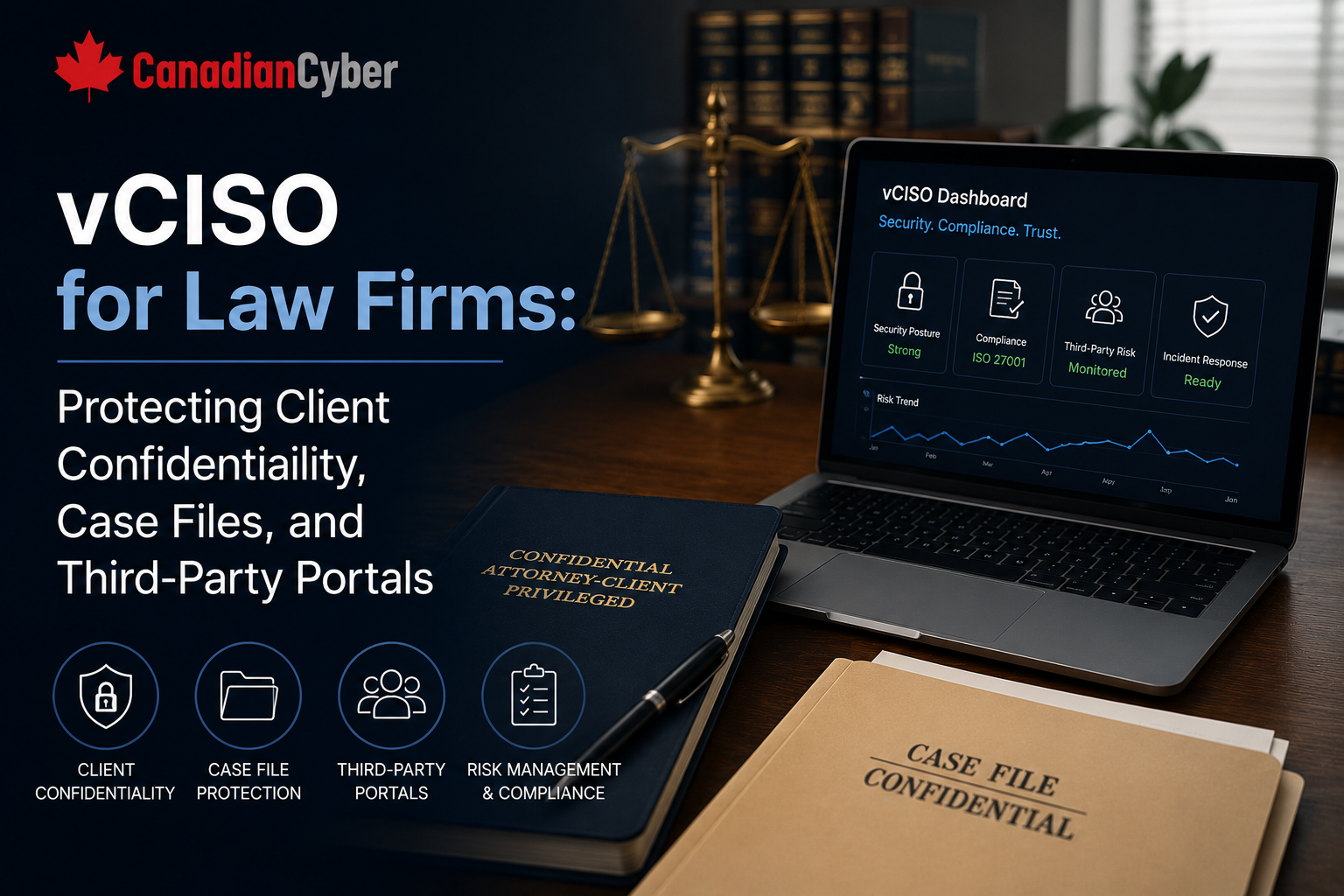
vCISO for Law Firms: Protecting Client Confidentiality, Case Files, and Third-Party Portals
Law firms handle highly sensitive client information every day. A vCISO helps turn cybersecurity from reactive IT support into structured security leadership, risk management, audit readiness, and client trust protection.
Canadian Cyber vCISO Services for Law Firms
Cybersecurity Leadership for Client Confidentiality, ISO 27001, and Legal Workflows
Canadian Cyber helps law firms build practical cybersecurity governance, protect client confidentiality, review case file access, assess third-party portals, prepare for ISO 27001, and organize audit evidence in SharePoint ISMS workspaces.
Quick Snapshot
| Law Firm Risk Area | How a vCISO Helps |
|---|---|
| Client Confidentiality | Builds governance around sensitive client data, privileged records, and matter files. |
| Case File Access | Reviews who can access legal documents, restricted matters, and practice group workspaces. |
| Document Management Systems | Tests DMS permissions, ethical walls, sharing settings, and admin access. |
| Third-Party Portals | Reviews eDiscovery, data room, court filing, client portal, and vendor access risks. |
| ISO 27001 Readiness | Helps law firms prepare risk registers, policies, evidence, access reviews, and audit readiness. |
| Business Outcome | Stronger client trust, better audit preparation, reduced access risk, and clearer security leadership. |
Introduction
Law firms are built on confidentiality.
Clients trust lawyers with information they may not share anywhere else. That information can include litigation strategy, settlement plans, privileged communications, merger and acquisition files, board documents, employment disputes, financial statements, intellectual property, regulatory investigation records, personal information, court filings, expert reports, eDiscovery records, and data room documents.
This makes cybersecurity a business issue for law firms. It is not only about firewalls, antivirus, and passwords. It is about protecting client trust.
Many law firms already have IT support. But IT support and cybersecurity leadership are not the same thing.
A vCISO gives the firm strategic security leadership without hiring a full-time Chief Information Security Officer. For law firms, a vCISO can help manage client confidentiality risks, ISO 27001 readiness, access reviews, vendor risk, incident response, third-party portals, document management controls, and executive security reporting.
Need vCISO Support for Your Law Firm?
Canadian Cyber helps law firms build practical cybersecurity governance, protect client confidentiality, review case file access, assess third-party portals, prepare for ISO 27001, and organize audit evidence in SharePoint ISMS workspaces.
Why Law Firms Need vCISO Leadership
Law firms face security expectations from many directions. Clients ask for proof. Insurers ask for controls. Partners ask about risk. Auditors ask for evidence. Regulators expect protection of sensitive data. Courts and counterparties depend on secure handling of records. Vendors need review. Lawyers need practical guidance.
A vCISO helps connect these needs into one security governance program.
| Traditional IT Support | vCISO Leadership |
|---|---|
| Fixes tickets | Manages security risk. |
| Supports users | Advises leadership. |
| Maintains tools | Builds cybersecurity roadmap. |
| Handles access requests | Reviews access risk. |
| Responds to issues | Prepares incident response strategy. |
| Focuses on operations | Focuses on governance, evidence, and client trust. |
Practical rule: IT keeps systems running. A vCISO helps the firm understand and manage cybersecurity risk.
Client Confidentiality: The Core Law Firm Security Objective
For law firms, confidentiality is not a slogan. It is a daily operational requirement. A vCISO helps translate confidentiality obligations into practical controls.
| Confidentiality Control Area | vCISO Focus |
|---|---|
| Matter Access | Who can access each matter and why. |
| Ethical Walls | How restricted matters are protected. |
| Document Management | How case files are stored, shared, and reviewed. |
| External Sharing | How files are shared with clients, courts, experts, and vendors. |
| Vendor Access | Which third parties can access client data. |
| Incident Response | How confidentiality issues are escalated and handled. |
| Audit Evidence | How the firm proves controls are working. |
Protecting Case File Access
Case files often contain the most sensitive information in the firm. The vCISO helps the firm review whether case file access is appropriate.
| Case File Access Question | Yes / No |
|---|---|
| Is each matter assigned an owner? | |
| Is the matter team documented? | |
| Are permissions based on need-to-know? | |
| Are support staff access rights justified? | |
| Are former matter team members removed? | |
| Are external guests reviewed? | |
| Are restricted matters reviewed separately? | |
| Is access review evidence retained? |
Evidence a vCISO may request:
SharePoint access report
Teams membership list
Client portal access list
Matter team roster
Access approval record
Offboarding sample
Exception register
Practical rule: Matter access should be reviewed regularly and documented clearly.
Document Management Systems Need Security Governance
Many law firms use legal document management systems such as iManage, NetDocuments, SharePoint, OneDrive, Teams, case management tools, client portals, or virtual data rooms. These platforms need governance.
| DMS Security Question | Why It Matters |
|---|---|
| Who has admin access? | Privileged access risk. |
| Are matter permissions reviewed? | Client confidentiality. |
| Are ethical walls enforced? | Restricted matter protection. |
| Are external links controlled? | Data leakage prevention. |
| Are vendor accounts reviewed? | Third-party risk. |
| Are audit logs available? | Investigation support. |
| Are retention rules defined? | Information lifecycle. |
Assess My Law Firm DMS Controls
Canadian Cyber helps law firms review legal document management controls, matter access, ethical walls, DMS admin permissions, external sharing, vendor assurance, and audit evidence.
Ethical Walls and Restricted Matters
Ethical walls protect restricted matters and help reduce confidentiality and conflict risk. A vCISO helps test whether these controls work in practice.
| Ethical Wall Review Question | Yes / No |
|---|---|
| Are restricted matters clearly identified? | |
| Is there an ethical wall approval process? | |
| Are restricted users documented? | |
| Are DMS permissions configured correctly? | |
| Are Teams, SharePoint, and email access aligned? | |
| Are exceptions approved? | |
| Is evidence retained? |
Practical rule: Ethical walls should be tested before a client, auditor, or regulator asks.
Third-Party Portals Create Hidden Risk
Law firms often use third-party portals for client work. These portals may be outside the firm’s main IT environment, but they still carry confidentiality risk.
Common third-party portals include:
Court filing systems
Client portals
Virtual data rooms
Expert witness portals
Regulatory submission portals
Document review platforms
Secure file transfer platforms
Legal research tools
| Portal Risk | Example |
|---|---|
| Unreviewed access | Former user still has access. |
| Weak permissions | Vendor sees more files than needed. |
| Expired matters | Old portal remains active. |
| Poor logging | Access cannot be investigated. |
| Weak MFA | External access is easier to compromise. |
| Data retention issue | Files remain after engagement ends. |
Practical rule: If client data enters a third-party portal, that portal should be included in the law firm’s risk review.
Vendor Risk Management for Law Firms
Vendors can create serious confidentiality risk. A vCISO helps build a vendor risk process that fits legal workflows.
Vendors to review:
DMS providers
Managed IT providers
Cloud providers
Data room providers
Court filing platforms
Transcription vendors
Forensic consultants
Cybersecurity vendors
Contract lawyers
| Vendor Review Evidence | Purpose |
|---|---|
| Vendor register | Shows supplier visibility. |
| Critical vendor list | Identifies high-risk vendors. |
| Vendor risk review | Documents due diligence. |
| Contract or confidentiality terms | Shows legal obligations. |
| Vendor assurance report | Shows security evidence. |
| Offboarding evidence | Shows access removal. |
Incident Response for Confidentiality Events
Law firms need incident response plans that match legal sector scenarios. A generic IT incident plan may not be enough.
Law firm incident scenarios include:
Misconfigured sharing link
Unauthorized matter access
Ethical wall breach
Lost laptop
Compromised lawyer mailbox
Ransomware affecting case files
Vendor portal breach
DMS outage
vCISO incident response support includes:
- incident response plan
- severity classification
- legal and client notification workflow
- role matrix
- cyber insurance coordination
- tabletop exercises
- lessons learned
- management reporting
ISO 27001 Readiness for Law Firms
A vCISO can help law firms prepare for ISO 27001 by building a practical ISMS that reflects real legal workflows and client confidentiality obligations.
| ISO 27001 Area | vCISO Support |
|---|---|
| ISMS Scope | Defines offices, systems, practice areas, and client data. |
| Risk Assessment | Identifies confidentiality, access, vendor, and continuity risks. |
| Policies | Builds practical security policies. |
| Access Reviews | Tests users, admins, guests, and vendors. |
| Vendor Reviews | Creates supplier assurance process. |
| Internal Audit | Prepares evidence and findings. |
| Management Review | Briefs leadership and tracks actions. |
Start My Law Firm ISO 27001 Roadmap
Canadian Cyber helps law firms build ISO 27001 readiness programs that protect client confidentiality and produce audit-ready evidence.
SharePoint ISMS for Law Firm Governance
A vCISO needs a place to manage evidence. A SharePoint ISMS workspace can help law firms centralize cybersecurity governance.
| SharePoint ISMS Section | Purpose |
|---|---|
| Risk Register | Tracks confidentiality, vendor, access, and system risks. |
| Policy Library | Stores approved policies and review dates. |
| Matter Access Evidence | Stores access reviews and permissions. |
| Vendor Register | Tracks vendor reviews and contracts. |
| Incident Response | Stores plans, tabletop records, and lessons learned. |
| Audit Evidence | Organizes ISO 27001 and client evidence. |
| Corrective Actions | Tracks findings and remediation. |
| Third-Party Portals | Tracks portal owners, access, and reviews. |
Explore the ISMS SharePoint Solution
Canadian Cyber’s ISMS SharePoint solution helps law firms organize risks, policies, access reviews, vendor evidence, incident response records, ISO 27001 audit evidence, and management review materials in one Microsoft 365 workspace.
vCISO Roadmap for Law Firms
A practical vCISO roadmap can help law firms improve security without overwhelming legal teams.
First 30 Days
Review current risks, identify sensitive client data systems, review DMS and SharePoint access, create an initial risk register, review MFA and privileged access, identify critical vendors, and review incident response.
Next 60 Days
Run matter access review, review ethical wall controls, assess third-party portals, update security policies, create vendor risk process, prepare management reporting, and start corrective action tracking.
Next 90 Days
Build ISO 27001 roadmap, prepare internal audit evidence, review backup and recovery, test incident response, formalize management review, launch SharePoint ISMS, and create a client trust evidence pack.
Practical rule: A vCISO roadmap should focus on the highest risks first: client data, access, vendors, incidents, and evidence.
vCISO Readiness Checklist for Law Firms
Governance
| Question | Yes / No |
|---|---|
| Do we have a current cybersecurity risk register? | |
| Does leadership receive security reports? | |
| Are security policies reviewed regularly? | |
| Are client confidentiality risks formally tracked? | |
| Are corrective actions assigned and monitored? |
Access and Case Files
| Question | Yes / No |
|---|---|
| Are matter access reviews performed? | |
| Are DMS permissions tested? | |
| Are ethical walls reviewed? | |
| Are external guests reviewed? | |
| Are privileged accounts reviewed? |
Vendors and Portals
| Question | Yes / No |
|---|---|
| Do we maintain a vendor register? | |
| Are third-party portals reviewed? | |
| Are vendors with client data assessed? | |
| Are vendor users removed after engagements? | |
| Are vendor incidents escalated properly? |
Incident and Compliance
| Question | Yes / No |
|---|---|
| Is incident response tested? | |
| Are confidentiality incidents tracked? | |
| Is ISO 27001 readiness being planned? | |
| Is audit evidence organized? | |
| Are management reviews documented? |
If several answers are “no,” a vCISO can help create structure and accountability.
Common Mistakes Law Firms Should Avoid
- Treating cybersecurity as only IT support. Law firm cybersecurity needs leadership, risk management, and governance.
- Ignoring matter-level access. Client confidentiality depends on who can access case files.
- Not testing ethical walls. Restricted matters need evidence.
- Forgetting third-party portals. Client data often leaves the firm’s main systems through portals and vendors.
- No vendor risk process. Vendors with client data need review and monitoring.
- No incident tabletop. Confidentiality incidents should be tested before they happen.
- No executive reporting. Partners and leadership need clear risk visibility.
What Good Looks Like
A strong vCISO program for law firms can show:
- cybersecurity risk register
- client confidentiality risk review
- matter access review process
- DMS permission review
- ethical wall testing
- third-party portal register
- vendor risk review
- privileged access review
- MFA evidence
- incident response plan
- tabletop exercise evidence
- backup and recovery review
- ISO 27001 readiness roadmap
- policy library
- corrective action tracker
- management review reports
- SharePoint ISMS workspace
This helps the firm protect clients and prove security maturity.
Canadian Cyber’s Take
At Canadian Cyber, we see law firms under pressure to prove security maturity to clients, insurers, auditors, and partners.
Many firms already have IT support. But they do not always have cybersecurity leadership. A vCISO helps fill that gap.
For law firms, the most important security questions often relate to client confidentiality: who can access case files, whether ethical walls are working, whether third-party portals are reviewed, and whether the firm can prove ISO 27001 readiness.
A vCISO helps answer those questions with governance, evidence, reporting, and action. The result is stronger client trust and better security direction.
Takeaway
Law firms need cybersecurity leadership that understands confidentiality, client matters, and legal workflows.
A vCISO can help protect:
- client confidentiality
- case files
- document management systems
- ethical walls
- third-party portals
- vendors
- client portals
- sensitive records
- audit evidence
- ISO 27001 readiness
The goal is not to create paperwork. The goal is to protect client trust with clear controls, ownership, and evidence.
How Canadian Cyber Can Help
Canadian Cyber provides vCISO services for law firms and professional services organizations handling sensitive client data.
- law firm vCISO services
- cybersecurity risk register development
- client confidentiality control reviews
- case file access reviews
- DMS permission assessments
- ethical wall testing
- third-party portal reviews
- vendor risk management
- incident response planning
- tabletop exercises
- ISO 27001 readiness planning
- internal audit preparation
- management security reporting
- SharePoint ISMS workspace setup
- client trust evidence packs
Stay Connected With Canadian Cyber
Follow Canadian Cyber for practical guidance on vCISO services, law firm cybersecurity, client confidentiality, case file protection, ISO 27001, SharePoint ISMS, SOC 2, ISO 42001, and third-party risk.