vCISO • Law Firm Cybersecurity • Client Security Requirements • ISO 27001 • Client Trust
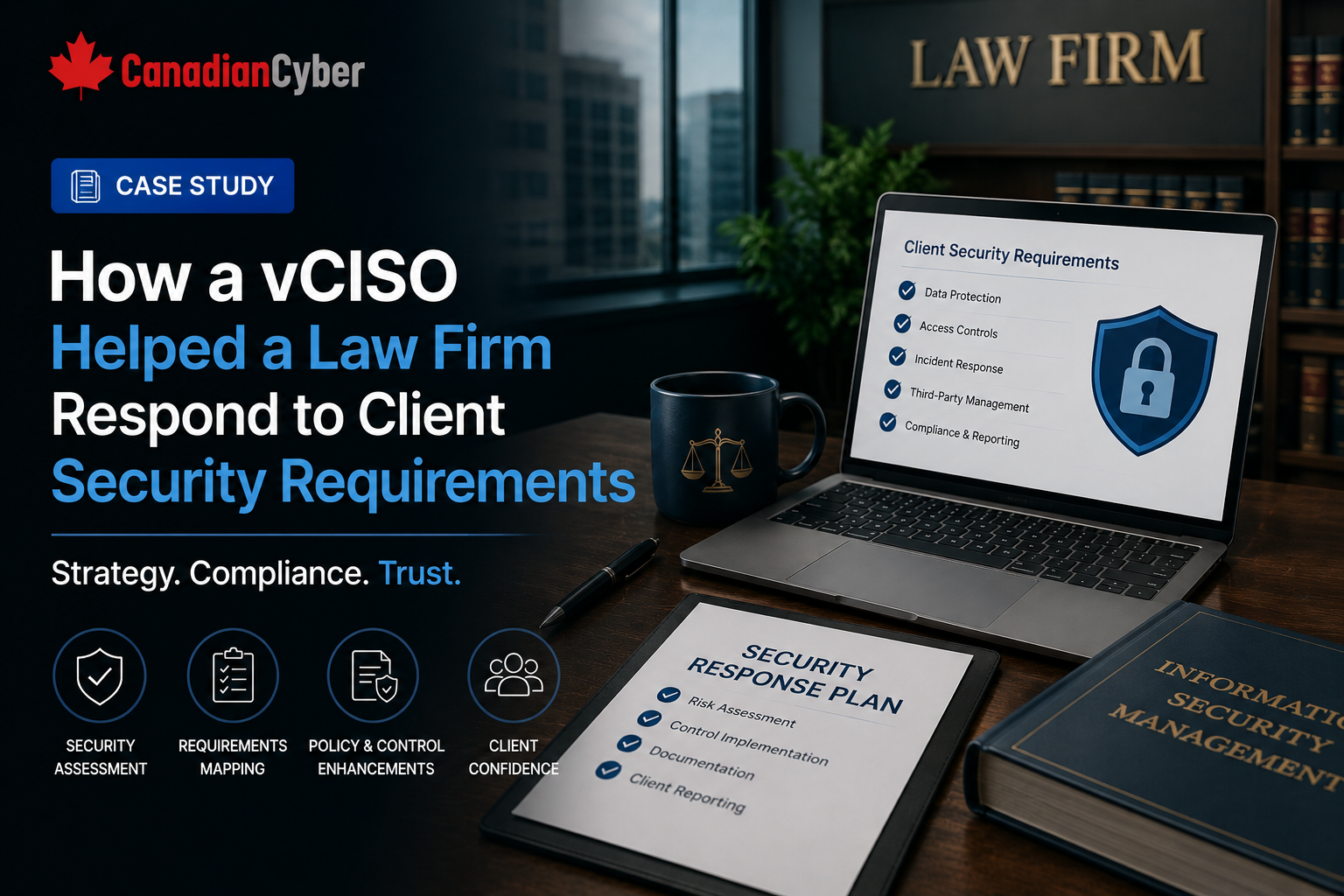
Case Study: How a vCISO Helped a Law Firm Respond to Client Security Requirements
Law firms are facing stronger security expectations from corporate clients, financial institutions, healthcare organizations, insurers, and regulated businesses. A vCISO helps turn scattered evidence into a confident, structured, client-ready response.
Canadian Cyber vCISO Support for Law Firms
Respond to Client Security Questionnaires With Evidence, Not Guesswork
Canadian Cyber helps law firms respond to client security requirements, prepare client-ready evidence packs, review confidentiality controls, build ISO 27001 readiness roadmaps, and organize governance evidence in SharePoint ISMS workspaces.
Quick Snapshot
| Case Study Area | What Improved |
|---|---|
| Business Context | Mid-sized law firm responding to a major client security review. |
| Main Challenge | Security evidence was scattered across IT, HR, vendors, policies, and document systems. |
| Client Concern | Confidentiality, access reviews, third-party portals, incident response, backups, and governance. |
| vCISO Support | Built a response plan, evidence pack, risk register, control summary, and leadership-ready roadmap. |
| Business Outcome | Faster client response, stronger trust, fewer evidence gaps, and clearer security governance. |
Introduction
A mid-sized law firm received a detailed security questionnaire from a large corporate client.
The client wanted proof that the firm could protect sensitive legal, financial, and business information.
The questionnaire asked about:
Access reviews
MFA
Data encryption
Document management controls
Incident response
Business continuity
Backup testing
Vendor risk
Cyber insurance
Security awareness training
ISO 27001 readiness
The firm had many controls in place, but the evidence was scattered. Some records were with IT. Some were in policy folders. Some were in email. Some were with HR. Some were with vendors. Some were inside the document management system. Some were not formally documented at all.
The managing partner wanted to respond quickly. The IT team was already busy. The client deadline was close. That is when the firm brought in a vCISO.
This fictional case study explains how a vCISO helped a law firm respond to client security requirements and turn a stressful questionnaire into a stronger client trust process.
Need Help Responding to Client Security Requirements?
Canadian Cyber provides vCISO support for law firms, helping teams respond to security questionnaires, prepare client evidence packs, review confidentiality controls, build ISO 27001 readiness, and organize governance evidence in SharePoint ISMS workspaces.
Meet the Law Firm
Let’s call the firm Harbour & Slate LLP.
Harbour & Slate was a growing professional services law firm with practice areas in corporate law, employment law, commercial litigation, real estate, privacy advisory, technology transactions, and regulatory matters.
The firm handled sensitive client data every day, including:
Board materials
Litigation files
Employment records
Financial documents
Personal information
Privileged communications
Settlement discussions
Due diligence records
Regulatory submissions
The firm had IT support and security tools, but it did not have a formal cybersecurity leadership function. There was no full-time CISO, no quarterly security governance report, and no client-ready evidence pack.
The issue: the firm had controls, but it was not ready to explain and evidence those controls under client review pressure.
The Trigger: A Major Client Security Questionnaire
The firm’s client sent a detailed security questionnaire before renewing its engagement. The client was not asking only basic IT questions. It wanted to know how the law firm governed cybersecurity.
| Client Question | What the Client Wanted to Know |
|---|---|
| Do you enforce MFA? | Account protection. |
| Do you review user access? | Confidentiality control. |
| How do you protect client matter files? | Document security. |
| How are ethical walls managed? | Restricted matter protection. |
| How are vendors reviewed? | Third-party risk. |
| Is incident response tested? | Readiness. |
| Are backups tested? | Resilience. |
| Are you ISO 27001 certified or working toward it? | Assurance maturity. |
Practical rule: Client security questionnaires are no longer simple forms. They are trust tests.
The Starting Problem
The firm was not careless. It had many controls. But the controls were not packaged for client assurance.
| Evidence Gap Found | Why It Created Risk |
|---|---|
| No central evidence workspace | Hard to respond quickly. |
| Access reviews were inconsistent | Difficult to prove need-to-know access. |
| DMS control evidence was incomplete | Client matter confidentiality was hard to demonstrate. |
| Vendor reviews were scattered | Third-party risk answers were weak. |
| Incident response was documented but not recently tested | Readiness looked incomplete. |
| Restore testing evidence was limited | Recovery proof was weak. |
| ISO 27001 roadmap was informal | Assurance maturity was not easy to explain. |
How the vCISO Helped
The vCISO started by turning the questionnaire into a structured response project.
| Step | Action |
|---|---|
| 1 | Review questionnaire and identify high-risk questions. |
| 2 | Map questions to existing controls. |
| 3 | Identify missing evidence. |
| 4 | Assign evidence owners. |
| 5 | Review client matter confidentiality controls. |
| 6 | Prepare a client-ready security summary. |
| 7 | Build a remediation tracker. |
| 8 | Create an ISO 27001-aligned roadmap. |
| 9 | Organize evidence in SharePoint. |
Practical rule: A vCISO helps the firm answer security questions with governance, not guesswork.
Turn Client Questionnaires Into a Repeatable Response Process
Canadian Cyber helps law firms map client requirements to controls, identify evidence gaps, prepare response summaries, and build a reusable evidence pack for future client reviews.
Step 1: Mapping Client Requirements to Controls
The vCISO created a requirements-to-controls matrix. This helped the firm avoid scattered answers and identify which questions had strong evidence.
| Client Requirement | Control Area | Evidence Needed |
|---|---|---|
| MFA required | Identity security | MFA report |
| Access reviewed | Access management | Access review records |
| Matter data protected | Confidentiality | DMS permission evidence |
| Vendors reviewed | Supplier security | Vendor risk assessments |
| Incidents managed | Incident response | IR plan and test records |
| Backups tested | Resilience | Backup and restore evidence |
| Security leadership | Oversight | vCISO report and roadmap |
Step 2: Creating a Client Security Evidence Pack
The vCISO helped the firm prepare a client-ready evidence pack. The goal was not to overshare confidential internal information. The goal was to provide clear assurance.
| Evidence Pack Section | Included Evidence |
|---|---|
| Security Governance | Policy list, risk register summary, vCISO roadmap. |
| Access Control | MFA evidence, access review summary, privileged access review. |
| Client Matter Confidentiality | DMS control summary, ethical wall process, matter access review summary. |
| Vendor Risk | Vendor review process and critical vendor list summary. |
| Incident Response | Incident response plan summary and tabletop evidence. |
| Backup and Recovery | Backup monitoring summary and restore test evidence. |
| Compliance Roadmap | ISO 27001 readiness plan and control improvement roadmap. |
Practical rule: Client evidence packs should be useful, professional, and controlled. Do not send raw internal exports unless necessary.
Step 3: Reviewing Client Matter Confidentiality Controls
The client cared most about confidentiality, so the vCISO reviewed how the firm protected matter files.
Confidentiality areas reviewed:
DMS permissions
Ethical walls
External sharing
Teams and SharePoint access
Client portal access
DMS admin access
Vendor access
Offboarding process
Incident escalation
| Question the vCISO Asked | Why It Mattered |
|---|---|
| Who can access sensitive client matters? | Need-to-know control. |
| Are matter teams documented? | Access justification. |
| Are ethical walls enforced? | Restricted matter protection. |
| Are external guests reviewed? | Data leakage prevention. |
| Are DMS admins reviewed? | Privileged access control. |
| Are confidentiality incidents tracked? | Response and improvement. |
Step 4: Fixing Access Review Gaps
Access review evidence was one of the weakest areas. The vCISO helped create a practical review process.
| Gap | Fix |
|---|---|
| Access reviews done informally | Standard review template created. |
| Matter access not reviewed regularly | High-risk matter review scheduled. |
| External guests not tracked centrally | Guest user review added. |
| Privileged access not separated | Admin access review completed. |
| Former users found in one portal | Portal offboarding checklist updated. |
| No remediation tracker | Access finding tracker created. |
Evidence created:
User access review
Privileged access review
DMS permission review
External guest review
Leaver testing sample
Remediation tracker
Closure evidence
Prepare Access Review Evidence Before the Client Deadline
Canadian Cyber helps law firms prepare MFA summaries, access review records, privileged access reviews, DMS permission evidence, external guest reviews, leaver testing samples, and remediation trackers.
Step 5: Reviewing Third-Party Portals and Vendors
The law firm used several external platforms. The vCISO identified third-party portals as a major hidden risk.
Portals reviewed:
Client collaboration portal
Virtual data room
Secure file transfer tool
Legal research platform
Court filing system
Managed IT support portal
Backup platform
| Vendor Review Question | Why It Mattered |
|---|---|
| Which vendors process client data? | Data exposure. |
| Are vendors reviewed before use? | Due diligence. |
| Do vendors provide security assurance? | Control confidence. |
| Are vendor users removed after engagement? | Access cleanup. |
| Are vendor incidents escalated? | Response readiness. |
Evidence created:
Critical vendor list
Vendor review template
Vendor assurance tracker
Portal owner list
Portal access review
Vendor incident contact list
Step 6: Strengthening Incident Response Evidence
The firm had an incident response plan, but it had not tested it recently. The vCISO helped prepare stronger evidence.
Incident scenarios reviewed:
Unauthorized matter access
Business email compromise
Ransomware
DMS outage
Vendor portal breach
Ethical wall breach
Client data exposure through sharing link
| Incident Evidence Prepared | Why It Helped |
|---|---|
| Incident response plan | Showed the response process. |
| Severity classification matrix | Clarified escalation rules. |
| Client notification decision process | Supported client communication readiness. |
| Tabletop exercise record | Proved the plan was tested. |
| Corrective action tracker | Showed continual improvement. |
Step 7: Preparing a Cyber Governance Summary for the Client
The vCISO wrote a concise security governance summary. This helped the firm respond professionally without overwhelming the client.
The governance summary included:
- security leadership model
- vCISO oversight
- risk management approach
- policy governance
- access review process
- vendor risk process
- incident response process
- backup and recovery approach
- ISO 27001 readiness roadmap
- continuous improvement plan
Step 8: Building an ISO 27001 Readiness Roadmap
The client asked whether the firm was ISO 27001 certified. The firm was not certified yet. Instead of giving a weak answer, the vCISO helped create a roadmap.
| Roadmap Area | Action |
|---|---|
| ISMS Scope | Define legal services, systems, and client data boundaries. |
| Risk Assessment | Build client confidentiality risk register. |
| Policies | Review and approve core security policies. |
| Access Reviews | Formalize quarterly access review process. |
| Vendor Risk | Build supplier assurance process. |
| Incident Response | Test incident response annually. |
| Internal Audit | Plan internal audit before certification. |
| Evidence Workspace | Centralize evidence in SharePoint. |
Practical rule: If you are not ISO 27001 certified, show a credible readiness roadmap.
Step 9: Organizing Evidence in SharePoint ISMS
The vCISO created a SharePoint ISMS evidence workspace. This helped the firm respond faster and prepare for future client reviews.
| SharePoint ISMS Section | Purpose |
|---|---|
| Client Security Questionnaires | Stores submitted questionnaires and responses. |
| Evidence Library | Stores approved evidence by control area. |
| Risk Register | Tracks cybersecurity and confidentiality risks. |
| Access Reviews | Stores access review summaries and evidence. |
| Vendor Register | Tracks vendor reviews and assurance records. |
| Incident Response | Stores plans, tabletop records, and lessons learned. |
| Corrective Actions | Tracks remediation tasks. |
| Management Review | Stores vCISO reports and leadership decisions. |
Organize Client Security Evidence in SharePoint ISMS
Canadian Cyber’s ISMS SharePoint solution helps law firms organize security questionnaires, ISO 27001 evidence, access reviews, vendor reviews, risk registers, policies, incidents, and management reports in one Microsoft 365 workspace.
Step 10: Preparing the Firm for Client Follow-Up
Security questionnaires often lead to follow-up calls. The vCISO helped leadership prepare to explain the program clearly.
Follow-up topics expected:
- why ISO 27001 was not yet certified
- how client data is protected
- how vendor access is controlled
- how incidents are escalated
- how access reviews are performed
- how backups are tested
- how ethical walls are enforced
- how security improvements are tracked
The managing partner received:
Risk and remediation overview
ISO 27001 readiness roadmap
Evidence pack index
Open action tracker
Client talking points
Results After vCISO Support
The firm responded to the client with more confidence.
| Before | After |
|---|---|
| Evidence scattered | Evidence pack created. |
| Questionnaire felt overwhelming | Requirements mapped to controls. |
| Access reviews inconsistent | Access review process formalized. |
| Vendor evidence scattered | Vendor register and tracker created. |
| Incident plan not recently tested | Tabletop evidence added. |
| ISO 27001 answer unclear | Readiness roadmap created. |
| No security leadership summary | vCISO governance summary prepared. |
Business outcome:
- client trust improved
- response speed improved
- security governance became clearer
- access control evidence improved
- vendor risk visibility improved
- incident readiness improved
- ISO 27001 readiness became more credible
- audit preparedness improved
Lessons for Law Firms
1. Client Security Reviews Are Business-Critical
They can affect client retention, new engagements, and reputation.
2. Evidence Must Be Organized Before the Deadline
Waiting until a questionnaire arrives creates unnecessary pressure.
3. Confidentiality Controls Need Proof
Matter access, ethical walls, and DMS controls should be documented.
4. vCISO Support Bridges IT and Leadership
A vCISO helps convert technical controls into client-ready assurance.
Client Security Requirements Checklist for Law Firms
Use this checklist before responding to a client questionnaire.
Governance
| Question | Yes / No |
|---|---|
| Do we have a cybersecurity risk register? | |
| Are security policies approved and current? | |
| Does leadership review cyber risk? | |
| Is there a vCISO or security governance owner? | |
| Is there an ISO 27001 roadmap or certification status? |
Client Confidentiality
| Question | Yes / No |
|---|---|
| Are client matter access controls documented? | |
| Are DMS permissions reviewed? | |
| Are ethical walls tested? | |
| Are external sharing controls documented? | |
| Are confidentiality incidents tracked? |
Access and Vendors
| Question | Yes / No |
|---|---|
| Is MFA enforced? | |
| Are access reviews performed? | |
| Are privileged users reviewed? | |
| Are vendors reviewed? | |
| Are third-party portals inventoried? |
Incident and Resilience
| Question | Yes / No |
|---|---|
| Is incident response documented? | |
| Has incident response been tested? | |
| Are backups monitored? | |
| Are restore tests documented? | |
| Are corrective actions tracked? |
If several answers are “no,” the firm may struggle with client security requirements.
Common Mistakes to Avoid
- Treating client security questionnaires as admin work. They are client trust exercises.
- Letting IT answer alone. Many answers require governance, legal, HR, vendor, and leadership input.
- Sending raw evidence without review. Evidence should be accurate, controlled, and client-appropriate.
- Ignoring matter-level confidentiality. Clients care about how their sensitive files are protected.
- No vendor or portal review. Third-party systems can hold client data.
- Saying “no” to ISO 27001 without a roadmap. A readiness plan can show maturity even before certification.
- No repeatable response process. Each questionnaire should improve the next response.
What Good Looks Like
A law firm with a mature client security response process can show:
- security governance owner
- vCISO report
- risk register
- approved policies
- client matter access review
- DMS control summary
- ethical wall process
- MFA evidence
- privileged access review
- vendor register
- third-party portal register
- incident response plan
- tabletop evidence
- backup and restore evidence
- security awareness training summary
- cyber insurance evidence
- ISO 27001 readiness roadmap
- client-ready evidence pack
- SharePoint ISMS evidence workspace
This helps the firm respond faster and protect client relationships.
Canadian Cyber’s Take
At Canadian Cyber, we see more law firms receiving detailed security requirements from corporate clients. This is not a trend that will slow down.
Clients want assurance that their legal service providers can protect sensitive data. They want to know that confidentiality is supported by real controls, not just professional duty.
A vCISO helps law firms answer these requirements with structure by connecting IT, legal operations, leadership, vendors, risk management, and evidence.
For many firms, this is the missing piece between having security tools and proving security maturity. Client security requirements should not be seen as a burden. They are an opportunity to build trust.
Takeaway
A vCISO can help law firms respond to client security requirements with confidence.
The key is to prepare:
- security governance summary
- risk register
- client matter access evidence
- DMS control evidence
- vendor reviews
- third-party portal inventory
- incident response records
- backup and restore evidence
- ISO 27001 roadmap
- client-ready evidence pack
When evidence is organized and governance is clear, client questionnaires become easier to answer. More importantly, they become a way to strengthen client trust.
How Canadian Cyber Can Help
Canadian Cyber provides vCISO and cybersecurity governance support for law firms responding to client security requirements.
- law firm vCISO services
- client security questionnaire responses
- client-ready evidence pack creation
- security governance summaries
- cybersecurity risk registers
- client confidentiality control reviews
- DMS permission reviews
- ethical wall testing
- third-party portal reviews
- vendor risk management
- incident response readiness
- tabletop exercises
- backup and restore evidence reviews
- ISO 27001 readiness roadmaps
- SharePoint ISMS workspace setup
- management reporting
Stay Connected With Canadian Cyber
Follow Canadian Cyber for practical guidance on vCISO services, law firm cybersecurity, client security requirements, ISO 27001, client confidentiality, SharePoint ISMS, SOC 2, ISO 42001, and vendor risk.