

vCISO • Law Firm Cybersecurity • Firm Risk • Cyber Governance • Client Confidentiality
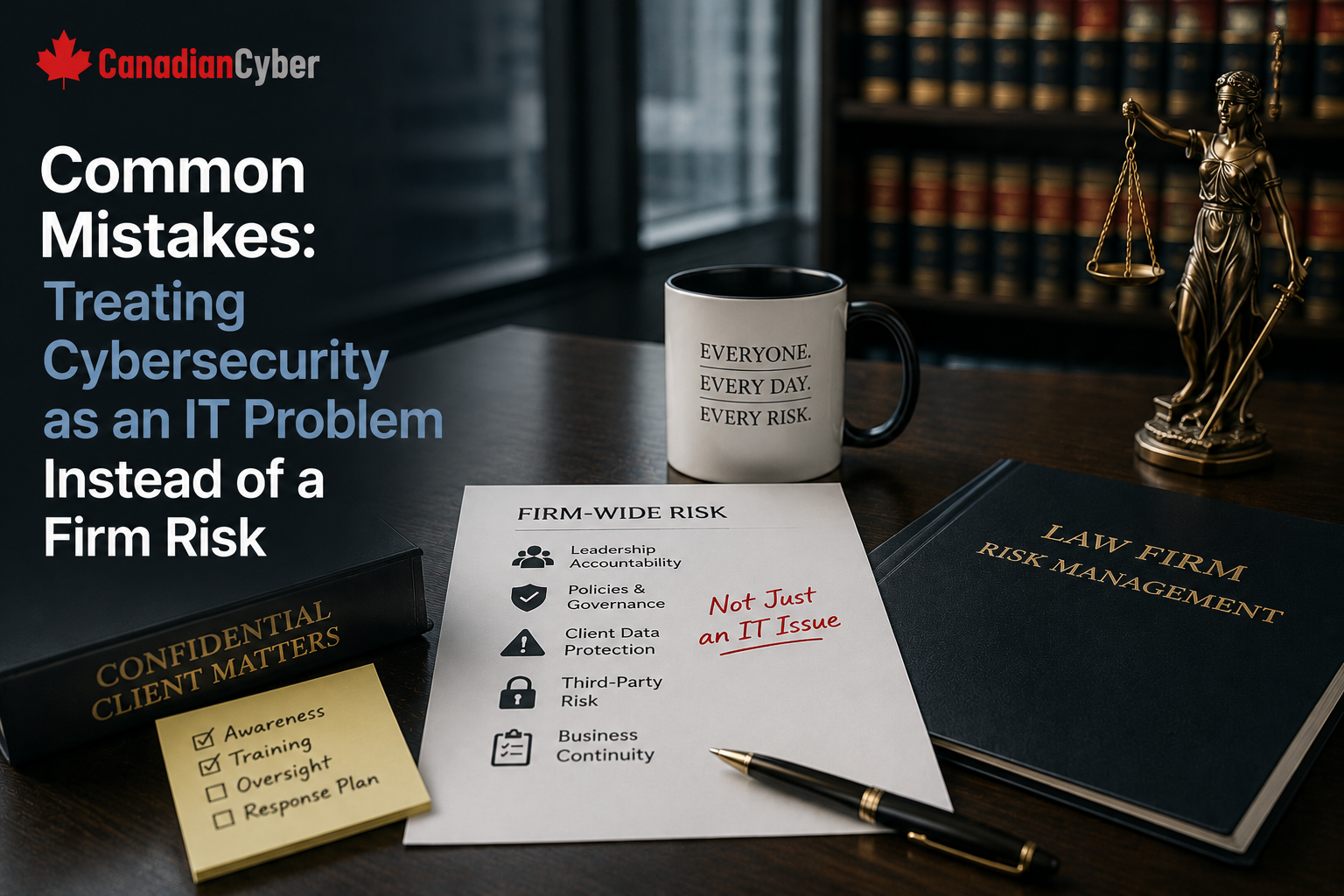
Common Mistakes: Treating Cybersecurity as an IT Problem Instead of a Firm Risk
Cybersecurity is often assigned to IT teams, but the impact of a cyber incident reaches far beyond technology. For law firms, cyber risk affects client confidentiality, privileged communications, court deadlines, insurance, reputation, and client trust.
Canadian Cyber vCISO Governance Support for Law Firms
Move Cybersecurity From IT Activity to Firm-Level Risk Management
Canadian Cyber provides vCISO services for law firms, helping managing partners review cyber risk, protect client confidentiality, prepare ISO 27001 readiness, organize security evidence, and build practical cyber governance programs.
Quick Snapshot
| Risk Area | Why It Is a Firm Risk |
|---|---|
| Client Confidentiality | A breach can expose privileged communications, matter files, and sensitive client data. |
| Business Continuity | Ransomware or outages can disrupt case work, billing, filings, and deadlines. |
| Reputation | Clients may lose confidence if the firm cannot prove security maturity. |
| Legal and Regulatory Duties | Privacy, contractual, professional, and notification obligations may apply. |
| Cyber Insurance | Weak governance can affect coverage, renewals, and claim readiness. |
| ISO 27001 Readiness | Auditors expect leadership involvement, risk ownership, evidence, and continual improvement. |
Introduction
Many law firms still treat cybersecurity as an IT issue.
That usually sounds like this:
- “IT handles security.”
- “Our MSP manages that.”
- “We have antivirus and MFA.”
- “We use a secure document system.”
- “Our cloud provider takes care of it.”
- “We only need to involve partners if something happens.”
This thinking is risky. IT teams play an important role, but cybersecurity is not only about tools. It is about firm risk.
A cyber incident can affect:
Matter files
Privileged communication
Ethical walls
Third-party portals
Billing systems
Case deadlines
Client relationships
Insurance claims
Regulatory obligations
Professional reputation
For law firms, cybersecurity must be governed like other serious business risks.
This blog explains the common mistakes law firms make when they treat cybersecurity as an IT problem instead of a firm risk.
Need Help Turning Cybersecurity Into Firm-Level Governance?
Canadian Cyber provides vCISO services for law firms, helping managing partners review cyber risk, protect client confidentiality, prepare ISO 27001 readiness, organize security evidence, and build practical cyber governance programs.
Why Cybersecurity Is a Firm Risk
Cybersecurity affects the whole firm. It affects how lawyers work, how clients share information, how matters are protected, how vendors access systems, how quickly the firm can recover, how leadership responds to incidents, and whether clients trust the firm with sensitive work.
| IT Problem Thinking | Firm Risk Thinking |
|---|---|
| IT owns cybersecurity | Leadership owns cyber risk. |
| Tools solve the problem | Governance, controls, and evidence matter. |
| Security is technical | Security protects client trust. |
| Review happens after incidents | Review happens quarterly. |
| Vendors are managed by procurement or IT | Vendors are part of confidentiality risk. |
| Policies sit in folders | Policies are reviewed, followed, and evidenced. |
Practical rule: IT manages many controls, but leadership owns the risk.
Mistake 1: Leaving Cyber Risk Out of Partner Discussions
Managing partners and executive committees may discuss revenue, staffing, client matters, hiring, compliance, and growth. But cybersecurity may only appear when something goes wrong.
That is a mistake.
| Cyber Topic Partners Should Review | Why It Matters |
|---|---|
| Top cyber risks | Shows where the firm is exposed. |
| Client confidentiality risks | Protects sensitive matters. |
| Access review gaps | Reduces unauthorized access. |
| Vendor risks | Controls third-party exposure. |
| Incident readiness | Reduces response confusion. |
| Backup and recovery | Supports continuity. |
| Audit findings | Tracks improvement. |
| Cyber insurance requirements | Supports renewal and claim readiness. |
Mistake 2: Measuring Security by Tools Instead of Risk
Many firms ask whether they have MFA, antivirus, backups, firewalls, or a secure document platform. These are useful questions, but they are not enough.
Better questions include:
- Are the controls working?
- Are exceptions approved?
- Are access reviews complete?
- Are backups restorable?
- Are vendors reviewed?
- Are incidents tested?
- Are audit findings closed?
- Are client requirements being met?
| Tool View | Risk View |
|---|---|
| We have MFA | Is MFA enforced for all users and admins? |
| We have backups | Have restores been tested? |
| We have a DMS | Are matter permissions reviewed? |
| We have a vendor portal | Who can access it and for how long? |
| We have policies | Are they approved, communicated, and evidenced? |
| We have security training | Are users completing it and reporting issues? |
Security maturity is not proven by owning tools. It is proven by control effectiveness.
Need a Risk-Based Cybersecurity View for Managing Partners?
Canadian Cyber helps law firms build leadership-ready cyber risk registers, control effectiveness reviews, quarterly vCISO reports, and practical security roadmaps that connect cybersecurity to firm risk.
Mistake 3: Assuming the MSP Owns the Risk
Many law firms use managed IT providers. That can be helpful, but outsourcing IT support does not transfer business risk. The firm remains responsible for protecting client confidentiality and managing cybersecurity obligations.
What an MSP May Handle
- Helpdesk support
- Patching
- Device setup
- Microsoft 365 administration
- Backup monitoring
- Endpoint tools
What Leadership Still Owns
- Risk decisions
- Client confidentiality obligations
- Policy approval
- Security budget
- Incident decisions
- ISO 27001 direction
The MSP may operate controls, but the firm still owns the risk.
Mistake 4: Not Having a vCISO or Security Governance Owner
Without a security governance owner, cybersecurity can become fragmented. IT handles tools. HR handles onboarding. Lawyers handle client obligations. Vendors manage portals. Finance handles insurance. Partners handle client relationships. But no one connects the full picture.
| vCISO Role | Business Value |
|---|---|
| Cyber risk reporting | Gives leadership visibility. |
| Security roadmap | Prioritizes improvements. |
| Policy governance | Keeps security expectations current. |
| ISO 27001 readiness | Builds audit-ready structure. |
| Client security support | Helps answer client requirements. |
| Vendor risk management | Reviews third-party exposure. |
| Evidence organization | Reduces audit and client review stress. |
Mistake 5: Ignoring Client Confidentiality as a Cyber Risk
Law firms often think about confidentiality as a legal or professional obligation. That is true, but it is also a cybersecurity risk.
Client confidentiality cyber risks include:
Wrong recipient email
Misconfigured sharing link
Ethical wall failure
Third-party portal exposure
Lost device
Vendor breach
Compromised mailbox
Ransomware affecting matter files
DMS admin misuse
| Leadership Question | Why It Matters |
|---|---|
| What are our top confidentiality risks? | Gives leadership visibility. |
| Are matter access reviews completed? | Tests need-to-know access. |
| Are ethical walls tested? | Protects restricted matters. |
| Are external sharing links reviewed? | Reduces leakage risk. |
| Are confidentiality incidents tracked? | Supports improvement. |
| Are vendors with client data reviewed? | Controls third-party exposure. |
Mistake 6: Leaving Matter Access Reviews to IT Alone
IT can export access lists, but IT may not know who should have access to a matter. Matter access review needs business ownership.
| Role | Responsibility |
|---|---|
| Matter Partner | Confirms appropriate matter access. |
| Practice Leader | Reviews high-risk or restricted matters. |
| IT | Provides access reports and removes access. |
| Records Team | Supports matter file governance. |
| HR | Supports joiner, mover, leaver triggers. |
| vCISO | Reviews risk, process, and evidence. |
Protect Client Confidentiality With Matter-Level Governance
Canadian Cyber helps law firms review matter access, ethical walls, DMS permissions, external sharing, third-party portals, and confidentiality incidents as part of a firm-level cyber risk program.
Mistake 7: Ignoring Third-Party Portals and Vendors
Law firms often use many third-party platforms. These may sit outside the main IT environment, but they still hold client data.
Examples include:
Virtual data rooms
Client portals
Court filing systems
Expert witness portals
Translation portals
Forensic platforms
Secure file transfer tools
Legal research platforms
Common risks:
- former users remain active
- client data remains after matter closure
- MFA is not enforced
- vendor security is not reviewed
- portal owner is unclear
- access logs are unavailable
- external users have broad access
Mistake 8: Treating Incident Response as a Technical Plan Only
Incident response is not only an IT procedure. It involves leadership decisions.
Incident decisions leadership may need to make:
- Should clients be notified?
- Should external counsel be engaged?
- Should cyber insurance be notified?
- Should systems be taken offline?
- Should law enforcement be contacted?
- Should operations continue manually?
- Who approves restoration priorities?
- Who signs off on lessons learned?
Mistake 9: Not Connecting Cybersecurity to Business Continuity
Law firms depend on availability. If systems fail, client work can suffer.
| Leadership Question | Why It Matters |
|---|---|
| What systems are critical to client service? | Defines recovery priorities. |
| Are backups monitored? | Confirms backup control. |
| Have restores been tested? | Proves recovery. |
| Are recovery objectives defined? | Sets expectations. |
| Are manual workarounds documented? | Supports continuity. |
| Are vendors included in recovery planning? | Reduces dependency risk. |
Backups are technical. Recovery is a firm-level business decision.
Mistake 10: Waiting for Clients to Ask Before Building Evidence
More clients are asking law firms for security evidence. Waiting until a questionnaire arrives creates pressure.
Evidence clients may ask for:
MFA confirmation
Access review process
Incident response summary
Business continuity summary
Vendor risk process
Cyber insurance status
Security awareness training
ISO 27001 certification or roadmap
Mistake 11: Treating ISO 27001 as an IT Certification
ISO 27001 is not only an IT certification. It is a management system. That means leadership, risk, policies, objectives, roles, audits, management review, corrective actions, and continual improvement all matter.
ISO 27001 leadership areas include:
Risk assessment
Risk treatment
Policy approval
Security objectives
Resource decisions
Management review
Internal audit
Corrective action
Mistake 12: No Quarterly Cyber Governance Rhythm
Without a regular review, cybersecurity becomes reactive. A quarterly cyber governance meeting helps leadership review risk and make decisions.
| Quarterly Agenda Item | Purpose |
|---|---|
| Top cyber risks | Focus leadership. |
| Client confidentiality issues | Protect trust. |
| Access review status | Reduce unauthorized access. |
| Vendor risk summary | Manage third parties. |
| Incident and near-miss review | Learn and improve. |
| Backup and recovery status | Support continuity. |
| Audit and compliance updates | Track readiness. |
| Roadmap and budget needs | Support decisions. |
Organize Cyber Governance Evidence in SharePoint ISMS
Canadian Cyber’s ISMS SharePoint solution helps law firms organize risk registers, policies, access reviews, vendor evidence, incident response records, backup evidence, ISO 27001 readiness, corrective actions, and management review records in one Microsoft 365 workspace.
Firm Risk Cybersecurity Checklist
Use this checklist to assess whether cybersecurity is being treated as a firm risk.
Leadership
| Question | Yes / No |
|---|---|
| Does leadership review cyber risk quarterly? | |
| Is there a cybersecurity risk register? | |
| Are security decisions documented? | |
| Is there a vCISO or governance owner? | |
| Are cyber risks linked to business impact? |
Client Confidentiality
| Question | Yes / No |
|---|---|
| Are confidentiality risks tracked? | |
| Are matter access reviews completed? | |
| Are ethical walls tested? | |
| Are external sharing risks reviewed? | |
| Are confidentiality incidents tracked? |
Vendors and Portals
| Question | Yes / No |
|---|---|
| Are vendors with client data identified? | |
| Are third-party portals inventoried? | |
| Are vendor access rights reviewed? | |
| Are vendor incidents escalated? | |
| Are portals closed after engagements? |
Incidents and Recovery
| Question | Yes / No |
|---|---|
| Is incident response tested? | |
| Are leadership roles defined in incident response? | |
| Are backups monitored? | |
| Are restores tested? | |
| Are recovery priorities approved? |
If several answers are “no,” cybersecurity may still be treated too much like an IT problem.
What Good Looks Like
A law firm treating cybersecurity as a firm risk can show:
- quarterly cyber governance reports
- cybersecurity risk register
- client confidentiality risk summary
- matter access review process
- ethical wall testing
- DMS permission reviews
- third-party portal register
- vendor risk management
- incident response plan
- tabletop exercise records
- backup and restore evidence
- cyber insurance evidence
- ISO 27001 readiness roadmap
- policy approvals
- corrective action tracker
- management review records
- SharePoint ISMS workspace
This gives leadership visibility and gives clients confidence.
Canadian Cyber’s Take
At Canadian Cyber, we see many law firms with capable IT teams but limited cyber governance. That creates a gap.
The firm may have security tools, but leadership may not have a clear picture of risk. The firm may have policies, but no evidence of control effectiveness. The firm may have vendors, but no central third-party risk review. The firm may have backups, but no recent restore evidence. The firm may have client security questionnaires, but no ready evidence pack.
This is why vCISO support is valuable. A vCISO helps law firms move from technical security activity to firm-level risk management.
It gives managing partners the visibility they need. It helps protect client confidentiality. It supports ISO 27001 readiness. It turns cybersecurity into a business conversation.
Takeaway
Cybersecurity should not be treated as only an IT problem.
For law firms, it is a firm risk because it affects:
- client confidentiality
- case files
- privileged communications
- third-party portals
- business continuity
- insurance
- ISO 27001 readiness
- client trust
- reputation
- leadership accountability
IT manages important controls. But firm leadership must govern the risk. That means asking better questions, reviewing evidence, assigning ownership, and tracking improvement.
How Canadian Cyber Can Help
Canadian Cyber provides vCISO and cyber governance support for law firms and professional services organizations.
- law firm vCISO services
- quarterly cyber governance reporting
- cybersecurity risk register development
- client confidentiality control reviews
- matter access review programs
- DMS permission assessments
- ethical wall testing
- third-party portal reviews
- vendor risk management
- incident response planning
- tabletop exercises
- backup and recovery evidence reviews
- ISO 27001 readiness planning
- client security evidence packs
- SharePoint ISMS workspace setup
- management review preparation
- corrective action tracking
Stay Connected With Canadian Cyber
Follow Canadian Cyber for practical guidance on vCISO services, law firm cybersecurity, cyber governance, client confidentiality, ISO 27001, SharePoint ISMS, SOC 2, ISO 42001, and third-party risk.