SOC 2 • Industrial SaaS • CleanTech Platforms • Availability • Change Management • Vendor Risk
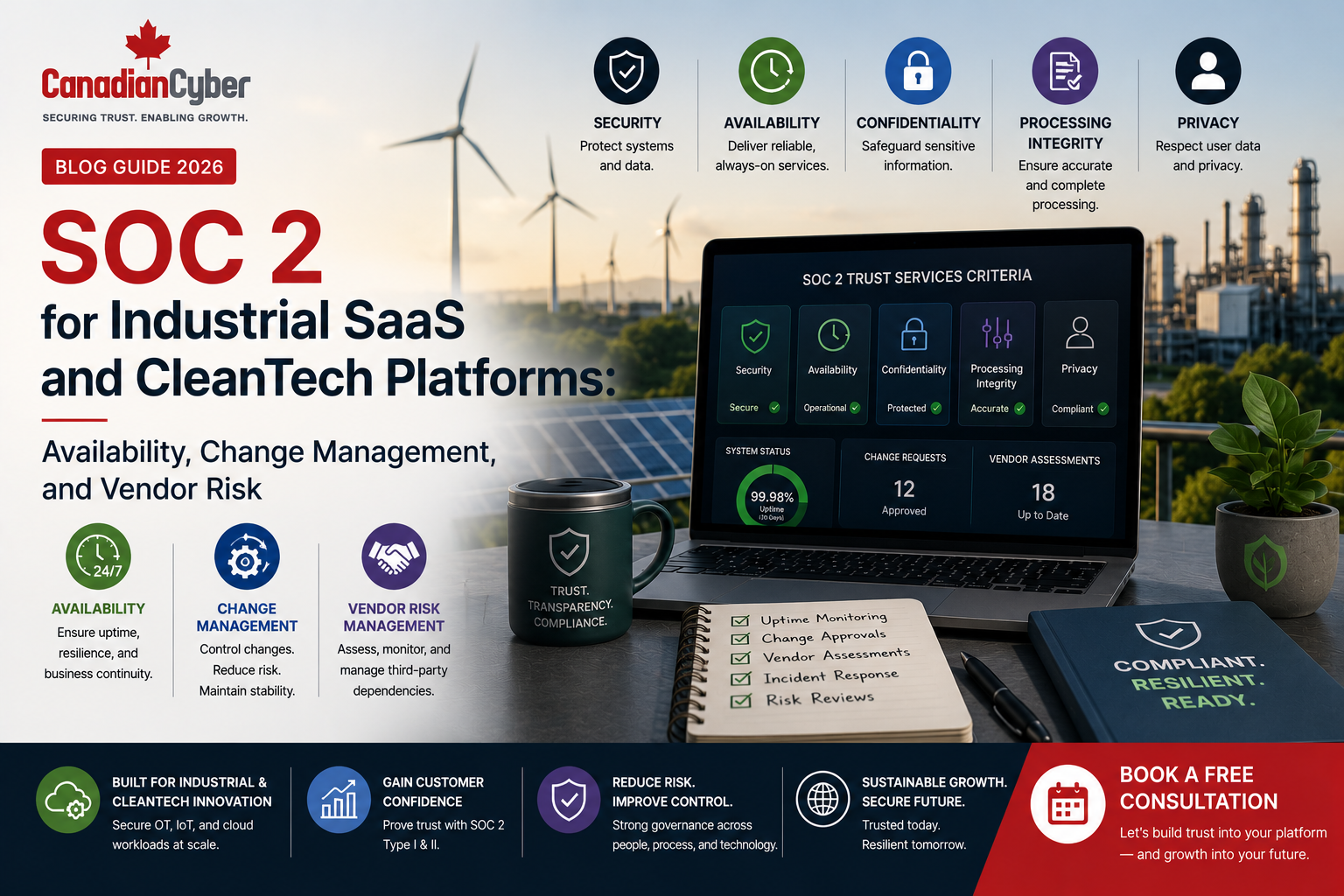
SOC 2 for Industrial SaaS and CleanTech Platforms: Availability, Change Management, and Vendor Risk
Industrial SaaS and CleanTech platforms operate in a different risk environment than ordinary business software. SOC 2 helps prove that the platform is secure, reliable, monitored, and ready for enterprise buyers.
Canadian Cyber SOC 2 Readiness Support
Prepare Your Industrial SaaS or CleanTech Platform for SOC 2
Canadian Cyber helps Industrial SaaS and CleanTech companies prepare for SOC 2. We review availability, change management, vendor risk, access control, incident response, cloud security, and audit evidence.
We help teams organize evidence before enterprise buyers or auditors ask for it.
Quick Answer
SOC 2 for Industrial SaaS and CleanTech platforms should focus on security, availability, operational reliability, data handling, change management, vendor risk, incident response, and customer trust.
These platforms should prepare evidence for uptime monitoring, backups, recovery testing, access reviews, production changes, release approvals, vendor reviews, support access, and incident response.
Practical takeaway: Availability, change management, and vendor risk are especially important because customers may depend on the platform for dashboards, monitoring, reporting, and operational decisions.
Quick Snapshot
| SOC 2 Area | Why It Matters |
|---|---|
| Availability | Customers rely on dashboards, alerts, reports, and operational visibility. |
| Change Management | Product or data pipeline changes can affect accuracy, uptime, and trust. |
| Vendor Risk | Cloud, IoT, analytics, AI, monitoring, and support vendors may support critical services. |
| Access Control | Admin, support, developer, and vendor access must be controlled. |
| Incident Response | Service disruption and data incidents require clear escalation. |
| Evidence | Buyers and auditors want proof that controls operate consistently. |
Why SOC 2 Matters for Industrial SaaS and CleanTech
Industrial SaaS and CleanTech platforms often support business-critical decisions.
Customers may use these platforms to monitor energy usage, equipment performance, facility conditions, emissions data, asset status, alerts, and compliance reporting.
If the platform is unreliable or poorly controlled, customers may question whether they can depend on it.
For Industrial SaaS and CleanTech, SOC 2 is not only a compliance exercise. It is proof of operational trust.
Who This Guide Is For
- Industrial SaaS companies preparing for SOC 2.
- CleanTech platforms selling to enterprise customers.
- Energy management software companies.
- Environmental monitoring platforms.
- Carbon accounting and ESG reporting platforms.
- IoT-enabled SaaS companies.
- Industrial analytics platforms.
- AI-enabled CleanTech companies.
- Founders, CTOs, compliance teams, and vCISO teams.
What Makes Industrial SaaS and CleanTech SOC 2 Different?
A standard SaaS product may focus mainly on customer data, access control, cloud security, and application changes.
Industrial SaaS and CleanTech platforms often need to consider more areas.
- Sensor data and IoT integrations.
- Field equipment data.
- API feeds and data pipelines.
- Customer dashboards and alerts.
- Environmental calculations.
- Energy analytics and asset telemetry.
- Third-party data providers and cloud infrastructure.
Practical rule: SOC 2 scope should follow the service promise made to the customer.
SOC 2 Scope for Industrial SaaS and CleanTech Platforms
SOC 2 scope should clearly explain what product, system, process, data, and infrastructure the audit covers.
Scope should consider:
- Customer-facing application.
- Data collection workflows.
- Data processing pipelines.
- Cloud hosting environment.
- APIs and integrations.
- Dashboards and reporting modules.
- Alerting or notification systems.
- Support workflows and admin portals.
- Critical vendors and subprocessors.
A SOC 2 scope that ignores key data flows or critical vendors may create buyer concerns later.
Area 1: Availability
Availability is often a major concern for Industrial SaaS and CleanTech buyers.
Customers may rely on the platform for visibility, alerts, reporting, or operational decisions.
Availability controls to review include:
- Uptime monitoring and service status monitoring.
- Incident detection and escalation.
- Backup and recovery.
- Restore testing.
- Capacity monitoring.
- Disaster recovery planning.
- Customer communication and SLA monitoring.
Evidence to prepare:
- Uptime reports and monitoring screenshots.
- Incident tickets and alert records.
- Backup reports and restore test evidence.
- Disaster recovery plan.
- Maintenance notification records.
- Post-incident review records.
Practical rule: Availability evidence should prove that the company monitors, responds, recovers, and learns.
Availability Is More Than Uptime
Many companies think availability means only an uptime percentage.
For Industrial SaaS and CleanTech, availability can include more than whether the website loads.
- Data ingestion availability.
- API availability.
- Dashboard refresh reliability.
- Alert delivery.
- Report generation.
- Sensor data transfer.
- Customer portal access.
Availability should be measured based on the service customers actually depend on.
Area 2: Change Management
Change management is a critical SOC 2 area for Industrial SaaS and CleanTech platforms.
A small code or data pipeline change can create a large customer impact.
Changes can affect:
- Customer dashboards.
- Data calculations.
- API behavior.
- Reports and integrations.
- Alerts and data pipelines.
- Environmental metrics.
- Availability, security, and customer trust.
Evidence to prepare:
- Change management policy.
- Pull request approvals.
- Release tickets and deployment logs.
- Test results and security review evidence.
- Rollback plans.
- Post-release monitoring evidence.
Practical rule: SOC 2 change management should prove that changes are reviewed before they affect customers.
Change Management for Data Pipelines
Industrial SaaS and CleanTech companies often depend on data pipelines.
These pipelines may collect, normalize, calculate, transform, or display data from many sources.
Data pipeline changes may affect:
- Energy usage calculations.
- Emissions reports.
- Asset performance metrics.
- Facility dashboards.
- Equipment alerts.
- Customer exports and analytics outputs.
Evidence to prepare:
- Data pipeline documentation.
- Calculation change approvals.
- Data validation test results.
- Failed job alerts.
- Data quality review records.
- Release notes for reporting changes.
For CleanTech platforms, data accuracy can be as important as system uptime.
Area 3: Vendor Risk
Industrial SaaS and CleanTech platforms often depend on many vendors.
Some vendors support simple business operations. Others directly support service delivery.
Vendor types to review include:
- Cloud hosting providers.
- Database providers and IoT platforms.
- Data providers and analytics tools.
- AI vendors and monitoring platforms.
- Logging tools and support ticketing systems.
- Email and notification platforms.
- Backup providers and hardware vendors.
Evidence to prepare:
- Vendor register and critical vendor list.
- Subprocessor list.
- Vendor risk assessments.
- Vendor SOC 2 reports.
- DPA records and contract security clauses.
- Vendor review dates and owner assignments.
Practical rule: A vendor that supports platform availability or customer data should receive deeper review.
Vendor Risk and Operational Dependency
Vendor risk is not only about data. It is also about operational dependency.
A vendor may be low privacy risk but high availability risk.
Vendor risk should consider:
- Data sensitivity.
- Service dependency.
- Customer impact.
- Availability dependency.
- Integration depth.
- Incident notification terms.
- Vendor recovery capability and exit strategy.
Critical vendors should be rated by both data risk and service dependency.
Area 4: Access Control
Access control is central to SOC 2.
Industrial SaaS and CleanTech platforms should control access to production systems, customer data, dashboards, cloud environments, vendor portals, and support tools.
Access areas to review include:
- Employee, developer, and support access.
- Admin, cloud, and database access.
- Vendor and contractor access.
- API and service account access.
- Emergency access.
Evidence to prepare:
- MFA report.
- User and privileged access reviews.
- Cloud admin review.
- Support access review.
- Offboarding evidence.
- Role-based access matrix and exception approvals.
Practical rule: Access reviews should include systems that affect availability, data accuracy, and customer trust.
Area 5: Incident Response
Incidents in Industrial SaaS and CleanTech may include more than data breaches.
They may include service outages, data processing failures, failed alerts, vendor outages, incorrect reports, or compromised accounts.
Incident types to consider include:
- Security and privacy incidents.
- Service outages and API disruptions.
- Data pipeline failures.
- Dashboard downtime and alerting failures.
- Vendor or cloud incidents.
- Incorrect environmental reporting or AI output issues.
Evidence to prepare:
- Incident response plan and severity matrix.
- Incident register and outage records.
- Post-incident reviews.
- Customer communication records.
- Tabletop exercise report.
- Corrective action tracker.
Incident response should cover security, availability, and customer-impacting data issues.
Area 6: Customer Communication
Enterprise buyers want to know how customers are informed when something goes wrong.
Communication scenarios may include:
- Planned maintenance.
- Service outage.
- Security incident or vendor outage.
- Data delay or reporting error.
- API disruption.
- Major release or material calculation change.
Evidence to prepare:
- Customer notification procedure.
- Status page records.
- Maintenance notification logs.
- Incident communication templates.
- Post-incident summaries and support escalation records.
Practical rule: Customer communication should be timely, accurate, approved, and documented.
Area 7: Audit Evidence Quality
SOC 2 evidence should not be collected at the last minute.
Evidence should show that controls operate throughout the audit period.
| Control Area | Evidence Examples |
|---|---|
| Availability | Uptime reports, monitoring alerts, incident tickets. |
| Change Management | Pull request approvals, release tickets, deployment logs. |
| Vendor Risk | Vendor assessments, SOC 2 reports, vendor register. |
| Access Control | MFA reports, access reviews, offboarding records. |
| Data Pipelines | Validation tests, failed job alerts, correction logs. |
| Incident Response | Incident register, tabletop report, lessons learned. |
SOC 2 evidence should be mapped, current, complete, and easy to explain.
SOC 2 Type I or Type II for Industrial SaaS and CleanTech?
Many companies ask whether they should begin with Type I or Type II.
| SOC 2 Type I May Be Better When | SOC 2 Type II May Be Better When |
|---|---|
|
|
Practical rule: Type I shows control design. Type II shows control operation over time.
Industrial SaaS and CleanTech SOC 2 Readiness Checklist
| Readiness Area | Ready? |
|---|---|
| SOC 2 scope reflects the customer-facing service. | |
| Critical systems and data flows are identified. | |
| Availability monitoring is documented. | |
| Backup and restore testing evidence exists. | |
| Incident response covers outages and data failures. | |
| Change management includes review and testing. | |
| Data pipeline changes are validated. | |
| Vendor register includes critical vendors. | |
| Access reviews include cloud, support, developer, and admin access. | |
| Evidence is organized in a central workspace. |
Common SOC 2 Mistakes to Avoid
- Treating availability as only website uptime. Dashboards, APIs, alerts, and reports may matter too.
- Weak change management evidence. Pull requests, approvals, testing, and release records should be retained.
- Ignoring data pipeline risk. Calculations, transformations, and integrations should be controlled.
- Incomplete vendor list. Cloud, analytics, IoT, AI, monitoring, and support vendors should be reviewed.
- No vendor service dependency rating. A vendor may be low privacy risk but high availability risk.
- Incident response only covers breaches. It should also cover outages and data failures.
- Evidence is scattered. SOC 2 evidence should be centralized.
How SharePoint Can Help Manage SOC 2 Evidence
A structured evidence workspace can help Industrial SaaS and CleanTech companies prepare for SOC 2.
Canadian Cyber’s ISMS SharePoint Solution helps teams collect evidence as controls operate.
It can organize:
- SOC 2 control register and evidence library.
- Availability and uptime evidence.
- Change management evidence.
- Vendor register and critical vendor reviews.
- Access review tracker.
- Incident register and data pipeline evidence.
- Corrective action tracker.
- Client-ready evidence room.
Practical rule: Industrial SaaS and CleanTech SOC 2 readiness is easier when evidence is collected continuously.
How Canadian Cyber Helps
Canadian Cyber helps Industrial SaaS and CleanTech platforms prepare for SOC 2, enterprise buyer reviews, security questionnaires, and audit readiness.
We help define scope, map controls, organize evidence, and review the areas buyers care about most.
- SOC 2 readiness reviews.
- SOC 2 Type I and Type II preparation.
- Industrial SaaS control mapping.
- CleanTech SOC 2 evidence planning.
- Availability control review.
- Change management control review.
- Vendor risk management.
- Data pipeline control review.
- Incident response tabletop exercises.
- SharePoint evidence workspace setup.
Frequently Asked Questions
Why is SOC 2 important for Industrial SaaS and CleanTech platforms?
SOC 2 helps prove that the platform has controls for security, availability, change management, vendor risk, incident response, access control, and customer trust.
Should availability be included in SOC 2 for CleanTech platforms?
Often yes. Availability matters when customers rely on dashboards, data processing, alerts, APIs, reports, or operational visibility.
Why is change management important for Industrial SaaS?
Changes can affect uptime, dashboards, data accuracy, integrations, reports, APIs, and customer trust. SOC 2 evidence should show that changes are reviewed, tested, approved, and monitored.
What vendor evidence is needed for SOC 2?
Useful evidence includes a vendor register, critical vendor list, vendor assessments, SOC 2 reports, DPAs, contract security clauses, review dates, and incident records.
How can CleanTech companies prepare SOC 2 evidence?
They should define scope, identify data flows, review availability controls, document change management, review vendors, perform access reviews, test incident response, and organize evidence in one workspace.
Can Canadian Cyber help with SOC 2 for Industrial SaaS and CleanTech?
Yes. Canadian Cyber supports SOC 2 readiness, evidence planning, availability reviews, change management reviews, vendor risk management, vCISO services, ISO 27001 alignment, and SharePoint evidence workspaces.
Takeaway
Industrial SaaS and CleanTech platforms need SOC 2 controls that match how their services actually work.
For these companies, trust depends on more than login security.
Customers care about availability, data accuracy, change control, vendor reliability, incident response, support access, cloud security, and evidence quality.
SOC 2 is not just about passing an audit. It helps prove that customers can rely on the platform.
Preparing Your Industrial SaaS or CleanTech Company for SOC 2?
Canadian Cyber can help you scope the audit properly and organize evidence before buyers or auditors ask for it.
We support SOC 2 readiness, SOC 2 Type I and Type II preparation, ISO 27001 alignment, availability control reviews, change management reviews, vendor risk management, vCISO services, incident response tabletop exercises, ISO 27017, ISO 27018, ISO 42001 AI governance, and SharePoint evidence workspaces. You can also learn more through Waqar Mehboob’s profile.
Stay Connected With Canadian Cyber
Follow Canadian Cyber for practical guidance on SOC 2 for Industrial SaaS, CleanTech security, availability controls, change management, vendor risk, ISO 27001, ISO 42001, ISO 27017, ISO 27018, SharePoint ISMS, audit evidence, cybersecurity assessments, and vCISO support.