SOC 2 • Readiness Assessment • Audit Preparation • SaaS Compliance • Evidence Readiness
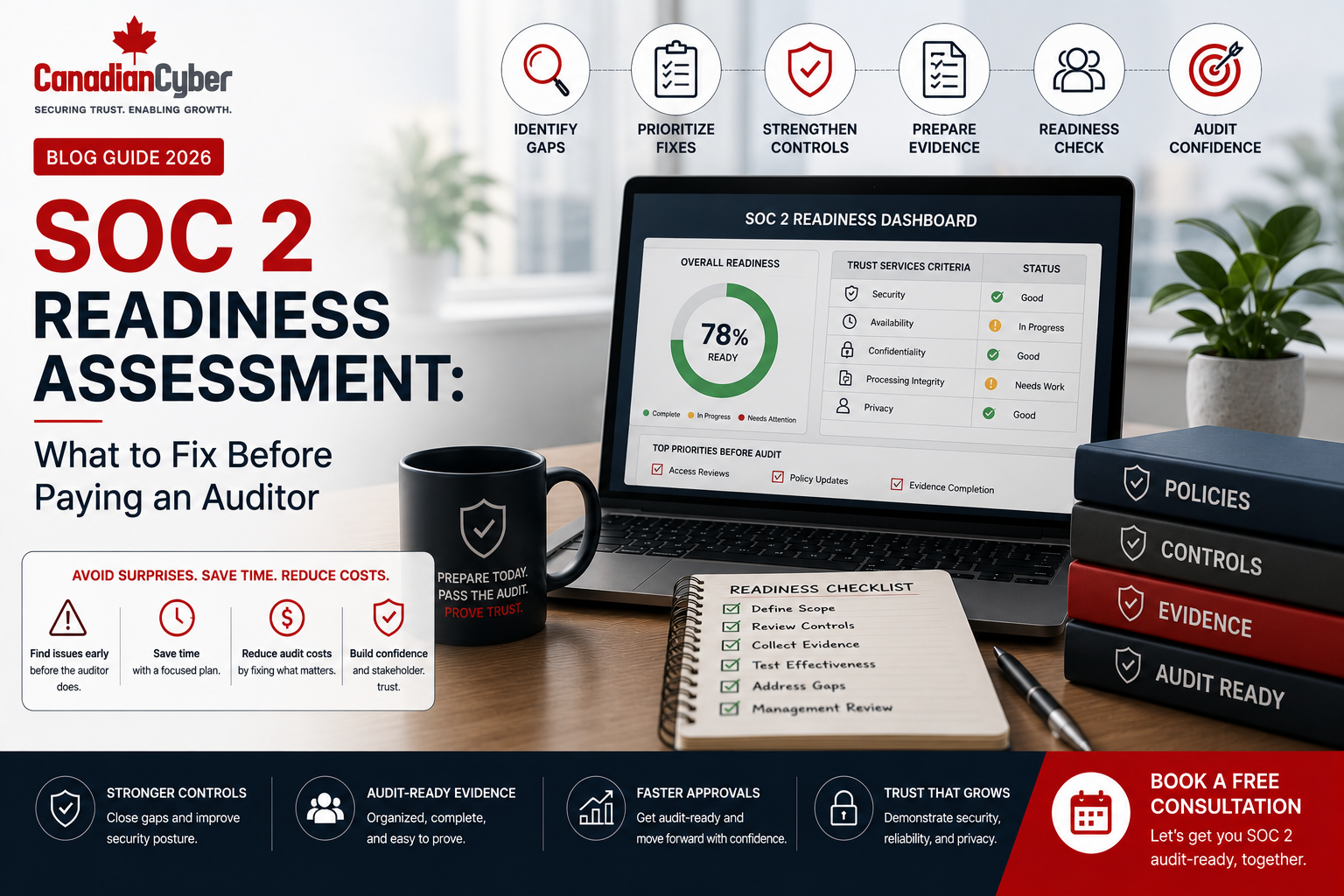
SOC 2 Readiness Assessment: What to Fix Before Paying an Auditor
Many companies pay for a SOC 2 audit too early. A readiness assessment helps find and fix gaps before the formal audit begins.
Canadian Cyber SOC 2 Readiness Support
Fix SOC 2 Gaps Before the Audit Starts
Canadian Cyber helps SaaS companies review SOC 2 readiness before paying for the formal audit. We review scope, controls, evidence, access, vendors, cloud security, incident response, training, and change management.
The goal is simple. Fix the right gaps first and enter the audit with stronger evidence.
Quick Answer
A SOC 2 readiness assessment helps a company find and fix control gaps before the formal SOC 2 audit begins.
The assessment should review scope, policies, access controls, MFA, offboarding, vendor risk, change management, cloud security, incident response, backups, training, support access, AI tool use, and evidence quality.
Practical takeaway: Do not pay an auditor to discover basic gaps you could have fixed earlier.
Quick Snapshot
| Readiness Area | What to Fix Before the Audit |
|---|---|
| Scope | Product, systems, data, vendors, and processes must be clearly defined. |
| Access Control | MFA, admin access, support access, access reviews, and offboarding must be evidenced. |
| Policies | Policies must be approved, current, realistic, and communicated. |
| Vendor Risk | Critical vendors and subprocessors must be identified and reviewed. |
| Change Management | Code changes, releases, emergency changes, and approvals must be documented. |
| Evidence | Records must be complete, current, mapped, and audit-ready. |
Why a SOC 2 Readiness Assessment Matters
SOC 2 is not only about hiring an auditor.
Before the auditor can test controls, the company must know what is in scope and what evidence already exists.
A readiness assessment helps the company identify missing evidence, weak controls, unclear ownership, and audit blockers.
It gives the team time to fix issues before the formal audit begins.
SOC 2 readiness helps reduce surprises before audit testing starts.
Who This Blog Is For
- SaaS companies preparing for SOC 2.
- Startups selling to enterprise customers.
- Founders under pressure from buyers.
- CTOs building a first compliance program.
- Security leaders organizing audit evidence.
- HealthTech, FinTech, AI SaaS, and CleanTech platforms.
- Companies answering security questionnaires.
- Teams using SharePoint or Microsoft 365 for evidence management.
SOC 2 Readiness vs SOC 2 Audit
A SOC 2 readiness assessment and a SOC 2 audit are not the same thing.
| SOC 2 Readiness Assessment | SOC 2 Audit |
|---|---|
|
A preparation exercise. It reviews whether the company is ready for audit. It identifies gaps, missing evidence, weak controls, and audit blockers. |
A formal examination by an independent CPA firm. The auditor tests controls. The auditor issues the SOC 2 report. |
Simple difference: Readiness helps you fix the house before inspection. The audit is the inspection.
What to Fix First: SOC 2 Scope
Scope is one of the first things to fix.
A weak scope creates confusion throughout the audit.
Scope should define:
- The product or service being audited.
- Customer-facing systems.
- Production infrastructure and cloud environment.
- Support tools and development tools.
- Data types processed.
- Vendors and subprocessors.
- Trust Services Categories.
Evidence to prepare:
- System description and scope statement.
- Architecture diagram and data flow diagram.
- Vendor list and subprocessor list.
- Asset inventory.
- Service boundary description.
If scope is unclear, evidence collection becomes messy and buyer trust weakens.
What to Fix Next: Access Control
Access control is one of the most common SOC 2 readiness gap areas.
Enterprise buyers and auditors want to know who can access systems and customer data.
Access areas to review include:
- MFA and SSO.
- Admin and cloud access.
- Developer and support access.
- Database and contractor access.
- Service accounts and shared accounts.
- Offboarding and access reviews.
Evidence to prepare:
- MFA report and SSO settings.
- User access review.
- Privileged access review.
- Offboarding evidence.
- Support access review.
- Role-based access matrix and exception register.
Practical rule: Before the SOC 2 audit, prove that access is approved, limited, reviewed, and removed.
What to Fix: Offboarding
Offboarding is a major SOC 2 readiness risk.
A company may have strong onboarding but weak termination evidence.
Questions to ask:
- How does HR notify IT of termination?
- How quickly is access removed?
- Which systems are included?
- Are contractors included?
- Are devices returned or wiped?
- Is access removal evidenced?
Evidence to prepare:
- Termination checklist.
- Offboarding ticket.
- HR notification.
- Access removal logs.
- Device return evidence.
- Sample terminated user testing.
SOC 2 auditors do not only ask if access was removed. They ask whether you can prove it.
What to Fix: Policies and Procedures
Policies are often created early. But they are not always audit-ready.
A policy should not be a generic document that nobody follows.
Policies to review include:
- Information security policy.
- Access control policy.
- Acceptable use policy.
- Incident response plan.
- Vendor management policy.
- Change management policy.
- Secure development policy.
- AI acceptable use policy.
Evidence to prepare:
- Approved policies.
- Policy review dates and owners.
- Version history.
- Employee acknowledgments.
- Procedure documents and communication records.
Practical rule: A SOC 2 policy should describe how the company actually operates.
What to Fix: Vendor Risk
SOC 2 readiness often exposes weak vendor management.
SaaS companies rely heavily on vendors. Some process customer data. Others support production, customer support, AI tools, or availability.
Vendor risk questions include:
- Who are our critical vendors?
- Which vendors process customer data?
- Which vendors support production systems?
- Which vendors are AI tools?
- Are vendors reviewed before use?
- Are vendor reviews repeated?
Evidence to prepare:
- Vendor register and critical vendor list.
- Vendor risk assessments.
- Subprocessor list.
- DPA records.
- Vendor SOC 2 reports or ISO certificates.
- AI vendor review records and owner assignments.
If a vendor can affect customer data or service availability, it should be reviewed before the audit.
Not Sure Whether You Are Ready for SOC 2?
Canadian Cyber helps SaaS companies perform SOC 2 readiness assessments before the formal audit begins.
What to Fix: Change Management
Change management is a key SOC 2 control area for SaaS companies.
Auditors want to see that production changes are reviewed, tested, approved, and tracked.
Change management areas include:
- Code changes and pull requests.
- Release approvals and deployment records.
- Emergency changes.
- Configuration and database changes.
- Security patches.
- AI model or feature changes.
Evidence to prepare:
- Change management policy.
- Pull request approvals.
- Release tickets and deployment logs.
- Testing evidence and security review records.
- Emergency change records.
- Rollback evidence and production access review.
Practical rule: Before the audit, make sure changes can be traced from request to approval to deployment.
What to Fix: Cloud Security
Most SOC 2 companies run on cloud infrastructure.
Using AWS, Azure, Google Cloud, or another provider does not automatically satisfy SOC 2.
Cloud areas to review include:
- Cloud admin access and MFA.
- Network configuration.
- Logging and monitoring.
- Backup configuration.
- Encryption settings.
- Secrets management.
- Environment separation and vulnerability management.
Evidence to prepare:
- Cloud architecture diagram.
- Cloud admin access review.
- MFA report and logging configuration.
- Monitoring alerts and backup report.
- Encryption settings.
- Vulnerability scan summary and environment separation evidence.
The cloud provider secures the cloud. Your company must prove how it secures what it controls.
What to Fix: Incident Response
Incident response is often written but not tested.
That creates a readiness gap.
Incident response questions include:
- Is there an incident response plan?
- Are roles assigned?
- Are severity levels defined?
- Do employees know how to report incidents?
- Has a tabletop exercise been performed?
- Are lessons learned tracked?
Evidence to prepare:
- Incident response plan and severity matrix.
- Escalation contact list.
- Incident register.
- Tabletop exercise report.
- Lessons learned and corrective action tracker.
- Customer communication process.
Practical rule: An incident response plan is stronger when it has been practiced.
What to Fix: Backups and Recovery
Backups are one of the most misunderstood readiness areas.
A backup configuration is not the same as recovery evidence.
Questions to ask:
- Are backups enabled?
- Are critical systems included?
- Are backups monitored?
- Are failures reviewed?
- Has restore testing been performed?
- Are backup responsibilities assigned?
Evidence to prepare:
- Backup job report.
- Backup monitoring report.
- Backup failure review.
- Restore test report.
- Disaster recovery plan.
- Critical system list and backup owner assignment.
Backups prove data is copied. Restore tests prove the business can recover.
What to Fix: Security Awareness Training
Training evidence should be complete before the audit.
Training areas include:
- Annual security awareness.
- New hire training.
- Policy acknowledgment.
- Phishing awareness.
- Secure development training.
- AI acceptable use training.
Evidence to prepare:
- Training completion report.
- New hire training evidence.
- Policy acknowledgment records.
- Overdue training reminders.
- Role-based training records and AI use acknowledgment.
Practical rule: Training evidence should prove assignment, completion, understanding, and follow-up.
What to Fix: Support Access and Customer Data Handling
Support teams often create SOC 2 evidence gaps.
They may access tickets, screenshots, customer records, logs, attachments, or admin panels.
Support areas to review include:
- Support platform access.
- Ticket handling and retention.
- Screenshot handling.
- Customer data exposure.
- Support escalation.
- Support AI tools.
Evidence to prepare:
- Support access review.
- Support data handling procedure.
- Ticket retention settings.
- Support training records.
- AI support tool review and sample redacted ticket evidence.
What to Fix: AI Tool Use
AI tools are now common in SaaS operations.
SOC 2 readiness should include AI governance if employees use AI tools or the product includes AI features.
AI areas to review include:
- Approved AI tools.
- AI acceptable use policy.
- Customer data restrictions.
- AI vendor review.
- Prompt and output handling.
- Human review of AI outputs.
Evidence to prepare:
- AI tool inventory.
- Approved AI tool list.
- AI acceptable use policy.
- AI vendor review.
- AI training evidence.
- AI risk assessment and incident process.
Uncontrolled AI use can become a SOC 2 confidentiality, privacy, vendor risk, and security concern.
SOC 2 Readiness Assessment Checklist
| Readiness Area | Fix Before Audit? |
|---|---|
| Scope statement is clear. | |
| System description is drafted. | |
| Data flows are documented. | |
| MFA is enforced. | |
| Access reviews are completed. | |
| Offboarding evidence exists. | |
| Policies are approved and current. | |
| Vendor register is complete. | |
| Change management evidence exists. | |
| Restore testing is documented. | |
| Incident response is tested. | |
| Training evidence is complete. | |
| AI tool use is governed. | |
| Evidence is organized centrally. |
What a Good SOC 2 Readiness Report Should Include
A readiness assessment should produce a practical report.
It should not be a confusing list of technical comments.
The report should include:
- Scope summary.
- Control maturity assessment.
- Gap list and risk rating.
- Recommended fixes.
- Evidence required.
- Control owners and target dates.
- Audit readiness status.
- Type I or Type II recommendation.
Practical rule: A readiness report should tell the company what to fix, who should fix it, and what evidence proves completion.
SOC 2 Type I or Type II: Readiness Impact
A readiness assessment can help decide whether the company should start with Type I or move toward Type II.
| Type I May Be Better When | Type II May Be Better When |
|---|---|
|
|
Readiness should determine the audit path, not pressure from the sales team alone.
Why an Evidence Workspace Matters Before the Audit
SOC 2 evidence should not be scattered across email, Slack, Teams chats, Jira, GitHub, folders, screenshots, and spreadsheets.
A central evidence workspace improves speed and consistency.
An evidence workspace should include:
- Control register and evidence library.
- Owner assignments and due dates.
- Recurring evidence schedule.
- Audit request tracker.
- Access review records.
- Vendor and training records.
- Incident and change management evidence.
- Client-ready evidence room.
How SharePoint Can Help With SOC 2 Readiness
Canadian Cyber’s ISMS SharePoint Solution helps companies manage SOC 2 and ISO evidence inside Microsoft 365.
It helps teams collect evidence continuously instead of rushing before the audit.
It can include:
- SOC 2 control register.
- Policy and procedure libraries.
- Risk register and evidence library.
- Access review tracker.
- Vendor register and incident register.
- Training evidence and backup evidence.
- Audit request tracker.
- Power Automate reminders and Teams notifications.
Practical rule: A SOC 2 evidence workspace turns audit preparation from a scramble into a repeatable process.
Common Mistakes Before Paying a SOC 2 Auditor
- Starting the audit without readiness. This often leads to delays and rushed remediation.
- Choosing scope too quickly. Scope drives evidence.
- Not reviewing access controls first. Access issues are common and can take time to fix.
- Assuming policies are enough. Policies must be approved, communicated, followed, and evidenced.
- Ignoring vendors. Vendors and subprocessors are central to SaaS risk.
- No restore test. Backups without restore testing create weak recovery evidence.
- No tabletop exercise. Incident response should be practiced before audit testing.
- No evidence owner. If no one owns the evidence, it usually becomes late or incomplete.
How Canadian Cyber Helps
Canadian Cyber helps organizations prepare for SOC 2 before the formal audit begins.
We help companies identify what to fix first, organize evidence, define controls, improve readiness, and prepare for enterprise buyer reviews.
- SOC 2 readiness assessments.
- SOC 2 Type I and Type II preparation.
- SOC 2 gap assessment and control mapping.
- Evidence planning and workspace setup.
- Access review program design.
- Vendor risk management.
- Change management review.
- Cloud security review.
- Incident response tabletop exercises.
- vCISO services and ISO 27001 alignment.
Frequently Asked Questions
What is a SOC 2 readiness assessment?
A SOC 2 readiness assessment reviews whether a company is prepared for a SOC 2 audit. It identifies gaps in scope, controls, policies, evidence, access, vendors, change management, incident response, backups, training, and cloud security.
Should we do a readiness assessment before paying a SOC 2 auditor?
Yes. A readiness assessment can help identify and fix gaps before the formal audit begins. This can reduce delays, stress, and rushed remediation.
What should be fixed before a SOC 2 audit?
Common areas include unclear scope, missing access reviews, weak offboarding evidence, incomplete policies, unreviewed vendors, poor change management evidence, untested incident response, missing restore tests, incomplete training records, and scattered evidence.
Is SOC 2 Type I easier than Type II?
Type I reviews control design at a point in time. Type II reviews whether controls operated over time. Type I is often a better starting point for companies with new controls or limited evidence history.
Can SharePoint be used for SOC 2 evidence?
Yes. SharePoint can organize policies, procedures, control evidence, access reviews, vendor reviews, training records, incident records, audit requests, and client-ready evidence rooms.
Can Canadian Cyber help with SOC 2 readiness?
Yes. Canadian Cyber supports SOC 2 readiness assessments, evidence planning, control mapping, SharePoint evidence workspace setup, vCISO services, ISO 27001 alignment, cybersecurity assessments, and incident response tabletop exercises.
Takeaway
SOC 2 success starts before the auditor arrives.
A readiness assessment helps the company understand what is missing, what is weak, what needs evidence, and what should be fixed first.
Before paying a SOC 2 auditor, review scope, access, offboarding, policies, vendors, change management, cloud security, incident response, backups, training, support access, AI tools, evidence quality, and control ownership.
The goal is not to delay SOC 2. The goal is to start the audit with confidence.
Preparing for SOC 2 but Not Sure You Are Ready?
Canadian Cyber can help you assess readiness before you pay for the formal audit.
We provide SOC 2 readiness assessments, evidence planning, control mapping, access review support, vendor risk reviews, tabletop exercises, SharePoint evidence workspaces, vCISO services, cybersecurity assessments, ISO 27001 alignment, ISO 27017, ISO 27018, and ISO 42001 AI governance support. You can also learn more through Waqar Mehboob’s profile.
Stay Connected With Canadian Cyber
Follow Canadian Cyber for practical guidance on SOC 2 readiness, audit evidence, SaaS compliance, ISO 27001, ISO 42001, ISO 27017, ISO 27018, SharePoint ISMS, cybersecurity assessments, incident response, and vCISO support.