ISO 27001 Internal Audit • Audit Readiness • ISMS Evidence • Certification Preparation
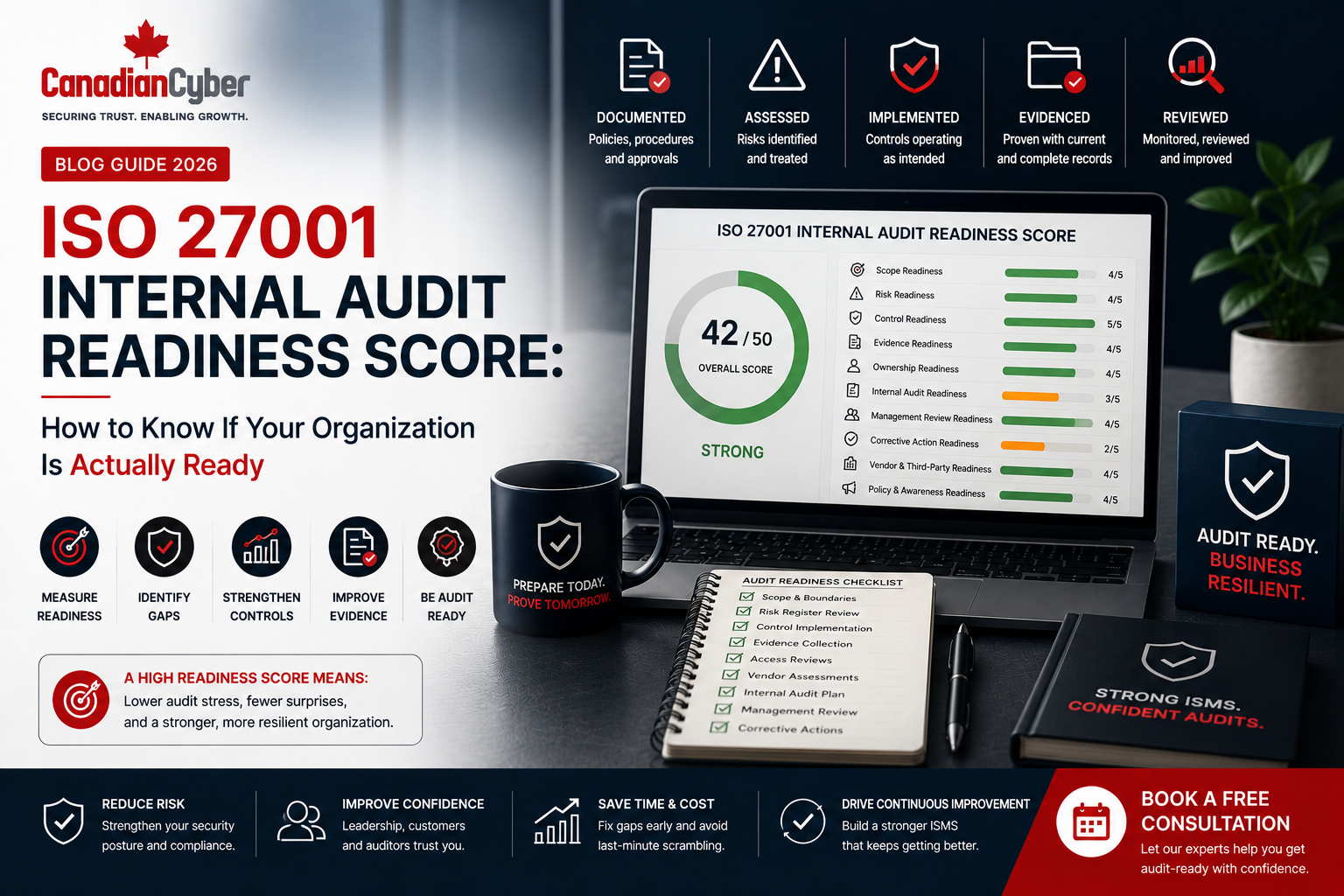
ISO 27001 Internal Audit Readiness Score: How to Know If Your Organization Is Actually Ready
Many organizations think they are ready because they have documents. But ISO 27001 readiness is about proving the ISMS is working.
Canadian Cyber ISO 27001 Readiness Support
Measure Readiness Before the Audit Starts
Canadian Cyber helps organizations assess ISO 27001 internal audit readiness. We review scope, risks, SoA, policies, controls, evidence, management review, and corrective actions.
The goal is simple. Know what is ready, what is weak, and what needs action before the auditor starts asking questions.
Quick Answer
An organization is ready for an ISO 27001 internal audit when its ISMS scope is clear, risks are reviewed, controls are implemented, and evidence is current.
Control owners should understand their responsibilities. Policies should be approved. The Statement of Applicability should be justified. Access reviews, vendor reviews, incidents, management review, and corrective actions should be documented.
Practical takeaway: A readiness score helps measure these areas before the internal audit begins.
Quick Snapshot
| Readiness Area | What It Measures |
|---|---|
| Scope Readiness | Whether the ISMS boundary is clear and realistic. |
| Risk Readiness | Whether risks are identified, reviewed, treated, and owned. |
| Control Readiness | Whether Annex A controls are implemented and evidenced. |
| Evidence Readiness | Whether proof is current, complete, and mapped. |
| Management Review | Whether leadership reviewed inputs, decisions, and actions. |
| Corrective Actions | Whether findings are tracked to verified closure. |
Why an Internal Audit Readiness Score Matters
An ISO 27001 internal audit should not feel like a surprise inspection.
Your organization should know whether it is ready before the audit begins.
A readiness score helps teams move from confidence to proof.
It also helps leadership see which areas need action before certification, surveillance audit, or customer review.
If readiness cannot be measured, it is probably being assumed.
Who This Guide Is For
- Organizations preparing for ISO 27001 certification.
- Companies planning an ISO 27001 internal audit.
- ISMS managers and compliance leads.
- Security managers, CTOs, and IT managers.
- vCISO teams, risk owners, and control owners.
- SaaS, HealthTech, FinTech, manufacturing, and MSP teams.
- Companies using Microsoft 365 or SharePoint for ISO 27001 evidence.
What Does “Actually Ready” Mean?
Being ready does not mean everything is perfect.
It means the organization can prove that the ISMS is implemented, controlled, monitored, reviewed, and improving.
A ready organization can explain:
- What is in scope and out of scope.
- Which risks matter most.
- Which controls apply and why.
- Who owns each process.
- Where evidence is stored.
- What exceptions exist.
- How findings are fixed and verified.
Practical rule: Internal audit readiness is the ability to prove the ISMS works, not the ability to say it exists.
The ISO 27001 Internal Audit Readiness Score Model
A simple readiness score can be built across 10 areas.
Each area can be scored from 0 to 5. The maximum score is 50.
| Score | Meaning |
|---|---|
| 0 | Not started. |
| 1 | Informal or incomplete. |
| 2 | Documented, but evidence is weak. |
| 3 | Implemented with some gaps. |
| 4 | Operating with strong evidence. |
| 5 | Audit-ready and consistently maintained. |
| Total Score | Readiness Level | What It Means |
|---|---|---|
| 0–15 | Not Ready | Major work is needed before internal audit. |
| 16–25 | Early Readiness | Some documents exist, but controls and evidence are weak. |
| 26–35 | Partial Readiness | Internal audit can begin, but findings are likely. |
| 36–44 | Strong Readiness | Most areas are prepared, with limited gaps. |
| 45–50 | Audit-Ready | Evidence, ownership, governance, and follow-up are strong. |
A readiness score should guide preparation, not create false confidence.
Area 1: ISMS Scope Readiness
Scope is the foundation of ISO 27001.
If scope is unclear, the entire audit becomes difficult.
Questions to ask:
- What products, services, systems, and teams are in scope?
- Which cloud platforms are included?
- Which vendors support in-scope services?
- Which data types are covered?
- Are remote workers included?
- Are exclusions justified?
Evidence to prepare:
- ISMS scope statement.
- Organization context and interested parties.
- Process map and data flow diagram.
- Asset inventory and vendor list.
- Cloud architecture summary and scope approval record.
Practical rule: If your team cannot explain the ISMS scope in plain English, you are not fully ready.
Area 2: Risk Assessment Readiness
ISO 27001 is risk-based.
The internal audit should test whether risks are identified, assessed, owned, treated, and reviewed.
Questions to ask:
- Are risks current?
- Are risk owners assigned?
- Are treatments documented?
- Are accepted risks approved?
- Are risks linked to controls?
- Are vendor, cloud, AI, support, and access risks included?
Evidence to prepare:
- Risk assessment methodology.
- Risk register and risk treatment plan.
- Risk acceptance records.
- Risk review history.
- Management review risk summary.
A risk register should be a management tool, not a spreadsheet created only for the auditor.
Area 3: Statement of Applicability Readiness
The Statement of Applicability is one of the most important ISO 27001 documents.
It explains which Annex A controls apply, which do not, and why.
Questions to ask:
- Is every Annex A control reviewed?
- Are applicability decisions justified?
- Are excluded controls explained clearly?
- Is implementation status accurate?
- Is the SoA linked to risk treatment?
Evidence to prepare:
- Statement of Applicability.
- Risk treatment links.
- Control implementation status.
- Control owner list.
- SoA review and approval record.
Practical rule: A weak SoA can create audit findings even if many controls exist.
Area 4: Policy and Procedure Readiness
Policies and procedures explain what the organization expects.
They must be approved, current, realistic, and communicated.
Questions to ask:
- Are policies approved?
- Do policies have owners?
- Are review dates defined?
- Are employees informed?
- Are acknowledgments recorded?
- Do procedures match actual operations?
Evidence to prepare:
- Policy and procedure libraries.
- Approval records and version history.
- Review dates and owners.
- Employee acknowledgments.
- Communication and exception records.
Area 5: Access Control Readiness
Access control is one of the most common internal audit finding areas.
Questions to ask:
- Is MFA enforced?
- Are admin accounts reviewed?
- Are user access reviews completed?
- Is support access reviewed?
- Is offboarding evidenced?
- Are privileged access exceptions documented?
Evidence to prepare:
- MFA report.
- User and privileged access reviews.
- Cloud admin and support access review.
- Offboarding records.
- Access approval tickets and exception register.
Access control is not ready until approvals, reviews, removals, and exceptions are evidenced.
Need to Know If You Are Actually Ready?
Canadian Cyber provides ISO 27001 internal audit readiness reviews. We test scope, risks, SoA, evidence, access reviews, vendors, management review, corrective actions, and control ownership.
Area 6: Vendor and Supplier Readiness
Vendors can create serious ISO 27001 risk.
A readiness score should test whether supplier controls are active.
Questions to ask:
- Do we have a complete vendor register?
- Which vendors are critical?
- Which vendors process sensitive data?
- Are vendors risk-rated?
- Are DPAs and contracts stored?
- Are AI vendors included?
Evidence to prepare:
- Vendor register and critical vendor list.
- Vendor risk assessments.
- DPA records and contracts.
- Subprocessor list.
- SOC 2 reports, ISO certificates, and AI vendor reviews.
Area 7: Evidence Readiness
Evidence is where many organizations struggle.
They may have controls, but proof is scattered or incomplete.
Questions to ask:
- Is evidence mapped to controls?
- Does each evidence item have an owner?
- Is evidence current?
- Are recurring controls tracked?
- Are due dates defined?
- Can evidence be retrieved quickly?
Evidence to prepare:
- Evidence library and evidence tracker.
- Control-to-evidence map.
- Owner assignments and review dates.
- Status dashboard.
- Audit request tracker and evidence naming rules.
Practical rule: Audit-ready evidence is mapped, current, owned, and retrievable.
Area 8: Incident Response and Continuity Readiness
Internal audit should test whether the organization can respond to incidents and recover from disruption.
Questions to ask:
- Is there an incident response plan?
- Are roles and severity levels defined?
- Has a tabletop exercise been performed?
- Are incidents recorded?
- Are backups monitored?
- Are restore tests performed?
Evidence to prepare:
- Incident response plan and incident register.
- Severity matrix and tabletop report.
- Lessons learned.
- Backup reports and restore test evidence.
- Business continuity plan and corrective action tracker.
Area 9: Management Review Readiness
Management review is leadership evidence.
It proves that top management reviews ISMS performance and makes decisions.
Questions to ask:
- Was management review completed?
- Who attended?
- Were risks and internal audit results reviewed?
- Were corrective actions reviewed?
- Were incidents and vendor issues discussed?
- Were decisions and actions documented?
Evidence to prepare:
- Management review agenda and attendee list.
- Input pack and risk dashboard.
- Security objectives report.
- Internal audit summary.
- Meeting minutes, decision log, and action tracker.
Management review should show leadership decisions, not just meeting notes.
Area 10: Corrective Action Readiness
Corrective actions prove continual improvement.
A readiness score should test whether findings are tracked to verified closure.
Questions to ask:
- Are findings recorded?
- Are NCRs and OFIs classified?
- Is root cause documented?
- Are owners and deadlines assigned?
- Is closure evidence linked?
- Is verification performed?
Evidence to prepare:
- Finding register and NCR register.
- OFI tracker and corrective action tracker.
- Root cause records.
- Evidence links and verification records.
- Management review status.
Practical rule: Corrective action is not closed until the fix is verified.
Internal Audit Readiness Scorecard
Use this scorecard before your ISO 27001 internal audit.
| Readiness Area | Score 0–5 |
|---|---|
| ISMS Scope Readiness | |
| Risk Assessment Readiness | |
| Statement of Applicability Readiness | |
| Policy and Procedure Readiness | |
| Access Control Readiness | |
| Vendor and Supplier Readiness | |
| Evidence Readiness | |
| Incident Response and Continuity Readiness | |
| Management Review Readiness | |
| Corrective Action Readiness | |
| Total Score / 50 |
What to Do If Your Score Is Low
A low readiness score does not mean failure.
It means the organization has a clearer preparation path.
| Score Range | Focus Area |
|---|---|
| 0–15 | Build the foundation. Focus on scope, risk register, SoA, policies, owners, and evidence workspace. |
| 16–25 | Start operating controls. Focus on access reviews, vendor reviews, training, incidents, and backup testing. |
| 26–35 | Improve audit readiness. Focus on evidence quality, sampling, management review, and owner interviews. |
| 36–44 | Refine weak areas. Close evidence gaps and verify corrective actions. |
| 45–50 | Maintain evidence. Keep review dates, recurring tasks, and continual improvement active. |
Common Reasons Organizations Think They Are Ready But Are Not
- Documents exist, but controls are not operating. A policy says access is reviewed, but no evidence exists.
- The risk register is not used. Risks were created once and never reviewed again.
- The SoA is not justified. Controls are included or excluded without clear reasons.
- Evidence is scattered. Proof lives in emails, screenshots, chats, folders, and personal drives.
- Management review is weak. Minutes exist, but decisions and actions are missing.
- Corrective actions are not verified. Tasks are closed without checking if the issue was fixed.
- Control owners are not prepared. Owners cannot explain the process or evidence.
How SharePoint Can Help Improve Readiness
A structured SharePoint ISMS can make internal audit readiness easier.
It helps teams move from scattered files to controlled, audit-ready evidence.
Canadian Cyber’s ISMS SharePoint Solution can manage:
- Policy and procedure libraries.
- Risk register and SoA tracker.
- Control register and evidence library.
- Access review tracker and vendor register.
- Incident register and backup evidence.
- Internal audit workspace and readiness scorecard.
- NCR, OFI, and corrective action trackers.
- Management review dashboard and client-ready evidence room.
Practical rule: Readiness improves when evidence, owners, dates, reminders, and dashboards live in one controlled workspace.
How Canadian Cyber Helps
Canadian Cyber helps organizations determine whether they are actually ready for ISO 27001 internal audit and certification.
Our approach is practical, evidence-based, and focused on real audit outcomes.
- ISO 27001 internal audit readiness reviews.
- ISO 27001 internal audits.
- Readiness scorecard assessments.
- Evidence readiness checks.
- Risk register and SoA reviews.
- Control owner interviews.
- Access and vendor review testing.
- Management review evidence checks.
- Corrective action verification.
- SharePoint ISMS implementation.
Frequently Asked Questions
What is an ISO 27001 internal audit readiness score?
It is a practical scoring method used to assess whether an organization is ready for internal audit. It reviews scope, risks, SoA, policies, controls, evidence, vendors, incidents, management review, and corrective actions.
What score means we are ready?
A score of 36–44 usually shows strong readiness with some gaps. A score of 45–50 suggests the organization is audit-ready.
Are policies enough for ISO 27001 readiness?
No. Policies matter, but readiness also requires evidence that controls operate, risks are reviewed, owners understand duties, management review is performed, and corrective actions are tracked.
What evidence is most important before an internal audit?
Important evidence includes scope, risk register, SoA, policies, access reviews, vendor reviews, training records, incidents, backup restore tests, management review minutes, audit plan, and corrective action tracker.
Can SharePoint manage ISO 27001 readiness?
Yes. SharePoint can manage policies, risks, SoA, evidence, access reviews, vendor records, internal audit findings, corrective actions, and management review dashboards.
Can Canadian Cyber assess our readiness score?
Yes. Canadian Cyber can perform a readiness review, calculate readiness against key audit areas, identify gaps, and help prepare evidence before certification or surveillance audits.
Takeaway
ISO 27001 internal audit readiness is not a feeling.
It should be measured.
An organization is ready when it can prove that scope is clear, risks are current, the SoA is justified, controls are operating, evidence is current, owners are prepared, vendors are reviewed, management review is complete, and corrective actions are verified.
A readiness score helps the organization see the truth before the auditor does.
Preparing for ISO 27001 Internal Audit or Certification?
Canadian Cyber can help you understand whether you are actually ready.
We provide ISO 27001 internal audit readiness reviews, internal audits, evidence readiness checks, control owner interviews, SoA reviews, risk register reviews, management review checks, corrective action verification, vCISO services, cybersecurity assessments, and SharePoint ISMS implementation. You can also learn more through Waqar Mehboob’s profile.
Stay Connected With Canadian Cyber
Follow Canadian Cyber for practical guidance on ISO 27001 internal audits, audit readiness, ISMS evidence, certification preparation, SOC 2, ISO 42001, ISO 27017, ISO 27018, SharePoint ISMS, cybersecurity assessments, and vCISO support.