ISO 42001
AI Governance
Internal Audit
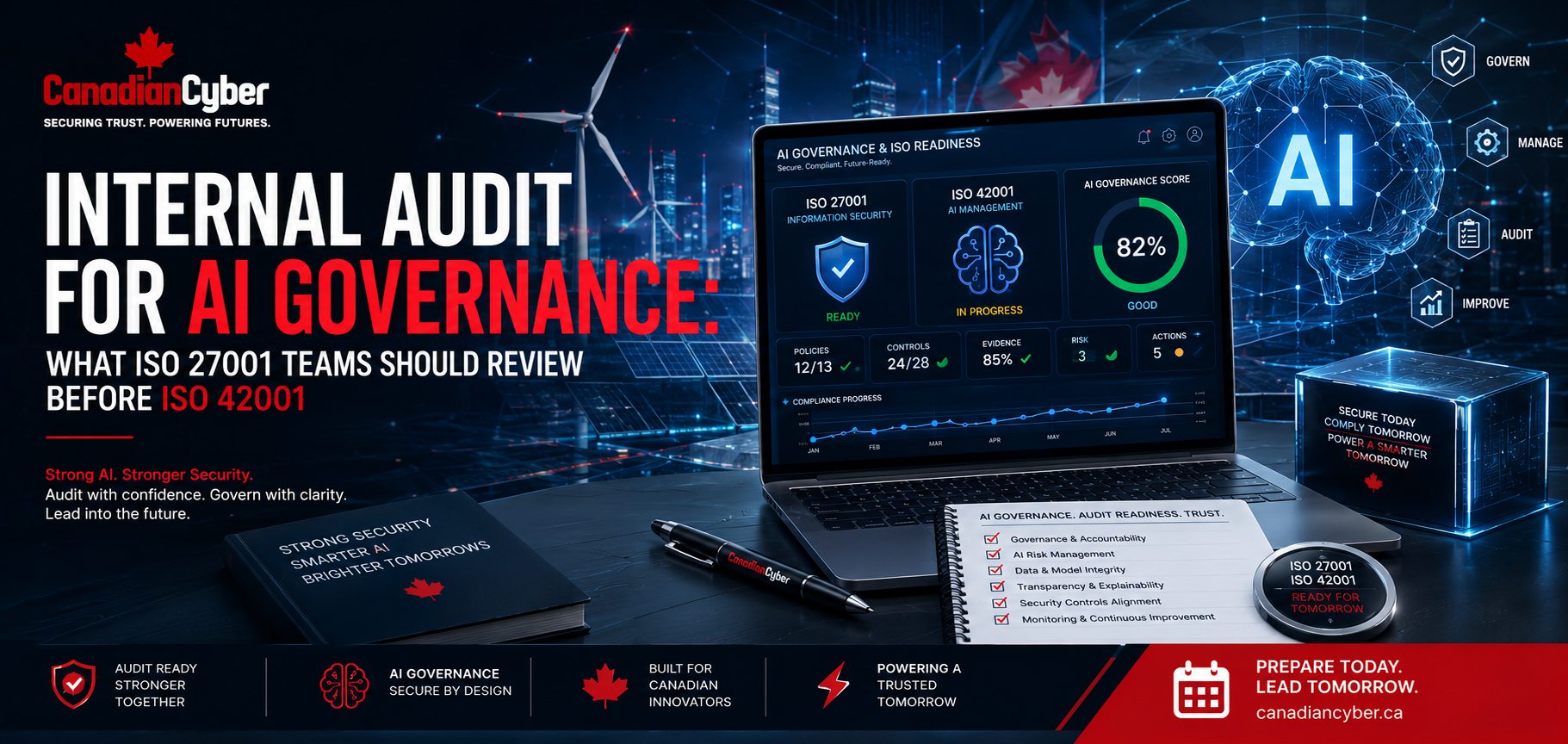
Internal Audit for AI Governance: What ISO 27001 Teams Should Review Before ISO 42001
AI is now part of SaaS, CleanTech, energy, manufacturing, cybersecurity, healthcare, finance, and software development. ISO 27001 teams should review AI governance before ISO 42001 becomes urgent.
Quick Answer
What should ISO 27001 teams audit before ISO 42001?
They should review how AI is identified, approved, risk-assessed, monitored, governed, and improved.
Key areas include AI inventory, AI risk, data inputs, human oversight, AI vendors, AI changes, incidents, Shadow AI, and management review.
Bottom line: ISO 27001 secures the environment around AI. ISO 42001 adds governance for AI itself.
Quick Snapshot
| Audit Area | What to Check | Evidence to Prepare |
|---|---|---|
| AI Inventory | AI systems are known. | AI register and approved tool list. |
| AI Risk | AI risks are assessed. | AI risk register and impact review. |
| Data Inputs | Data use is clear. | Data flow and input records. |
| Human Oversight | People review high-risk outputs. | Review procedure and approval records. |
| AI Vendors | AI suppliers are reviewed. | Vendor risk review and DPA. |
Why AI Governance Matters
AI is no longer a side experiment.
It now supports products, operations, support teams, security alerts, reports, and business decisions.
That creates new risk.
AI may produce wrong answers. It may use sensitive data. It may create biased outputs. It may also affect customers or operations.
AI governance is about trust, accountability, evidence, and control.
Who This Blog Is For
- ISO 27001 certified organizations exploring ISO 42001.
- AI SaaS, CleanTech, FinTech, HealthTech, and robotics companies.
- Industrial automation and manufacturing technology teams.
- Cybersecurity and data analytics platforms.
- Organizations using Microsoft 365, Copilot, or AI workflow tools.
- Internal auditors and vCISO teams preparing for AI reviews.
ISO 27001 vs ISO 42001: What Changes?
ISO 27001 focuses on information security.
It helps protect confidentiality, integrity, and availability.
ISO 42001 focuses on AI governance.
It looks at how AI systems are identified, used, monitored, explained, and improved.
| ISO 27001 Helps With | ISO 42001 Adds |
|---|---|
| Security risk, access control, suppliers, incident response, assets, internal audit, management review, and corrective action. | AI inventory, AI lifecycle, AI impact, AI outputs, human oversight, transparency, AI monitoring, and AI-specific incidents. |
Practical rule: ISO 27001 secures the environment around AI. ISO 42001 governs AI itself.
What Internal Audit Should Review
1. AI System Inventory
Start with a clear list of AI systems and tools.
Include product AI, internal tools, vendors, APIs, Copilot, and AI assistants.
Evidence: AI inventory, approved AI tool list, owner list, vendor list, and use case descriptions.
2. AI Use Case Risk
Review what could go wrong with each AI use case.
Focus on impact, not only technical security.
Evidence: AI risk assessment, impact assessment, treatment plan, approvals, and residual risk records.
3. Data Inputs
AI governance starts with the data entering the system.
Check customer data, personal data, production data, and confidential data.
Evidence: Data flow, data classification, prompt rules, privacy review, and retention rules.
4. Human Oversight
AI should not silently replace accountability.
Define when people must review AI outputs.
Evidence: Oversight procedure, output review records, reviewer roles, and escalation records.
5. AI Vendor Risk
Many companies use third-party AI tools.
Review data use, model training, subprocessors, and security evidence.
Evidence: AI vendor register, vendor risk review, DPA, terms review, and subprocessor list.
6. AI Change Management
AI systems change often.
Review changes to models, prompts, datasets, APIs, and features.
Evidence: Change records, prompt logs, test results, release notes, validation, and rollback plans.
7. AI Monitoring
AI governance does not end at launch.
Review errors, complaints, drift, false positives, and false negatives.
Evidence: Monitoring dashboard, issue register, output reviews, metrics, and corrective actions.
8. Transparency
Users should understand when AI is involved.
They should also know AI limits where needed.
Evidence: AI system descriptions, user guidance, limitation statements, disclosures, and training.
9. AI Incidents
AI incidents may not look like normal cyber incidents.
They may include harmful outputs, wrong advice, data leakage, or unauthorized AI use.
Evidence: AI incident procedure, issue register, severity matrix, lessons learned, and actions.
10. Shadow AI
Employees may use AI tools without approval.
This can create data, privacy, and contract risk.
Evidence: AI acceptable use policy, approved tool list, Shadow AI assessment, training, and exception register.
11. AI Accountability
AI risk needs clear ownership.
Assign owners for AI systems, data, vendors, oversight, and incidents.
Evidence: AI governance charter, role matrix, approval workflow, decision logs, and owner training.
12. AI Management Review
Leadership should review AI risks and decisions.
This helps show accountability and improvement.
Evidence: AI dashboard, risk summary, incident summary, training report, decision log, and action tracker.
Need to Extend ISO 27001 Into AI Governance?
Canadian Cyber helps teams build AI governance evidence before ISO 42001 readiness begins.
ISO 27001 to ISO 42001 Readiness Checklist
| AI Governance Review Question | Ready? |
|---|---|
| AI system inventory exists. | |
| AI use cases are documented. | |
| AI owners are assigned. | |
| AI risks are assessed. | |
| AI impact assessments are performed where needed. | |
| AI data inputs are documented. | |
| Human oversight is documented. | |
| AI vendors are reviewed. | |
| AI change management exists. | |
| AI outputs are monitored. | |
| AI incidents and issues are tracked. | |
| AI acceptable use policy is approved. | |
| Shadow AI risk is assessed. | |
| AI management review is performed. | |
| Corrective actions are tracked and verified. |
Common Mistakes to Avoid
- Assuming ISO 27001 covers all AI governance. It helps, but AI needs extra evidence.
- No AI inventory. You cannot govern AI systems you have not identified.
- Ignoring internal AI use. Product AI and workplace AI both matter.
- Weak AI vendor reviews. AI vendors need security and AI-specific data review.
- No human oversight rules. High-impact outputs need review.
- No AI incident process. AI issues should be logged and escalated.
- No AI change control. Model, prompt, data, and feature changes need control.
- No evidence workspace. AI governance proof should be organized early.
How SharePoint Can Help
A structured SharePoint workspace can turn AI governance into a clear evidence system.
It can organize AI systems, risks, owners, vendors, incidents, changes, approvals, and management decisions.
Canadian Cyber’s ISMS SharePoint Solution can organize:
- AI system inventory and AI use case register.
- AI risk register and AI impact assessments.
- AI vendor register and AI acceptable use policy.
- AI training evidence and AI change records.
- AI incident register and issue register.
- Human oversight records and AI monitoring dashboard.
- ISO 42001 readiness workspace, management dashboard, reminders, Teams notifications, and client-ready evidence room.
AI governance becomes easier when systems, risks, owners, evidence, and decisions live in one controlled workspace.
How Canadian Cyber Helps
Canadian Cyber helps high-tech, AI-driven, and new-energy organizations prepare for ISO 42001.
We build on your ISO 27001 foundation. Then we help add the AI governance layer.
Canadian Cyber can support:
- AI governance readiness reviews.
- ISO 42001 readiness assessments.
- ISO 27001 to ISO 42001 evidence mapping.
- AI system inventory and AI risk register development.
- AI acceptable use policy and Shadow AI review.
- AI vendor risk reviews.
- AI change and incident process design.
- AI management review preparation.
- SharePoint AI governance workspace setup, vCISO services, SOC 2 readiness, ISO 27017, and ISO 27018 support.
FAQ
Why should ISO 27001 teams review AI governance before ISO 42001?
They already manage risk, controls, audits, reviews, and corrective actions. Reviewing AI governance early helps find AI-specific gaps before ISO 42001 readiness begins.
Does ISO 27001 cover AI governance?
It gives a strong security foundation. But AI governance also needs AI inventory, AI risk, AI oversight, AI monitoring, and AI incident evidence.
What should an AI governance internal audit review?
It should review AI inventory, risks, data inputs, human oversight, vendors, change management, monitoring, incidents, acceptable use, Shadow AI, roles, and management review.
Can SharePoint support AI governance evidence?
Yes. SharePoint can manage AI inventories, risk registers, vendor reviews, incident records, policies, training evidence, change records, dashboards, and ISO 42001 readiness evidence.
Can Canadian Cyber help with ISO 42001 readiness?
Yes. Canadian Cyber supports ISO 42001 readiness, AI governance reviews, evidence mapping, AI risk registers, AI vendor reviews, Shadow AI reviews, and SharePoint AI governance workspaces.
Takeaway
AI governance is becoming a core trust requirement.
ISO 27001 teams already have a strong foundation.
However, ISO 42001 adds a new layer for AI systems, data, vendors, outputs, oversight, monitoring, incidents, and accountability.
The goal is not to slow innovation. The goal is to make AI trustworthy, explainable, controlled, and audit-ready.
Ready to Review AI Governance Before ISO 42001?
Canadian Cyber can help your ISO 27001 team understand ISO 42001 readiness and build practical AI governance evidence.
We support AI governance readiness reviews, ISO 42001 preparation, ISO 27001 internal audits, AI risk registers, AI vendor reviews, Shadow AI assessments, AI acceptable use policies, SharePoint AI governance workspaces, vCISO services, cybersecurity assessments, SOC 2 readiness, ISO 27017, and ISO 27018 support.
Stay Connected With Canadian Cyber
Follow Canadian Cyber for practical guidance on AI governance, ISO 42001, ISO 27001 internal audits, high-tech compliance, CleanTech cybersecurity, SOC 2, ISO 27017, ISO 27018, SharePoint ISMS, cybersecurity assessments, and vCISO support.