ISO 27001
Audit Evidence
SaaS Compliance
SOC 2 vs ISO 27001 Audit Evidence: What Overlaps and What Does Not
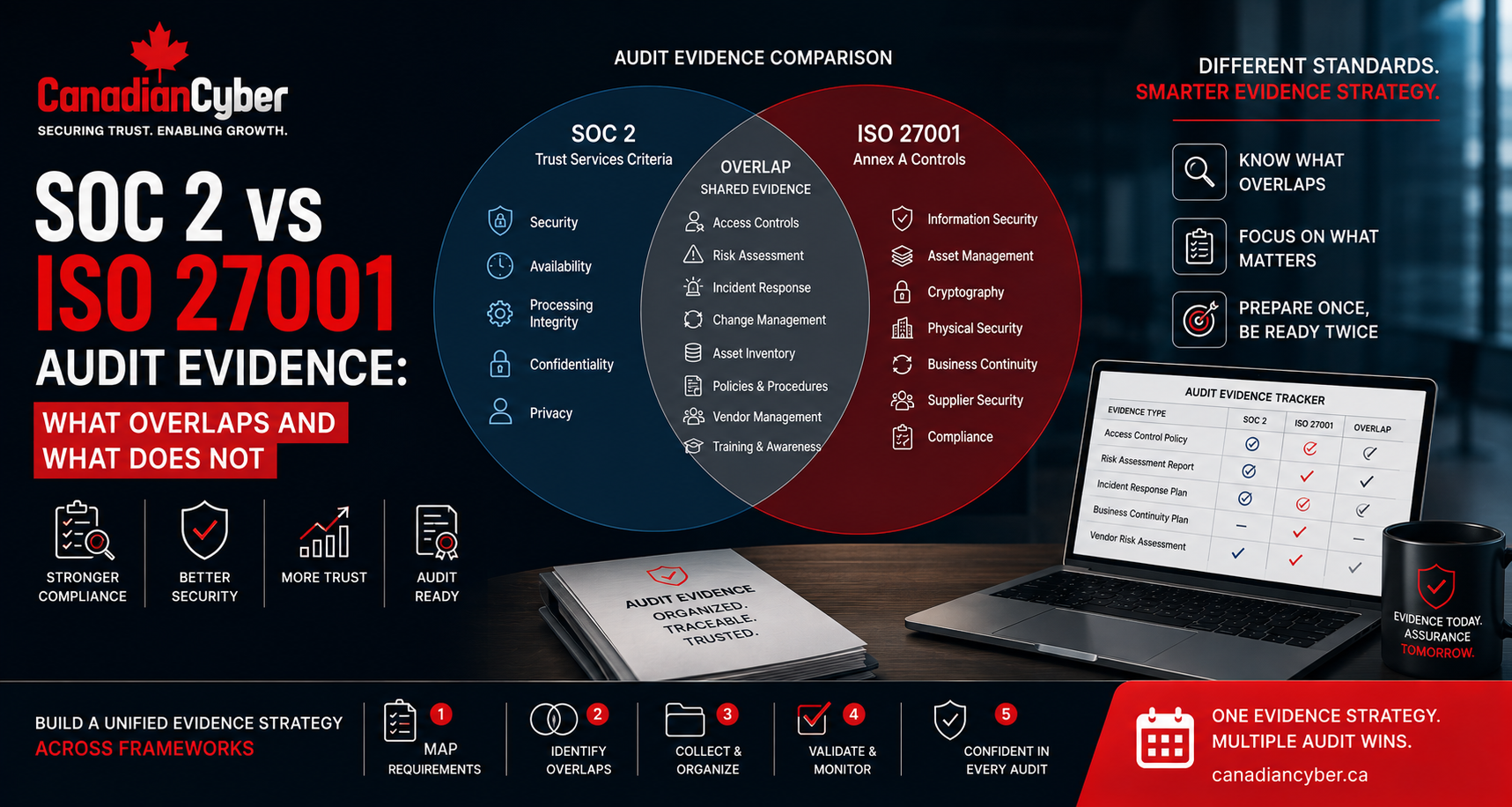
SOC 2 and ISO 27001 are different paths. But many evidence items can support both. The key is to map evidence clearly and keep framework-specific records where needed.
Quick Answer
Can SOC 2 and ISO 27001 use the same audit evidence?
Yes. Many evidence items can support both SOC 2 and ISO 27001.
Strong overlap often appears in access reviews, vendor reviews, incident response, training, change management, vulnerability management, backups, logging, monitoring, policies, and corrective actions.
However, the frameworks are not the same.
Bottom line: Reuse evidence where it fits. Keep separate records where each framework has its own requirements.
Canadian Cyber Evidence Mapping Support
Stop Collecting the Same Evidence Twice
Canadian Cyber helps teams align SOC 2 and ISO 27001 evidence.
We help build evidence maps, SharePoint evidence libraries, internal audit workspaces, SOC 2 readiness views, ISO 27001 evidence packs, and corrective action trackers.
Quick Snapshot
| Evidence Area | SOC 2 | ISO 27001 | Overlap |
|---|---|---|---|
| Access Reviews | Yes | Yes | Strong |
| Vendor Reviews | Yes | Yes | Strong |
| Incident Response | Yes | Yes | Strong |
| Security Awareness | Yes | Yes | Strong |
| Change Management | Yes | Yes | Strong |
| Vulnerability Management | Yes | Yes | Strong |
| Risk Register | Sometimes | Yes | Partial |
| Statement of Applicability | No | Yes | ISO-specific |
| System Description | Yes | Different format | SOC 2-specific |
Why SOC 2 and ISO 27001 Evidence Mapping Matters
Audit evidence takes time to collect.
Control owners are busy. Security teams are overloaded. Developers are shipping product.
When evidence is collected twice, teams waste time.
The smarter approach is to build one shared evidence library and map each item to the right framework.
Do not collect evidence twice when one strong, well-labeled item can support both SOC 2 and ISO 27001.
Who This Blog Is For
- SaaS companies preparing for SOC 2 and ISO 27001.
- ISO 27001 internal auditors.
- SOC 2 readiness teams.
- ISMS managers and compliance leads.
- Security managers and IT managers.
- vCISO teams.
- MSPs, cloud providers, FinTech firms, HealthTech firms, and AI platforms.
- Canadian businesses preparing for certification.
- Teams using SharePoint or Microsoft 365 for compliance evidence.
SOC 2 and ISO 27001 Have Different Goals
SOC 2 and ISO 27001 share evidence. But they ask different questions.
SOC 2 Asks
Are controls designed and operating to meet selected Trust Services Criteria?
It focuses on service commitments, system requirements, and control assurance.
ISO 27001 Asks
Is the ISMS established, implemented, maintained, reviewed, and improved?
It focuses on scope, risk, leadership, controls, internal audit, management review, and continual improvement.
Practical rule: SOC 2 is control assurance for service commitments. ISO 27001 is management system assurance for information security governance.
Where Audit Evidence Strongly Overlaps
Many evidence items can support both frameworks.
The key is to label each item clearly. It should show the owner, control, period, status, and framework mapping.
1. Policies and Procedures
Both frameworks need approved, current, and communicated policies.
Shared evidence: security policy, access policy, vendor policy, incident plan, change procedure, backup procedure, and secure development policy.
Audit question: Do policies match real practice?
2. Access Control Evidence
This is one of the strongest overlap areas.
Shared evidence: access reviews, MFA reports, SSO settings, access requests, offboarding records, admin reviews, and exception records.
Audit question: Can access approval, review, removal, and privilege control be proven?
3. Vendor and Third-Party Risk
Vendors can affect data, security, privacy, and availability.
Shared evidence: vendor register, risk assessments, DPAs, contracts, SOC 2 reports, ISO certificates, subprocessors, and AI vendor reviews.
Audit question: Are vendors reviewed based on risk?
4. Incident Response
Both frameworks need proof that incidents are handled.
Shared evidence: incident response plan, incident register, tabletop report, lessons learned, notification procedure, and corrective actions.
Audit question: Has the incident process been tested?
5. Security Awareness and Training
People need to know their security duties.
Shared evidence: training reports, new hire training, contractor training, policy acknowledgments, phishing results, secure coding training, and AI use training.
Audit question: Does training show completion, coverage, and follow-up?
6. Change Management
Fast changes still need control.
Shared evidence: change tickets, pull request approvals, code reviews, release notes, testing evidence, emergency changes, and security scan results.
Audit question: Are changes approved, tested, and traceable?
7. Vulnerability Management
A scan report is not enough.
Shared evidence: scan reports, penetration test reports, remediation tracker, severity ratings, exception approvals, and verification records.
Audit question: Are vulnerabilities prioritized and fixed?
8. Backup and Recovery
Availability and recovery evidence often supports both audits.
Shared evidence: backup policy, backup reports, failure reviews, restore test evidence, continuity plan, and lessons learned.
Audit question: Has recovery been tested?
9. Logging and Monitoring
Tools are not enough. Review must be shown.
Shared evidence: logging policy, monitoring reports, alert reviews, event tickets, endpoint dashboard, escalation records, and review sign-offs.
Audit question: Does evidence show review and response?
Need One Evidence Library for Both SOC 2 and ISO 27001?
Canadian Cyber helps teams design shared evidence libraries and framework-specific views.
What Does Not Fully Overlap
Evidence overlap is useful. But it has limits.
SOC 2 and ISO 27001 have different structures, reports, and audit expectations.
ISO 27001-Specific Evidence
ISMS Scope Statement
ISO 27001 needs clear ISMS boundaries. Include services, systems, departments, locations, dependencies, exclusions, and approval.
Context of the Organization
ISO 27001 expects internal and external issues to be understood. This can include business, technology, cloud, customer, legal, and AI-related drivers.
Interested Parties
ISO 27001 expects relevant interested parties and requirements. This includes customers, regulators, suppliers, leadership, and internal teams.
Risk Methodology
ISO 27001 needs a defined risk process. Include risk criteria, scoring, acceptance rules, owners, review frequency, and approval.
Risk Register and Treatment Plan
ISO 27001 uses risk treatment as a core ISMS activity. Keep risk owners, residual risk, acceptance, reviews, and action status.
Statement of Applicability
SOC 2 does not replace the SoA. ISO 27001 needs control applicability, justification, implementation status, ownership, and review history.
Internal Audit Program
ISO 27001 needs planned internal audits. Keep the audit procedure, schedule, plan, scope, criteria, report, findings, and follow-up records.
Management Review
ISO 27001 needs formal leadership review. Include agenda, inputs, risks, audit results, decisions, resources, and action tracker.
Continual Improvement
ISO 27001 places strong focus on nonconformity, corrective action, verification, recurrence checks, and improvement records.
No SOC 2 evidence set replaces the ISO 27001 Statement of Applicability, internal audit program, or management review.
SOC 2-Specific Evidence
System Description
SOC 2 reports need a system description. It covers services, infrastructure, software, people, data, controls, and commitments.
Trust Services Criteria Mapping
SOC 2 needs controls mapped to selected Trust Services Criteria. ISO 27001 maps differently.
Service Commitments
SOC 2 focuses on commitments made to customers. This includes availability, confidentiality, privacy, and contract promises.
Type I and Type II Evidence
SOC 2 Type II needs operating evidence across the audit period. Samples often need month or quarter coverage.
Complementary User Entity Controls
SOC 2 may include customer responsibilities. ISO 27001 does not use CUECs in the same way.
Subservice Organization Presentation
SOC 2 has specific reporting treatment for subservice organizations. It may use carve-out or inclusive methods.
Evidence Overlap Matrix
| Evidence Type | Shared Evidence | ISO-Specific | SOC 2-Specific |
|---|---|---|---|
| Security Policies | Yes | Sometimes | Sometimes |
| Access Reviews | Yes | No | No |
| Vendor Reviews | Yes | No | No |
| Incident Response | Yes | No | No |
| Risk Register | Partial | Yes | Sometimes |
| Statement of Applicability | No | Yes | No |
| Internal Audit Program | Partial | Yes | Not the same requirement |
| Management Review | Partial | Yes | Sometimes useful |
| System Description | No | No | Yes |
| TSC Mapping | No | No | Yes |
| Type II Period Testing | Partial | No | Yes |
| CUECs | No | No | Yes |
How Internal Audit Should Review Shared Evidence
Internal audit should not only ask if evidence exists.
It should test whether the evidence is useful for both frameworks.
Practical rule: Shared evidence should be collected once, mapped twice, and reviewed carefully.
Common Mistakes When Reusing Evidence
SOC 2 evidence helps, but it does not replace ISMS-specific evidence.
ISO evidence helps, but it does not replace SOC 2 report-specific needs.
Strong evidence loses value when it is not linked to controls or criteria.
SOC 2 Type II evidence must support the review period.
Evidence without owners becomes stale.
Email, chat, local folders, and old exports create audit delays.
Internal Audit Checklist: Evidence Reuse
| Checklist Item | Ready? |
|---|---|
| Create a shared evidence library. | |
| Identify evidence that supports both frameworks. | |
| Map evidence to ISO 27001 clauses and Annex A controls. | |
| Map evidence to SOC 2 criteria and control descriptions. | |
| Assign evidence owners. | |
| Define evidence frequency and review dates. | |
| Separate shared evidence from framework-specific evidence. | |
| Confirm evidence covers the correct audit period. | |
| Confirm ISO-specific evidence includes risk register, SoA, internal audit, and management review. | |
| Confirm SOC 2-specific evidence includes system description, TSC mapping, commitments, and period testing. | |
| Track gaps in a corrective action tracker. | |
| Build separate auditor-ready views for SOC 2 and ISO 27001. |
How SharePoint Can Map SOC 2 and ISO 27001 Evidence
A structured SharePoint ISMS can reduce duplicate work.
It lets teams store shared evidence once and create framework-specific views.
Canadian Cyber’s ISMS SharePoint Solution can organize:
- Policy library and shared evidence library.
- ISO 27001 control register and SOC 2 control matrix.
- Statement of Applicability tracker and risk register.
- Access review, vendor, incident, change, vulnerability, backup, and training evidence.
- Management review dashboard and internal audit workspace.
- Corrective action tracker and framework mapping views.
- Client-ready evidence room, Power Automate reminders, and Teams notifications.
SharePoint works best when evidence has metadata for owner, control, framework, period, status, and review date.
How Canadian Cyber Helps
Canadian Cyber helps teams align SOC 2 and ISO 27001 evidence.
We help reduce duplicate work and improve audit readiness.
Canadian Cyber can support:
- ISO 27001 internal audits.
- SOC 2 readiness assessments.
- SOC 2 and ISO 27001 evidence mapping.
- Shared evidence library design.
- SharePoint ISMS implementation.
- Control mapping workshops.
- Risk register and Statement of Applicability reviews.
- SOC 2 readiness evidence reviews.
- Corrective action tracking.
- Management review preparation.
- vCISO services.
- ISO 27017, ISO 27018, ISO 42001 AI governance readiness, and cybersecurity assessments.
Canadian Cyber’s Evidence Mapping Approach
Canadian Cyber helps teams move from duplicated audit effort to structured evidence reuse.
Our approach includes:
- Evidence inventory.
- Framework overlap review.
- Control mapping.
- Owner assignment.
- Evidence quality review.
- Gap identification.
- Corrective action planning.
- SharePoint evidence workspace design.
- Auditor-ready and client-ready evidence views.
Frequently Asked Questions
Can SOC 2 evidence be reused for ISO 27001?
Yes. Many SOC 2 evidence items can support ISO 27001. Access reviews, vendor reviews, incidents, training, changes, vulnerabilities, backups, logging, and monitoring often overlap.
Can ISO 27001 evidence be reused for SOC 2?
Yes. ISO 27001 evidence can support SOC 2 controls. But SOC 2 still needs report-specific evidence such as system description, criteria mapping, service commitments, and period-based testing.
What evidence overlaps most?
The strongest overlap is usually access control, vendor management, incident response, training, change management, vulnerability management, backup and recovery, logging, monitoring, policies, and corrective actions.
What evidence is ISO 27001-specific?
ISO 27001-specific evidence includes ISMS scope, context, interested parties, risk assessment methodology, risk register, risk treatment plan, Statement of Applicability, internal audit, management review, and continual improvement records.
What evidence is SOC 2-specific?
SOC 2-specific evidence includes system description, Trust Services Criteria mapping, service commitments, system requirements, Type I or Type II period evidence, CUECs, and subservice organization presentation.
Should companies create one shared evidence library?
Yes. A shared evidence library can reduce duplicate work. It should use metadata and views to separate shared, SOC 2-specific, and ISO 27001-specific evidence.
Can Canadian Cyber help map SOC 2 and ISO 27001 evidence?
Yes. Canadian Cyber helps organizations map evidence, build SharePoint evidence libraries, perform ISO 27001 internal audits, prepare for SOC 2 readiness, and create auditor-ready evidence packs.
Takeaway
SOC 2 and ISO 27001 are different.
But the evidence does not need to be completely separate.
Many controls overlap. This creates a chance to reduce duplicate work.
Still, each framework has its own needs.
ISO 27001 needs ISMS-specific evidence. SOC 2 needs report-specific evidence.
The best approach is evidence mapping. Collect once. Label clearly. Map to both frameworks. Store in one controlled workspace. Create framework-specific views.
Ready to Map SOC 2 and ISO 27001 Evidence?
Canadian Cyber can help you reduce duplicate audit work and build stronger evidence.
We provide ISO 27001 internal audits, SOC 2 readiness support, evidence mapping, SharePoint ISMS workspaces, corrective action tracking, vCISO services, enterprise security review readiness, ISO 27017, ISO 27018, ISO 42001 AI governance readiness, and cybersecurity assessments.
Stay Connected With Canadian Cyber
Follow Canadian Cyber for practical guidance on SOC 2, ISO 27001 internal audits, audit evidence mapping, SharePoint ISMS, enterprise security reviews, ISO 42001, ISO 27017, ISO 27018, vCISO services, cybersecurity assessments, and certification readiness.