Healthcare
HealthTech
PHI Protection
ISO 27001 Internal Audit for Healthcare and HealthTech: PHI, Cloud Apps, and Vendor Access
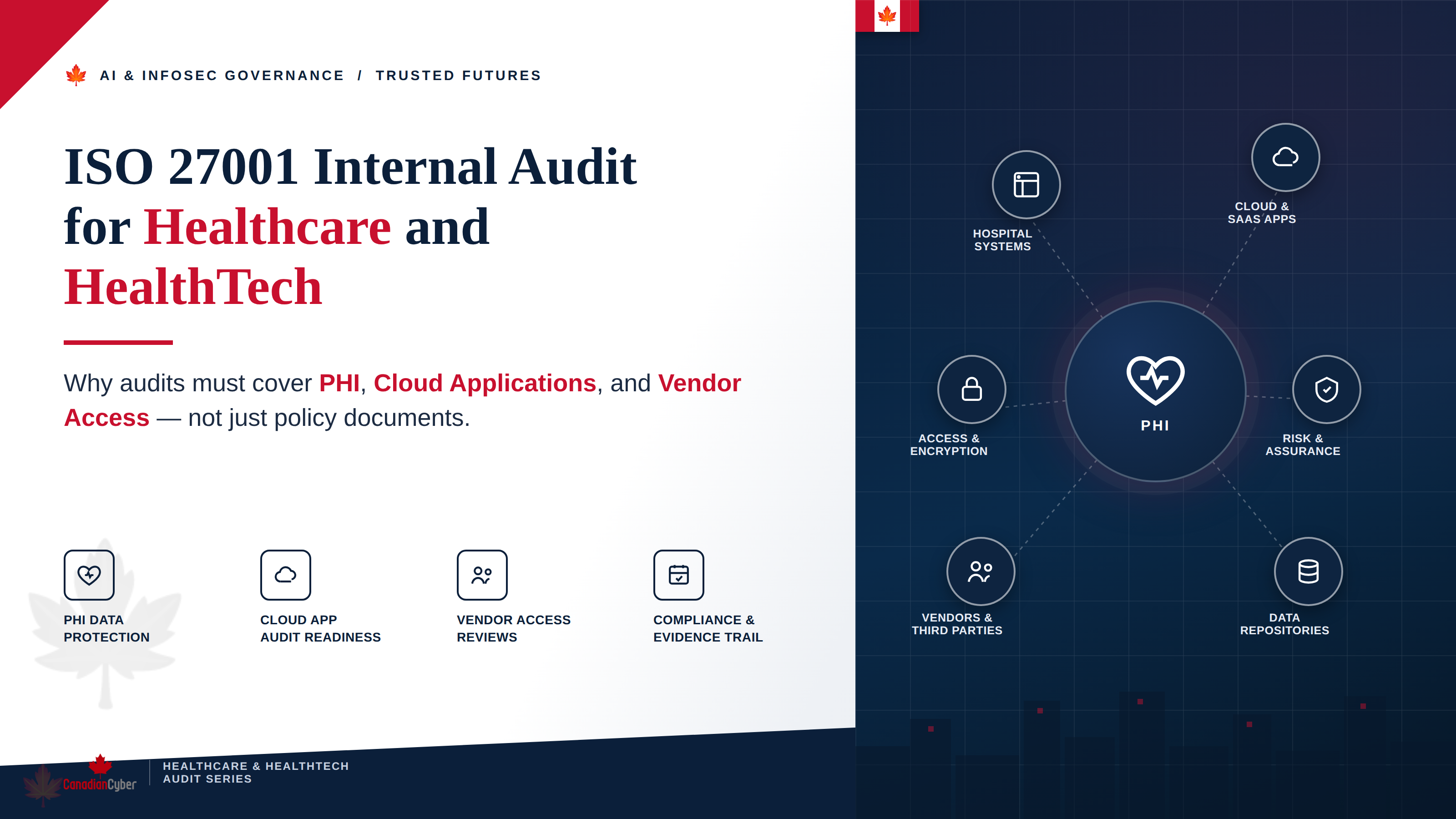
An ISO 27001 internal audit for healthcare should follow PHI across systems, users, vendors, cloud apps, AI tools, backups, logs, and support workflows.
Quick Answer
What should a healthcare ISO 27001 internal audit check?
It should check whether PHI is identified, classified, protected, backed up, monitored, and accessed only by approved users.
It should also review cloud apps, vendor access, admin roles, AI tools, support tickets, logs, incident response, risks, and corrective actions.
Bottom line: the audit should prove that PHI protection is working in practice, not only written in policies.
Canadian Cyber Healthcare Audit Support
Make PHI Evidence Audit-Ready
Canadian Cyber helps healthcare and HealthTech organizations prepare stronger ISO 27001 internal audit evidence.
We review PHI handling, cloud apps, vendor access, AI tools, logs, backups, support workflows, risks, and corrective actions.
Quick Snapshot
| Audit Area | What Internal Audit Should Check |
|---|---|
| PHI Inventory | Where PHI is stored, processed, backed up, and shared. |
| Cloud Apps | Which SaaS and cloud tools hold PHI or healthcare data. |
| Access Control | Who can access PHI, patient portals, admin tools, and support systems. |
| Vendor Access | Which vendors, MSPs, contractors, or support teams can access systems. |
| AI Tools | Whether AI scribes, chatbots, copilots, or summarizers process PHI. |
| Evidence | Whether control operation can be proven during audit. |
Why Healthcare Internal Audits Need More Depth
Healthcare and HealthTech organizations handle highly sensitive information.
This includes patient records, clinical notes, billing records, portal messages, support tickets, and cloud app logs.
This information is not ordinary business data.
It is personal health information, and it needs strong control evidence.
For healthcare and HealthTech, internal audit should follow the data, the access, the vendors, and the evidence.
Who This Blog Is For
- Healthcare providers, clinics, clinic networks, and telehealth teams.
- HealthTech companies, medical SaaS platforms, and patient portal providers.
- Healthcare MSPs, support vendors, and medical billing platforms.
- Privacy officers, security managers, IT managers, and internal auditors.
- Organizations preparing for ISO 27001, SOC 2, or ISO 42001 readiness.
- Canadian healthcare and HealthTech organizations handling PHI.
The Main Internal Audit Question
Do not stop at this question:
“Do we have healthcare security policies?”
Ask a stronger question:
“Can we prove that PHI is protected across people, systems, vendors, cloud apps, AI tools, support workflows, and incident response?”
Audit Area 1: PHI Inventory and Data Mapping
Internal audit should begin with PHI visibility.
If the organization cannot show where PHI lives, it cannot prove that PHI is protected.
Audit Questions
- What types of PHI does the organization handle?
- Where is PHI stored?
- Which cloud apps process PHI?
- Which vendors receive PHI?
- Which AI tools may process PHI?
- Are PHI data flows documented?
Evidence to Review
- PHI inventory.
- Data classification register.
- Data flow diagram.
- SaaS and cloud asset inventory.
- Vendor register.
- Backup scope list.
Audit Area 2: Cloud App Governance
Healthcare and HealthTech teams often use many cloud tools.
Each cloud app needs clear governance before it holds PHI.
| Cloud App Audit Question | Evidence |
|---|---|
| Which apps are approved for PHI? | Approved SaaS list and cloud app inventory. |
| Are cloud apps risk-rated? | Cloud vendor assessment and risk register. |
| Are access rights reviewed? | Access review evidence. |
| Are logs and backups understood? | Logging evidence and backup responsibility matrix. |
Practical rule: a cloud app should not support PHI workflows until access, logging, vendor, backup, and contract risks are reviewed.
Audit Area 3: PHI Access Control
Access control is one of the most important audit areas.
Healthcare and HealthTech teams should prove that only approved users can access PHI.
Access Evidence to Review
Need to Audit PHI, Cloud Apps, and Vendor Access?
Canadian Cyber can review healthcare audit evidence and help your team close control gaps.
For senior advisory support, view Waqar Mehboob’s profile.
Audit Area 4: Privileged Admin Roles
Admin roles create high risk in healthcare systems.
Administrators may access portals, databases, logs, backups, APIs, and security settings.
| Admin Control | Evidence to Review |
|---|---|
| Admin role approval. | Admin access approval records. |
| Break-glass accounts. | Break-glass procedure and activity records. |
| Service accounts. | Service account register. |
| Admin role changes. | Role change logs and review notes. |
Audit Area 5: Vendor Access and Third-Party Risk
Healthcare and HealthTech organizations often depend on vendors.
Any vendor that can access, process, store, or influence PHI should be reviewed as a high-priority supplier.
Vendor Evidence to Review
Audit Area 6: AI Tools in Healthcare and HealthTech
AI tools are now common in healthcare workflows.
They may include AI scribes, chatbots, documentation tools, copilots, support summarizers, and analytics tools.
AI Audit Questions
- Which AI tools are used?
- Do any AI tools process PHI?
- Are AI tools approved before use?
- Are AI vendors risk-assessed?
- Are human reviews required before using AI outputs?
- Can AI misuse or PHI exposure be reported?
AI tools that touch PHI should be audited as data, vendor, access, privacy, and accountability risks.
Audit Area 7: Support Tickets and Client Data Handling
Support tickets often become hidden PHI locations.
They may include screenshots, portal issues, appointment details, billing records, error logs, or patient identifiers.
| Support Audit Question | Evidence |
|---|---|
| Do support tickets contain PHI? | Ticket samples and ticket data classification rules. |
| Are screenshots reviewed? | Screenshot handling guidance. |
| Are credentials prohibited? | Credential handling policy. |
| Are AI ticket tools approved? | AI ticket tool review and approval record. |
Audit Area 8: Logs and Monitoring
Logs help prove that access, admin activity, patient portal events, cloud alerts, and incidents are reviewed.
However, logs only help when someone reviews them and acts on findings.
Log Evidence to Review
Audit Area 9: Backups and Restore Testing
PHI systems need reliable backup and recovery evidence.
Backup reports show that backups ran. Restore tests show that recovery can work.
| Backup Audit Question | Evidence |
|---|---|
| Which PHI systems are backed up? | Backup scope list and configuration. |
| Are backup failures reviewed? | Failure tickets and review notes. |
| Are restore tests performed? | Restore test reports. |
| Are backup vendors reviewed? | Backup vendor review and risk register. |
Audit Area 10: Incident Response for PHI Exposure
Healthcare incident response should include PHI-specific scenarios.
It should also include vendor incidents, cloud incidents, and AI misuse.
Incident Evidence to Review
Audit Area 11: Risk Register and Statement of Applicability
ISO 27001 internal audit should confirm that healthcare risks appear in the ISMS.
The risk register should not use generic cybersecurity wording only.
Example Healthcare Risks
Internal Audit Checklist for Healthcare and HealthTech
| Checklist Item | Ready? |
|---|---|
| PHI inventory is documented. | |
| PHI data flows are mapped. | |
| Cloud apps holding PHI are identified. | |
| PHI access reviews are completed. | |
| Privileged access is reviewed separately. | |
| Vendor access is tracked and reviewed. | |
| AI tools processing PHI are reviewed. | |
| Support tickets are checked for PHI handling risk. | |
| Logs are enabled and reviewed. | |
| Restore testing is performed and documented. | |
| PHI incidents are included in incident response. | |
| Corrective actions are tracked to verified closure. |
Common Internal Audit Findings
The organization cannot show where PHI is stored, backed up, or shared.
Apps contain PHI but are not classified or reviewed.
Vendors or contractors have access without regular review.
AI tools process data without enough approval or oversight.
Screenshots, logs, and attachments include PHI without handling rules.
Backups are configured, but recovery has not been tested.
How SharePoint Can Help Manage Healthcare Audit Evidence
A SharePoint ISMS workspace can help healthcare and HealthTech teams organize evidence in one controlled location.
This makes audit preparation easier before the auditor asks.
SharePoint Can Track
How Canadian Cyber Helps
Canadian Cyber helps healthcare and HealthTech organizations perform practical ISO 27001 internal audits.
We help teams move from scattered screenshots to structured, audit-ready evidence.
Frequently Asked Questions
What should an ISO 27001 internal audit check for healthcare?
It should check PHI inventory, access control, admin roles, cloud apps, vendor access, support tickets, AI tools, backups, logs, incidents, risks, and corrective actions.
Why is PHI important in internal audit?
PHI can create privacy, security, contractual, reputational, and patient trust risks. Internal audit should test whether PHI is protected across systems and workflows.
Should AI tools be included in healthcare internal audit?
Yes. AI tools should be included when they process PHI, clinical notes, transcripts, support tickets, patient communications, or healthcare workflow data.
Are backup reports enough for ISO 27001?
Backup reports are useful. However, organizations should also show restore testing evidence to prove recovery can work.
Can SharePoint manage healthcare ISO 27001 evidence?
Yes. SharePoint can organize PHI inventories, access reviews, vendor evidence, AI governance records, backup reports, log reviews, risks, and corrective actions.
Can Canadian Cyber help healthcare and HealthTech companies?
Yes. Canadian Cyber supports ISO 27001 internal audits, PHI handling reviews, cloud app reviews, vendor access reviews, AI governance reviews, SharePoint ISMS implementation, SOC 2 readiness, and vCISO services.
Takeaway
Healthcare and HealthTech internal audits need to follow the real path of PHI.
Where is it collected? Where is it stored? Who can access it?
Which cloud apps process it? Which vendors support it? Which AI tools may touch it?
ISO 27001 internal audit helps prove that security is operating across systems, people, vendors, cloud platforms, AI tools, and leadership decisions.
For healthcare and HealthTech, this is not only about passing an audit. It is about protecting patient trust.
Ready to Strengthen Healthcare ISO 27001 Internal Audit Readiness?
Canadian Cyber can help your healthcare or HealthTech organization review PHI protection, cloud apps, vendor access, AI tools, backups, logs, and corrective actions.
We provide ISO 27001 internal audits, PHI handling reviews, cloud app evidence reviews, vendor access reviews, AI governance reviews, SharePoint ISMS workspaces, vCISO services, SOC 2 readiness alignment, ISO 42001 readiness, ISO 27017, ISO 27018, and cybersecurity assessments.
Stay Connected With Canadian Cyber
Follow Canadian Cyber for practical guidance on ISO 27001 internal audits, healthcare cybersecurity, PHI protection, HealthTech security, AI governance, cloud security, vendor access, SharePoint ISMS, SOC 2, ISO 42001, vCISO services, and certification readiness.