ISO 27001
Patient Data
Internal Audit
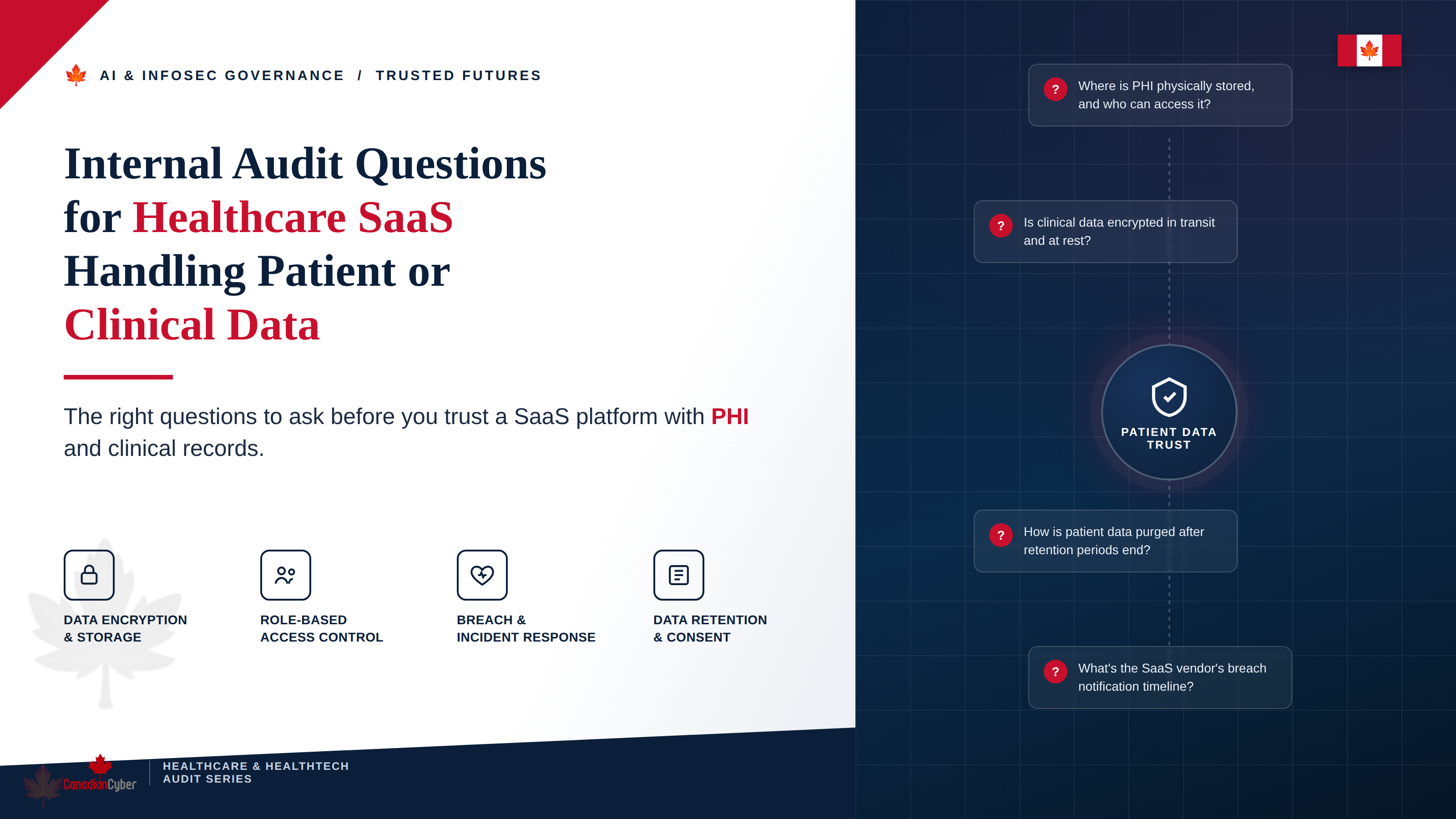
Internal Audit Questions for Healthcare SaaS Handling Patient or Clinical Data
A Healthcare SaaS internal audit should prove that patient and clinical data is protected across the product, cloud, support, vendor, API, and AI environment.
Quick Answer
What should a Healthcare SaaS internal audit review?
A Healthcare SaaS internal audit should review how patient and clinical data is collected, stored, accessed, processed, shared, backed up, logged, monitored, and deleted.
It should test access control, privileged roles, vendor access, cloud security, support tickets, AI tools, API security, backups, restore testing, incidents, risks, and corrective actions.
Bottom line: the goal is to prove that patient and clinical data is protected across the full SaaS environment, not only described in policies.
Canadian Cyber Healthcare SaaS Audit Support
Make Patient Data Evidence Audit-Ready
Canadian Cyber helps Healthcare SaaS and HealthTech companies prepare stronger ISO 27001 internal audit evidence.
We review patient data, clinical data, cloud apps, vendors, APIs, AI tools, support workflows, logs, backups, risks, and corrective actions.
Quick Snapshot
| Audit Area | What Internal Audit Should Check |
|---|---|
| Patient Data Inventory | Where patient and clinical data is stored, processed, and shared. |
| SaaS Platform Scope | Which applications, databases, APIs, cloud services, and integrations are in scope. |
| Access Control | Who can access patient data and why. |
| Vendor Access | Which vendors, contractors, MSPs, and subprocessors can access systems or data. |
| AI Tools | Whether AI tools process patient, clinical, support, or product data. |
| Evidence | Whether the company can prove controls are operating. |
Why Healthcare SaaS Needs a Strong Internal Audit
Healthcare SaaS companies do not just manage software.
They manage trust.
Their platforms may handle patient profiles, clinical notes, lab results, provider messages, billing records, support tickets, APIs, logs, and integrations.
That data may move through care teams, clinics, hospitals, vendors, support staff, developers, cloud systems, and AI tools.
A Healthcare SaaS internal audit should follow patient and clinical data across the full product, support, cloud, vendor, and operational environment.
Who This Blog Is For
- Healthcare SaaS companies, HealthTech startups, and digital health platforms.
- Telehealth providers, patient portals, and clinical workflow platforms.
- Medical billing SaaS, AI health platforms, and healthcare analytics tools.
- Security managers, privacy officers, ISMS managers, internal auditors, and vCISO teams.
- Canadian Healthcare SaaS companies preparing for ISO 27001.
- HealthTech companies responding to hospital, clinic, or enterprise security reviews.
The Main Healthcare SaaS Internal Audit Question
The strongest audit question is not:
“Do we have security controls?”
Ask this instead:
“Can we prove that patient and clinical data is protected wherever it flows?”
Audit Area 1: Patient and Clinical Data Inventory
The audit should start by identifying what data the SaaS company handles.
Patient data protection starts with knowing where patient data actually lives.
Audit Questions
- What types of patient data does the platform collect?
- What types of clinical data does the platform process?
- Where is patient data stored?
- Which APIs transmit patient data?
- Which vendors process patient or clinical data?
- Which AI tools may touch patient data?
Evidence to Review
- Patient data inventory.
- Clinical data inventory.
- Data flow diagram.
- API inventory.
- Vendor register.
- AI tool inventory.
Audit Area 2: SaaS Platform Scope
ISO 27001 internal audit should confirm that the SaaS platform scope is clear.
The scope should match how the Healthcare SaaS product actually operates.
| Scope Question | Evidence |
|---|---|
| Is the SaaS platform included in the ISMS scope? | ISMS scope statement and system boundary document. |
| Are APIs, patient portals, and integrations included? | Product architecture and integration inventory. |
| Are support systems included? | Support tool inventory and data review. |
| Are AI-enabled features included? | AI feature register and risk register. |
Audit Area 3: Access Control to Patient and Clinical Data
Access control is one of the most important areas for Healthcare SaaS.
Access should be approved, limited, reviewed, and removed when no longer needed.
Access Evidence to Review
Audit Area 4: Privileged and Administrative Access
Privileged roles create higher risk.
Admins may access databases, cloud infrastructure, audit logs, user accounts, backups, security settings, and patient data.
| Privileged Access Question | Evidence |
|---|---|
| Who has platform, database, or cloud admin access? | Privileged access inventory and admin role export. |
| Who can export patient data? | Export permission review. |
| Are break-glass accounts controlled? | Break-glass procedure and emergency access records. |
| Are service accounts reviewed? | Service account register and review notes. |
Practical rule: privileged access should be reviewed separately because the risk is greater.
Need to Audit Patient Data, APIs, and Cloud Access?
Canadian Cyber can review Healthcare SaaS evidence and help close ISO 27001 control gaps before certification or client reviews.
For senior advisory support, view Waqar Mehboob’s profile.
Audit Area 5: Support Ticket and Client Data Handling
Support tickets are often overlooked.
For Healthcare SaaS, tickets may contain screenshots, logs, attachments, or clinical details.
Support Evidence to Review
Audit Area 6: Cloud Apps and Cloud Infrastructure
Most Healthcare SaaS platforms rely on cloud infrastructure and SaaS tools.
Internal audit should review whether cloud services are approved, configured, monitored, and risk-assessed.
| Cloud Audit Question | Evidence |
|---|---|
| Which cloud providers host the platform? | Cloud asset inventory and architecture diagram. |
| Are cloud configurations reviewed? | Configuration review evidence. |
| Are encryption settings reviewed? | Encryption evidence. |
| Are cloud logs enabled? | Log source inventory and cloud log evidence. |
Audit Area 7: Vendor and Subprocessor Access
Healthcare SaaS companies often depend on vendors and subprocessors.
Any vendor that can access or process patient or clinical data should be reviewed as high risk.
Vendor Evidence to Review
Audit Area 8: AI Tools and AI Features
AI is becoming common in Healthcare SaaS.
AI may support documentation, ticket summaries, product features, analytics, coding, or internal productivity.
AI Evidence to Review
AI tools that touch patient or clinical data should be audited as data, vendor, access, privacy, and accountability risks.
Audit Area 9: API Security and Integrations
Healthcare SaaS platforms often depend on APIs.
APIs may connect to EHR systems, labs, patient portals, billing tools, analytics tools, mobile apps, or third-party platforms.
| API Audit Question | Evidence |
|---|---|
| Which APIs transmit patient or clinical data? | API inventory and integration register. |
| Are API keys and secrets protected? | API key management and secret management evidence. |
| Are unused API keys disabled? | API access review. |
| Are API changes reviewed? | Change tickets and approval records. |
Audit Area 10: Secure Development and Production Data
Healthcare SaaS companies should review how development teams handle patient and clinical data.
Development controls should protect patient data by design, not only after release.
Development Evidence to Review
Audit Area 11: Backups and Restore Testing
Patient and clinical data systems need reliable backup and recovery evidence.
Backup success reports are not enough. Restore testing proves recovery readiness.
| Backup Audit Question | Evidence |
|---|---|
| Which patient data systems are backed up? | Backup scope list and backup configuration. |
| Are backup failures ticketed? | Backup failure tickets. |
| Are restore tests performed? | Restore test reports. |
| Are backup vendors reviewed? | Backup vendor review. |
Audit Area 12: Logging and Monitoring
Healthcare SaaS companies should review logs for access, admin activity, API usage, failed logins, exports, and suspicious events.
Logs should support detection, investigation, accountability, and audit evidence.
Log Evidence to Review
Audit Area 13: Incident Response for Patient Data Exposure
Healthcare SaaS incident response should include patient and clinical data exposure scenarios.
It should also include vendor incidents, API compromise, cloud misconfiguration, and AI misuse.
| Incident Audit Question | Evidence |
|---|---|
| Does the plan cover patient data exposure? | Incident response plan and patient data incident procedure. |
| Are client notification duties defined? | Client notification matrix. |
| Are tabletop exercises performed? | Tabletop report. |
| Are lessons learned tracked? | Lessons learned and corrective action tracker. |
Healthcare SaaS Internal Audit Checklist
| Checklist Item | Ready? |
|---|---|
| Patient and clinical data inventory is documented. | |
| Data flows are mapped. | |
| SaaS platform scope is clear. | |
| APIs and integrations are inventoried. | |
| Access to patient data is role-based. | |
| Privileged access is reviewed separately. | |
| Developer access to production is restricted. | |
| Support ticket handling rules are documented. | |
| Vendor and subprocessor risks are reviewed. | |
| AI tools and AI features are inventoried. | |
| Restore testing is performed. | |
| Logs are collected and reviewed. | |
| Incident response includes patient data scenarios. | |
| Corrective actions are tracked to verified closure. |
Common Internal Audit Findings
The company cannot show where patient or clinical data is stored, transmitted, backed up, or shared.
Tickets include screenshots, logs, or attachments without classification or handling rules.
Vendors, MSPs, or contractors have system access without regular review.
Developers can access production data without clear approval or masking controls.
AI tools process support, product, or patient-related data without proper review.
Patient data flows through APIs, but integrations and keys are not fully documented.
Corrective Action Examples
| Finding | Immediate Correction | Corrective Action |
|---|---|---|
| Patient data inventory incomplete. | Identify major patient data systems. | Create quarterly data inventory review. |
| Support tickets contain patient data. | Restrict ticket access. | Create ticket data handling and redaction procedure. |
| Vendor access not reviewed. | Review active vendor accounts. | Add vendors to access review workflow. |
| AI tool not assessed. | Pause restricted use. | Add AI tools to vendor and risk review. |
| API inventory missing. | Document active APIs. | Create API inventory and key review process. |
How SharePoint Can Help Manage Healthcare SaaS Audit Evidence
A SharePoint ISMS workspace can help Healthcare SaaS companies organize evidence in one controlled place.
It makes patient data, vendor access, AI tools, cloud systems, APIs, and corrective actions more visible.
SharePoint Can Track
How Canadian Cyber Helps
Canadian Cyber helps Healthcare SaaS and HealthTech companies perform practical ISO 27001 internal audits.
We help organizations move from scattered screenshots and informal explanations to structured, audit-ready evidence.
Frequently Asked Questions
What should a Healthcare SaaS internal audit check?
It should check patient data, clinical data, access control, privileged roles, support tickets, cloud apps, vendors, APIs, AI tools, backups, logs, incidents, risks, and corrective actions.
Why is patient data inventory important?
Patient data inventory helps the company know where patient and clinical data is stored, processed, transmitted, backed up, and shared.
Should AI tools be included in a Healthcare SaaS audit?
Yes. AI tools should be included when they process patient data, clinical data, support tickets, product data, logs, transcripts, or AI-enabled product features.
What is a common support ticket risk?
A common risk is that screenshots, logs, attachments, or ticket notes contain patient data without classification, redaction, or access restrictions.
Are backup reports enough for ISO 27001?
Backup reports are helpful, but restore testing is also needed. Restore testing proves that recovery can work.
Can SharePoint help manage Healthcare SaaS ISO 27001 evidence?
Yes. SharePoint can organize patient data inventories, access reviews, vendor records, AI evidence, API evidence, tickets, backups, logs, incidents, risks, corrective actions, and dashboards.
Can Canadian Cyber help Healthcare SaaS companies?
Yes. Canadian Cyber supports ISO 27001 internal audits, patient data handling reviews, cloud and vendor access reviews, AI governance reviews, SharePoint ISMS implementation, vCISO services, SOC 2 readiness, and cybersecurity assessments.
Takeaway
Healthcare SaaS companies handle highly sensitive patient and clinical data.
That data moves through applications, APIs, cloud platforms, support tickets, vendors, backups, logs, AI tools, and client workflows.
ISO 27001 internal audit helps test whether those data flows are protected.
The audit should ask where patient data is stored, who can access it, which vendors process it, which APIs transmit it, and which AI tools may touch it.
For Healthcare SaaS, internal audit is not just about certification. It is about proving that patient trust is protected by real controls, real evidence, and real improvement.
Ready to Strengthen Healthcare SaaS Internal Audit Readiness?
Canadian Cyber can help your Healthcare SaaS company prepare stronger ISO 27001 internal audit evidence.
We provide ISO 27001 internal audits, patient and clinical data handling reviews, cloud app evidence reviews, vendor access reviews, AI governance reviews, API and integration evidence reviews, backup and restore testing, logging and monitoring reviews, SharePoint ISMS workspaces, corrective action tracking, vCISO services, SOC 2 readiness alignment, ISO 42001 readiness, ISO 27017, ISO 27018, and cybersecurity assessments.
Stay Connected With Canadian Cyber
Follow Canadian Cyber for practical guidance on ISO 27001 internal audits, Healthcare SaaS security, patient data protection, HealthTech security, AI governance, API security, cloud security, vendor access, SharePoint ISMS, SOC 2, ISO 42001, vCISO services, and certification readiness.