Microsoft 365
ISO 27001
Hospital Reviews
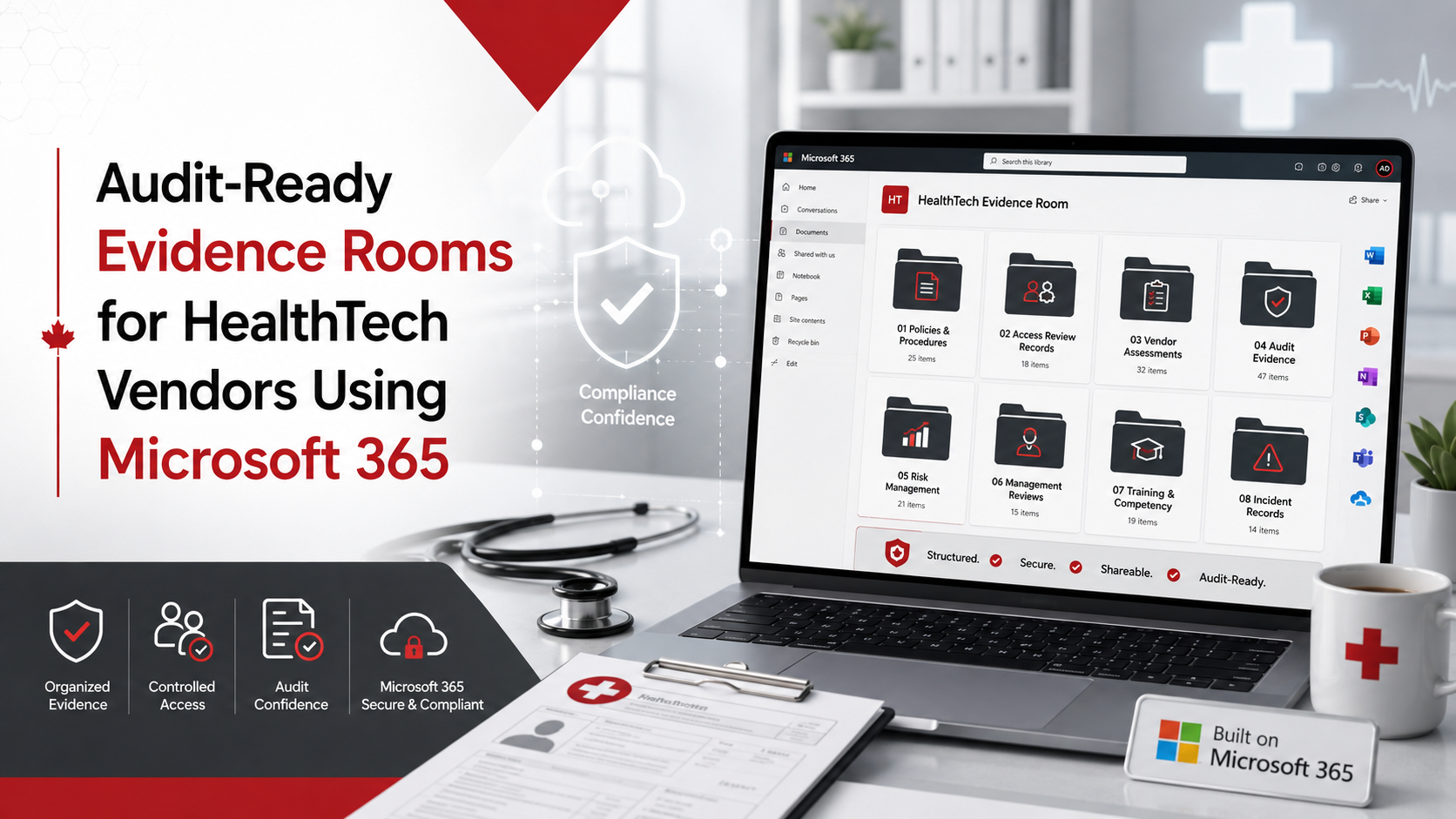
Audit-Ready Evidence Rooms for HealthTech Vendors Using Microsoft 365
An audit-ready evidence room helps HealthTech vendors organize ISO 27001 evidence, PHI-related records, vendor reviews, AI governance, access reviews, and hospital security review documents in one controlled Microsoft 365 workspace.
Quick Answer
What is an audit-ready evidence room for HealthTech vendors?
An audit-ready evidence room is a controlled Microsoft 365 workspace that organizes security policies, ISO 27001 evidence, PHI-related records, access reviews, vendor reviews, AI governance documents, backup evidence, incident records, risk registers, corrective actions, and client-ready security documents.
It helps HealthTech vendors respond faster to hospital security reviews, reduce duplicate evidence requests, and improve internal audit readiness.
Bottom line: a folder stores files. An evidence room manages proof.
Canadian Cyber Evidence Room Support
Build a Microsoft 365 Evidence Room Before the Hospital Asks
Canadian Cyber helps HealthTech vendors build audit-ready evidence rooms for ISO 27001, SOC 2, hospital security reviews, PHI evidence, AI governance, vendor risk, access reviews, and corrective actions.
We help you separate internal evidence from client-ready evidence, map documents to controls, and create a repeatable review process.
Quick Snapshot
| Evidence Room Area | What It Should Manage |
|---|---|
| Policy Library | Approved security, privacy, AI, access, vendor, and incident policies. |
| PHI Evidence | Patient data inventory, data flows, access reviews, and support ticket controls. |
| ISO 27001 Evidence | Scope, risk register, SoA, internal audit, management review, and corrective actions. |
| Vendor Evidence | Vendor register, DPAs, BAAs where applicable, subprocessors, and security reviews. |
| AI Governance | Approved AI tools, AI vendor reviews, PHI restrictions, and human oversight. |
| Client-Ready Room | Hospital-ready documents without sensitive internal details. |
Why HealthTech Vendors Lose Time During Reviews
HealthTech vendors do not lose time only because controls are missing.
They lose time because evidence is scattered.
Policies may be in SharePoint. Risk registers may be in Excel. Vendor reviews may be in email.
Backup reports may sit in dashboards. AI approvals may be buried in chats. Support evidence may stay inside the ticketing platform.
Then a hospital asks for proof, and the team has to rebuild the same evidence pack again.
A HealthTech vendor needs more than a document folder. It needs an audit-ready evidence room.
Who This Blog Is For
- HealthTech vendors and Healthcare SaaS companies.
- Digital health platforms, telehealth providers, and patient portal providers.
- AI health platforms and clinical workflow software vendors.
- Medical billing SaaS providers and healthcare analytics platforms.
- Founders, sales teams, privacy officers, security managers, IT managers, ISMS managers, and vCISO teams.
- Organizations preparing for ISO 27001, SOC 2, hospital reviews, or client security reviews.
Why HealthTech Vendors Need Evidence Rooms
Hospital security reviews are evidence-heavy.
Hospitals do not only ask what your policy says.
They ask for proof that your controls operate.
Common Evidence Requests
Practical rule: an evidence room should help the HealthTech vendor prove control operation without exposing unnecessary internal risk details.
What Makes an Evidence Room Audit-Ready?
An audit-ready evidence room is not just a folder.
It is a structured workspace for storing, tracking, reviewing, and sharing audit evidence.
It Should Include
Microsoft 365 as the Evidence Room Foundation
Many HealthTech vendors already use Microsoft 365.
That makes it a practical foundation for an evidence room when the workspace is designed with the right structure, permissions, ownership, metadata, and workflows.
| Microsoft 365 Component | Evidence Room Use |
|---|---|
| SharePoint | Evidence libraries and controlled document storage. |
| Teams | Collaboration and evidence owner communication. |
| OneDrive | Controlled working drafts before publishing. |
| Power Automate | Reminders, approvals, and evidence workflow notifications. |
| Microsoft Entra ID | Identity and access management. |
| Microsoft Purview | Retention, sensitivity labels, audit, and compliance capabilities. |
Healthcare and PHI Context
HealthTech vendors often support healthcare organizations that handle patient data, clinical data, or electronic protected health information.
For this reason, an evidence room should show more than documents.
It should show that PHI-related risks, vendors, access, backups, logs, incidents, and corrective actions are managed.
If the HealthTech vendor supports patient or clinical workflows, the evidence room should be designed around sensitive data protection from the beginning.
Section 1: Client-Ready Security Overview
Start with a clear client-ready overview.
This section helps hospital procurement, security teams, and client stakeholders understand your security program without reviewing every internal file.
Include
- Company security summary.
- Service overview.
- Security governance summary.
- ISO 27001 readiness summary.
- Data protection summary.
- Cloud security summary.
- Vendor risk summary.
- AI governance summary.
Do Not Include
- Full internal audit reports.
- Detailed vulnerabilities.
- Admin account names.
- Private screenshots.
- Unredacted PHI.
- Confidential architecture diagrams.
- Internal findings with exploit detail.
- Unapproved auditor notes.
Section 2: Policies and Procedures
Hospitals often ask for security policies.
The evidence room should make policies easy to locate and prove they are approved.
Policy Metadata to Track
Section 3: PHI and Patient Data Evidence
HealthTech vendors need a dedicated area for PHI-related evidence.
This section should show where patient or clinical data exists and how it is protected.
Evidence to Include
Section 4: ISO 27001 Evidence
For ISO 27001 internal audit readiness, the evidence room should hold the core ISMS records.
The goal is to show that the ISMS is operating, not only that templates exist.
| ISO 27001 Evidence | Purpose |
|---|---|
| ISMS scope | Defines what is included in the management system. |
| Risk register | Shows security and PHI-related risks under management. |
| Statement of Applicability | Maps Annex A controls to applicability, justification, and evidence. |
| Internal audit report | Shows what was tested and what was found. |
| Management review minutes | Shows leadership review and decisions. |
Need a HealthTech Hospital Review Evidence Pack?
Canadian Cyber can help your team build a Microsoft 365 evidence room with client-ready documents, PHI evidence, vendor records, AI governance, access reviews, and ISO 27001 evidence mapping.
For senior advisory support, view Waqar Mehboob’s profile.
Section 5: Access Review Evidence
Access evidence is usually one of the first things hospitals and auditors ask for.
HealthTech vendors should separate access evidence by risk.
Access Evidence Categories
Practical rule: access review evidence should show who reviewed access, what exceptions were found, what was removed, and when the review was completed.
Section 6: Vendor and Subprocessor Evidence
Hospital reviewers often want to know which vendors support the HealthTech platform.
The evidence room should include both vendor documentation and review records.
Vendor Evidence to Include
Section 7: Cloud and Infrastructure Evidence
HealthTech vendors using cloud platforms should prepare evidence that cloud environments are governed.
Cloud evidence should show configuration, access, logging, backup, vendor, and risk ownership.
| Cloud Evidence | Why It Matters |
|---|---|
| Cloud architecture diagram | Shows how systems support the platform. |
| Cloud access review | Shows who can administer cloud systems. |
| Encryption evidence | Shows how sensitive data is protected. |
| Logging configuration | Shows detection and investigation support. |
| Shared responsibility summary | Shows what the vendor controls and what the cloud provider controls. |
Section 8: Backup and Restore Evidence
HealthTech vendors should not rely on backup claims alone.
They need restore evidence.
Evidence to Include
Section 9: Logging and Monitoring Evidence
Logging and monitoring evidence supports detection, investigation, and accountability.
Logs should be retained, reviewed, protected, and linked to investigation or escalation where needed.
| Logging Evidence | Use |
|---|---|
| Logging policy | Defines logging expectations. |
| Log source inventory | Shows which systems generate logs. |
| Admin activity logs | Supports accountability for privileged actions. |
| Alert review tickets | Shows that alerts were reviewed and handled. |
Section 10: AI Governance Evidence
HealthTech vendors increasingly use AI.
AI may support documentation, support summaries, chatbots, analytics, product features, coding, or client communication.
AI Evidence to Include
AI governance evidence should show approved tools, approved use cases, vendor review, data restrictions, human oversight, and risk tracking.
Section 11: Incident Response Evidence
Hospital reviewers may ask how the HealthTech vendor handles incidents.
The evidence room should include both the plan and proof of testing.
Incident Evidence to Include
Section 12: Corrective Actions and Findings
An evidence room should show how gaps are tracked and closed.
A finding should not be marked closed until closure evidence is reviewed and verified.
| Suggested Status | Meaning |
|---|---|
| Open | The finding has been logged. |
| Assigned | A named owner is responsible. |
| In Progress | The corrective action is underway. |
| Pending Evidence | Closure evidence is still needed. |
| Pending Verification | Evidence is uploaded and ready for review. |
| Closed and Verified | Closure evidence has been reviewed and accepted. |
Section 13: Client-Ready Evidence Pack
HealthTech vendors need a separate client-ready evidence pack for hospitals.
This pack should be controlled, approved, and redacted where needed.
Client-Ready Evidence May Include
- Security overview.
- Policy summaries.
- Certification status.
- Risk management summary.
- Access control summary.
- Vendor risk summary.
- AI governance summary.
- Incident response summary.
Keep Internal
- Full internal audit reports.
- Sensitive findings.
- Technical vulnerabilities.
- Admin account names.
- Private evidence links.
- Detailed system diagrams.
- Unredacted PHI.
- Internal risk acceptance notes.
Evidence Room Permission Model
Permissions are critical.
HealthTech evidence may include sensitive security details and PHI-related information.
Suggested Permission Groups
Evidence Room Metadata Model
Metadata makes the evidence room searchable and audit-ready.
It turns Microsoft 365 from a storage space into an audit management system.
Suggested Metadata Fields
Evidence Room Dashboard
A dashboard helps leadership and audit teams see readiness.
It should show what needs attention before the hospital asks for it.
Dashboard Items
Audit-Ready Evidence Room Checklist
| Checklist Item | Ready? |
|---|---|
| Evidence room owner is assigned. | |
| SharePoint site is created with proper permissions. | |
| Client-ready evidence area is separated. | |
| Policies are version-controlled. | |
| PHI evidence library is created. | |
| ISO 27001 evidence library is created. | |
| Risk register is linked to evidence. | |
| Vendor register includes PHI and subprocessor status. | |
| AI governance evidence is included. | |
| Corrective actions require closure evidence. | |
| Dashboard is created. | |
| Permissions are reviewed regularly. |
Common Mistakes to Avoid
A folder does not show ownership, review status, due dates, or control mapping.
Hospitals need approved evidence, not sensitive internal audit notes.
Evidence with patient-related details should be classified and restricted.
Vendor reports are collected but not reviewed or summarized.
AI tools are used, but approvals, reviews, use cases, and PHI restrictions are missing.
Evidence room access expands over time and is not reviewed.
30-Day Evidence Room Build Plan
Week 1
Create the structure, evidence libraries, permission groups, metadata fields, and client-ready sections.
Week 2
Load core evidence, including policies, risk register, SoA, vendor records, access reviews, backups, and incident response records.
Week 3
Add PHI views, AI governance records, hospital-ready evidence, and redaction rules.
Week 4
Create dashboards, assign owners, set review dates, add reminders, and test the evidence request workflow.
How Canadian Cyber Helps
Canadian Cyber helps HealthTech vendors build audit-ready evidence rooms in Microsoft 365 for ISO 27001 internal audit readiness, SOC 2 alignment, hospital security reviews, PHI evidence, vendor risk, AI governance, and client confidence.
We help organizations move from scattered evidence to structured trust readiness.
Frequently Asked Questions
What is an audit-ready evidence room?
An audit-ready evidence room is a structured workspace that stores and tracks security evidence with owners, review dates, permissions, control mapping, risk links, and client-ready status.
Why should HealthTech vendors use Microsoft 365 for evidence rooms?
Many HealthTech vendors already use Microsoft 365, so SharePoint, Teams, OneDrive, Power Automate, Entra ID, and Microsoft Purview can support structured evidence management when configured properly.
Can an evidence room help with hospital security reviews?
Yes. A client-ready evidence room can help HealthTech vendors respond faster to hospital security questionnaires and evidence requests.
Should PHI-related evidence be stored in the same room?
PHI-related evidence can be managed in Microsoft 365 when permissions, classification, retention, access reviews, and sharing controls are properly designed. Client-ready evidence should be separated from sensitive internal records.
What should be included in a HealthTech evidence room?
It should include policies, risk register, SoA, access reviews, vendor reviews, PHI evidence, AI governance evidence, backup and restore reports, log review evidence, incident response records, corrective actions, management review records, and client-ready summaries.
Should AI governance evidence be included?
Yes. HealthTech vendors using AI should include approved AI tools, AI vendor reviews, approved use cases, PHI restrictions, human oversight evidence, AI risks, incidents, and training.
Can Canadian Cyber build a Microsoft 365 evidence room?
Yes. Canadian Cyber can design and implement Microsoft 365 and SharePoint evidence rooms for HealthTech vendors, including ISO 27001 evidence, PHI evidence, vendor tracking, AI governance, corrective actions, dashboards, and hospital-ready evidence packs.
Takeaway
HealthTech vendors need to prove trust quickly.
Hospitals, clients, auditors, and partners want evidence.
Not scattered screenshots. Not outdated files. Not policy drafts. Not informal AI approvals.
They want organized proof.
An audit-ready evidence room using Microsoft 365 can help make security evidence controlled, searchable, current, reviewed, and ready.
Ready to Build Your Microsoft 365 Evidence Room?
Canadian Cyber can help your HealthTech company build an audit-ready evidence room using Microsoft 365.
We provide Microsoft 365 evidence room design, SharePoint ISMS workspaces, ISO 27001 evidence mapping, SOC 2 alignment, PHI evidence organization, hospital security review evidence packs, AI governance registers, vendor risk trackers, corrective action dashboards, vCISO services, ISO 42001 readiness, ISO 27017, ISO 27018, and cybersecurity assessments.
Stay Connected With Canadian Cyber
Follow Canadian Cyber for practical guidance on HealthTech security, Microsoft 365 evidence rooms, SharePoint ISMS, ISO 27001 internal audits, hospital security reviews, PHI protection, AI governance, vendor risk, SOC 2, ISO 42001, vCISO services, and certification readiness.