Annex A
Organizational Controls
Evidence Sampling
Annex A Internal Audit Guide: How to Test Organizational Controls Without Over-Collecting Evidence
A practical ISO 27001 Annex A internal audit guide for testing organizational controls with risk-based sampling, targeted evidence, owner interviews, exception testing, and clear audit conclusions.
Quick Answer
How should auditors test Annex A organizational controls?
An ISO 27001 Annex A internal audit should use risk-based sampling instead of collecting every available document.
Start with the control objective, risk, owner, procedure, and expected operational evidence.
Then test a focused sample, interview the owner, inspect exceptions, and expand testing only when the evidence shows weakness or inconsistency.
More Evidence Does Not Always Mean a Better Audit
Many internal audit teams collect too much evidence.
They request every policy, screenshot, ticket, vendor document, approval, training record, and meeting note.
Soon, the evidence folder contains hundreds of files.
Yet the audit team may still struggle to answer the most important question: is the control actually working?
Practical rule: evidence should support the audit conclusion. It should not become the audit itself.
ISO 27001 Annex A Internal Audit Snapshot
| Audit Area | What Internal Audit Should Test |
|---|---|
| Control Purpose | What risk or requirement is the control intended to address? |
| Ownership | Who performs, reviews, and approves the control? |
| Operational Evidence | What records naturally prove the control is operating? |
| Sampling | Is the sample enough to support a conclusion? |
| Exceptions | Were failures, delays, or deviations identified and handled? |
| Evidence Quality | Is the evidence current, relevant, reliable, and traceable? |
Why Organizational Controls Need a Different Audit Approach
Organizational controls often cross several departments.
They may involve governance, suppliers, incidents, asset management, cloud services, privacy, change management, continuity, legal obligations, and documented procedures.
Because the scope is broad, it is easy to request too much evidence.
Over-Collection Creates
Duplicate documents, audit fatigue, longer timelines, repeated requests, unclear conclusions, and large folders with limited value.
Focused Testing Creates
Clearer control conclusions, stronger sampling, better interviews, faster fieldwork, and more attention on real exceptions.
The Main Annex A Audit Question
The strongest audit question is not, “How much evidence can we collect?”
A better question is:
What is the minimum reliable evidence needed to determine whether this control is designed properly and operating effectively?
Start With the Control Objective
Before asking for documents, understand what the control is supposed to achieve.
This keeps the audit focused.
Ask First
- What risk does this control reduce?
- Who owns it?
- How often does it operate?
- What event triggers it?
- What evidence should naturally exist?
- What would failure look like?
Practical rule: define the audit conclusion before defining the evidence request.
Relevant Evidence Beats Available Evidence
Organizations often provide whatever is easiest to find.
However, availability does not make evidence useful.
| Weak Evidence | Stronger Evidence |
|---|---|
| Generic policy. | Approved policy plus operational record. |
| Old screenshot. | Current system-generated report. |
| Blank template. | Completed record with approval. |
| Vendor questionnaire only. | Questionnaire plus risk conclusion and action. |
Audit Area 1: Governance and Security Responsibilities
Organizational controls often begin with governance.
The auditor should test whether responsibilities are clear and understood.
Evidence to Review
- Roles and responsibilities matrix.
- Organization chart.
- Control owner matrix.
- Management review records.
- Selected owner interviews.
Avoid Over-Collecting
You usually do not need every employee job description, every organization chart version, or every control owner email.
Practical rule: one strong owner interview may provide more value than twenty job descriptions.
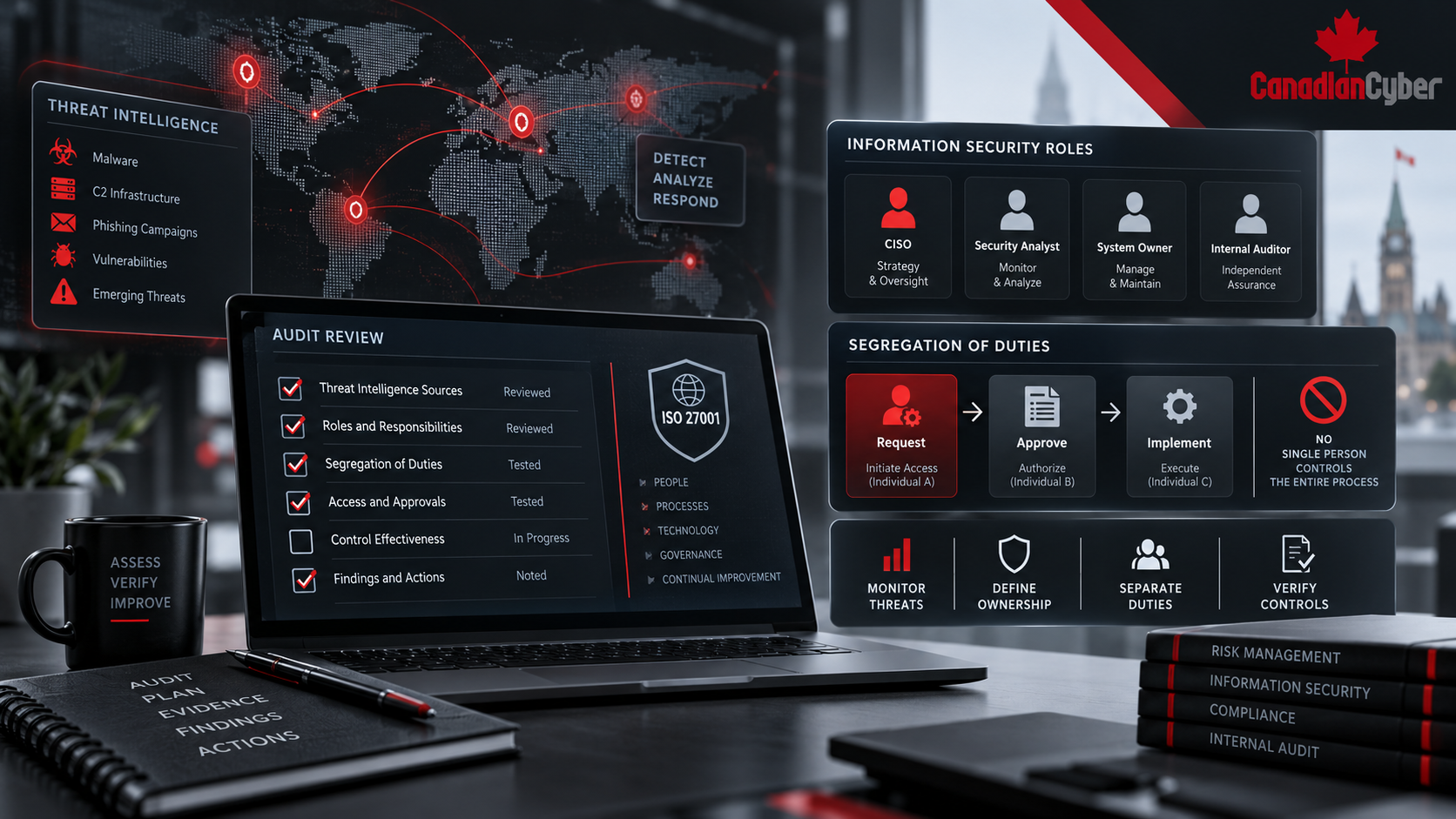
Audit Area 2: Segregation of Duties
Segregation of duties should be tested through both design and real transactions.
The goal is to see whether incompatible activities are separated in practice.
Focused Sample
- One access request.
- One privileged access change.
- One production change.
- One approved exception.
Common finding: the procedure requires separation, but sampled tickets show one administrator requesting, approving, and implementing the same activity.
Audit Area 3: Supplier Security
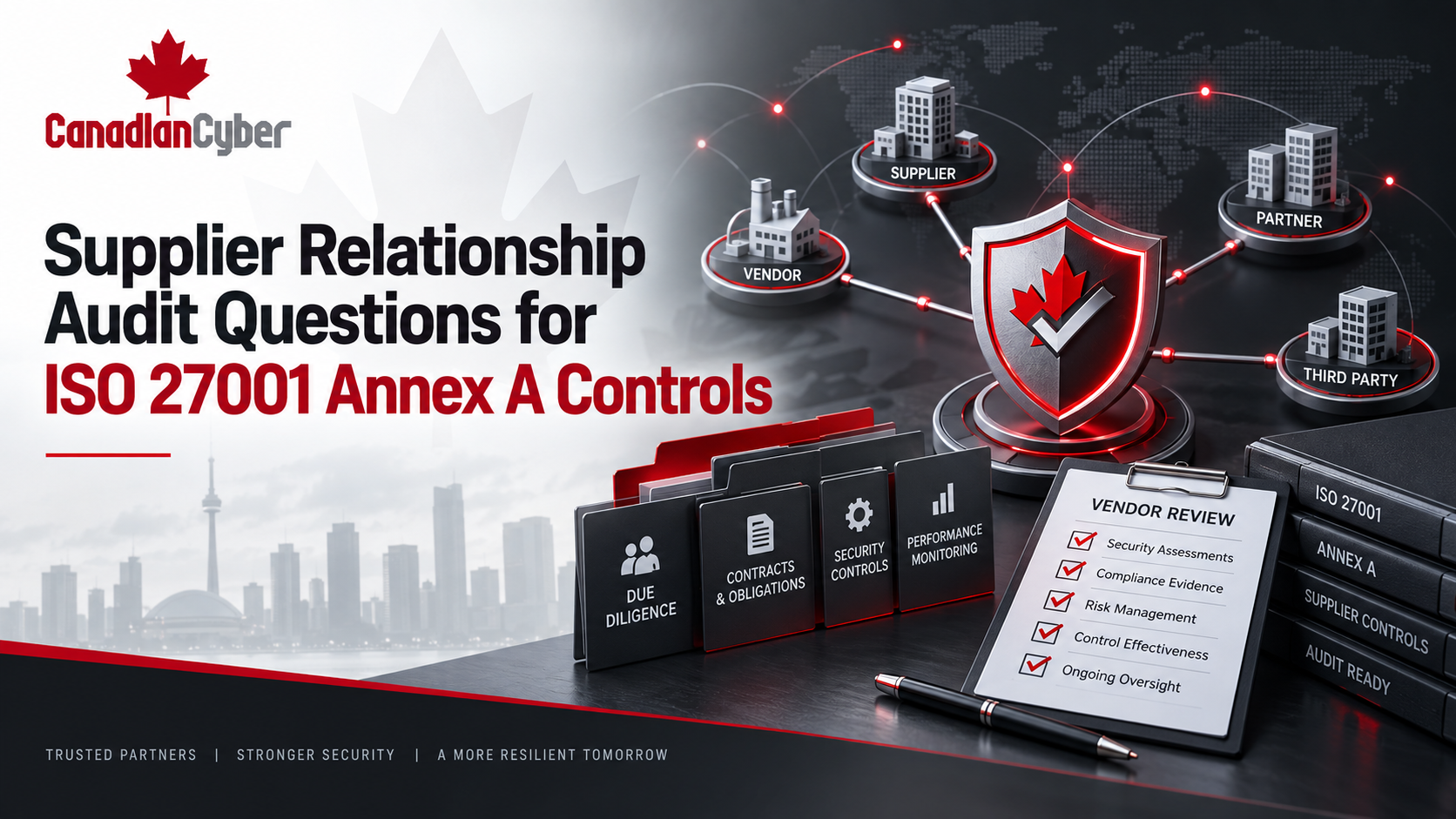
Supplier security is one of the biggest sources of evidence overload.
You usually do not need to review every vendor.
Risk-Based Vendor Sample
- One critical cloud vendor.
- One vendor with customer data access.
- One high-risk outsourced service provider.
- One recently onboarded vendor.
- One vendor with an open issue.
Review classification, security review, risk rating, contract requirements, open risks, approval, and next review date.
Practical rule: sample by risk, not by file count.
Need to Test Annex A Controls Before Certification?
Canadian Cyber helps organizations perform ISO 27001 Annex A internal audits using focused evidence sampling, control testing, targeted interviews, and practical reporting.
The goal is stronger assurance without unnecessary document collection.
Audit Area 4: Security in Project Management
Security requirements should appear in relevant projects.
Test real projects rather than relying only on the project management policy.
Common finding: security is included in the project methodology, but sampled projects do not consistently show security review evidence.
Audit Area 5: Information Classification
Information classification should work in daily operations.
A policy alone does not prove employees understand how sensitive information should be handled.
Evidence to Review
- Classification policy.
- Selected documents.
- SharePoint labels where used.
- Support ticket sample.
- Employee interview.
Practical rule: a few strong samples can show more than hundreds of labeled files.
Audit Area 6: Acceptable Use and Asset Governance
Acceptable use should connect policy to actual behavior.
Test whether users understand restrictions around devices, accounts, cloud services, and AI tools.
Practical rule: do not over-collect policy acknowledgments. Test whether users understand the rule.
Audit Area 7: Cloud Service Governance
Cloud services affect several organizational controls.
A focused cloud sample can provide more assurance than dozens of configuration screenshots.
Audit Area 8: Incident Management
Incident management should be tested through actual operation.
Do not request every incident. Choose samples based on risk.
| Sample Factor | Why It Matters |
|---|---|
| Severity | Higher-impact events deserve deeper testing. |
| Recency | Recent samples show the current process. |
| Vendor Involvement | Tests third-party escalation and communication. |
| Customer Impact | Tests reporting, escalation, and lessons learned. |
Audit Area 9: Threat Intelligence
Threat intelligence can become a paper exercise.
The auditor should test whether threat information leads to action.
Strong Sample
Select one threat advisory and trace what happened next.
Look for patching, configuration change, monitoring update, risk review, or awareness communication.
Practical rule: threat intelligence is useful when information turns into action.
Audit Area 10: Security During Disruption
Organizational security controls should continue during disruption.
A strong test may combine one exercise, one restore test, and one role interview.
Audit focus: roles, access during recovery, emergency changes, backups, exercises, and lessons learned.
Audit Area 11: Legal, Regulatory, and Contractual Requirements
The auditor should test whether relevant obligations influence controls.
The goal is not to collect every contract.
Audit Area 12: Records Protection
Records should be retained, protected, retrievable, and controlled.
A small number of traceable records can prove more than a large uncontrolled evidence archive.
Evidence to Review
- Retention policy.
- SharePoint library settings.
- Permission review.
- Sample audit records.
- Sample management review or access review evidence.
Use Interviews as Audit Evidence
Auditors sometimes avoid interviews because documents feel easier.
For organizational controls, that can be a mistake.
| Interview Question | What It Tests |
|---|---|
| What do you own? | Role clarity. |
| How often does the control operate? | Frequency awareness. |
| What evidence does it create? | Evidence ownership. |
| What happens if it fails? | Escalation understanding. |
Practical rule: documents show what should happen. Interviews help reveal what actually happens.
Use Risk-Based Sampling
Not every control needs the same sample size.
Higher-risk areas deserve more attention.
Practical rule: start focused. Expand only when the evidence gives you a reason.
How Much Evidence Is Enough?
There is no universal file count.
The right amount depends on risk, frequency, population size, control complexity, previous findings, process consistency, automation, and evidence quality.
Example
A quarterly control creates four records each year.
The auditor reviews two quarters, one exception, and one owner interview.
If the results are consistent and traceable, the sample may be enough. If one sample fails, testing should expand.
Practical rule: sufficiency comes from audit confidence, not arbitrary document quantity.
Signs You Are Over-Collecting Evidence
Evidence Requests: Weak vs Strong
| Weak Request | Stronger Request |
|---|---|
| Send all vendor files. | Send the vendor register and evidence for three selected critical vendors. |
| Send all access screenshots. | Send the latest access review, exceptions, and removal evidence. |
| Send all policies. | Send the relevant approved policy and one supporting operational sample. |
| Send all incidents. | Send the incident register and two selected incident samples. |
The Four-Part Evidence Quality Test
1. Relevant
Does the evidence support the control being tested?
2. Current
Does it represent the current process or audit period?
3. Reliable
Can the source, owner, or workflow be trusted?
4. Sufficient
Is there enough evidence to support the conclusion?
Common Annex A Evidence Mistakes
Sample Annex A Internal Audit Finding
Weak Finding
Annex A evidence management needs improvement.
Stronger Finding
The internal audit reviewed supplier security evidence for three critical vendors. One sampled vendor did not have a documented review conclusion or next review date. Because the exception may indicate inconsistency in the supplier review process, broader testing of critical vendors is required before the control can be considered effective.
Annex A Internal Audit Interview Questions
| Interview Group | Questions to Ask |
|---|---|
| ISMS Manager | How do you map Annex A controls to evidence? How do you decide what evidence is sufficient? |
| Control Owners | What control do you own? What evidence does it produce? What exceptions occurred? |
| Internal Auditors | Why did you select these samples? What conclusion will they support? When will you expand testing? |
| Leadership | Which organizational controls have high-risk gaps? Which findings need resources? |
Annex A Organizational Control Audit Checklist
| Checklist Area | What to Confirm |
|---|---|
| Audit Planning | Control objective, risk, owner, expected evidence, sample strategy, and previous findings are understood. |
| Evidence Quality | Evidence is relevant, current, reliable, traceable, and sufficient. |
| Sampling | Samples are risk-based, exceptions are included, and testing expands when weakness appears. |
| Interviews | Control owners understand responsibilities, evidence, exceptions, and escalation. |
| Control Effectiveness | The control operates as designed and exceptions lead to corrective action. |
How SharePoint Can Reduce Annex A Evidence Over-Collection
A SharePoint ISMS workspace can map evidence directly to Annex A controls.
This reduces duplicate evidence requests and makes the right evidence easier to find.
Track control ID, owner, status, frequency, and evidence links.
Map evidence directly to controls and risks.
Make responsibilities clear.
Track critical vendors, risks, reviews, and next due dates.
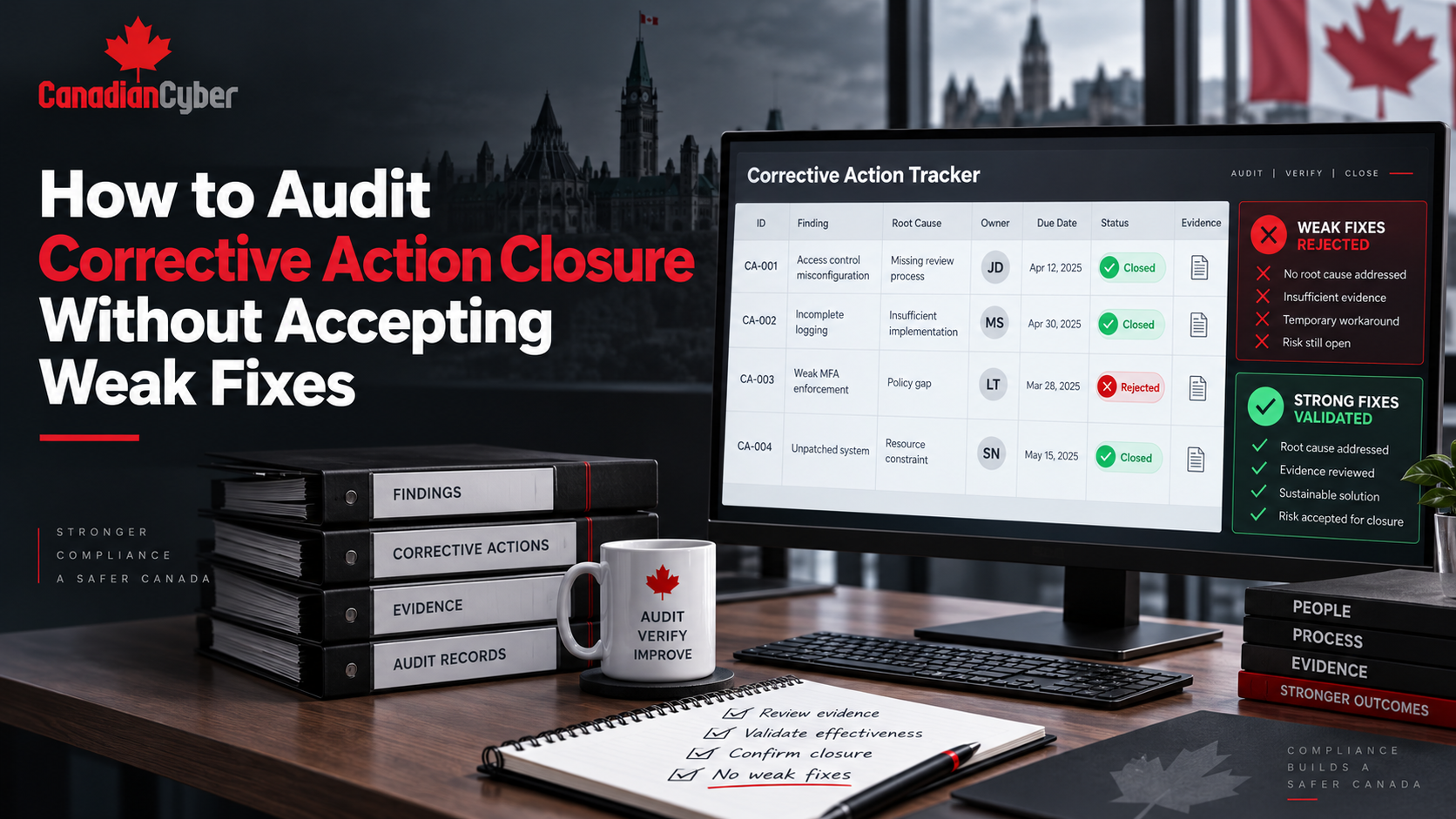
Link exceptions to owners, evidence, and closure.
Show high-risk controls, missing evidence, and repeat findings.
Practical rule: the goal is not to store more evidence. The goal is to make the right evidence easy to find.
High-Intent Buyer Signals for Annex A Internal Audit Support
Organizations may need professional support when these problems appear:
How Canadian Cyber Helps
Canadian Cyber helps organizations perform ISO 27001 Annex A internal audits using focused evidence testing.
We help teams identify the right sample, test control effectiveness, interview owners, investigate exceptions, and build a clear evidence structure.
Our support includes Annex A internal audits, organizational control testing, risk-based sampling, evidence sufficiency reviews, supplier security audits, incident management testing, cloud governance reviews, Statement of Applicability reviews, SharePoint evidence mapping, corrective action tracking, management review preparation, vCISO services, SOC 2 readiness alignment, ISO 42001 AI governance readiness, ISO 27017, ISO 27018, and cybersecurity assessments.
Frequently Asked Questions
What are ISO 27001 Annex A organizational controls?
Annex A organizational controls cover governance, responsibilities, supplier security, incident management, information handling, access governance, cloud services, continuity, legal requirements, privacy, and other organizational security processes.
Do auditors need every possible piece of evidence?
No. Evidence should be sufficient to support the audit conclusion. Auditors should avoid collecting files that do not improve audit confidence.
How much evidence should an internal auditor collect?
The amount depends on risk, frequency, population size, previous findings, consistency, automation, change history, and evidence quality.
What is risk-based audit sampling?
Risk-based sampling prioritizes higher-risk systems, vendors, processes, transactions, or exceptions instead of reviewing every record equally.
When should an auditor expand a sample?
Expand testing when evidence is inconsistent, exceptions appear, previous findings exist, ownership is unclear, records are missing, or the control is highly manual or high risk.
Can SharePoint reduce Annex A evidence over-collection?
Yes. SharePoint can map evidence directly to Annex A controls, owners, risks, review dates, exceptions, and corrective actions. This reduces duplicate requests and scattered evidence.
Can Canadian Cyber help audit Annex A organizational controls?
Yes. Canadian Cyber helps organizations test Annex A controls using risk-based sampling, targeted evidence, owner interviews, SharePoint evidence mapping, and certification readiness reporting.
Takeaway
A strong Annex A internal audit is not measured by the number of files collected.
It is measured by the quality of the audit conclusion.
The auditor should understand the control objective, risk, owner, natural evidence, relevant samples, exceptions, and conditions that require deeper testing.
The goal is simple: collect enough of the right evidence to understand whether the control actually works.
Test Annex A Controls Without Building an Evidence Warehouse
Canadian Cyber can help your organization test Annex A organizational controls before an ISO 27001 internal audit or certification audit.
We provide Annex A internal audits, evidence sampling, control owner interviews, Statement of Applicability reviews, SharePoint ISMS evidence mapping, corrective action tracking, management review preparation, vCISO support, SOC 2 readiness alignment, ISO 42001 AI governance readiness, ISO 27017, ISO 27018, and cybersecurity assessments.
Stay Connected With Canadian Cyber
Follow Canadian Cyber for practical guidance on ISO 27001 internal audits, Annex A controls, evidence sampling, organizational controls, certification readiness, SharePoint ISMS, corrective actions, SOC 2 readiness, AI governance, vCISO services, ISO 42001, ISO 27017, ISO 27018, and cybersecurity maturity.